

Quick Answer: The Pentek 150233 Big Blue (20", 1" NPT) is the housing to buy for most whole-house setups. It's the original Big Blue, it takes almost any 4.5" x 20" cartridge, and Pentair lists it at 1 psi pressure drop at 15 GPM. If you want to see when a sediment cartridge is loading up, get the Pentek 166201 Big Clear. If your service line is 1-1/4" or bigger, step up to the 1-1/2" Pentek 150236.
Disclosure: As an Amazon Associate, Grains & Gallons earns from qualifying purchases.
Nobody gets excited about a filter housing. That's why so many end up wrong: a 3/4" port on a 1" line, a 10" can that needs a new cartridge every six weeks, a clear sump sitting in a sunny garage growing algae. The housing outlasts every cartridge you'll put in it, so it's worth a few minutes of thought.
"Big Blue" started as Pentair's Pentek trade name. Now it's shorthand for any housing that takes a 4.5"-diameter cartridge. That diameter is what makes them worth having for a whole house. A 4.5" x 20" cartridge has several times the media of a standard 2.5" slim filter, so it flows more and lasts longer.
In this guide
Four decisions, in this order
1. Port size: match your pipe, never go smaller. If the main line feeding your softener is 1", a 3/4" housing is a restriction you'll feel in the shower. Pentair's own spec sheet shows the 3/4" 10" housing (150469) at 2 psi drop at 15 GPM, while the 1" versions sit at 1 psi at the same flow. That's before you add the cartridge, which usually costs more pressure than the housing does.
2. Length: 20" unless you can't fit it. A 10" housing holds half the media, so the cartridge clogs about twice as fast. Go 10" only when height is the limit, like a crawl space or a cramped closet under a stair.
3. Blue or clear. Clear sumps let you see a sediment cartridge turn brown, which takes the guessing out of change intervals. They also let light in. If the housing sits anywhere with daylight, algae can grow on the cartridge. Clear for sediment in a dark basement; blue for carbon, or for anywhere sunny.
4. Pressure-relief button. Every housing here has one except the 1-1/2" Pentek 150236, so plan to bleed that one through a valve or faucet downstream. If you're comparing other brands, don't skip it. Without a bleed button, the sump is under pressure when you try to unscrew it, and that's how people crack housings and soak themselves.
Side by side
| Housing | Length | Ports | Sump | Max pressure (maker spec) | Best for |
|---|---|---|---|---|---|
| Pentek 150233 | 20" | 1" NPT | Blue polypropylene | 90 psi | Most homes |
| Pentek 166201 Big Clear | 20" | 1" NPT | Clear SAN | 100 psi | Sediment stage you want to watch |
| Pentek 150236 | 20" | 1-1/2" NPT | Blue polypropylene | 90 psi | Large homes, 1-1/4"+ service |
| Pentek 150469 | 10" | 3/4" NPT | Blue polypropylene | 100 psi | Short spaces, 3/4" plumbing |
| Max Water clear 20" | 20" | 1" NPT | Clear | Check listing | Budget DIY kit with bracket |
The Pentek figures come from Pentair's published Big Blue / Big Clear data. All the Pentek models are rated 40–100°F, so none of them belong on a hot line or anywhere they could freeze.
Notes on each housing
Pentek 150233: the default choice
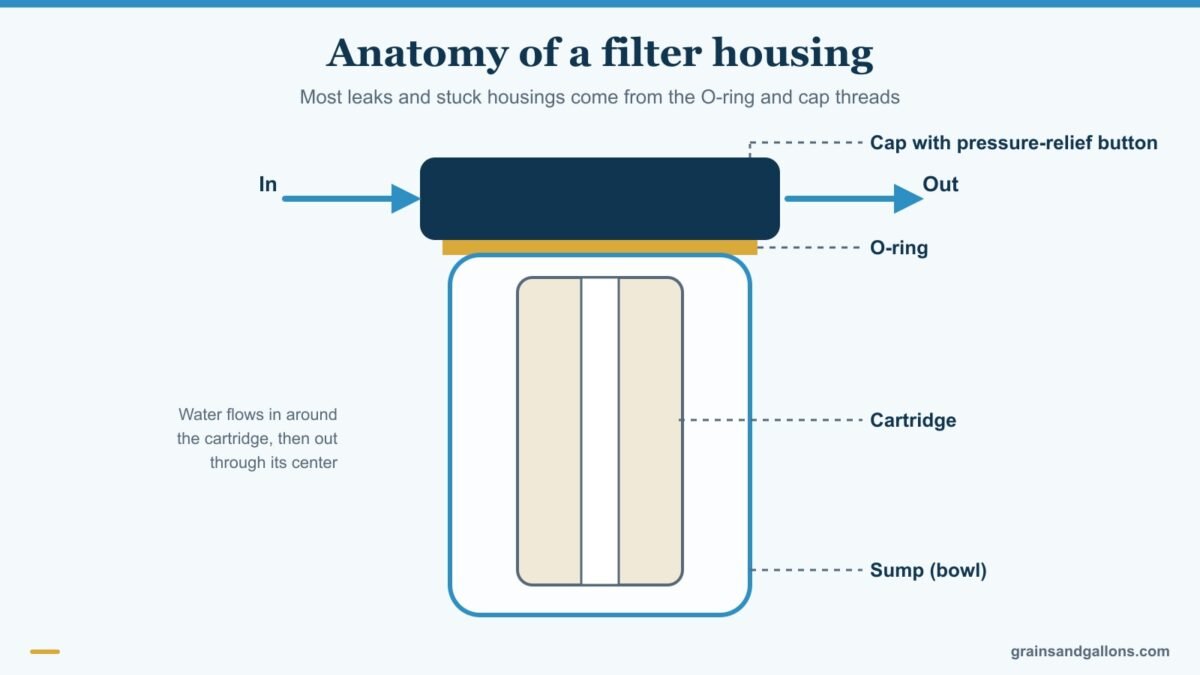
This is the housing most whole-house cartridges are designed around. It has a polypropylene sump and cap, a stainless and EPDM pressure-relief button, and a Buna-N O-ring. Pentair lists it under NSF/ANSI 42 for materials. Rated drop is 1 psi at 15 GPM, which is low enough to run in series with a softener without anyone noticing.
The real downside is the 90 psi max on the 20" version. If your street pressure runs above that, you need a pressure-reducing valve ahead of it anyway, but don't skip that step. Buy the mounting bracket and housing wrench separately if they don't come in the box. You'll want both.
Pentek 166201 Big Clear: when you want to see the dirt
Same footprint and 1" ports, but the sump is clear SAN plastic. Pentair rates it at 40–100 psi and 40–100°F, with the bleed button on the inlet side of the cap. Its best use is as the first stage on well water, holding a pleated or spun sediment cartridge. You'll see the outside of the cartridge darken and change it when it looks bad, not when the calendar says so.
Don't use it for carbon. You can't learn much by looking at a carbon block, and light encourages growth on a medium that's already a good home for bacteria.
Pentek 150236: for 1-1/4" and bigger service lines
Big homes with a 1-1/4" or 1-1/2" main and a softener with a 1-1/2" valve should run this one. It's the same 20" x 4.5" Big Blue format with a polypropylene sump, an HFPP cap and an EPDM O-ring, but with large 1-1/2" NPT ports that pass more water through the cap. Pentair certifies it to NSF/ANSI 42 for materials and structural integrity and rates it to 90 psi and 40–100°F. Reducing a 1-1/2" line down to a 1" housing would throw away the extra flow you paid for with the bigger softener.
Two things to know before you order: this model has no pressure-relief button, so put a shutoff and a drain or faucet downstream to bleed pressure before you open the sump. And the cartridge, bracket and wrench are sold separately.
On a normal 3/4" or 1" house, skip it. You'll spend money on reducer fittings and get nothing back.
Pentek 150469: 10 inches for low ceilings
Under 13 inches tall per Pentair's dimensions, 3/4" NPT ports, 100 psi rating. It's the right call in a crawl space or a utility closet where a 20" housing plus cartridge-removal clearance won't fit. Plan on changing cartridges about twice as often as you would with a 20". On a 1" line it's a bottleneck, so only use it where the plumbing is already 3/4".
Max Water 20" clear: the budget kit
A 20" x 4.5" clear housing with 1" NPT ports. It comes with a wall bracket and a wrench, the two things the Pentek often makes you buy separately. It's a fair choice for a cabin, a workshop, or a first DIY sediment stage. The downside is documentation. Max Water doesn't publish the same detailed pressure-drop and certification data Pentair does, so check the listing for pressure and temperature limits before you put it on a well with a 60/80 psi switch.
The cartridge matters more than the housing
Every housing on this list takes a standard 4.5" x 20" (or 4.5" x 10") cartridge, so you're never locked into one brand of filter. That freedom is useful, but it also means the housing won't stop you from choosing the wrong one. A few rules for softener setups:
- Sediment ahead of a softener: a pleated cartridge in the 20–50 micron range is a good starting point on most wells. Pleated cartridges can be rinsed a few times before you replace them, and their large surface area keeps pressure drop low. Spun polypropylene in 5–25 micron catches finer silt but clogs faster and can't be cleaned.
- Going finer: if you need 5 micron or less, stage it. Put a coarse cartridge in the first housing and the fine one in the second. One fine cartridge alone on dirty water will clog and choke your flow.
- Carbon: a carbon block filters more finely and removes more, but it restricts flow more than loose granular carbon (GAC). For a whole house, check the cartridge's rated flow, not just the housing's.
- Don't run carbon on unchlorinated well water and forget it. Carbon strips out the disinfectant that keeps bacteria down, and a cartridge sitting for months can grow a biofilm. Change it on schedule.
Whatever you put in, write the install date on the housing with a marker. It's the single most useful thing you can do for maintenance.
Installing it so it doesn't leak
Most housing leaks come from the same few mistakes:
- Flow direction. The cap is marked IN and OUT. Reversed flow pushes water the wrong way through the cartridge and can collapse a pleated filter.
- Thread sealant on the NPT ports only. Wrap the pipe fittings with PTFE tape or use pipe dope. Don't put anything on the big sump threads. The O-ring does the sealing there.
- Lubricate the O-ring. A thin film of food-grade silicone grease keeps it seated and makes the sump easier to open next time. Never use petroleum grease, which swells rubber.
- Don't overtighten. Hand-tight plus a short turn with the wrench is enough. Cranking down with the wrench is how housings crack at the threads.
- Mount it. A full 20" housing holding water is heavy. Hanging it on the pipes alone puts stress on the fittings. Use a bracket screwed into a stud or backer board.
- Bleed it after a change. Open the water slowly, then press the pressure-relief button until water rather than air comes out.
Where the housing belongs relative to the softener
Sediment goes before the softener, so grit never reaches the resin or the control valve. Carbon placement depends on why you're using it. Before the softener, carbon protects resin from chlorine. After it, carbon polishes the water for taste. We go through both setups in filter before or after a water softener and in our guide to running carbon and a softener together.
If you run two housings back to back, sediment then carbon, add up the pressure drops. Two 20" housings with fresh cartridges cost a few psi. Once a sediment cartridge loads up, it can cost a lot more. If your showers got weak after adding filtration, see why softener setups lose pressure before you blame the resin.
Plan the space before you buy
A 20" housing is about 23 inches tall on its own, per Pentair's dimensions. You also need room under it to drop the sump and pull the cartridge out, so plan on roughly 30 inches or more from the bottom of the bracket to the floor. Our softener space guide has a layout for a softener plus a two-stage filter rack.
Install a bypass loop or isolation valves around the housings. Changing a cartridge shouldn't mean shutting off water to the whole house.