


Quick Answer: How much space does a water softener need? Plan for the floor footprint of both tanks side by side (often around 2.5 to 3 feet wide and 1.5 to 2 feet deep for a two-tank unit), the full height of the resin tank plus the valve, and about a foot of open space around the valve for service. Then confirm a drain and a grounded outlet are within reach and the spot stays above freezing. Tank height and the headroom above it are what usually rule out closets and crawl spaces.
Grab a tape measure before you grab a softener. The floor footprint is rarely the problem. The surprises are height, the room you need to work on the valve, and whether a drain is close enough. Here's what to measure, in the order that tends to rule spots in or out.
In this guide
- How much space does a water softener need on the floor?
- Height is the measurement that kills most installs
- Drain, overflow and outlet within reach
- Temperature, sunlight and a level floor
- Leave room for the rest of the line
- Tape out the spot before you buy
- Headroom and drain reach decide the spot, not floor area
- FAQ
How much space does a water softener need on the floor?
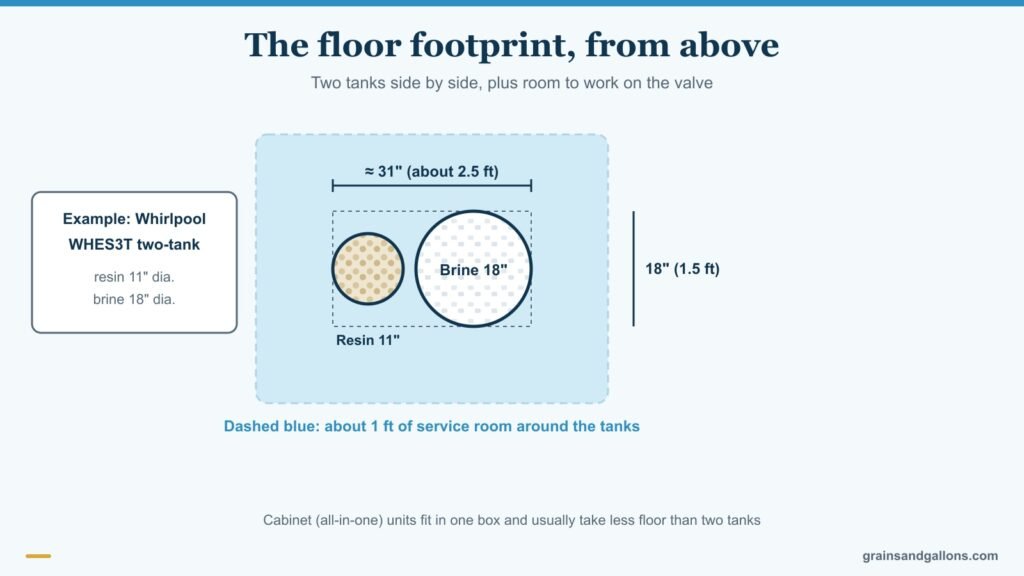
Softeners come in two basic layouts.
Two-tank (resin tank + separate brine tank). This is the classic setup with a Fleck or Clack valve on a tall fiberglass tank. Common resin tanks are about 9 to 10 inches in diameter for smaller homes and 12 to 14 inches for larger capacities. Brine tanks are usually wider, often 15 to 18 inches. As a real example, Whirlpool's WHES3T two-tank model lists an 11-inch resin tank and an 18-inch round brine tank (owner's manual). Side by side with a small gap, a pair like that covers about 31 by 18 inches, so plan on roughly 2.5 to 3 feet of width and 1.5 to 2 feet of depth before clearance.
Cabinet (all-in-one). Big-box brands like Whirlpool, GE and Morton also sell units with a short resin tank inside the salt cabinet. The footprint is a single box, usually smaller than a two-tank system, which is why they're popular in closets and utility rooms. The trade-off is lower capacity and a smaller salt reserve.
Then add service room. Clack's manual for its WS1 valve says to "allow one foot of clearance to service the valve" and to leave enough room to clean and repair the water meter without disconnecting the plumbing (Clack WS1 drawings and service manual). That's a sensible minimum for any brand: about a foot on the sides and front of the valve, easy reach to the bypass without moving the tanks, and a clear path to carry salt bags in.
Exact sizes vary by model and capacity, so pull the spec sheet for anything you're considering. For tight utility rooms, our picks for the best water softeners for a small house focus on compact units.
Height is the measurement that kills most installs
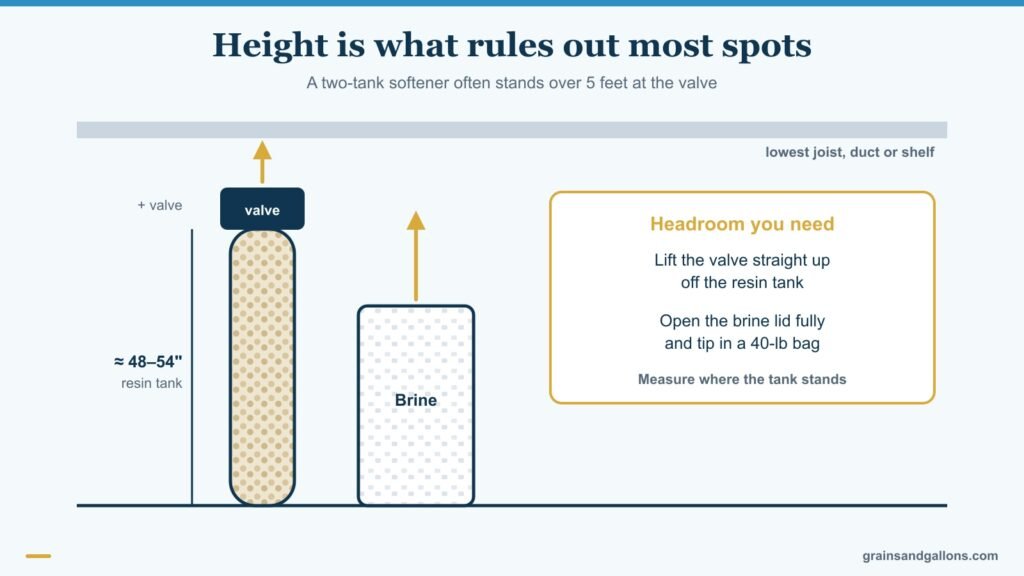
A typical 1.5-cubic-foot resin tank is about 54 inches tall, and the control valve adds several more inches on top. A larger 13×54 tank is the same height but wider. Even the smaller WHES3T resin tank stands 48-3/4 inches. So a two-tank softener often reaches well over 5 feet at the valve.
Then add working room above it. To replace resin, you lift the valve straight off and pour new resin in through the top, so you need open space above the tank. And you need enough room above the brine tank to open the lid fully and tip a 40-lb bag in.
Measure from the floor to the lowest obstruction: a joist, a duct, a shelf, a water heater vent. If it's tight, measure at the exact spot the tank will stand, because basement ceilings often aren't level.
Drain, overflow and outlet within reach
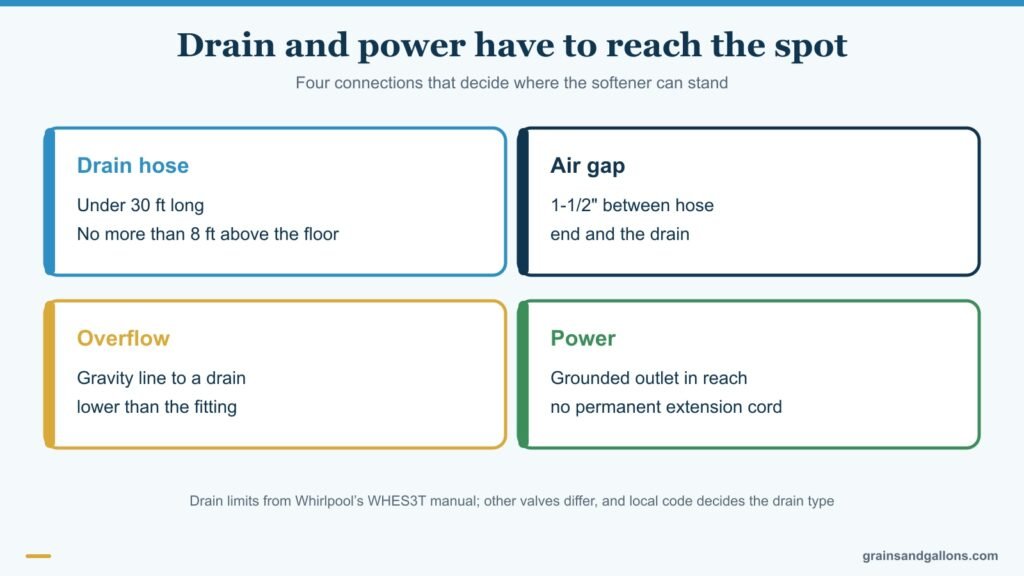
A softener needs a place to send regeneration water and a grounded outlet. Both decide where it can go.
Drain. The drain line has limits on length and height. Whirlpool's WHES3T manual says to avoid drain hose runs longer than 30 feet and not to elevate the hose more than 8 feet above the floor, because back pressure can stop the brine draw. It also calls for a 1-1/2 inch air gap between the end of the hose and the drain to prevent sewer water backing up. Other valves have their own limits, which also depend on your water pressure. The drain might be a floor drain, a standpipe, a laundry tub or a sump, and local plumbing code decides which are allowed. Our guide on water softener drain line requirements covers the details.
Brine tank overflow. Most brine tanks also have an overflow fitting that needs its own gravity line to a drain point lower than the fitting.
Power. Most softeners use a plug-in adapter, so you need a grounded outlet within cord reach, in a dry spot. Don't plan on an extension cord as a permanent fix.
Temperature, sunlight and a level floor

The space also has to suit the equipment.
- Above freezing. Clack lists an operating temperature of 40°F minimum and 110°F maximum for its WS1 valve, and Whirlpool says not to install where freezing temperatures occur. Unheated garages in cold climates are a problem unless you add protection.
- Out of direct sun. Whirlpool warns that sun heat can distort non-metallic parts. UV also degrades plastic tanks and housings over time.
- A solid, level floor. A full brine tank with salt and water is heavy. Whirlpool says to set the unit on a solid, level surface and not to put shims directly under the salt tank, since the weight can fracture it at the shim. A crawl space with a dirt floor needs a level pad.
If you're comparing specific rooms, our breakdown of softeners in a basement, garage, crawl space or closet covers what goes wrong in each. Slab homes in warm climates sometimes have no utility room at all; see our guide to outdoor water softener installation, and our comparison of water softener enclosures for covers that keep out sun and weather.
Leave room for the rest of the line
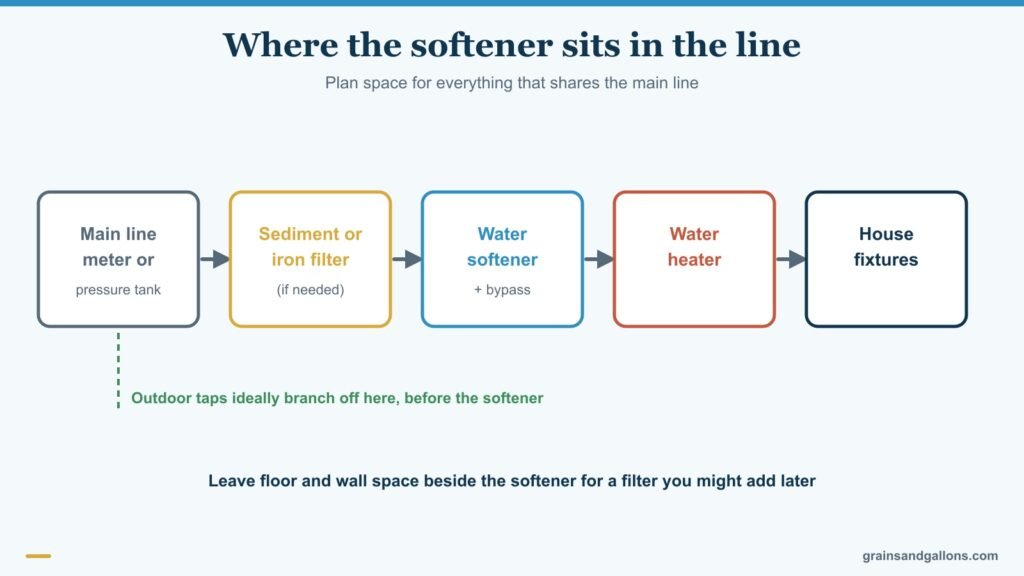
The softener isn't the only thing that needs wall and floor space at the main line. It belongs after the meter or pressure tank and after any sediment or iron filter, but before the water heater. If your water has sediment or iron you might deal with later, leave space beside the softener now for a filter housing.
Outdoor taps ideally branch off before the softener, so you're not softening lawn water. Whether that's practical depends on where your hose bibs tee off; we cover it in should outdoor faucets bypass a water softener. For the bigger placement picture, see where to install a water softener.
Tape out the spot before you buy
Mark the footprint on the floor with painter's tape, including the gap between the tanks and a foot of clearance around the valve. Then stand in the taped area and ask:
- Can I lift the valve straight up off the tank without hitting anything?
- Can I open the brine lid all the way and pour a bag in?
- Can I reach the bypass with one hand?
- Where does the drain line go, and is it under the length and height limits?
- Is there a grounded outlet within cord reach?
If all five are yes, the spot works. If one is no, it's usually cheaper to solve now (move a shelf, add an outlet, reroute a drain) than after the softener is plumbed in.
Headroom and drain reach decide the spot, not floor area
So how much space does a water softener need? Floor area is the easy part: about 2.5 by 1.5 feet for a typical two-tank unit, less for a cabinet model, plus a foot of service room around the valve. The measurements that actually rule spots out are the height to the lowest obstruction, a drain within the valve's length and height limits, a nearby outlet, and a room that never freezes.
FAQ
Can a water softener go in a closet?
Often, if it's a compact cabinet unit and the closet has a drain, an outlet and enough headroom to open the lid. Plan for leaks too: a pan or a leak alarm is cheap insurance on a finished floor.
How much clearance does a water softener need?
Clack recommends one foot of clearance to service its WS1 valve, which is a good rule for any brand. You also need room above the tanks to lift the valve off and to open the brine lid fully.
How tall is a typical water softener?
Most two-tank residential softeners use resin tanks around 48 to 54 inches tall, plus several inches for the valve, so the top of the valve often sits more than 5 feet off the floor. Cabinet models are usually shorter.
How far can a water softener be from a drain?
It depends on the valve and your water pressure. Whirlpool's WHES3T manual says to avoid drain hose runs longer than 30 feet and rises of more than 8 feet above the floor. Check your own model's manual.
Can a water softener be installed in a garage?
Yes, in mild climates or a garage that stays above freezing. Clack's WS1 valve is rated for 40°F to 110°F. Keep it out of direct sun, and add insulation or heat if winter temperatures drop below freezing.