

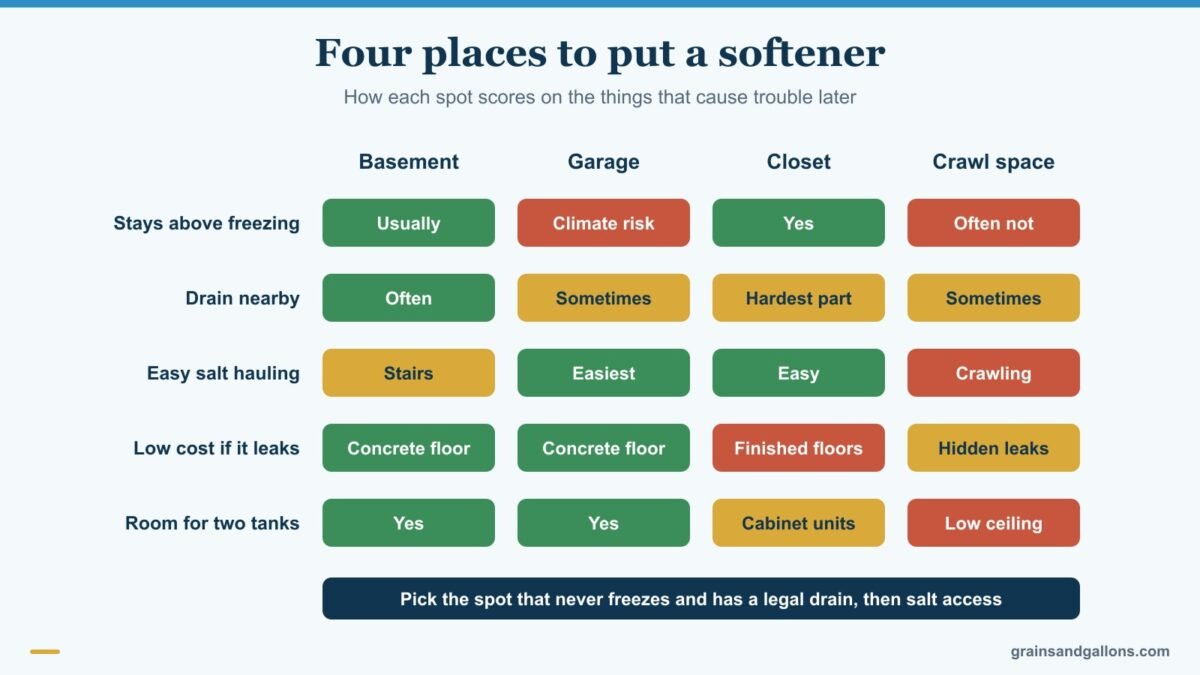
Quick Answer: A softener in basement utility areas is usually the easiest install: the space stays above freezing, sits near the main line and often has a floor drain. A garage works only if it never freezes and the tanks are protected from sun and cars. A closet suits compact cabinet units if there's a drain, a pan and a leak alarm. A crawl space comes last, mostly because you'll be dragging 40-pound salt bags through it for years.
The plumber is asking where you want it, and the honest answer is "wherever the pipe comes in," which might be a cramped closet, a garage wall or a hatch in the floor. A softener in basement corners, garages, closets and crawl spaces can all work. Each one fails in its own way, so it helps to know what you're signing up for. (For plumbing order rather than rooms, see where to install a water softener.)
In this guide
- Six things every softener spot needs
- Why a softener in basement utility rooms usually wins
- A garage install depends on your winters
- Closets fit cabinet units, if you plan for the leak
- Crawl spaces: possible, rarely pleasant
- Rank your options in five questions
- FAQ
- A warm room with a drain beats a short pipe run
Six things every softener spot needs

- Above freezing, all year. Clack's WS1 service manual lists operating temperatures of 40°F to 110°F, and Fleck's 5600SXT manual says the unit can't be subjected to freezing and water can't exceed 110°F. Check your own spec page.
- A drain within reach, with an air gap. Fleck calls for a gap of twice the drain line diameter, 1 inch minimum. Our guide to where a water softener can drain covers the options.
- Constant power. Fleck says the power adapter must not be on a switched outlet.
- A level, solid floor. A full brine tank holds hundreds of pounds of salt and water.
- Room to work. You need to lift the lid, pour salt and reach the valve and bypass. See how much space a water softener needs.
- The right spot on the line: after the well pressure tank, before the water heater, and usually after the branch to outdoor spigots. Penn State Extension's water softening guide notes outdoor spigots can be left on unsoftened water.
Why a softener in basement utility rooms usually wins
Basements hold a steady temperature, the main line often enters there, and a floor drain or laundry standpipe is usually close. Salt goes down a staircase, which isn't fun, but at least you're walking upright.
What goes wrong:
- Damp. Humid basements make salt clump and bridge, and the brine tank can sweat in summer. Keep salt bags off the slab, and see our guides to brine tank sweating and salt bridges.
- Drain height. If the only drain is a laundry sink or standpipe, check that your valve can push water up to it. Most can lift a modest height; the manual sets the limit.
- Flooding. If the basement takes on water, set the tanks on a low platform so the brine tank isn't sitting in a puddle.
A garage install depends on your winters

Garages make salt deliveries easy (back the car up, carry the bags ten feet), have floor space to spare, and in slab-built homes the main line often enters on a garage wall. In the South and Southwest it's the most common spot.
What goes wrong:
- Freezing. An unheated garage in a cold snap can freeze the brine tank, crack the control valve or split a mineral tank. If yours ever drops below freezing, add safe heat and insulation or put the softener inside. Our frozen water softener guide covers what to check afterward.
- Heat and sun. A west-facing door can bake the tanks, and UV breaks down plastic over time. A cover helps; see our softener enclosure picks and the outdoor installation guide.
- Bumpers. Put it where a car can't nudge it. A wheel stop costs far less than a cracked bypass valve.
- No floor drain. Many garages lack one, so you may need a run to a laundry standpipe or another approved spot.
Closets fit cabinet units, if you plan for the leak
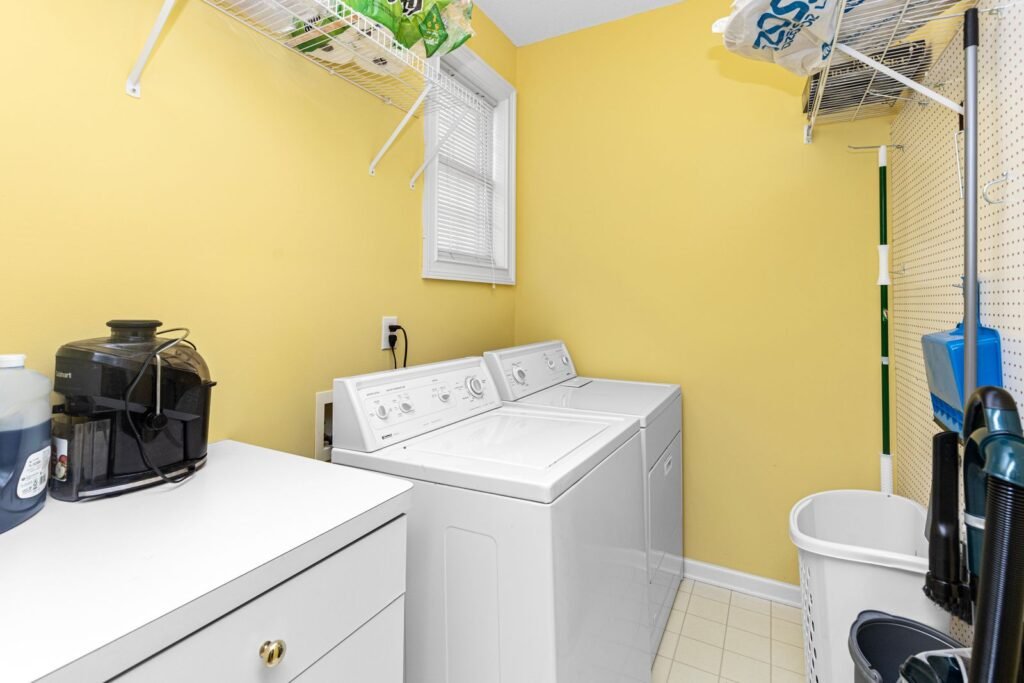
In condos, townhouses and slab homes, a utility closet near the water heater is often the only indoor option. It's warm, out of sight and close to power.
What goes wrong:
- Size. A two-tank softener plus brine tank needs more floor than most closets have. Cabinet-style units fit far better; start with our softeners for small homes.
- The drain. Getting a code-legal drain into a closet is usually the hardest part. A nearby water heater standpipe or a laundry box on the other side of the wall helps; otherwise budget for a plumber.
- Leaks onto finished floors. A cracked fitting in a basement is a wet floor. Over hardwood or a downstairs ceiling, it's an insurance claim. Use a drain pan and a battery leak alarm at minimum, and consider an automatic shutoff valve.
- Noise. Regeneration means rushing water and a motor stepping through cycles. Next to a bedroom, schedule it for a time you won't notice, and see drain line noise if it's loud.
Crawl spaces: possible, rarely pleasant

Sometimes the main line enters there, and it keeps the unit completely out of living space. The downsides stack up fast:
- Salt. A family can go through a 40-pound bag every month or two. Crawling with that, over and over, gets old. Some people move only the brine tank to an accessible spot with a longer brine line, but check with the manufacturer first.
- Cold and damp. Vented crawl spaces can freeze in winter and stay humid enough to rust fittings and grow mold on the brine tank.
- Height. Mineral tanks commonly stand four to five feet tall; many crawl spaces don't. Measure before you order.
- Neglect. You'll check salt less often if it takes a flashlight and kneepads, and a softener that runs dry sends hard water through the house for weeks.
If the crawl space is the only access to the main, a plumber can often run the line up into a nearby closet or garage and back down. It costs more up front and pays off every time you add salt.
Rank your options in five questions

- Never freezes
- Has a legal drain with an air gap
- Easy to carry salt to
- Cheap to clean up if it leaks
- Close to the main line, upstream of the water heater
A spot that fails one of the first two is out. Among the rest, the one that's easiest to reach with salt usually wins, even if it means a longer pipe run.
FAQ
Can a water softener go in an unheated garage?
Only if the garage never drops below freezing. Clack's WS1 lists 40°F as the minimum operating temperature, and Fleck says its 5600SXT can't be exposed to freezing. Otherwise add heat and insulation or move it inside.
Is it OK to put a water softener in a closet?
Yes, if it fits, has a legal drain and has leak protection. Cabinet-style units are the usual choice, with a drain pan and a leak alarm underneath.
Does a water softener need a floor drain?
It needs an approved drain with an air gap, not necessarily a floor drain. A laundry standpipe or sink often works if the valve can push water up to it.
Can a water softener be installed in a crawl space?
It can, if the space stays above freezing and has the headroom. The bigger problem is refilling salt through a hatch for years.
How far can a softener be from the drain?
That depends on the valve and drain height; follow your manual's limits for drain line length and lift, and keep the air gap at the end.
A warm room with a drain beats a short pipe run
For most homes, a softener in basement space is the right call, followed by a closet or a garage that never freezes. Use a crawl space only when nothing else is reachable. Settle temperature and drain first, then pick the spot you'll actually walk to with salt.