


Quick Answer: Most water softener drain line noise is normal: a steady hiss or whistle while the softener sends water to drain is water squeezing through the drain line flow control. It gets loud when house pressure is high, so check static pressure with a hose-bib gauge like the Watts pressure test gauge; over 80 psi, a pressure reducing valve is the real fix. Banging when the cycle changes is water hammer, rattling is loose tubing, and water hissing to drain between regenerations means the valve is leaking or stuck.
Disclosure: As an Amazon Associate, Grains & Gallons earns from qualifying purchases.
It's 2:15 in the morning and something in the basement is whistling like a tea kettle. Or there's a thump, a pause, and another thump. Softeners regenerate at night on purpose, so nobody is using water while the resin recharges. That's also when the house is quiet enough to hear every sound the drain line makes.
Most of those sounds are harmless. A few point to something you should fix. The trick is matching the sound to the moment it happens.
In this guide
- Sound by sound: normal or not
- The whistle: a tiny orifice doing its job
- Check pressure before blaming the softener
- Banging when the cycle changes
- Rattling and slapping: the tubing itself
- Gurgling at the standpipe
- A drain line that hisses when it shouldn't
- FAQ
- Most noises are pressure, tubing or a valve that won't seal
Sound by sound: normal or not
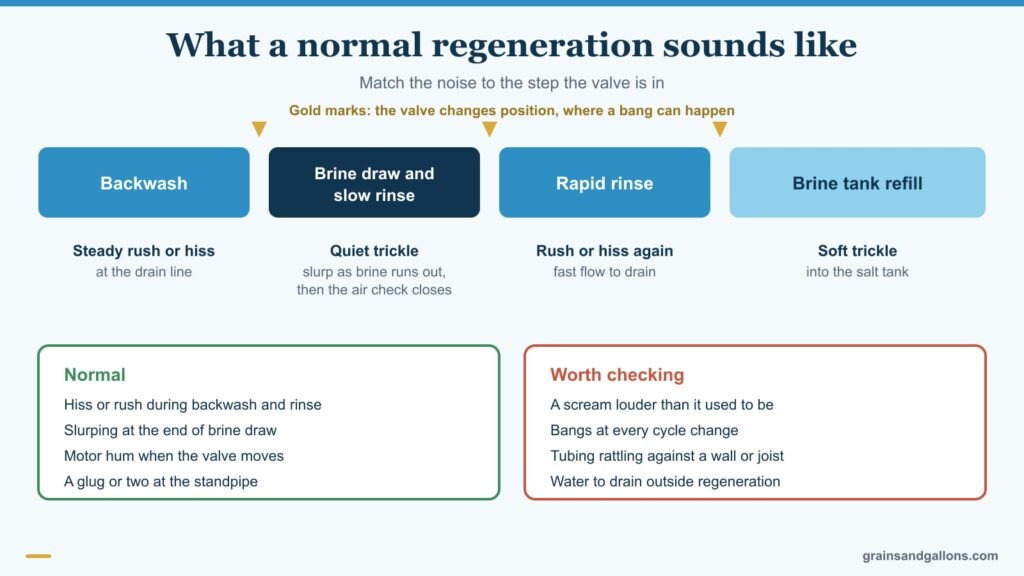
A regeneration runs through a fixed set of steps. On a typical downflow valve like the Fleck 5600SXT, that's backwash, brine draw with slow rinse, rapid rinse, and brine tank refill. Each step has its own sound. Penn State Extension's guide to water softening explains what each step does to the resin, and our guide to how water softener regeneration works goes step by step.
| What you hear | When | Usually means | Normal? |
|---|---|---|---|
| Steady hiss or whistle | Backwash and rapid rinse | Water forced through the drain line flow control | Yes, unless it's very loud |
| Loud, high-pitched scream | Same | High house pressure, or a worn flow control | Check pressure |
| One or two bangs | The moment the valve changes position | Water hammer from flow starting or stopping abruptly | Common, fixable |
| Rattling or slapping | Backwash | Loose tubing vibrating against a wall, joist or standpipe | No, secure it |
| Gurgling at the drain end | During and after backwash | Standpipe or trap drawing air, slow drain | Often harmless |
| Hissing to drain outside regeneration | Daytime, any time | Valve leaking water to drain, or stuck mid-cycle | No |
| Slurping from the brine tank side | End of brine draw | Injector pulling the last brine, then air | Normal |
Pin down where water softener drain line noise comes from
Start a manual regeneration during the day and stand next to the softener with the cycle display in view. Put a hand on the drain tubing, then on the standpipe, then on nearby supply pipes. Vibration you can feel tells you which part is making the sound. Note which step the valve is in when it starts and stops. A noise that only happens in backwash and rinse is the drain side; one that happens at each step change is hammer; one that shows up in brine draw is the injector and brine line.
The whistle: a tiny orifice doing its job
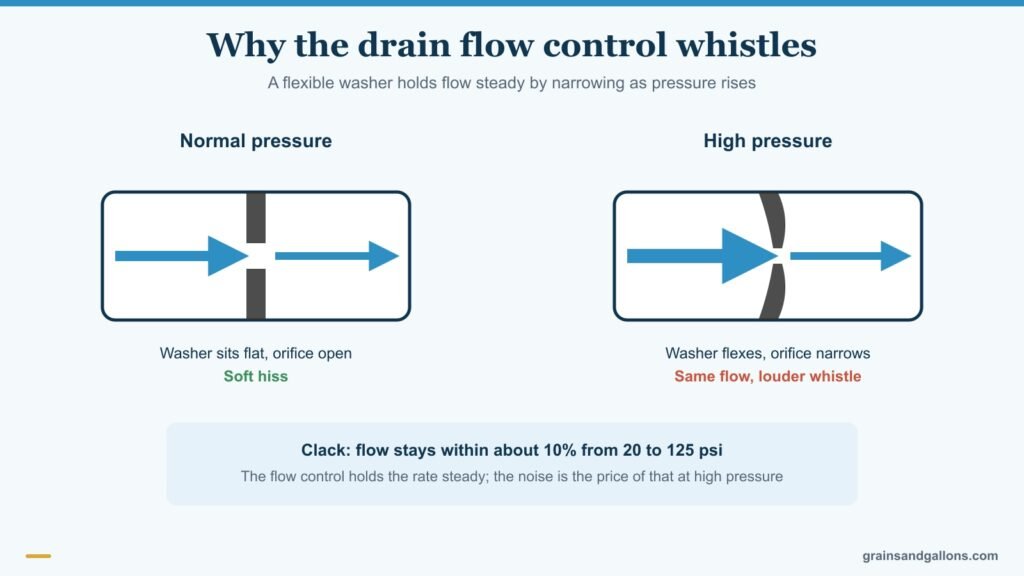
Every residential softener valve has a drain line flow control: a small rubber washer with a precise hole that caps how fast water leaves during backwash and rinse. Without it, backwash flow would lift the resin and wash it out of the tank. The washer flexes under pressure to hold the flow steady. The Clack WS1 service manual says its flow controls stay within about 10% of their rated flow anywhere from 20 to 125 psi.
So the flow stays constant, but at higher pressure there's more force pushing water through that small opening. More pressure, more noise. A soft hiss at 50 psi can turn into a whistle at 90.
If pressure is normal but the whistle has changed (louder, wobbling, sputtering), the flow control may be partly blocked or the washer may have hardened. Our guide to a clogged drain line flow control explains how to clean it. Never pull the flow control out to quiet it. That's the fastest way to lose resin down the drain.
Check pressure before blaming the softener
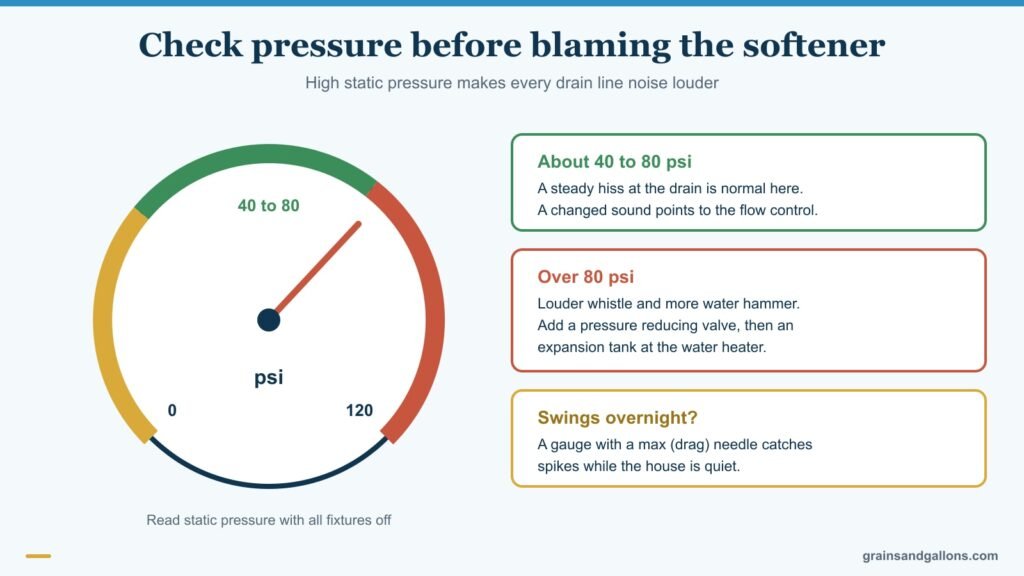
High static pressure makes the whistle louder and the hammer harder, so measure it first.
- Screw a gauge onto an outdoor spigot, laundry faucet or water heater drain with every fixture off. A gauge with a drag (max) needle left on overnight also catches spikes that happen while the house is quiet, which is exactly when the softener regenerates.
- If it's above 80 psi, that's beyond what most plumbing codes allow inside a home, and it stresses the softener, the water heater and every faucet. A pressure reducing valve on the main line quiets the whistle and protects everything else. Our guide to the best water pressure reducing valves covers models that suit homes with softeners.
- Add an expansion tank if you add a PRV. A PRV closes the system, so heated water has nowhere to expand. Most homes need a thermal expansion tank at the water heater once a PRV is in.
Banging when the cycle changes
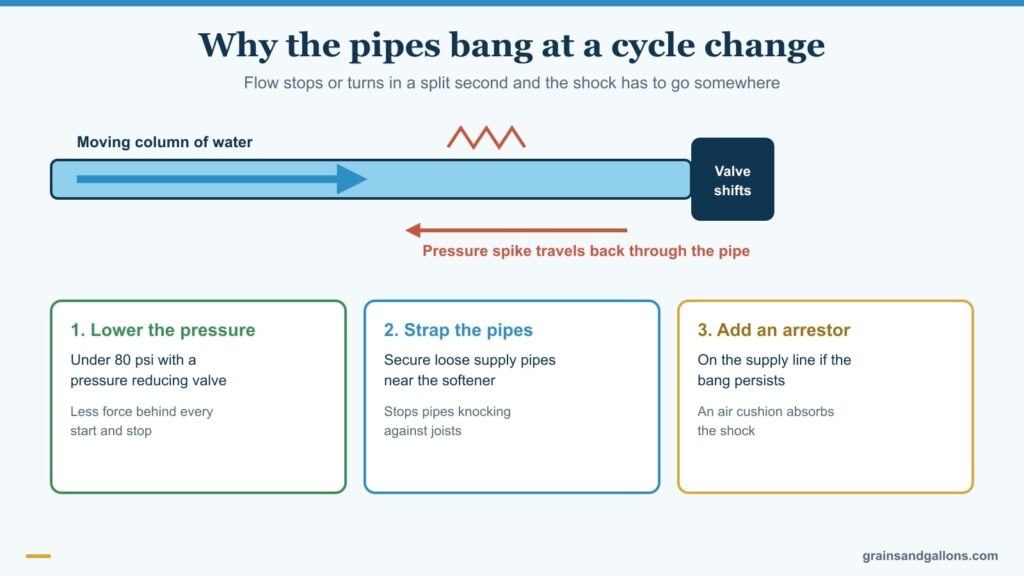
A bang right when the valve moves from backwash to brine draw, or from rinse to service, is water hammer. A moving column of water gets stopped or redirected in a split second, and the shock travels through the pipes. High pressure makes it worse, and so do long runs of rigid pipe that aren't strapped down.
It's not just a noise. Repeated hammer is hard on joints, flex connectors and the valve itself. Bring the pressure into range, strap loose supply pipes near the softener, and add a water hammer arrestor on the supply side if the bang persists. Our guide to water hammer after a water softener covers arrestor placement in detail.
On a well, a bang or a sputter at the drain can also come from the pressure tank and pump cycling during backwash, or from air in the lines. If the drain end spits air and water at the start of a cycle, see our guide to well pump flow and backwashing.
Rattling and slapping: the tubing itself
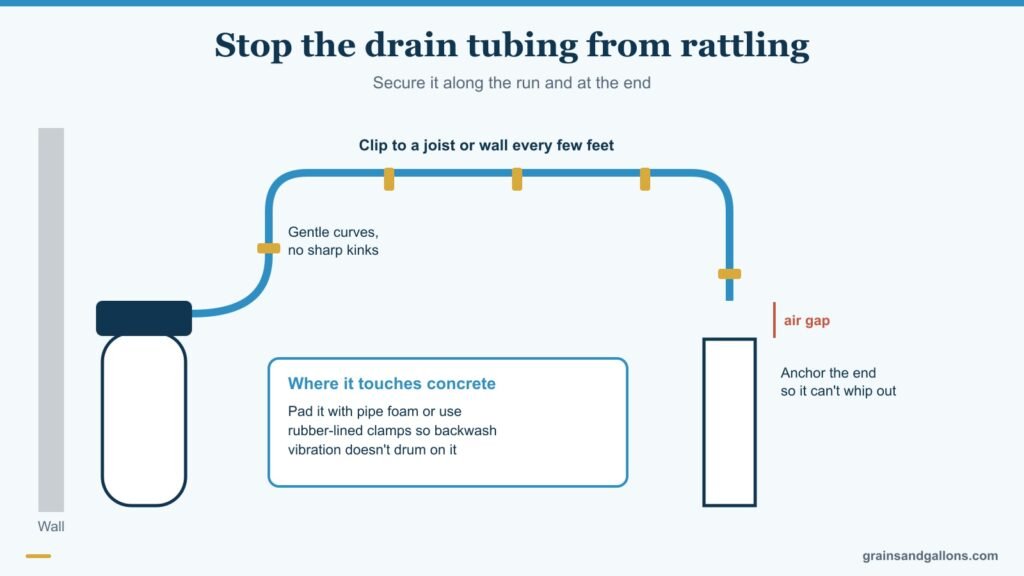
Loose vinyl or poly drain tubing vibrates during backwash and slaps whatever it touches. Sometimes it walks right out of the standpipe. To quiet it:
- Run the tubing in gentle curves with no sharp bends or kinks, which also cause chattering.
- Clip it to the wall or a joist every few feet.
- Where it touches concrete, pad it with pipe foam or use rubber-lined clamps.
- Anchor the end. An air gap fitting on the standpipe holds it steady and keeps the code-required gap. Our air gap fittings guide shows what fits 1-1/2" and 2" standpipes.
Gurgling at the standpipe
When several gallons a minute pour into a standpipe, the trap and vent have to move air out of the way. Some glugging is normal, especially in older homes. Persistent loud gurgling, or other drains in the house burping at the same time, points to a slow or poorly vented drain, which is a plumbing issue rather than a softener one. A drain end pushed down into standing water can also gurgle and chatter, and it's missing its air gap, so lift it out.
If the gurgling comes from the salt tank instead, that's a different problem. See brine tank gurgling or bubbling.
A drain line that hisses when it shouldn't
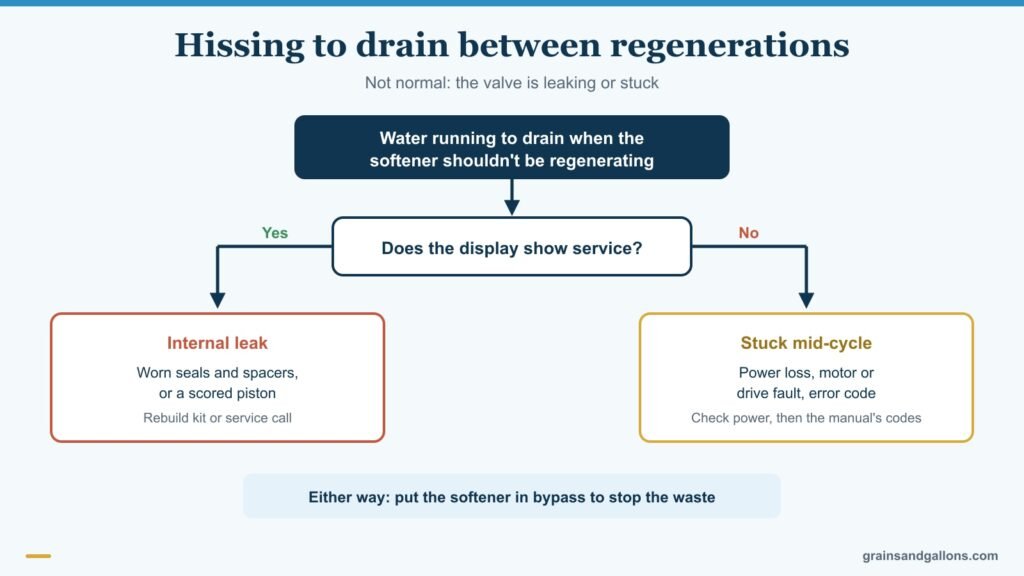
If you hear water moving to drain in the middle of the afternoon, first check whether the softener is actually regenerating. Some metered valves start right away when capacity runs out; see water softener regenerating during the day. If it isn't regenerating, the valve is leaking internally or it's stuck partway through a cycle. That wastes water and can send brine to your taps.
Look at the display or cam. If it shows service and water still flows to drain, worn seals, spacers or a scored piston are the usual cause; the Fleck 5600SXT service manual troubleshooting table points to the same parts for an internal control leak. If it's stuck mid-cycle, check power and the error codes in your manual. Either way, put the softener in bypass until it's repaired.
FAQ
Is it normal for a water softener to make noise at night?
Yes. Many softeners ship set to regenerate at 2:00 a.m. (GE and Whirlpool both use that factory setting), and a steady hiss or rush at the drain during backwash and rinse is normal. You can move the regeneration time if it bothers you; see what time a water softener should regenerate.
Why does my water softener whistle?
The whistle is water forced through the small drain line flow control. It's normal, but it gets louder as house pressure rises. If it's suddenly louder or warbling, check your pressure and clean the flow control.
Can I remove the drain flow control to stop the noise?
No. The flow control limits backwash flow so the resin bed lifts without washing out. Without it, you'll lose resin down the drain and the softener will lose capacity.
How do I stop my softener drain line from banging?
Bring static pressure under 80 psi with a pressure reducing valve, strap loose pipes and tubing, and add a water hammer arrestor on the supply line if the bang continues at each cycle change.
Why is my softener draining all the time?
Constant flow to drain outside regeneration means the valve is stuck mid-cycle or leaking internally through worn seals or the piston. Bypass the softener and have the valve serviced or rebuilt.
Most noises are pressure, tubing or a valve that won't seal
Water softener drain line noise is usually the flow control doing its job, made louder by high pressure. Measure your pressure, and fit a PRV and expansion tank if it's over 80 psi. Clip and pad loose tubing, and treat bangs at cycle changes as water hammer. The one sound you shouldn't ignore is water hissing to drain when the softener isn't regenerating: that's a valve that needs attention.