

Quick Answer: Skip the drain saddle and use a listed air gap on a standpipe. The Mr. Drain AG100-001A is the easiest pick for most installs. It takes 1/2" or 5/8" tubing, drops into a 1-1/2" or 2" standpipe, and is rated up to 12.5 GPM. If you're running rigid 3/4" PVC, use the threaded ET115-002. If the same standpipe also takes an RO drain, the AG130-001 dual air gap handles both lines.
Disclosure: As an Amazon Associate, Grains & Gallons earns from qualifying purchases.
Here's the shortcut people try: clamp a saddle onto the nearest drain pipe, drill a hole, and push the softener's drain tubing into it. It's quick, it's hidden, and in most jurisdictions it's wrong. A saddle makes a direct connection between your softener and the sewer. If the drain ever backs up, or a vacuum forms in the line, wastewater has a path back toward the control valve. That's exactly what an air gap prevents. Most inspectors will fail a saddle on a softener discharge, and many home inspectors flag it at resale.
There's a practical problem too. The drain saddles sold online are mostly built for reverse osmosis systems with 1/4" or 3/8" tubing and a trickle of reject water. A softener in backwash can push several gallons a minute. A small saddle port can't keep up, and the drain line ends up under pressure, or worse, sprays out wherever it finds a gap.
So the honest answer to "best drain line saddle" is that for a softener, you want an air gap fitting on a standpipe or floor drain. The five below are all from Air Gap International's softener line, and they differ mainly by the kind of tubing coming out of your softener.
In this guide
What the code actually asks for
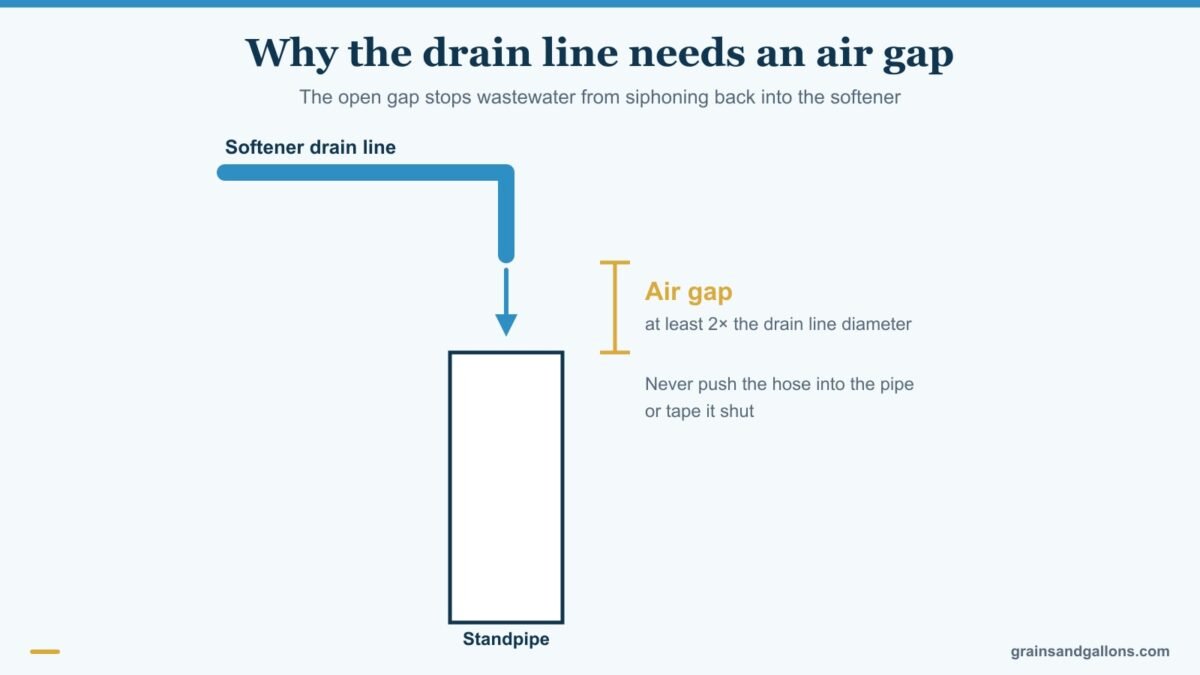
The rule in most places: the softener drain must discharge through an air gap, meaning open air between the end of the drain line and the flood rim of whatever receives it. The gap is typically at least twice the diameter of the discharge line. It can't be submerged, and the line can't be clamped into a sealed drain. Local rules vary on the details: whether a laundry standpipe is allowed, how far the trap sits below, whether a floor drain counts. Our softener drain line requirements guide covers the common rules. Where a softener can drain runs through the usual options, from laundry standpipes to utility sinks to sump pits.
A loose tube zip-tied above a laundry standpipe technically gives you an air gap, and lots of houses run that way. The fittings below make the same thing neat and permanent. The tube can't flip out during a high-pressure backwash, and an inspector can see in two seconds that it's right.
Pick by what's coming out of your softener
Look at the drain fitting on your control valve and at the tubing running from it. That decides which of these you need.
Flexible poly tubing, 1/2" OD or 5/8" → Mr. Drain AG100-001A (takes either) or ET117-006 (5/8" JACO compression). Barbed hose fitting, 1/2" → ET117-008. Rigid 3/4" PVC pipe → ET115-002. Softener and an RO system going to the same standpipe → AG130-001.
Mr. Drain AG100-001A: the universal one
If you're not sure what you've got, this is the safe choice. Supply-house specs list 1/2" OD and 5/8" OD inlets, a fit for 1-1/2" and 2" standpipes, and a 12.5 GPM maximum (7 GPM is the stated optimum). It's UPC and IPC listed. It's about 6-1/2" tall and made of polystyrene. In a plastic standpipe you can glue it in with regular PVC cement.
The install notes are worth following, because most splash complaints come from skipping them. Put the P-trap at least 20" below the top of the standpipe. Support 5/8" tubing within 12–18" of the inlet. If it's noisy or splashes, add a 22-degree elbow at least 12" downstream.
The downside: polystyrene is less tough than polypropylene. Don't stand on it or let a laundry hose bang against it.
ET117-006: 5/8" JACO compression, PVC trap adapter
A right-angle JACO compression inlet grips 5/8" flexible tubing securely. That matters on softeners with strong backwash flow, where push-in tubing can work itself loose over time. It sits on a 1-1/2" standpipe and includes a PVC trap adapter. It's polypropylene and UPC listed. The right-angle inlet keeps the tubing from kinking where it comes down a wall.
The downside: it's sized for 1-1/2" standpipes. On a 2" standpipe you'll want the Mr. Drain or an adapter. There's also an ABS version (ET117-005) if your drain is black ABS, so buy the one that matches your pipe.
ET117-008: 1/2" barb, PVC trap adapter
Many box-store softeners and smaller cabinet units ship with a 1/2" barbed drain elbow and soft hose. This air gap matches that with a 1/2" barb inlet on a 1-1/2" standpipe and a PVC trap adapter. Clamp the hose onto the barb and it's done.
The downside: barbed connections rely on the hose clamp. Use a real stainless clamp, not a zip tie. As with the ET117-006, there's an ABS version (ET117-007) for ABS drains.
ET115-002: 3/4" threaded inlet for rigid pipe
When the drain run is long, has to cross a ceiling, or simply looks better in rigid PVC, this is the right fitting. It has a 3/4" NPT Schedule 40 inlet and fits a 1-1/2" standpipe (2" with a coupler). Specs list a 9 GPM maximum and a 0.5 GPM minimum. The design is meant to keep water from splashing out anywhere within that range. Rigid pipe also helps with a long or uphill drain, because there's no tubing to sag and hold water. If your drain has to rise above the softener, check how high a softener can lift its drain before committing to the route.
The downside: 9 GPM is plenty for a typical residential softener, but large twin-tank or high-capacity commercial units can backwash harder. Check your valve's backwash flow (the drain line flow control rating) before you buy.
AG130-001: one air gap, two drains
If you have a softener and a whole-house or point-of-use RO in the same utility room, this gives each its own inlet on a single standpipe. The softener port takes 5/8" OD poly or 1/2" ID PVC slip. The RO port takes 3/8" OD tubing, or 1/4" with the included adapter. It fits 1-1/2" to 2" standpipes and is UPC listed.
The downside: max flow isn't published for each port the way it is for the Mr. Drain. If you have a high-flow softener, confirm with the maker or put the softener on its own air gap.
Standpipe, floor drain or laundry sink?
All five fittings here are built for a 1-1/2" or 2" standpipe, the vertical pipe with a trap at the bottom that a washing machine drains into. That's the most common receptor, but there are others:
- Dedicated standpipe. This is the best option. If you're finishing a utility room, have the plumber stub one in near the softener. The P-trap needs to be far enough below the top that backwash doesn't overflow. The Mr. Drain instructions call for at least 20".
- Shared laundry standpipe. Allowed in many areas, but the washer and softener can drain at the same time. A regeneration at 2 a.m. rarely overlaps with laundry. Still, don't schedule regeneration for Sunday afternoon.
- Floor drain. A tube clipped a couple of inches above the grate makes a legal air gap in many jurisdictions. The weak point is the floor drain trap drying out between uses, which lets sewer gas in. A trap primer, or pouring water in it now and then, fixes that.
- Laundry sink. Fine if the tube is secured above the flood rim. It's ugly, and someone eventually knocks the tube into the basin.
- Sump pit. Some areas allow it and some forbid it, because sump water often goes to the yard or storm sewer and brine shouldn't. Check before you do it.
Why the saddle keeps showing up
Two reasons. Some softeners come in an RO bundle, and the RO's saddle valve gets reused for the softener drain. And a saddle needs no standpipe, so on a slab house with no nearby drain it looks like the only option. If that's your situation, the real fix is a short standpipe tied into the nearest drain line, or a drain pump rated for your softener's backwash flow if the drain point is higher than the valve can push. Our page on softeners with no nearby drain covers the workable options.
Install notes that save a callback
- Size the drain to the flow. Your softener's drain line flow control (often stamped on the valve or listed in the manual) sets the backwash rate. Make sure the air gap and standpipe can handle it.
- Keep the tubing supported and kink-free. A kink makes backwash back up into the valve, and that can look like a regeneration failure. Connecting softener drain tubing covers clamps, inserts and routing.
- Don't share a sealed connection with the washing machine hose. Each discharge needs its own air gap.
- The brine tank overflow is a separate line. It drains by gravity and shouldn't be teed into the pressurized valve drain.