

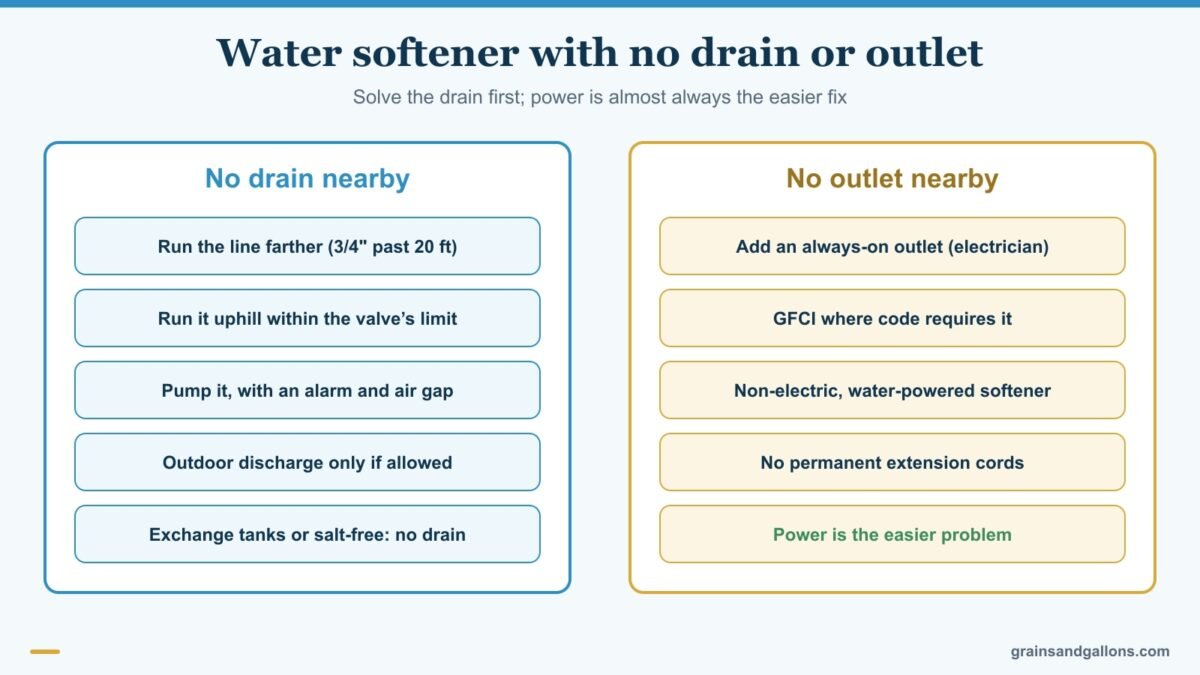
Quick Answer: A water softener with no drain or outlet nearby can almost always still be installed. The drain is the hard part: run the softener's drain line overhead or along a wall to the nearest laundry standpipe, utility sink or floor drain, ending in an air gap. Many valves can push drain water several feet uphill if your pressure is high enough. Power is easier: add an always-on outlet or choose a non-electric, water-powered softener. Only if no drain is reachable at all should you look at pumps, exchange-tank service or a salt-free conditioner.
The best spot for a softener is where the main line comes in. Unfortunately, that's often a crawl space corner, a garage wall or a utility closet, and you end up planning a water softener with no drain or outlet within reach. Before you give up on that spot, know that softeners are more flexible about drains than people assume, and that power is the easier of the two problems.
In this guide
- Why every salt-based softener needs a drain
- Six ways to fit a water softener with no drain or outlet
- How far uphill a softener drain line can go
- The overflow line doesn't follow the same rules
- Getting power to the valve without a nearby outlet
- Shortcuts that fail inspection or flood the floor
- FAQ
- Find the drain first, then solve power
Why every salt-based softener needs a drain
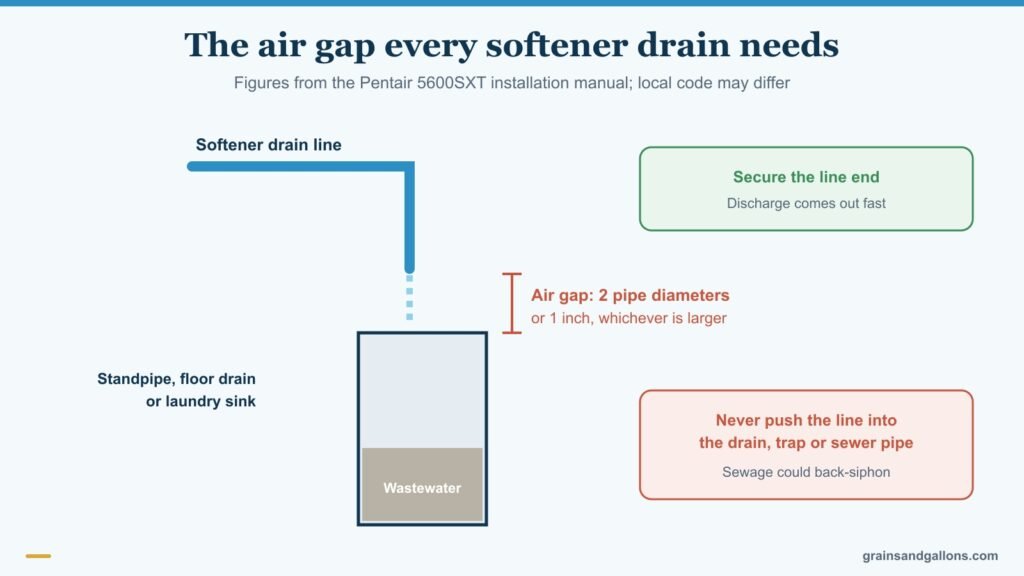
Every regeneration sends water to drain: backwash, brine and rinse. Penn State Extension estimates about 50 gallons per regeneration cycle, and the flow isn't a trickle. A Wisconsin utility's softener cross-connection brochure puts it simply: "When water softeners discharge water, the water flows fast. It doesn't dribble out." The water also carries salt, so you can't let it run onto the floor or into a bucket, and most codes don't let you run it into just any pipe.
The drain line also needs an air gap: open space between the end of the line and the receiving drain, so sewage can never be siphoned back into the softener and your drinking water. The Pentair 5600SXT installation manual calls for an air gap of "2 pipe diameters or 1 inch (22 mm) whichever is larger" and warns never to insert the drain line directly into a drain, sewer line or trap. Your local plumbing code may ask for more. A dedicated fitting makes this neat; see our picks for the best air gap fittings for softener drain lines, and our drain line requirements guide for sizing.
What doesn't need a drain? Exchange-tank service and salt-free conditioners, covered in option 6 below. Every salt-based softener that regenerates at your house needs one.
Six ways to fit a water softener with no drain or outlet
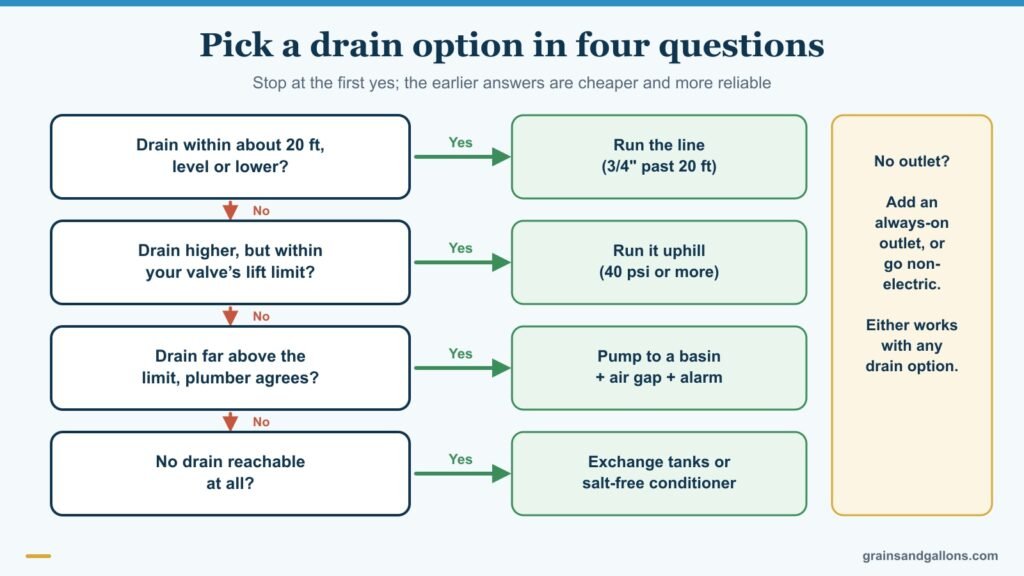
Work down this list. The first option that works is usually the best one, because each step adds cost or a new way to fail.
1. Run the drain line to a drain that's farther away
The drain line is just flexible tubing, usually 1/2-inch or 5/8-inch. It can run along joists, through a wall or across a ceiling to a laundry standpipe, a utility sink or a floor drain in another room.
Distance limits come from your valve's manual. The Pentair 5600SXT manual says the unit should be "not more than 20 feet (6.1 m) from the drain" and calls for 3/4-inch pipe when the drain line is longer than 20 feet. Longer runs add friction, which can cut backwash flow, so check your own manual before you plan a 40-foot run. Our guide to where a water softener can drain covers which receptors are usually acceptable and which aren't.
2. Run it uphill
A drain doesn't have to be lower than the valve. During regeneration the line is under house water pressure, so it can climb. That opens up a lot: a basement softener draining to a first-floor laundry standpipe, or a garage softener draining up and over to a sink. The limits are in the next section.
3. Pump it
If the nearest drain is well above your valve's lift limit, a pump can collect the discharge in a basin and lift it. Three warnings:
- Capacity. Many small condensate pumps aren't built for a sustained high flow lasting the whole backwash. The pump and basin must handle the softener's peak drain flow for the full cycle, or the basin overflows.
- Salt. Brine is corrosive. Choose a pump rated for it, and keep the air gap where the softener line enters the basin.
- Failure. A pump adds a failure point. If it dies mid-regeneration, you get a puddle. A cheap leak alarm next to the basin is worth it, and a plumber should confirm the setup meets code.
4. Drain outdoors, only where it's allowed
Some rural areas allow softener discharge to a dry well or separate drainage area. Many don't, and some restrict softener discharge entirely. Never run brine onto a lawn, garden or near a well. Check with your local building or health department first. If you're on a septic system, read our guide to a water softener with a septic system before choosing where the discharge goes.
5. Solve power with a new outlet or a non-electric softener
If power is your only problem, a non-electric softener sidesteps it. These use water flow to drive the valve and meter, usually in twin-tank designs that regenerate based on gallons used. You still need a drain. Our roundup of the best non-electric water softeners covers how they work and the trade-offs. The other route, a new outlet, is covered below.
6. Avoid the drain entirely
Only two common setups need no drain at the house:
- Exchange-tank (portable exchange) service. A dealer installs resin tanks and swaps them on a schedule, regenerating them at their facility. No brine tank, no drain line, no power. Availability depends on your area.
- Salt-free conditioners. Template-assisted crystallization units reduce scale formation but don't remove hardness, and they need no drain or power. They're a different product with different results; read water softener alternatives before assuming one will feel like soft water.
How far uphill a softener drain line can go
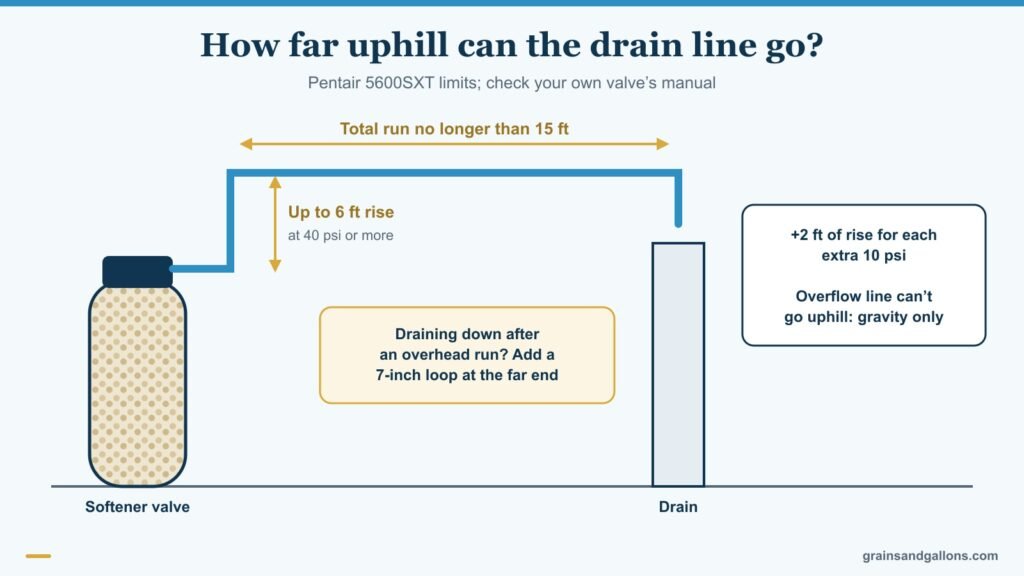
Lift limits are set by each valve maker, so treat these as one real example rather than a universal rule. The Pentair 5600SXT manual says the drain line "may be elevated up to 6 feet (1.8 m) providing the run does not exceed 15 feet (4.6 m) and water pressure at the softener is not less than 40 psi." Elevation can increase by 2 feet for each additional 10 psi at the drain connector.
Two details from the same manual matter when you route a line up and over:
- Add a loop if the line drops back down. Where the line is elevated but empties into a drain below the level of the valve, form a 7-inch loop at the far end, with the bottom of the loop level with the valve's drain connection. That acts as a siphon trap so the line doesn't drain itself and pull on the valve.
- Use a trap for overhead sewer lines. Where the drain empties into an overhead sewer line, a sink-type trap is required.
Check your pressure before you count on lift. A cheap gauge on a hose bib near the softener tells you whether you're above 40 psi. If your pressure is low, the line may not clear the high point, and backwash suffers. Our drain lift height guide goes deeper on other valves.
The overflow line doesn't follow the same rules
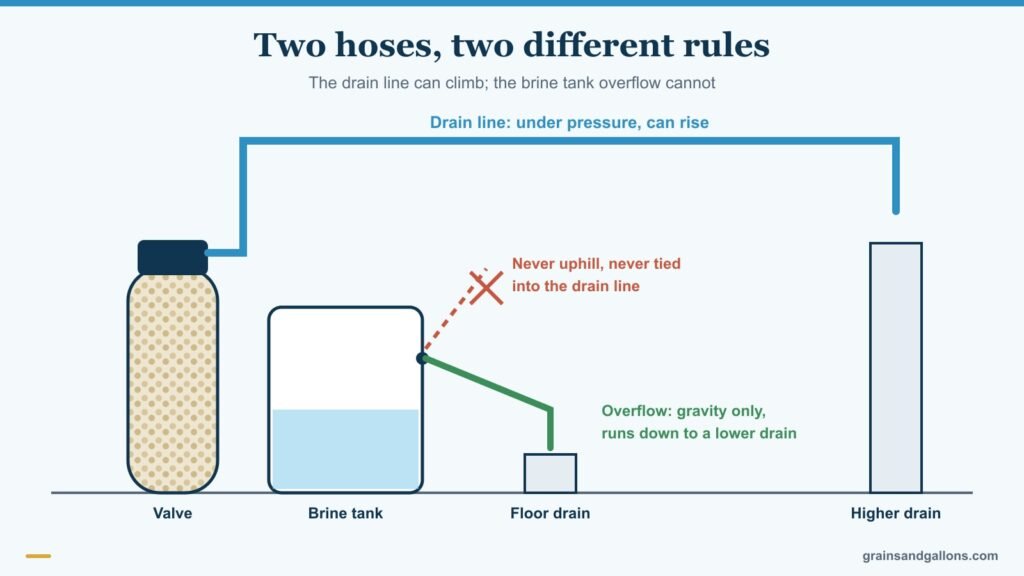
People often forget the second hose. Most brine tanks have an overflow fitting on the side, there to send water to a drain if the brine tank overfills. Unlike the pressurized drain line, the overflow works by gravity only. The Pentair manual says not to elevate the overflow line above the overflow fitting, not to tie it into the valve's drain line, and to run it as a separate line to a drain with its own air gap.
That has a practical consequence. If you solved your drain problem by running the main line uphill, the overflow can't follow it. You have three choices: route the overflow to a lower drain, use a floor-level receptor nearby, or accept that the overflow is unconnected and rely on the brine tank's safety float. Many installers add a leak alarm in that last case. If the softener sits on a finished floor, the overflow is worth solving properly.
Getting power to the valve without a nearby outlet
Most electronic softener valves run on a small plug-in adapter. The Pentair 5600SXT, for example, runs on 12-volt AC from a supplied adapter, and the manual says the power outlet "must be grounded and always on," and not on a switched outlet. Power interruptions longer than 8 hours can make the controller lose its time setting, so an outlet that someone switches off with the lights is a real problem.
Your options:
- Add an outlet. Because the draw is tiny, this is usually a simple job for an electrician. Garages, basements and crawl spaces often require GFCI protection.
- Go non-electric. A water-powered softener needs no outlet at all.
- Don't run a permanent extension cord across a damp floor. It's a shock and trip hazard, and it tends to get unplugged.
- Mind the location. The same manual says the valve is for dry locations unless it's used with a power supply listed for outdoor use, and that it can't be exposed to freezing.
Shortcuts that fail inspection or flood the floor
- Don't push the drain line into a sewer pipe, trap or standpipe without an air gap.
- Don't drain into a sump pit that pumps to the yard unless local code explicitly allows it; many prohibit it.
- Don't cap or kink the drain line "for now." The valve will regenerate on schedule anyway.
- Don't tie the overflow into the drain line, or run it uphill.
- Don't ignore freezing. A drain line through an unheated space can freeze and back water up into the valve.
- Don't leave the end of the line loose. Fast discharge can whip an unsecured hose out of the standpipe.
Sometimes moving the softener 15 feet closer to a drain beats any workaround. See where to install a water softener for placement rules.
FAQ
Can I install a water softener without a floor drain?
Yes. A floor drain is only one option. Most softeners can drain to a laundry standpipe or utility sink, as long as the drain line ends in an air gap and the run stays within your valve's length and lift limits. The softener just needs somewhere legal for about 50 gallons of salty water per regeneration.
Can a water softener drain into a washing machine standpipe?
Usually, yes. A laundry standpipe is one of the most common softener drains. Secure the line so it can't whip out, keep an air gap above the standpipe opening, and check that the standpipe can handle the softener's flow at the same time the washer might drain.
Can a softener drain line run uphill?
Yes, within limits. Because the line is under pressure during regeneration, it can climb. The Pentair 5600SXT allows up to 6 feet of rise over a run of no more than 15 feet at 40 psi or more. Other valves have their own limits, so check your manual.
Do non-electric water softeners need a drain?
Yes. A non-electric softener solves the power problem only. It still regenerates and still sends brine and rinse water to a drain with an air gap. Only exchange-tank service and salt-free conditioners need no drain at the house.
Can I plug a water softener into an extension cord?
Not as a permanent setup. A long cord across a damp floor is a shock and trip hazard, and if it gets unplugged for more than a few hours, many valves lose their time setting. An always-on, grounded outlet installed by an electrician is the right fix.
Find the drain first, then solve power
A water softener with no drain or outlet nearby is a routing problem, not a dead end. Start with the drain: a longer run, an uphill run within your valve's limits, or a pump with an alarm, always ending in an air gap. Remember that the overflow line can't go uphill. Then handle power with an always-on outlet or a non-electric softener. Only if no drain is reachable at all do exchange tanks or a salt-free conditioner make sense, and only if you accept what they can and can't do.