

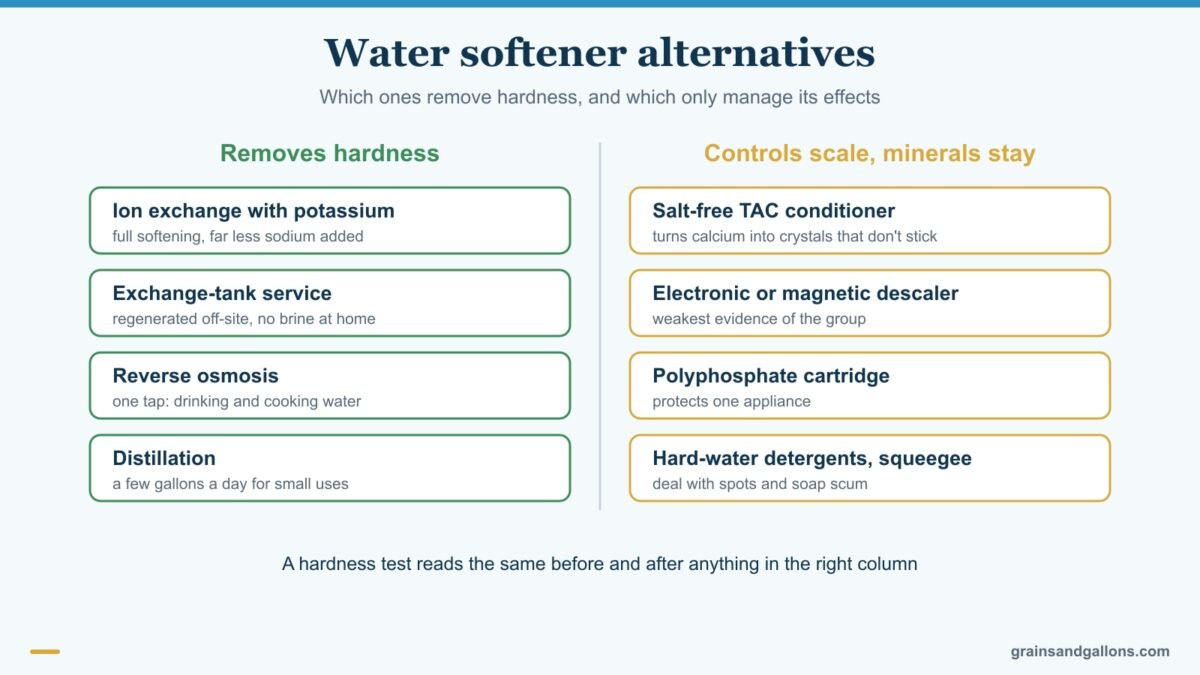
Quick Answer: Only a few water softener alternatives actually remove hardness: an ion-exchange softener run on potassium chloride, exchange-tank service, reverse osmosis and distillation. Everything else manages the effects. Salt-free TAC conditioners are the strongest whole-house option for cutting scale in pipes and water heaters, but they won't stop spots or soap scum. Electronic and magnetic descalers have much weaker evidence. Pick the alternative that fixes the one problem that bothers you most.
Maybe your lot has no drain for brine, your town restricts softener discharge, someone in the house is on a low-sodium diet, or you just don't want to haul salt for the next fifteen years. Whatever the reason, water softener alternatives can make hard water less of a nuisance. But "alternative" covers products that do very different things, so decide what you want to stop before you look at any of them.
In this guide
Start with the problem, not the product
Hard water causes several separate problems, and no single alternative fixes all of them:
- Scale inside pipes, water heaters and appliances: crusty elements, tankless heater errors, clogged aerators
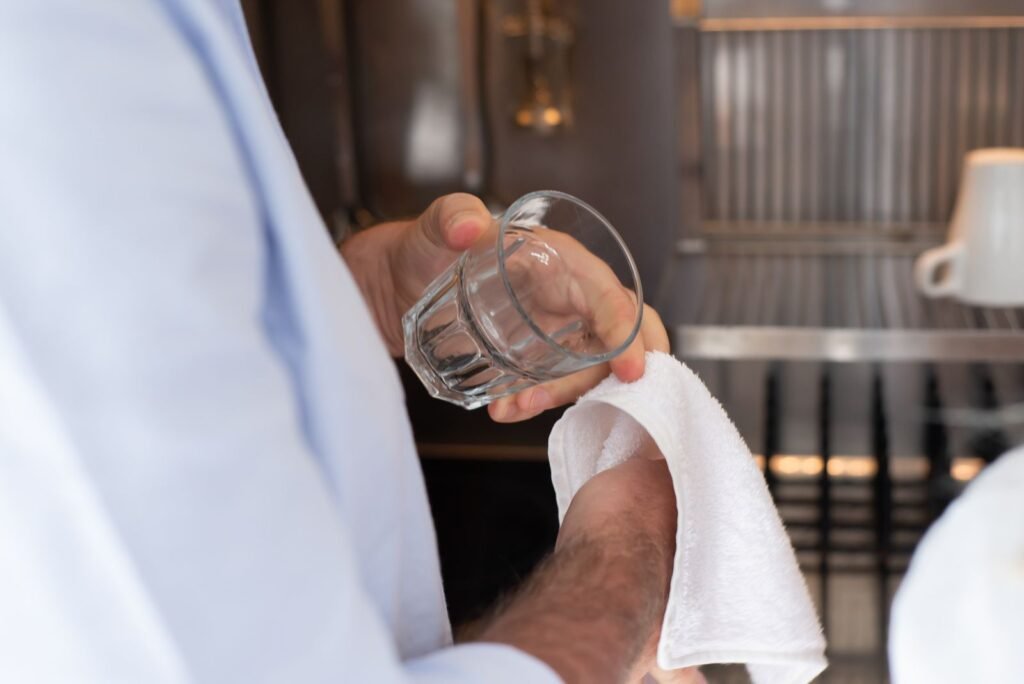
- Spots and film on glass, fixtures and dishes when water dries
- Soap scum and poor lather in showers and laundry
- Kettle and coffee maker crust
- Hair and skin feel after showering
A real softener handles all five. Most alternatives handle one or two. Keep your list in mind as you read.
How the main water softener alternatives compare

The best independent comparison is a WateReuse Research Foundation study led by Arizona State University, which ran salt-free devices on several water qualities and measured scale on heating elements. Its project summary reports that every device reduced scale, template-assisted crystallization by more than 88 percent, and electromagnetic treatment and electrically induced precipitation by about 50 percent. Untreated water left hard calcite that needed acid to remove.
Salt-free conditioners (template-assisted crystallization)
Water flows through a tank of media that converts dissolved calcium into microscopic crystals. The crystals stay suspended and tend not to stick as scale. The hardness minerals are still in the water; they've changed form. Our explainer on how a salt-free conditioner works has the details.
Good at: scale in pipes, water heaters and tankless units. No salt, no drain and, for most models, no electricity.
Not good at: spots on glass, soap lather, and water with iron, manganese, high chlorine or very high hardness, which can foul or overwhelm the media. Our guide to when a salt-free conditioner is the wrong choice lists the water conditions to check. The Watts OneFlow is one of the better-known TAC systems; our Watts OneFlow review covers what it does and doesn't promise.
Electronic and magnetic descalers
A coil wrapped around the pipe, or magnets clamped on it, is claimed to change how calcium crystallizes. The University of Nebraska–Lincoln's overview of salt-free alternatives says there's no scientific consensus that magnetic treatment works, and that results vary from home to home. Electronic units did better than nothing in the WateReuse test but far worse than TAC. They're cheap and easy to install, so treat one as a low-risk experiment: photograph a showerhead or check the water heater element before and after. Our iSpring ED2000 review looks at one popular model, and our guide to an electronic water descaler not working covers what to check if you already own one.
Potassium chloride in a regular softener
Still an ion-exchange softener, just regenerated with potassium chloride instead of sodium chloride. You get fully softened water with much less sodium added. The trade-offs: potassium chloride costs more, softeners often need a higher salt setting with it, and it still discharges brine, so it doesn't help if your problem is a brine restriction or no drain.
Reverse osmosis at one tap

A membrane rejects most dissolved minerals, hardness included. It's ideal for drinking and cooking water, and kettles and coffee makers fed with RO water stay clean. Whole-house RO exists but is expensive and wastes a lot of water, and membranes scale faster on hard water. For most people, RO is a kitchen add-on, not a softener replacement. Our picks for countertop RO systems need no plumbing at all, which suits renters.
Distillation
Boiling water and condensing the steam leaves the minerals behind. It's good for small amounts of very pure water for drinking, CPAP machines, steam irons or humidifiers, but it's slow, uses a lot of electricity, and the boiling chamber needs regular descaling.
Polyphosphate scale-inhibitor cartridges
These release a small amount of phosphate that keeps calcium from forming scale, mostly at moderate temperatures. They're sold as small cartridges for tankless heaters, ice makers and coffee machines. Good for protecting one appliance cheaply; look for drinking-water certification and follow the cartridge schedule. They don't soften water.
Exchange-tank service
In some areas, especially where brine discharge is restricted, companies install a softener tank with no brine system and swap it for a freshly regenerated one on a schedule. You get real soft water with no salt or brine at home. Availability is local, so ask water treatment dealers near you.
Cheap fixes for spots, scum and laundry

Not glamorous, but often enough on moderately hard water:
- Dishwasher detergent built for hard water plus rinse aid. Our picks for the best dishwasher detergent for hard water cover which ones handle spotting.
- Laundry detergent with water conditioners, or a laundry booster.
- A citric acid or vinegar routine for kettles, coffee makers and showerheads.
- A squeegee on shower glass after each use.
- Filter pitchers with ion-exchange resin for kettle water. They reduce some hardness in small volumes; carbon-only pitchers don't. See whether boiling or filtering softens water for what to expect.
Which alternative fits which goal
| Your main problem | Best alternative | Removes hardness? |
|---|---|---|
| Scale in water heater, tankless unit, pipes | Salt-free TAC conditioner | No (changes form) |
| Scale in one appliance only | Phosphate cartridge, or descale on a schedule | No |
| Hard-water taste, kettle crust | Countertop or under-sink RO | Yes, at that tap |
| Spots on glass and dishes | Hard-water detergent and rinse aid; squeegee | No |
| Want soft water, need less sodium | Softener with potassium chloride | Yes |
| Want soft water, no brine allowed | Exchange-tank service | Yes, regenerated off-site |
| Low budget, willing to experiment | Electronic descaler | No (evidence limited) |
Claims that should make you skeptical
Some products are marketed with words that sound like softening. Red flags:
- "Salt-free softener" that "removes hardness." TAC doesn't remove hardness; a hardness test reads the same before and after.
- "Maintenance-free forever." TAC media wears out over years, and pre-filters need changing.
- "Works on any water." Iron, manganese, chlorine and very high hardness are common limits.
- "Proven" with no independent testing or certification named. UNL notes that testing standards for most of these devices are lacking.
Our guide on evaluating salt-free and maintenance-free claims explains which certifications mean something.
Water softener alternatives protect pipes better than glassware
Most water softener alternatives are scale-control tools, and they work best on moderately hard water when your goal is protecting a water heater, a tankless unit or one appliance. If your water is very hard (roughly 15 to 20 gpg or more), if spots and soap scum bother you most, or if you have iron along with hardness, a real ion-exchange softener is usually the better fit, run on potassium chloride if sodium is the concern, or as an exchange-tank service if brine is the problem.
FAQ
What is the best alternative to a water softener?
For whole-house scale protection, a salt-free TAC conditioner has the strongest evidence, with more than 88 percent scale reduction in the WateReuse study. If you want truly soft water without sodium, use a softener with potassium chloride instead.
Do salt-free water softeners really work?
They work for scale, not softening. TAC conditioners keep calcium from sticking to pipes and heating elements, but the minerals stay in the water, so spots and poor lather remain.
Is there a way to soften water without salt?
Yes, but only a few ways remove hardness: potassium chloride in an ion-exchange softener, exchange-tank service, reverse osmosis at a single tap, or distillation for small amounts.
Do magnetic water softeners work?
The evidence is weak. The University of Nebraska–Lincoln says there's no scientific consensus on magnetic treatment, and electronic devices cut scale by only about half in the WateReuse lab test.
Can I just use reverse osmosis instead of a softener?
For drinking and cooking water, yes. For the whole house, RO is expensive, wastes water and scales up quickly on hard water, so most homes pair point-of-use RO with another scale solution.