

Quick Answer: The Watts OneFlow Plus (OFPSYS) is a good pick for city-water homes with moderate hardness (under 30 gpg), almost no iron, and up to about 10 gpm of peak demand, if what you want is less scale in your water heater and pipes, not soft water. Skip it if you're on iron-heavy well water, want spot-free glasses, or expect slippery "soft" water. In those cases, look at a real softener like the DuraWater Fleck 5600SXT 48,000. For a bigger house that still wants salt-free, the Premier 15 GPM salt-free system handles more flow.
Disclosure: As an Amazon Associate, Grains & Gallons earns from qualifying purchases.
Watts says it plainly in its own spec sheet: the OneFlow "is not a water softener and does not soften water." Most salt-free brands bury that point. Watts prints it, and that's a good reason to trust the rest of the document. It's also the most important sentence for you to read before buying.
So the question isn't "does it work?" The question is whether the kind of protection it gives matches what's bugging you about your water. Below I go through Watts' published specs, operating limits and replacement schedule for the OneFlow Plus, the version you can buy on Amazon, and point out where a different product fits better. I haven't installed this unit myself. Everything here comes from Watts' documentation and the product listings.
In this guide
What you're actually buying
The OneFlow name covers two kinds of product. Watts first marketed OneFlow to homes as tank-style units in 8, 12 and 16 gpm sizes (model numbers like OF744 and up). You'll mostly find those through plumbing and industrial suppliers. The one sold on Amazon is the OneFlow Plus, model OFPSYS: two cartridge housings side by side on one head.
- Cartridge 1, OFPRFC: a 20-micron radial-flow carbon block. Watts rates it for chlorine taste and odor reduction for up to 50,000 gallons at 3 gpm, with up to 2.2 lb of dirt-holding capacity.
- Cartridge 2, OFPSP: the scale-prevention cartridge. It uses template-assisted crystallization (TAC).
- Connections: 1" MNPT inlet and outlet.
- Flow: up to 10 gpm nominal and peak. Watts warns that going over the maximum flow can reduce effectiveness and may void the warranty.
- Weight: 16 lb dry, 28 lb full. It's light enough to hang on a wall bracket. Watts says to mount it 32" to 60" above the finished floor.
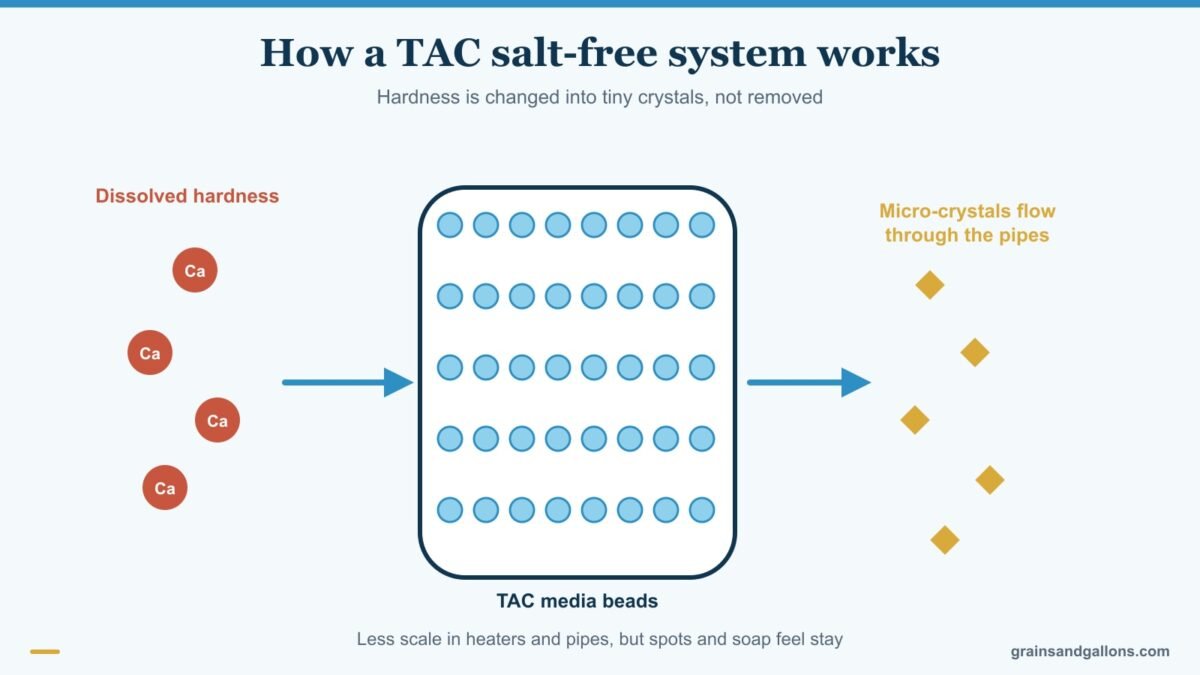
TAC media turns dissolved calcium and magnesium into microscopic crystals that stay suspended and wash through the plumbing, so they don't bake onto heater elements. If you want the chemistry, we cover it in how a salt-free water conditioner works. In practice, the hardness is still in your water. A hardness test strip after the OneFlow reads about the same as before it. That's normal, and it doesn't mean the unit failed.
The spec sheet's fine print, translated
Watts lists feed-water limits for the OFPSYS. Read this list with your water report next to you. Every limit you're over is a reason this unit may disappoint you.
| Feed-water condition | Watts' limit | What it means for you |
|---|---|---|
| Hardness | 30 gpg (513 ppm) max | Most city water is under this. Some Southwest and well supplies aren't. |
| Iron | 0.3 ppm max | Iron fouls TAC media. Many wells are well above this. |
| Manganese | 0.05 ppm max | That's a very low limit, so test for it if you're on a well. |
| Free chlorine | Under 2 ppm | Normal city levels are usually fine, and the carbon block takes some out first. |
| pH | 6.5 to 8.5 | Acidic well water needs correcting first. |
| Copper | 1.3 ppm max | New copper lines need at least 4 weeks to passivate before service. |
| Oil and H2S | Must be removed first | A rotten-egg smell rules it out until that's treated. |
| Silica | 20 ppm max | It does not reduce silica scaling. |
| Pressure / temp | 10–90 psi, 40–100°F | Install it on the cold line, indoors, where it won't freeze. |
Two more rules surprise people. First, the OneFlow has to be the last whole-house treatment stage. Only point-of-use carbon, RO or UV can come after it, and you can't add other antiscalants before or after. Second, Watts says soaps, chemicals and cleaners can reduce its anti-scale effect or cause spotting, and that laundry and dishwashing chemistry may need adjusting.
If you haven't measured your hardness yet, do that before anything else. Our guide to testing water hardness at home shows the cheap ways to get a usable number.
Where it earns its keep
The best case for the OneFlow Plus is a house on municipal water with 8 to 20 gpg hardness, a tank or tankless water heater you want to protect, and owners who don't want to haul salt or run a drain line. In that situation:
- No salt, no drain, no electricity. It doesn't backwash or regenerate, so it needs no standpipe, no outlet and no brine tank. That matters in condos, slab homes and garages with no floor drain.
- It's two jobs in one footprint. The carbon block deals with chlorine taste and sediment, so the scale cartridge sees cleaner water.
- Water heaters and fixtures. Scale protection is mainly about heat exchange surfaces. If your water heater is what hard water is costing you, that's exactly what TAC is designed to protect. We've written more on salt-free conditioning for tankless heaters and boilers.
- Honest paperwork. The OFPSYS is WQA-certified to NSF/ANSI/CAN 372 for lead-free compliance. Watts also says outright that its carbon performance claims (sediment, chlorine, the 50,000-gallon rating) are not tested or certified by WQA. That's unusually candid.
Where it doesn't
Spots on glassware. Watts says the system is "not spot-free" and that soft scale spotting may occur. They recommend a point-of-use softener for spot-sensitive uses like glassware. If cloudy dishes are your main complaint, this is the wrong tool.
The "soft water feel." You won't get slick skin, extra lather or less soap use. The hardness ions are still in solution. For the long version, see does a salt-free system actually soften water?
Wells with iron or manganese. The 0.3 ppm iron and 0.05 ppm manganese caps rule out a big share of private wells. You'd need iron removal upstream, and then the OneFlow can only be the final stage. At that point, a salt softener built for iron is usually the simpler system.
Big houses. Ten gpm is enough for a typical 2 to 3 bath home. A house with four people showering while the dishwasher and an irrigation zone run can push past it, and Watts says over-flowing can hurt performance.
What it costs to keep running
This is a cartridge system, so your ongoing cost is cartridges, not salt:
- Carbon block (OFPRFC): Watts says replace at least once a year. The genuine OFPRFC wasn't available on Amazon when I checked, but the Elovener radial-flow carbon block (Check price on Amazon) is sold as a compatible 20-micron replacement for the OneFlow Plus, rated for the same 50,000 gallons or 12 months. It's a third-party cartridge, so check the fit and seals when it arrives.
- Scale cartridge (OFPSP): replace after 250,000 gallons or 3 years, whichever comes first.
- Watts also sells an OFPCOM combo pack with one of each.
A rough usage check: a family of four using around 300 gallons a day goes through about 110,000 gallons a year. That's well past the carbon block's 50,000-gallon chlorine rating, which explains the yearly change. On the scale side, the 3-year limit will usually come first. For a heavy-use household, the 250,000-gallon cap could arrive in a little over two years. Put both dates on your calendar. Our salt-free conditioner maintenance guide walks through the routine.
Check price on Amazon: Watts OneFlow Plus OFPSYS
Three alternatives, and when each makes more sense
Premier 15 GPM salt-free system. It also works by template-assisted crystallization, but it's a tank system rather than two cartridges. Premier's listing sizes it for 3 to 6 bathroom homes at 15 gpm, compared with the OneFlow Plus's 10. The package includes a mineral tank, TAC media, a tank head with bypass valve, and a dual-stage Big Blue 10" housing set with carbon and sediment prefilters. Like the OneFlow, it needs no electricity, backwash, drain or salt. Downsides: it takes up a lot more room than two cartridges on a wall, you'll still be changing the two prefilters, and Premier's listing doesn't publish feed-water limits the way Watts does, so ask for them before you buy if you're on a well. Check price on Amazon: Premier 15 GPM salt-free system
A. O. Smith AO-WH-DSCLR. If changing the scale cartridge every 3 years bothers you, this one is rated for up to 6 years or 600,000 gallons with a 6-year warranty, and the listing says it works on city and well water. It's a descaler only, with no carbon block, so add a filter if chlorine taste matters to you. Its limits are tighter than the OneFlow's on hardness: A.O. Smith specifies under 15 gpg, along with under 0.3 ppm iron and pH under 8.3. Like every salt-free unit, it won't stop spotting or change how water feels. Check price on Amazon: A. O. Smith Salt-Free Descaler
DuraWater Fleck 5600SXT 48,000 grain. This is the "I actually want soft water" option. It's a salt-based ion-exchange softener with a metered Fleck 5600SXT valve, 1.5 cu ft of resin, a 10×54 mineral tank and a brine tank with a safety float, so hardness really drops, spots go away and soap lathers. The trade-offs are salt, a drain connection and an outlet. If you're over 30 gpg or have some iron, this kind of system belongs on your shortlist instead of any TAC unit. Check price on Amazon: DuraWater Fleck 48k
Should you buy it? A short decision path
- City water, under 30 gpg, iron at or near zero, mostly worried about the water heater and fixtures → The OneFlow Plus is a sensible, compact buy.
- Same, but a 4+ bath house or very high simultaneous use → Look at the Premier 15 GPM system for the extra flow.
- You hate cartridge schedules → The A. O. Smith descaler has the longer rated life, if your hardness is under 15 gpg.
- Spotty glasses, dry skin, crunchy towels, over 30 gpg, or a well with iron → Get a salt softener. A TAC system won't fix those problems.