


Quick Answer: How does a salt free water conditioner work? The common type uses template assisted crystallization (TAC). Water flows through a tank of specially treated beads whose surfaces coax dissolved calcium and carbonate into microscopic crystals. The crystals stay suspended and are far less likely to stick to pipes and heaters as scale. Nothing is removed, so your water still tests hard, still spots glass and still behaves like hard water with soap.
Here's the moment most people hit: they install a salt-free system, run a hardness test, and the number hasn't budged. Did it break? Probably not. It was never designed to change that number. Once you see how a salt free water conditioner works, both the marketing claims and the limits make a lot more sense, and you can tell quickly whether one fits your house.
In this guide
- One mental model: give the scale somewhere harmless to form
- How does a salt free water conditioner work from tank to tap?
- What a TAC conditioner changes and what it leaves alone
- The independent evidence on TAC and scale
- Water conditions the media needs, and how long it lasts
- Not every "salt-free" box uses TAC
- FAQ
- Choose a salt free water conditioner for scale, not for soft water
One mental model: give the scale somewhere harmless to form

Scale is calcium carbonate coming out of solution and growing on a surface. It grows best where there's heat and where it already has a foothold: the bottom of a water heater, a heating element, the inside of a tankless heat exchanger, a showerhead.
A TAC conditioner gives it a different place to start. Its media beads have surface sites, "templates," that act as seeds. As hard water passes through the bed, dissolved calcium and carbonate ions cluster on those sites and form nanometer-scale crystals. Once a crystal reaches a certain size, it releases from the bead and travels on with the water.
Now much of the hardness is already in crystal form. Those crystals are stable and don't readily attach to surfaces, so the mineral that would have plated onto your heating element is largely tied up in particles that flow out of the tap instead. Watts, for example, describes its OneFlow process as converting hardness into "inactive microscopic crystals" that stay suspended and are carried away, in its product specification sheet.
That's the whole trick: no ion exchange, no brine, no regeneration cycle, no drain line and usually no electricity.
How does a salt free water conditioner work from tank to tap?

Follow one gallon through a typical whole-house install:
- Pre-treatment. On city water, most systems put a sediment or carbon filter first. Carbon protects the media from chlorine and improves taste; sediment keeps particles from coating the beads.
- Contact with the media. Water passes through the TAC tank. The beads stay in the tank; only the tiny crystals leave. There's no backwash and no waste water.
- Crystals ride the plumbing. Downstream, the water still carries its full mineral load, but a large share is now in suspended crystal form. The crystals pass through the water heater, pipes and fixtures.
- Heat is the test. Heat is what normally drives scale onto surfaces, which is why hot water causes more scale. A water heater or tankless unit is where a working conditioner pays off.
- Out of the tap, nothing new. You drink the same calcium and magnesium as before. There is no added sodium or potassium.
Because the crystals form as water flows, manufacturers place the tank on the main line upstream of the water heater. Water that sits in pipes for a long time may not behave the same way. If tankless heaters and boilers are your main concern, see salt-free conditioning for tankless and boilers.
What a TAC conditioner changes and what it leaves alone
| Salt-based softener | TAC salt-free conditioner | |
|---|---|---|
| Calcium and magnesium in water | Removed (swapped for sodium or potassium) | Still there, much of it as tiny crystals |
| Hardness test result | Near 0 gpg | Same as before |
| Scale in heaters and pipes | Prevented | Greatly reduced in independent testing |
| Spots on glass and fixtures | Mostly gone | Still happen; may wipe off more easily |
| Soap lather | Much better | Little change |
| Salt, drain, electricity | Needed | None |
| Water wasted | Some, during regeneration | None |
If you're after the slippery feel, better lather and spot-free shower glass, that's what ion-exchange softening does and TAC doesn't. Our deeper look at whether a salt-free system actually softens water explains why spots still form when the water dries.
The independent evidence on TAC and scale
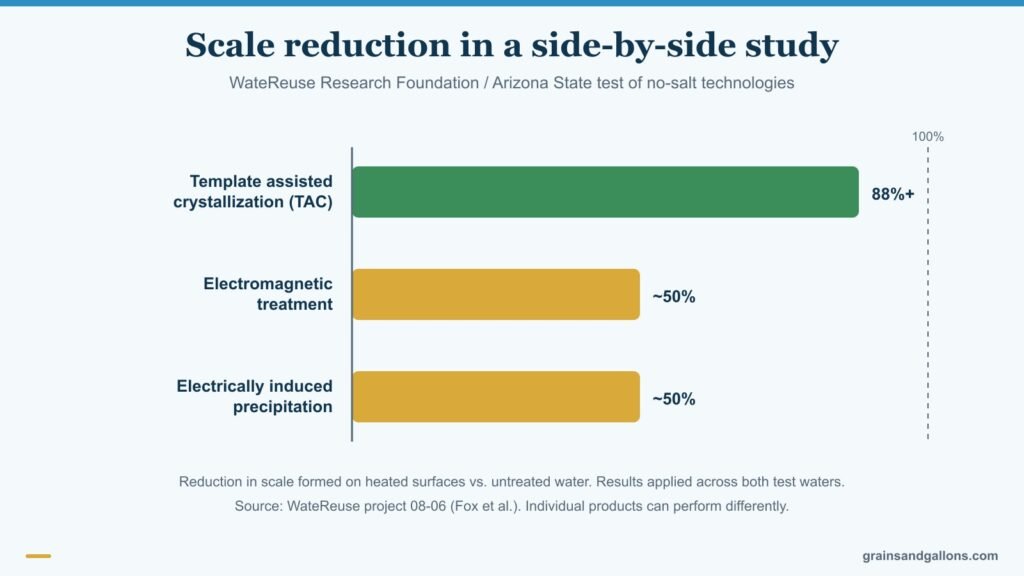
Salt-free marketing is full of claims, so it's worth knowing what independent testing actually found. The best-known study is WateReuse Research Foundation project 08-06, Evaluation of Alternatives to Domestic Ion Exchange Water Softeners, led by Arizona State University. It ran several no-salt technologies side by side on two different source waters, using a scale test based on the German DVGW W512 protocol.
The headline results:
- Template assisted crystallization reduced scale formation by more than 88%.
- Electromagnetic treatment and electrically induced precipitation each managed about 50%.
- Performance did not depend on the water type, even though the two waters formed very different amounts of scale.
That is solid support for TAC as a technology. It doesn't certify any particular product, though. When a brand quotes test results, check that they apply to the exact model and that the test was run by a third party; our guide to evaluating salt-free and maintenance-free claims walks through that. NSF/ANSI 44, the standard for softeners, doesn't apply because these units don't soften.
Water conditions the media needs, and how long it lasts
TAC media is fussy about what else is in the water. Iron, manganese, copper and some other contaminants can coat the template sites and stop them working. Here's one example, from Watts' published requirements for its OneFlow whole-house system:
- Hardness: 30 grains per gallon maximum
- Iron: 0.3 ppm maximum
- Manganese: 0.05 ppm maximum
- Copper: 1.3 ppm maximum (new copper pipe should be passivated for at least four weeks)
- Free chlorine: below 2 ppm
- pH: 6.5–8.5
- Phosphates: below 3.0 ppm
- Silica: 20 ppm maximum (it doesn't prevent silica scale)
- Oil and hydrogen sulfide removed first
Other brands set different numbers, so check the spec sheet for your exact model. The pattern is clear, though: these systems are built for municipal-type water. Many wells exceed the iron or manganese limits, which is the most common reason the technology disappoints. See when a salt-free conditioner is the wrong choice.
"No salt" also doesn't mean "no maintenance." The media gradually loses activity and is replaced every few years, and any carbon pre-filter needs changing more often. Our salt-free water conditioner maintenance guide has the schedule. And while some owners report old scale softening over time, don't buy one as a descaler; more on that in whether salt-free conditioners remove existing scale.
Not every "salt-free" box uses TAC
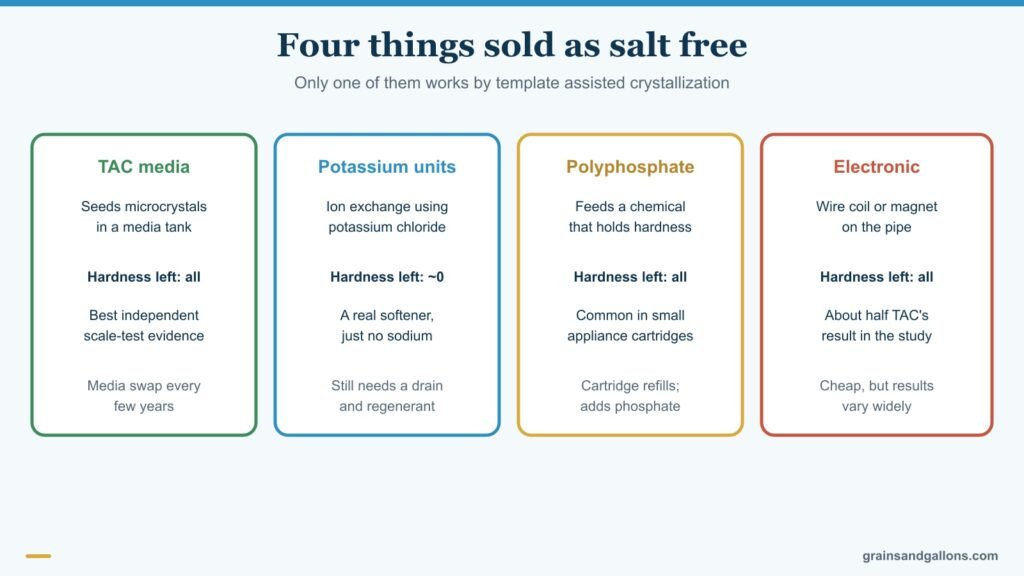
"Salt-free" is used loosely, and the products under that label work in very different ways:
- TAC media tanks do what this article describes, with the strongest independent evidence.
- Potassium-based units are real ion-exchange softeners that use potassium chloride instead of sodium chloride. They remove hardness, but they still need a regenerant and a drain.
- Polyphosphate feeders dose a chemical that holds hardness in solution. They're common in small cartridges ahead of appliances and add phosphate to the water.
- Electronic and magnetic devices clamp onto the pipe. In the WateReuse study, electronic methods cut scale about half as well as TAC, and real-world results vary widely. If you already have one and see no change, our guide to an electronic water descaler not working covers the usual reasons.
Ask any seller which of these the product is before comparing prices. A quick way to sort them: if the unit has a drain line and a salt or potassium tank, it's a softener. If it's a tank of media with no drain, it's probably TAC. If it's a cartridge you replace every few months, it's likely polyphosphate. If it's a box with wires wrapped around the pipe, it's electronic. The words "conditioner," "descaler" and "salt-free softener" are used for all four, so the hardware tells you more than the label does.
FAQ
Does a salt-free water conditioner remove hardness?
No. A TAC conditioner leaves calcium and magnesium in the water and changes their form so they're less likely to form scale. A hardness test reads the same before and after. Only ion exchange (or reverse osmosis) actually removes hardness.
Do salt-free water conditioners really work?
For scale prevention, TAC has good independent support: the WateReuse and Arizona State study measured more than 88% less scale. They don't deliver softened-water benefits such as better lather or spot-free glass, and they work poorly on water with iron, manganese or very high hardness.
How long does TAC media last?
The media is replaced every few years, depending on the brand, water quality and how much water the house uses. A carbon pre-filter, if fitted, is changed more often. Check the manufacturer's schedule for your model.
Will a salt-free conditioner work on well water?
Only if the well water meets the manufacturer's limits, which typically means very low iron and manganese and no hydrogen sulfide. Many wells need iron or sulfur treatment first, and some are better served by a conventional softener.
Can I drink water from a salt-free conditioner?
Yes. Nothing is added: no sodium, no potassium. The water keeps its natural calcium and magnesium, which is one reason people on low-sodium diets choose these systems.
Choose a salt free water conditioner for scale, not for soft water
So, how does a salt free water conditioner work in practice? It leaves the hardness in your water and changes its form so it stops building up on hot surfaces. That makes the decision simpler. TAC is a reasonable choice if you're on city water or similar, your water is moderately hard and low in iron and manganese, and your main goal is protecting a water heater, tankless unit or plumbing from scale. It suits homes where brine discharge is restricted and people who don't want added sodium or salt bags to haul. It's the wrong tool if you want soft-feeling water, spot-free glass and less soap, or if you're on a well with iron, manganese or sulfur.
If you're leaning toward one, our Watts OneFlow review looks at a well-documented TAC system, and our SpringWell FutureSoft vs Pelican NaturSoft comparison compares two popular whole-house salt-free brands.