


Quick Answer: Here's when a salt-free conditioner is wrong: when you want spot-free glass and better soap lather, when your water has iron above about 0.3 ppm or manganese above about 0.05 ppm, when it carries hydrogen sulfide or oil, when pH sits outside roughly 6.5 to 8.5, or when hardness runs past the maker's recommended maximum. In those cases the media gets fouled or simply can't do what you're hoping. Check your water test against the spec sheet for the exact model before buying.
Salt-free conditioners have a lot going for them. No salt bags, no drain, no electricity, no added sodium. For the right water and the right expectations, they do a decent job of keeping scale out of pipes and water heaters.
But they get sold to a lot of people they don't fit. Then the owner sees the same white spots on the shower door a month later and wonders what they paid for. Knowing when a salt-free conditioner is wrong for your house saves that money. Run your situation against these seven deal-breakers.
In this guide
- Conditioning isn't softening, and that's the root of it
- When a salt-free conditioner is wrong for spotless glass and rich lather
- Deal-breaker 3: iron, manganese or copper in the water
- Deal-breakers 4 to 6: oil, sulfur, pH and other chemistry
- Deal-breaker 7: very hard water or a hot-water install
- Where salt-free conditioning still makes sense
- Run this check before you buy
- Test your water before trusting salt-free
- FAQ
Conditioning isn't softening, and that's the root of it
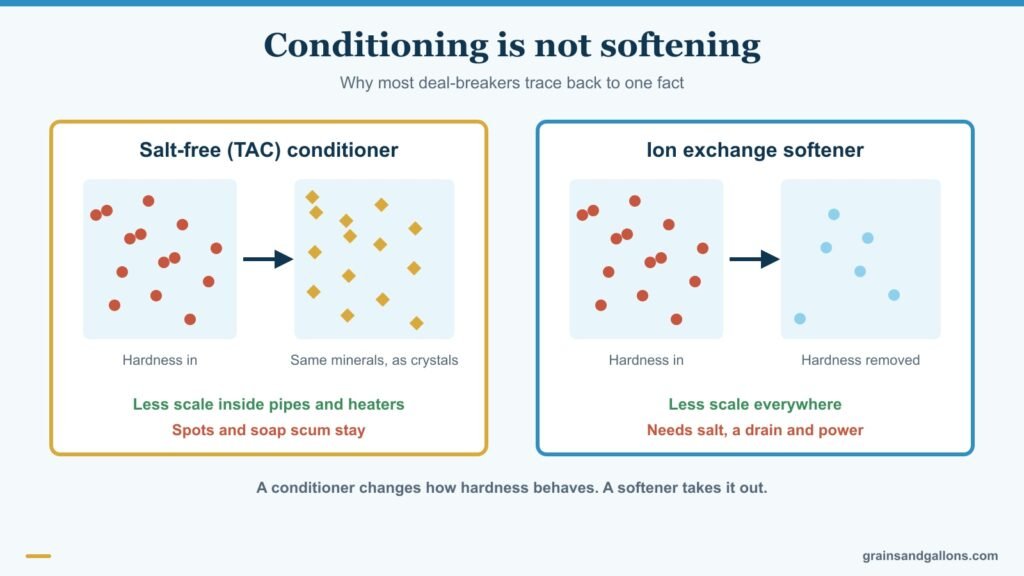
Template-assisted crystallization (TAC) media has sites that encourage calcium and magnesium to form tiny, stable crystals. Those microscopic crystals stay suspended in the water and are less likely to stick to pipes and heating surfaces as hard scale. The calcium and magnesium are still in the water. Nothing is removed.
University of Nebraska–Lincoln water specialists put it plainly: TAC converts hardness rather than removing it, and if you actually want calcium, magnesium or low levels of iron and manganese taken out, you need an ion exchange softener. Our guide on how a salt-free water conditioner works explains the chemistry. Keep that point in mind. Most of the deal-breakers below follow from it.
When a salt-free conditioner is wrong for spotless glass and rich lather

Deal-breaker 1: you want spot-free surfaces
This is the most common mismatch. When water dries on glass, chrome or dishes, the minerals are left behind whether they're dissolved or in tiny crystals. So a TAC system doesn't stop water spots. Some makers say the residue wipes off more easily than normal scale, but it's still there. Watts' own spec sheets warn of "aesthetic issues related to soft scale residue formation outside of the plumbing system" at higher hardness.
If spot-free shower glass and dishes are your main goal, you want an ion exchange softener. It removes the calcium and magnesium. We cover the difference in does a salt-free system actually soften water?
Deal-breaker 2: you want soap to lather like soft water
Soap reacts with calcium and magnesium. Since a conditioner leaves them in the water, lather, soap scum and that "squeaky" rinse feel usually don't change much. If the slick soft water feel is what you're after, a conditioner won't deliver it.
Deal-breaker 3: iron, manganese or copper in the water

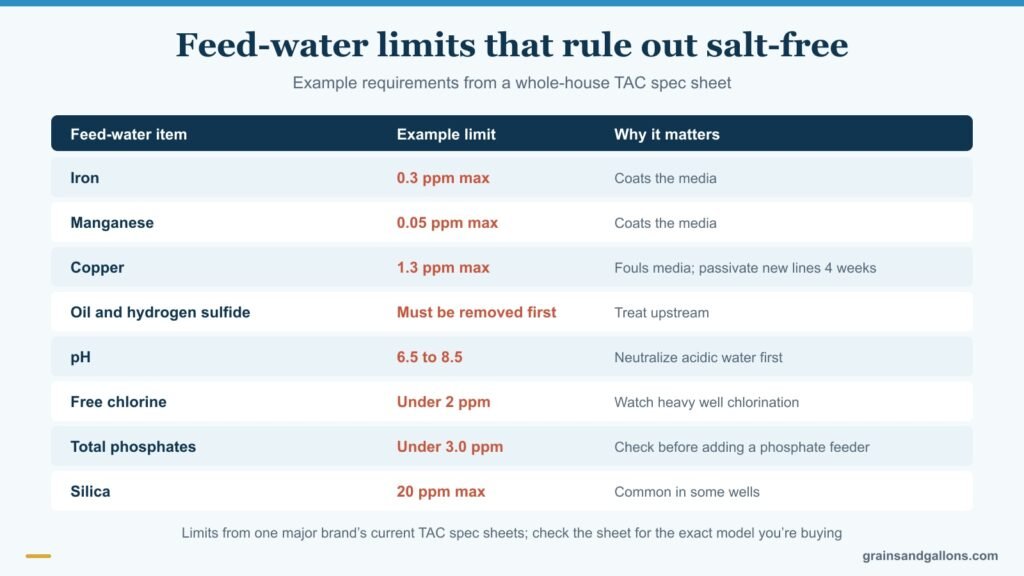
Iron and manganese coat TAC media and block the sites that do the work. Manufacturers set tight limits. The Watts OneFlow+ residential system specification sheet, for example, lists a maximum of 0.3 ppm iron and 0.05 ppm manganese in the feed water. Many well waters exceed one or both.
Copper is the sneaky one. The same sheet caps copper at 1.3 ppm and notes that high copper usually comes from new copper plumbing. New copper lines need to be passivated for at least four weeks before the unit goes into service. If you just repiped, that's a timing problem, not a reason to skip the system entirely.
Your options for iron and manganese:
- Remove them first with a dedicated filter, then condition. That adds cost and maintenance.
- Use an ion exchange softener, which can handle some dissolved iron as part of its job. See can a water softener remove iron?
Deal-breakers 4 to 6: oil, sulfur, pH and other chemistry
Deal-breaker 4: hydrogen sulfide or oil is present
The Watts sheet says oil and hydrogen sulfide must be removed before the water reaches the conditioner. Rotten egg smell means hydrogen sulfide, which is common in some wells and needs its own treatment. The sheet also limits total phosphates to under 3.0 ppm, so if you already run a phosphate feeder, check the dose before adding a TAC unit.
Deal-breaker 5: your pH is too low or too high
The sheet calls for pH between 6.5 and 8.5. Acidic well water below 6.5 is common in some regions. If yours is low, you need an acid neutralizer before the conditioner, which changes the whole system. That's not a reason a TAC can't work, but it's a reason a "simple install" isn't simple for you.
Deal-breaker 6: silica or chlorine is high
Spec sheets limit these too. The current Watts sheets list a maximum of 20 ppm silica and free chlorine under 2 ppm. Most city water sits under that chlorine level, but a well with a chlorinator dosing heavily can go over.
Deal-breaker 7: very hard water or a hot-water install
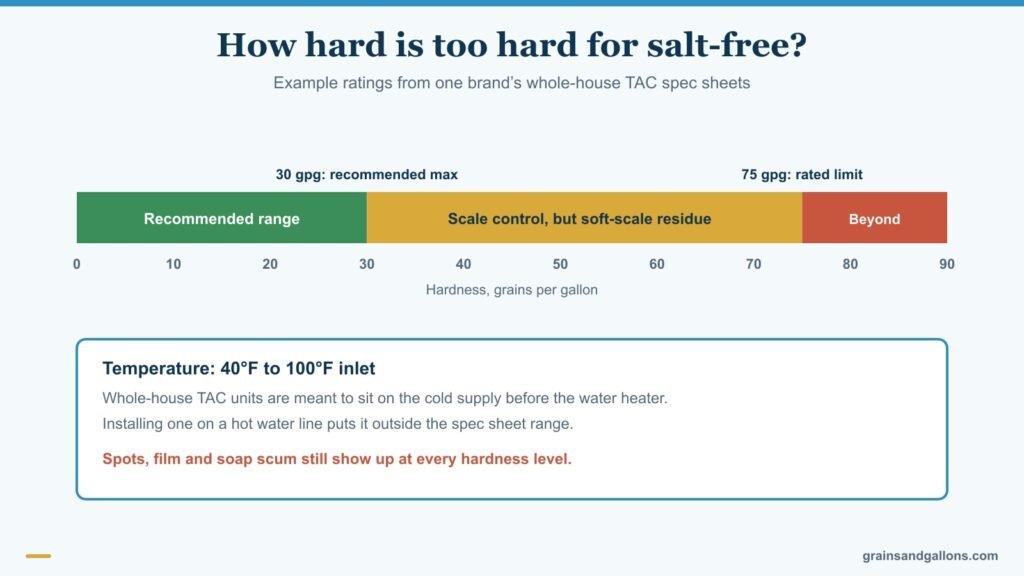
Some conditioners are rated for very high hardness. A Watts OneFlow specification sheet for its larger systems says the technology controls scale inside plumbing up to 75 grains per gallon, but recommends 30 gpg as the practical maximum because of soft-scale residue outside the plumbing. That's a scale-prevention rating, not a promise of soft-water results. At 25 or 30 gpg, the gap between a conditioner and a softener is huge in daily life: heavy spotting, poor lather and lots of residue. If you're dealing with very hard water and want the full fix, our list of the best water softeners for very hard water is the better starting point.
Temperature matters too. The same sheets list a feed-water range of 40°F to 100°F, which means these whole-house units belong on the cold supply ahead of the water heater, not on a hot line. For tankless heaters and boilers, see our guide to salt-free conditioning for tankless heaters and boilers.
Limits differ between brands and models, and even between versions of the same sheet. Always use the current spec sheet for the exact unit you're considering.
Where salt-free conditioning still makes sense

None of this means TAC is a bad technology. It fits well when:
- Your water is on a city supply with low iron, manganese and normal pH
- Your main goal is protecting the water heater, tankless unit and pipes from scale
- You can't have a softener because of a brine discharge ban, no drain, or an HOA or condo rule
- You want to avoid adding sodium and don't want to deal with potassium chloride
- You're fine still wiping down the shower
Plan for upkeep, too. TAC media wears out and needs replacing on the maker's schedule; our guide to salt-free conditioner maintenance covers what that involves. If you're comparing other routes, our overview of water softener alternatives lines them up, and our Watts OneFlow review looks at one of the better-known TAC systems in detail.
Run this check before you buy
Get a water test that includes hardness, iron, manganese, copper, pH, total dissolved solids and, for well water, hydrogen sulfide. Then answer:
- Is iron at or below the maker's limit? (Often 0.3 ppm.)
- Is manganese at or below the limit? (Often 0.05 ppm.)
- Is pH within the stated range?
- Is there any rotten egg smell, oil sheen or a fresh copper repipe?
- Is hardness under the recommended maximum for that model?
- Is your main goal scale prevention, not spot-free glass or better lather?
If any answer is "no," a salt-free conditioner is probably the wrong tool on its own.
Test your water before trusting salt-free
The short version of when a salt-free conditioner is wrong: whenever you expect softened water, or whenever your water breaks the spec sheet's chemistry limits. Treat iron, sulfur and pH problems first or choose an ion exchange softener. Buy TAC only when your test is clean and your goal is protecting pipes and heaters from scale.
FAQ
Do salt-free water conditioners actually work?
They can reduce hard scale inside pipes and water heaters when the feed water meets the maker's limits. They don't remove hardness, so they don't stop water spots or improve soap lather the way a softener does.
Can I use a salt-free conditioner on well water?
Sometimes. Many wells carry iron, manganese, hydrogen sulfide or low pH above typical TAC limits, which foul the media. Test first, and plan on pretreatment if any of those are over the spec sheet values.
What hardness is too high for a salt-free conditioner?
It depends on the model. One major brand rates its systems for scale control up to 75 grains per gallon but recommends 30 gpg as the practical maximum. Above that, expect more soft-scale residue on fixtures and glass.
Will a salt-free conditioner remove iron stains?
No. Iron coats TAC media and makes it stop working. You need a dedicated iron filter ahead of the conditioner, or an ion exchange softener that can handle low levels of dissolved iron.
Is a salt-free conditioner better for a tankless water heater?
It can help with scale if your water chemistry fits, but it must sit on the cold supply ahead of the heater. Some tankless makers have their own water quality requirements, so check the heater's manual too.