

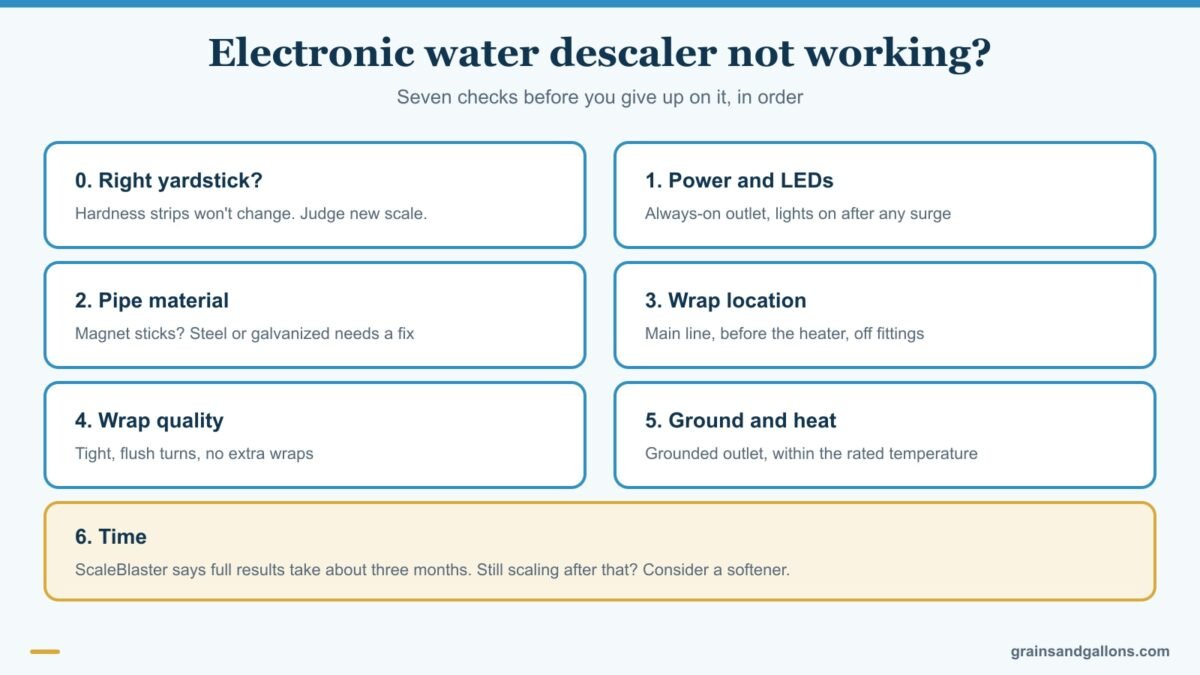
Quick Answer: Electronic water descaler not working? First make sure you're judging it the right way: it doesn't remove hardness, so a hardness strip reads the same. That isn't a failure. Then check the basics: indicator lights on, an always-on grounded outlet, the coil wrapped tight and flush on a straight run of copper, PEX or PVC (not steel), away from valves and fittings, and at least two to three months for results.
An "electronic water descaler not working" complaint usually starts one of two ways. Either you tested the water and hardness didn't budge, or months have passed and you still see crust on faucets and scale in the kettle. The first is a misunderstanding about what these devices do. The second might be an install problem, or the device reaching its limits. (Own a popular plug-in model? Our iSpring ED2000 review covers its setup.)
In this guide
What "working" actually looks like
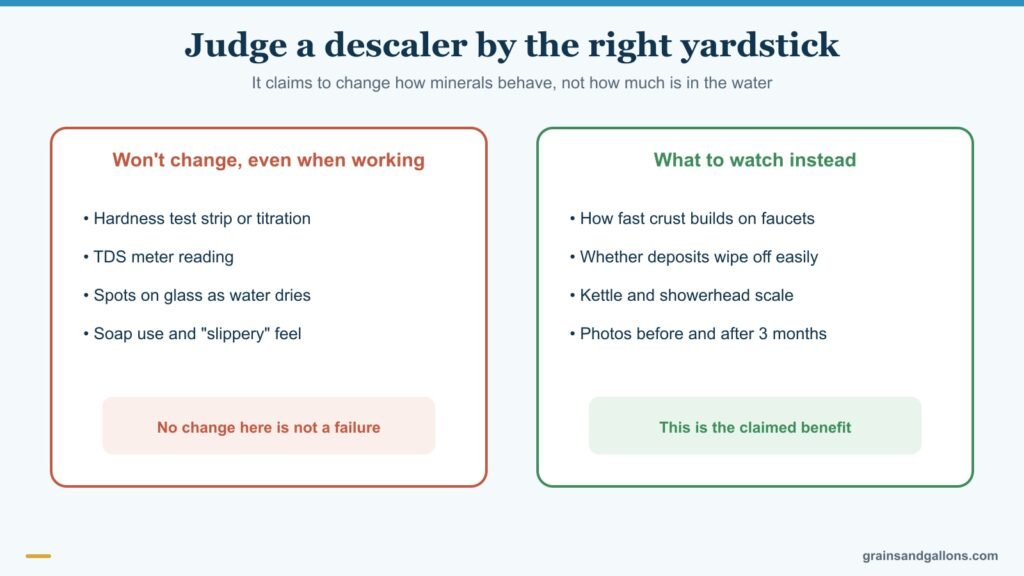
Electronic descalers, the box with a wire or coil wrapped around the pipe, don't take calcium or magnesium out of the water. The claim is that they change how minerals behave so less sticks as hard scale. ScaleBlaster's support FAQ says plainly that hardness and TDS stay the same.
So a hardness strip, TDS meter, spotty glasses and soap lather are the wrong yardsticks; none change much even when the unit works. The claimed benefit is slower, softer, more wipeable buildup on fixtures and heaters.
Set expectations, too. The Water Quality Association's page on scale deposits notes that anti-scale devices don't reduce total calcium or magnesium and aren't proven to achieve soft water. Our guide to evaluating salt-free and maintenance-free claims covers the mixed evidence, which tends to be weaker on very hard water.
Six checks for a descaler that seems dead
1. Power and indicator lights
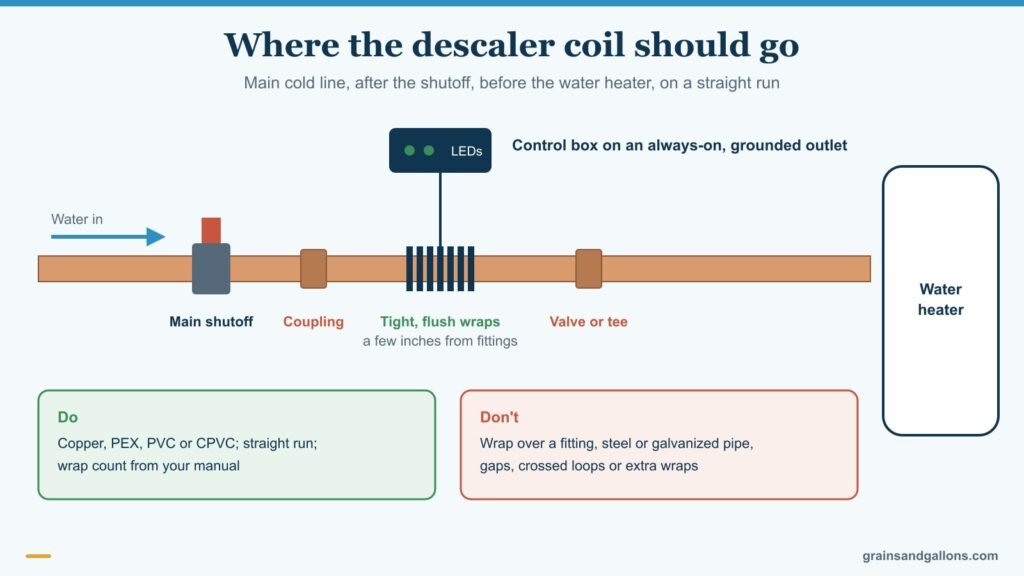
Is the box on an outlet that's always on? Switched outlets and tripped GFCIs are common culprits. ScaleBlaster suggests checking that its two LEDs are lit, especially after a power surge. Light patterns vary by brand, so check your manual.
2. A grounded outlet
Some direct-wire units rely on the outlet's safety ground. A descaler patent describes units that appear to run normally but can't send a proper signal when a three-prong outlet lacks a ground. A cheap outlet tester settles it.
3. Pipe material
Coil-type descalers generally need non-ferrous pipe: copper, PEX, PVC or CPVC. If a magnet sticks, you have steel or galvanized pipe, and ScaleBlaster's fix is replacing about a foot of the line with a suitable material and wrapping that.
4. Where and how it's wrapped
The wrap goes on the main cold line after the shutoff and before the water heater. ScaleBlaster prefers it a few inches from couplings and fittings, with turns flush and even. Follow your manual's wrap count; ScaleBlaster says extra wraps weaken the signal. Our guide to installing an electronic descaler shows the wrap in detail.
5. Heat and location
ScaleBlaster rates its units for 32 to 122°F air temperature, and only its weatherproof models can go outdoors. A hot, enclosed closet is a poor home for electronics.
6. Time
ScaleBlaster says users may notice a difference within days, visible deposits dissolve over the first two months, and the full process takes about three months. Three weeks is too soon to judge.
Flakes at the aerators after install don't always mean it's failing
If existing scale is loosening, the bits collect at the narrowest point: aerators and showerheads. Unscrew them, soak in vinegar, rinse and reinstall. ScaleBlaster also suggests draining the bottom of the water heater tank after a couple of months.
When an electronic water descaler not working means it's the wrong tool

Move on if any of these apply after three months with a correct install:
- Very hard water, and scale still building quickly.
- Iron, manganese or sulfur. Descalers don't address those.
- You want spot-free glass, less soap or a soft-water feel. Only a softener removes the hardness behind those.
- A tankless heater whose warranty specifies a treatment type.
Our guide on when a salt-free conditioner is the wrong choice goes deeper. To compare units, see our Yarna capacitive descaler review. And use your return window if you're inside it; ScaleBlaster lists a 90-day money-back guarantee on residential units.
FAQ
Why does my hardness test show no change with a descaler?
Because descalers don't remove hardness. The calcium and magnesium stay in the water; the device only claims to change how they deposit.
How long does an electronic descaler take to work?
ScaleBlaster says a few days for first signs, about two months for visible deposits, and about three months for full results.
Do electronic descalers work on PEX?
Coil-type units are generally meant for non-ferrous pipe, including PEX, copper, PVC and CPVC. Steel and galvanized pipe are the problem.
Should I replace my descaler with a water softener?
If you want soft-water results or scale is still building after three months, yes. A softener removes the hardness instead of trying to change it.
Give it a fair test, then decide
An electronic water descaler not working usually means it's being judged on hardness, installed on the wrong pipe or spot, or not given three months. Fix power, ground, pipe and wrap, track scale with photos, and if buildup hasn't slowed, switch to a softener.