

Quick Answer: The Yarna Electronic Water Descaler (CWD48) is worth a trial if you have moderate hardness and a mostly cosmetic scale problem: crusty showerheads, cloudy glass doors. The CWD48 is the size currently in stock on Amazon, and it's listed for pipes up to 4 inches. Yarna advertises a 365-day return policy on its listings, which lets you test it on your own fixtures, but confirm the model you order carries it. Don't expect soft water, a lower test-strip reading or spot-free dishes. If you'd rather have published operating limits, the iSpring ED2000 states a 10–19 gpg window. If you want hardness actually removed, get a softener like the Fleck 5600SXT 48k.
Disclosure: As an Amazon Associate, Grains & Gallons earns from qualifying purchases.
"Capacitive" is doing a lot of work in Yarna's marketing. It's the word that's supposed to set this box apart from the dozens of clamp-on descalers on Amazon. So I went looking for Yarna's technical explanation of what capacitive means here, how it differs from a coil unit, and what testing backs it up.
I didn't find one. The product listing describes "patented electronic pulse technology" and a microchip that breaks down "water crystals." The most detailed description I found came from a hands-on reviewer, not from Yarna. That doesn't make the product useless. It does mean you're buying on a refund guarantee, not on published evidence, and you should shop with that in mind.
I haven't installed a Yarna. What follows is from the listing, retailer mirrors of it, and one independent hands-on review.
In this guide
- What "capacitive" is supposed to mean
- CWD24, CWD30 or CWD48: choose by pipe size
- The one hands-on report I could find
- Where it has a fair shot, and where it doesn't
- Yarna and iSpring, compared on what's published
- Questions to ask Yarna before you order
- How to run your own test inside the refund window
- If you'd rather not gamble
What "capacitive" is supposed to mean
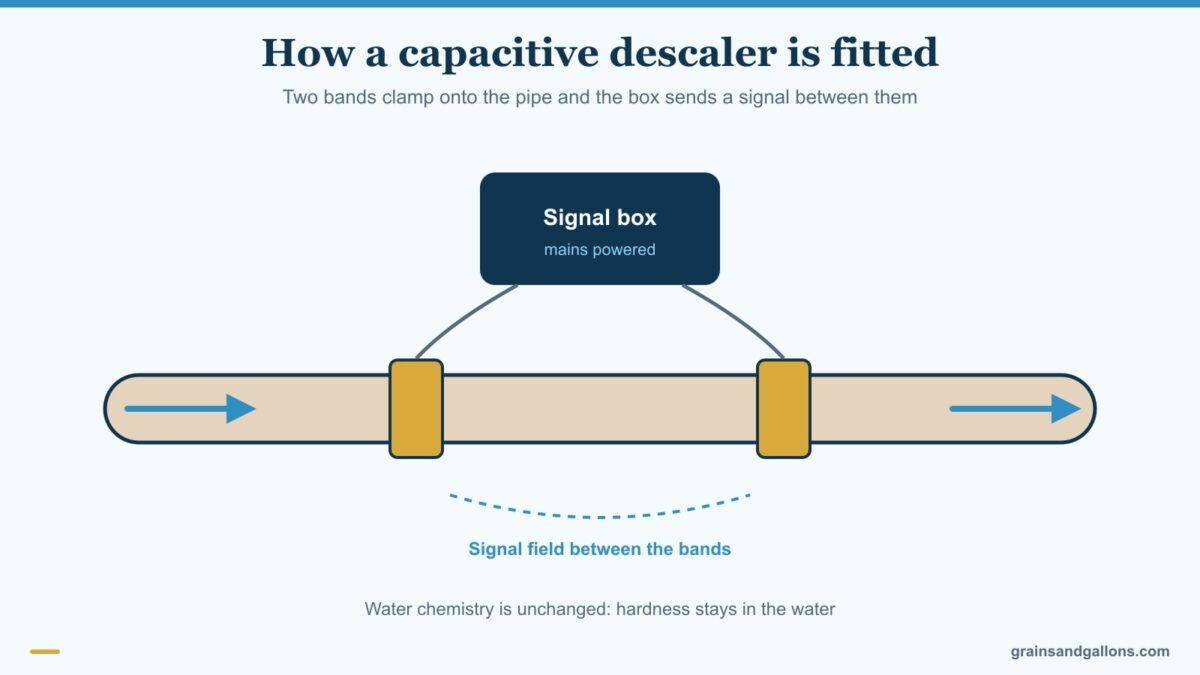
Most electronic descalers wrap wire around a pipe and drive a changing signal through it, inducing a field in the water. Yarna's units use copper conduit wrapped on both sides of the control box. The Gadgeteer reviewer who tested the CWD30 relayed the claim this way: the capacitive design uses the water itself to carry energy to the limescale, rather than an electromagnetic field that "wastes energy."
That's a plausible-sounding distinction. But no frequency, field strength or lab test result is attached to it. Physically, what both designs aim for is the same: nudge dissolved calcium carbonate to form tiny crystals in the water, instead of hard crust on hot surfaces. If you want the chemistry behind that family of claims, our explainer on how a salt-free water conditioner works covers the crystal-formation idea, including the media-based versions.
CWD24, CWD30 or CWD48: choose by pipe size
Yarna sells more than one size, and the model number matters:
- CWD24: listed for pipes up to 1 inch. Replacement power adapters sold for it are 24V, so expect a wall-wart transformer, not a hardwired unit.
- CWD30: the model the Gadgeteer reviewed, listed for pipes up to 2 inches. It's black with copper conduit at each end and a six-foot power cord, and it mounts to the pipe with zip ties or to the wall with the included screws and drywall anchors.
- CWD48: listed for pipes up to 4 inches, and the size we found in stock on Amazon. Yarna says it needs at least 10 inches of free pipe and installs without tools. Its listing describes "Ultra Flat Impulse Bands" wrapped on the pipe, and says it may take up to three months to see a significant improvement.
Measure the outside of your main pipe before ordering. "1 inch" on a listing generally means nominal pipe size, and the outside diameter of a "1-inch" galvanized steel main isn't the same as a "1-inch" copper or PEX line. If your main is bigger than the model's rating, the conduit may not wrap the way the instructions expect.
The one hands-on report I could find
The Gadgeteer's review of the CWD30 is the most concrete evidence out there, so here it is in full context:
- After about 72 hours (Yarna's stated time for treated water to cycle through a house), the reviewer saw less residue on glassware.
- What residue remained was "almost powdery versus cemented to the glass."
- The reviewer's partner, who has sensitive skin, reported less dryness. That's subjective, and it's one person.
- The reviewer still saw some residue, and wished the box included a test strip to confirm it was working.
- Yarna provided the unit.
One household, a free sample, judged by eye. I'd treat it as a sign the product can produce a visible change. It's not proof it will in your house. In the comments, a reader asked whether it's safe with a water heater expansion tank, and the reviewer couldn't answer. Yarna didn't publish an answer either.
Where it has a fair shot, and where it doesn't
Probably worth a try if:
- You're on city water with moderate hardness. Some third-party buying guides suggest these units do best under roughly 15 gpg, though Yarna doesn't publish a limit.
- You're a renter, or there's no drain, outlet space or floor space for a softener.
- Your complaint is how hard scale is to clean, not whether it appears at all.
Skip it if:
- Your water is very hard. Above 25 gpg, even iSpring tells buyers of its descaler to add a softener.
- You have iron or manganese. That needs dedicated treatment first.
- Hot-water scale is the real problem. Heat drives calcium out of solution fastest. See why hot water causes more scale. An untested device is a thin shield for a tankless heater or boiler.
- You want existing scale gone. Even media-based conditioners work slowly on old deposits, as covered in salt-free conditioners and existing scale. Descale fixtures by hand first.
Our guide on when a salt-free conditioner is the wrong choice runs through more of these cases.
Yarna and iSpring, compared on what's published
| Yarna (CWD24 / CWD48) | iSpring ED2000 | |
|---|---|---|
| Design claim | "Capacitive" pulse via copper conduit | Frequency-modulated signal via two antenna cable coils |
| Pipe guidance | Up to 1" (CWD24) or 4" (CWD48) | Two units suggested for mains over 1" and under 1.5" |
| Hardness guidance | Not published by Yarna | 10–19 gpg; add a softener above 25 gpg |
| Iron guidance | Not published | Iron filter needed above 0.3 ppm |
| Guarantee | 365-day return (per Yarna's CWD30 listing) | 1-year money-back plus lifetime tech support |
The table tells you more about the companies than the gadgets. iSpring writes down where its product stops working. Yarna doesn't. If both are on the table and your water is in iSpring's window, I'd lean toward the one with written limits.
Questions to ask Yarna before you order
These are the gaps I couldn't fill from public information. Ask them through the Amazon listing's Q&A or Yarna's support, and get the answers in writing:
- What's the maximum hardness the unit is designed for? A product that "works on any water" usually hasn't been tested on very hard water.
- Is the 365-day guarantee a refund, a replacement, or both? And does it cover the product failing, or only "not seeing results"?
- What's the power draw? It's plugged in around the clock, so it's a fair question.
- Does it matter if a water heater expansion tank, a PRV or a metal union is close by? The Gadgeteer reader asked, and no answer was given publicly.
- Can it go in an unheated garage? The control box and adapter are electronics, and the listing doesn't give a temperature range.
How to run your own test inside the refund window
- Install as close to where the main enters as possible, so all water passes through the treated section. Our electronic descaler install guide walks through placement.
- Clean one showerhead and one glass panel completely on day zero. Then leave them alone.
- Photograph them weekly in the same light.
- At around 8 weeks, wipe both with a dry microfiber cloth. If deposits come off without vinegar, that's the change Yarna is promising. If they're as stubborn as before, start the refund well before day 365.
If you'd rather not gamble
iSpring ED2000. Same category and install style, but with published hardness and iron limits and a one-year money-back guarantee. A downside: the evidence base is just as thin as Yarna's. Check price on Amazon
RKIN OnliSoft Pro. A salt-free conditioner paired with a whole-house carbon filter, sold for 1–3 bathroom homes. It uses physical media instead of a signal, and adds chlorine filtration. It needs plumbing and periodic media replacement. Check price on Amazon
Fleck 5600SXT 48,000 grain. If you're tired of guessing, ion exchange removes hardness, and you can confirm it with a test strip the same day. This package uses the widely serviced Fleck 5600SXT metered valve, 1.5 cubic feet of 8% crosslink resin and a 15" × 36" brine tank with safety float, and the seller rates it for up to 12 gpm service flow. It needs salt, a drain and space. Check price on Amazon
Want to give the Yarna its trial? Check price on Amazon