

Quick Answer: The iSpring ED2000 is a low-risk experiment, not a softener. Buy it if your water falls in iSpring's stated 10–19 gpg range, has under 0.3 ppm iron, and you mainly want softer, easier-to-wipe scale. The one-year money-back guarantee lets you judge it on your own fixtures. Don't buy it if you're above 25 gpg, want spot-free glass, or need protection you can measure. For scale control with a known mechanism, the iSpring WGB32B-DS uses polyphosphate. For truly soft water, a salt softener like the DuraWater Fleck 5600SXT 48k is the honest answer.
Disclosure: As an Amazon Associate, Grains & Gallons earns from qualifying purchases.
iSpring's own Amazon title includes the phrase "Different from a Water Softener." Take that seriously, because it's the most accurate claim attached to this product. The ED2000 doesn't remove calcium or magnesium. It doesn't lower the number on a hardness test strip. What it claims to change is how those minerals behave once they leave the pipe.
So the useful question is narrower than "does it work?" Will the specific change iSpring promises show up in your house, at your hardness, before the refund window closes? I haven't installed one. This review is built from iSpring's published claims, retailer spec pages and the independent research I could find.
In this guide
What iSpring actually says it does
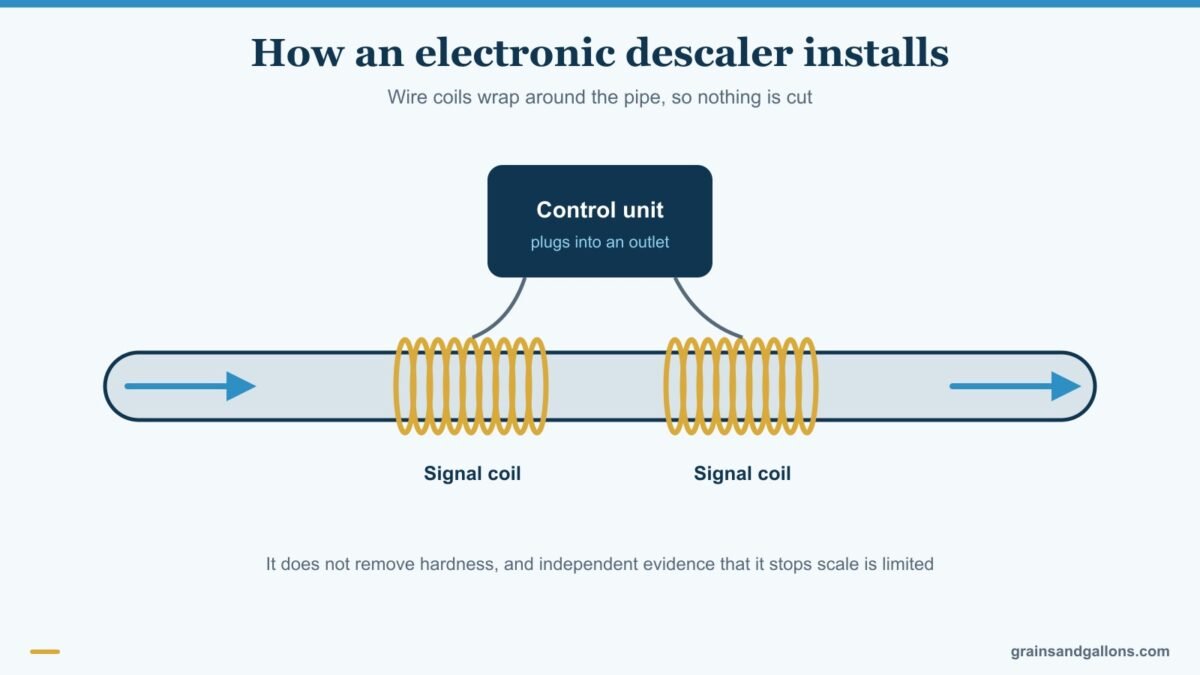
There's no cartridge, tank or plumbing cut. You wrap two antenna cables around your main water pipe to form coils, plug the control box into a 110–120V outlet, and it sends what iSpring calls a frequency-modulated electromagnetic waveform into the water. According to iSpring, that causes calcium bicarbonate to precipitate as particles that rinse away instead of sticking. It also claims existing scale gradually softens with regular contact with treated water.
The limits iSpring and its retailers publish:
- Hardness: designed for 10–19 grains per gallon. Above 25 gpg, iSpring recommends a traditional softener in addition to the ED2000.
- Iron: more than 0.3 ppm needs an iron filter ahead of it.
- Pipe: works on any pipe material, including PEX and PVC. Retailers note that homes with a main over 1" but under 1.5" may need two units side by side, and one product page says you need about 10 inches of straight pipe.
- Maintenance: none. No salt, chemicals or cartridges.
- Guarantee: a 1-year money-back guarantee plus lifetime tech support from iSpring in Alpharetta, Georgia.
What a hardness test will show (nothing, and that's expected)
If you test before and after with test strips or a titration kit, you'll get the same number. That doesn't mean the unit failed. It's true of every salt-free approach, and it's why people get confused about these products. Our explainer on whether a salt-free system actually softens water goes through the difference between "soft" and "scale-resistant."
It also means you can't check the ED2000 with a cheap test. You have to judge it by what scale does over weeks and months. That's slow, and it's easy to fool yourself.
The evidence problem
I went looking for independent tests of clamp-on electronic or magnetic units. The record is thin and mixed. A Lawrence Livermore National Laboratory test of a commercial magnetic water treatment device, run upstream of an air stripper where calcite scale was forming, found "no beneficial effect." That was a magnet, not an electronic waveform unit like the ED2000, and an industrial setting rather than a house. So it doesn't prove the ED2000 fails. It does show why "physical water conditioning" earns skepticism. We go into how to read these claims in evaluating salt-free and maintenance-free claims.
The fair summary: the mechanism is plausible on paper, the independent evidence is weak, and household results depend on water chemistry, pipe layout and how you judge "better." The one-year refund is iSpring admitting that results vary.
A one-year plan to judge it fairly
Because the guarantee runs a full year, you can run a real trial instead of going on vibes:
- Before installing, photograph your worst spots: a showerhead face, the kettle element, a glass shower door after a week without cleaning.
- Clean a few test surfaces completely on install day, then stop cleaning them.
- At 4, 8 and 12 weeks, photograph the same spots in the same light. Note whether new deposits wipe off with a dry cloth or need vinegar.
- Check your water heater or tankless if it has a flush schedule. Compare how much debris comes out against the previous flush. That's the clearest sign. See scale in a tankless water heater for what to look for.
- Decide by month 10, so you aren't racing the refund deadline.
If results stall, our checklist for an electronic descaler not working covers coil placement, power and grounding issues before you give up on it.
ED2000 or ED2000S?
Search Amazon and you'll find a second model, the ED2000S. Going by iSpring's listing titles, the S adds a "breathing" LED light design and a magnet, and it's sold for the same salt-free scale job. iSpring doesn't publish a side-by-side explaining what the magnet changes in practice, and I couldn't find one. My take: the indicator light is handy because it tells you the unit is powered. That matters with a device whose effect you can't test. But nothing published shows the S model reduces scale any better. Buy whichever one carries the guarantee terms you want, and confirm the money-back period on the listing before you order.
It's also worth knowing what iSpring doesn't publish for either model: wattage, signal frequency and dimensions. None of those were on the retailer spec pages I checked. Running cost is likely small for a plug-in control box, but I can't give you a number iSpring hasn't stated.
Installation notes
Install is the ED2000's best feature. Mount the box near an outlet close to where the main enters, wrap the two antenna cables around a straight run of pipe (spacing and wrap count are in iSpring's guide), and plug it in. You don't cut a pipe or need a permit, and there's no drain line. You can do it in an apartment, a rental or a house where the main is boxed in. It also doesn't touch water flow, so there's no pressure drop.
One practical thing: put it upstream of the water heater branch. A unit wrapped on a pipe after the heater tee does nothing for the heater.
Who it suits, and who it doesn't
A good candidate: a city-water house at roughly 10–19 gpg with no iron, where the main annoyance is crust on showerheads and faucets, and no room or drain for a softener (renters especially).
A poor candidate:
- Above 25 gpg. iSpring itself tells you to add a softener.
- Well water with iron or manganese. Iron needs real treatment first.
- You want spot-free dishes and glass. Minerals stay in the water and still dry on surfaces.
- You're protecting an expensive tankless or boiler under a warranty that names a specific treatment. Check what the manufacturer accepts.
Better-fit options
iSpring WGB32B-DS Anti-Scale System. This is iSpring's own non-electronic route: sediment, polyphosphate and carbon block in a three-housing setup. Polyphosphate is a known chemical scale inhibitor, and it also gives you chlorine reduction. The downsides are cartridges to replace and plumbing work to install. Check price on Amazon
AO Smith AO-WH-DSCLR Salt-Free Descaler. A media tank system that AO Smith rates for 6 years or 600,000 gallons, per its listing. It's bigger and needs plumbing, but there's a physical media doing the work instead of a signal. Check price on Amazon
DuraWater Fleck 5600SXT 48,000-grain softener. If you're over 25 gpg, or you want soft water you can prove with a test strip, this is the category that does it. You'll need salt, a drain and an outlet. Check price on Amazon
Still want to try the ED2000 first? It's the lowest-commitment way to find out whether physical conditioning helps your house, and the refund window gives you room to decide: Check price on Amazon