


Quick Answer: For most conventional septic systems, a water softener with septic system plumbing is fine if the softener is right-sized and set to use salt and water efficiently. Industry-funded studies found brine didn't harm septic bacteria or slow drainfield absorption, and a later study linked efficient softeners to better septic tank performance. The real risks are extra water from frequent or faulty regenerations, very inefficient salt settings, and local rules or aerobic-unit warranties that restrict discharge. Use a metered softener at a modest salt dose, fix any leaking valve, and check your county rules and septic paperwork first.
You'll hear both sides. A neighbor says the softener killed their drainfield. The softener dealer says that's a myth. The septic pumper shrugs. Each has a piece of it. Whether a water softener with septic system plumbing works well for you depends on what kind of septic system you have and how the softener is set up.
In this guide
- What softener discharge does on its way through a septic system
- What the brine studies found, and where they stop
- Water volume is the risk that actually floods drainfields
- Aerobic units, local rules and where the drain goes
- How to set up a water softener with septic system plumbing
- Warning signs in the yard and at the drain
- FAQ
- Efficient settings make softeners and septic tanks compatible
What softener discharge does on its way through a septic system
Picture a regeneration at 2 a.m. The softener sends backwash water, then salty brine carrying the calcium and magnesium it pulled off the resin, then rinse water to the drain. Penn State Extension estimates "about 50 gallons of water are used for each regeneration cycle" and tells septic owners to consider "the additional load on your drainage field."
All of it lands in the septic tank, where solids settle and bacteria break down waste. The liquid then moves on to the drainfield and soaks into the soil. Three worries come up:
- Salt killing the bacteria in the tank.
- Sodium damaging the soil in the drainfield so it stops absorbing water.
- Extra water stirring up the tank or overloading the field.
The softened water you use all day is a separate, much smaller issue. It carries a little added sodium (Penn State puts it at 7.5 mg per quart for each grain per gallon removed), but it isn't strong brine.
What the brine studies found, and where they stop
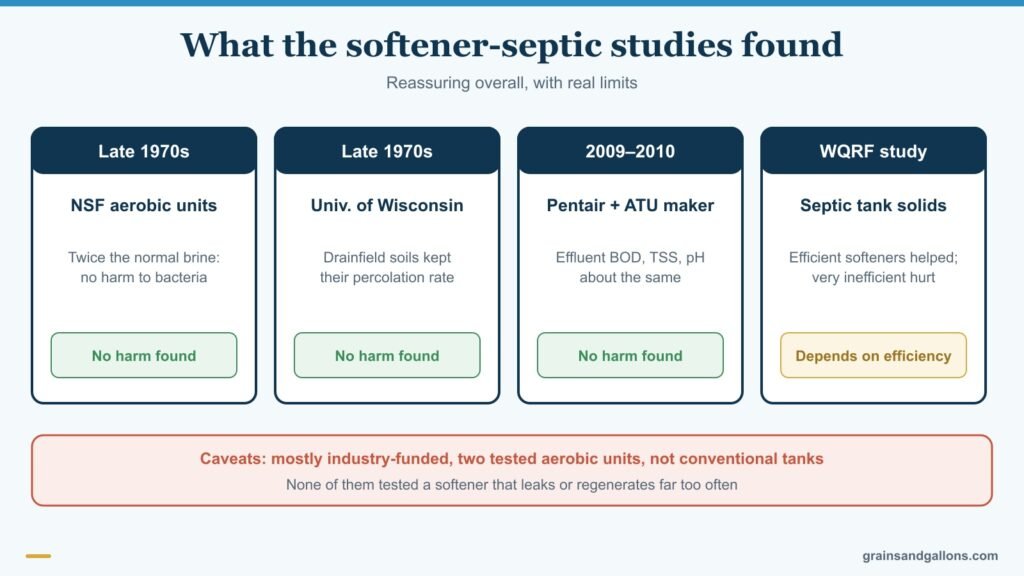
The research is older and mostly industry-funded, so read it with that in mind. A Water Conditioning & Purification summary, written by authors from Pentair and an aerobic-unit maker, describes the main work:
- NSF, late 1970s. Researchers tested aerobic treatment units dosed with softener brine, up to twice the normal load, and found that "brine wastes had no negative effects on the bacterial population living in the aerobic treatment tank."
- University of Wisconsin Small Scale Waste Management Project, late 1970s. Researchers looked at drainfield soils and found the brine "did not reduce the percolation rate of water in the absorption field." Their explanation: the calcium in spent brine offsets sodium's effect on soil structure.
- A 2009–2010 test using a certified aerobic treatment unit regenerated every two days. Effluent BOD stayed at 9.0 mg/L, pH at 7.4, and suspended solids moved from 9.0 to 10.3 mg/L, which the authors called "virtually the same with and without softener discharge."
A separate Water Quality Research Foundation study, summarized by the Water Quality Association, used columns of real septic tank solids plus data from private tanks. It found that efficiently operated softeners improved septic tank performance, while very inefficient ones "may have a negative effect on solids discharge to the drain field."
The limits are real. Two of the older studies used aerobic units, not ordinary septic tanks. The authors and funders had commercial interests, and the WC&P article itself notes that "some people feel that more research needs to be done." None of these studies tested a softener that leaks or regenerates far too often. Still, there's no solid evidence that a normally operating softener ruins a healthy septic system.
Water volume is the risk that actually floods drainfields
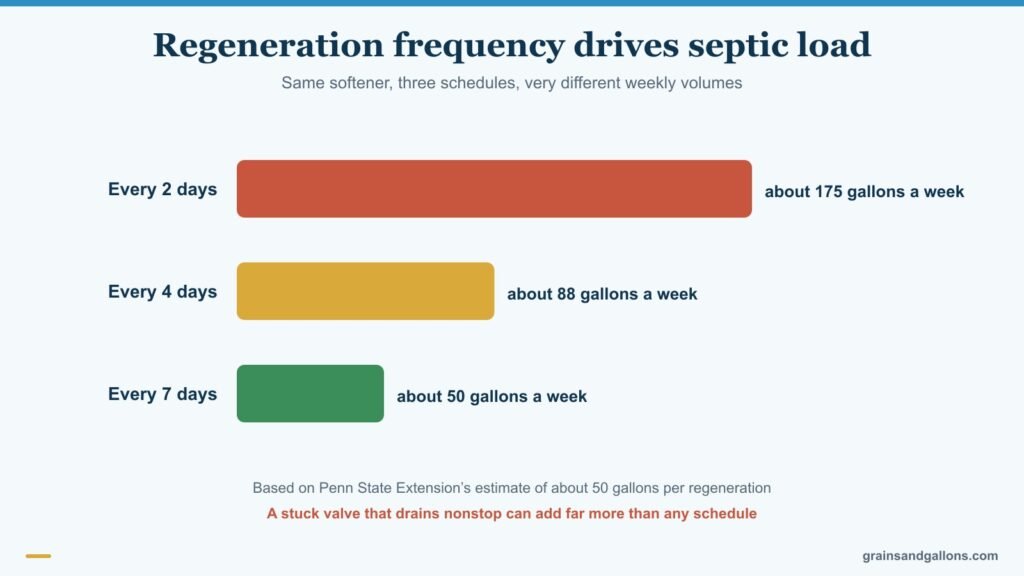
Hydraulic load is the most common real problem, and it's the one you control. Using Penn State's 50-gallon estimate, a softener that regenerates every two days sends roughly 175 gallons a week to the tank. One that regenerates weekly sends about 50. The EPA's septic care guidance makes the same point about laundry: spread it through the week, because doing it all in one day "could flood your drainfield."
Watch for three ways a softener piles on water:
- An oversized timer softener. Old clock-type valves regenerate on a fixed schedule whether you used the water or not. See water softener regenerating too often if yours cycles more than your use justifies.
- A stuck or leaking valve. A worn seal or brine valve can send water to drain all day, every day. That can overwhelm a small or marginal field faster than any schedule.
- A long backwash on a big tank. Larger resin tanks use more water per cycle. Our guide to how much water regeneration uses covers typical ranges.
A drainfield that was already struggling, with fine clay soils, a high water table or an overdue pumping, has little margin for any of this. The softener isn't the root cause there, but it isn't helping.
Aerobic units, local rules and where the drain goes
Aerobic treatment units (ATUs). Some ATU and media-filter makers restrict softener discharge as a warranty condition. The WC&P article describes standard policy as voiding warranties when brine is discharged, and notes that one maker changed its warranty to accept its approved demand-initiated, twin-tank softeners. Read your system's manual and warranty before assuming either way.
Local rules. Some counties and states regulate softener discharge to onsite systems, require separate routing, or limit softeners where chloride in groundwater is a concern. Our pages on water softener brine restrictions and whether you need a permit for a water softener explain what kinds of rules exist and how to find yours.
Bypassing the tank. Some installers route softener discharge to a separate dry well. That's legal only in some places and concentrates chloride in one spot near groundwater. Don't do it without the health department's sign-off, and never near a well.
How to set up a water softener with septic system plumbing

| Choice | Why it helps |
|---|---|
| Metered (demand-initiated) regeneration | Regenerates only when you've used the capacity, no "just in case" cycles |
| Modest salt dose per cubic foot | Raises salt efficiency, so less brine goes to the tank |
| Right-sized resin tank | Avoids long backwash and oversized brine volumes |
| Regenerate overnight | Keeps the load away from showers and laundry |
| Yearly check of the valve and drain flow | Catches a continuous-drain fault before it floods the field |
| Pre-filter iron and sediment | Prevents extra cleaning cycles and fouled resin |
Salt efficiency, measured in grains of hardness removed per pound of salt, is the number the WQRF study tied to septic results. Lower salt doses per regeneration generally raise it, and metered valves avoid wasting regenerations. Our explainer on water softener salt efficiency shows how to calculate yours. If you're shopping, the best high-efficiency water softeners and best metered on-demand softeners focus on units with these features. For one you already own, see optimizing a softener for salt and water efficiency.
What about potassium chloride? Swapping sodium chloride for potassium chloride removes sodium from the discharge, which some people prefer for drainfield soil. It costs more and recharges resin less efficiently, so you'll usually need a higher setting. It doesn't reduce water volume, which is often the bigger concern.
Warning signs in the yard and at the drain

- Standing water or soggy, unusually green grass over the drainfield, especially the morning after a regeneration.
- The softener drain running when it shouldn't be. Listen at the drain line at midday, when the softener should be idle.
- The septic pumper reports unusual scum or sludge levels. The EPA says household tanks are typically pumped every three to five years; ask your pumper whether yours needs it sooner.
- The softener regenerates far more often than your water use justifies.
If you see any of these, have the softener's settings and valve checked and the septic system inspected. Those are two different trades, so don't assume one diagnosis covers both.
FAQ
Does a water softener hurt a septic system?
A properly set softener generally doesn't. Studies from NSF and the University of Wisconsin found no harm to treatment bacteria or drainfield soil, and a later WQRF study linked efficient softeners to better tank performance. Problems come from excess water, very inefficient salt use, or a valve that drains continuously.
Will softener salt kill septic bacteria?
The research says no at normal loads. NSF found no negative effect on bacteria even at twice the normal brine load in aerobic units. Regeneration brine is diluted by everything else in the tank, and the softened water you use daily carries only a small amount of added sodium.
Should a water softener drain into a septic tank or a separate dry well?
Most installations drain into the septic tank, which is what the studies tested. A separate dry well is legal only in some areas and can concentrate chloride near groundwater. Check with your county health department before routing discharge anywhere other than the tank.
Do I need a bigger septic tank if I add a water softener?
Usually not for a properly set, metered softener. If you're building or replacing a system, tell the designer you'll have a softener so the flow estimate includes it. If your drainfield is already marginal, fix that first.
Is a salt-free conditioner better for a septic system?
It has no regeneration discharge, so it adds nothing to the septic load. But it doesn't remove hardness the way a softener does. Read our guide to water softener alternatives before treating it as a drop-in replacement.
Efficient settings make softeners and septic tanks compatible
A water softener with septic system plumbing works for most homes when it's sized correctly, regenerates by meter instead of by clock, and uses a modest salt dose. The studies, though industry-funded, found no harm from normal brine loads and pointed to salt efficiency as the factor that matters. Keep water volume down, check the valve once a year so it can't drain nonstop, and confirm your county rules and any aerobic-unit warranty before you install.