

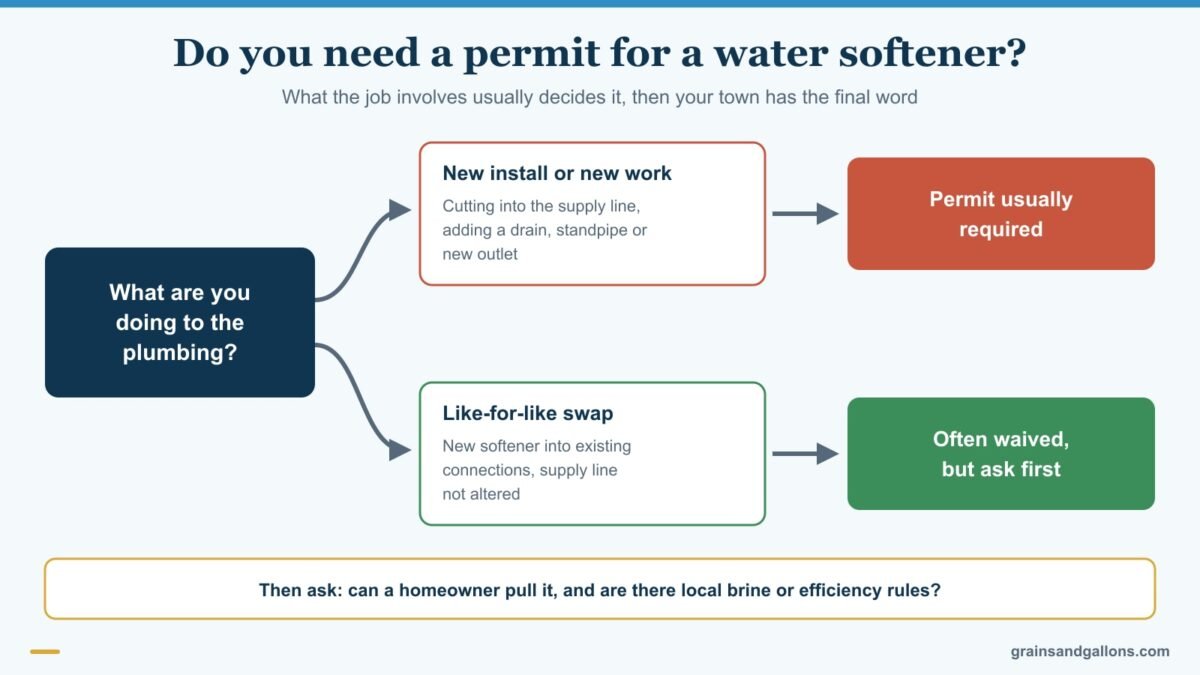
Quick Answer: Do you need a permit for a water softener? Often, yes, for a new installation: many towns treat cutting into the main water line and adding a drain connection as permitted plumbing work. Minnesota, for example, requires a plumbing permit for every new softener. A like-for-like replacement that doesn't alter the supply line is often exempt, and a few places restrict softeners outright. One call to your local building department settles it. Plan for a 1-inch air gap on the drain either way, because that's what inspectors check most.
Someone at the store asked whether you'd pulled a permit, or a neighbor mentioned an inspection, and now you're not sure whether this weekend project needs paperwork. So, do you need a permit for a water softener? There's no single national answer, because plumbing permits are handled at the city, county or sometimes state level. Below is what usually decides it, what real local rules look like, and how to get the answer for your address in one phone call.
In this guide
- When do you need a permit for a water softener?
- Three real rulebooks: Minnesota, Colorado and California
- What inspectors look at
- Can a homeowner pull the permit, or do you need a licensed plumber?
- Places where softeners themselves are restricted
- The phone call: three questions to ask
- Renters, condos and HOAs
- Why skipping a required permit costs more later
- FAQ
- One phone call beats an unpermitted softener
When do you need a permit for a water softener?

Permit rules vary, but these pieces of the job are the ones most likely to need one:
- Cutting into the main water supply. Many jurisdictions treat any change to the potable water piping as plumbing work.
- A new drain connection. Softener discharge is wastewater. Adding a standpipe, a tee into a drain line or a new floor drain is often permitted work.
- A new electrical outlet. If there's no outlet near the softener and you add one, that's electrical work with its own permit.
- Backflow devices or rerouting around the water heater. Adding a backflow assembly or repiping around the heater pulls in more requirements.
- New construction or a remodel. If a permit is already open for the project, the softener usually goes on it.
What often doesn't need one, depending on the town: swapping an old softener for a new one on existing connections, or a portable softener on a hose bib. Some towns still want a permit for a replacement, so don't assume.
Three real rulebooks: Minnesota, Colorado and California
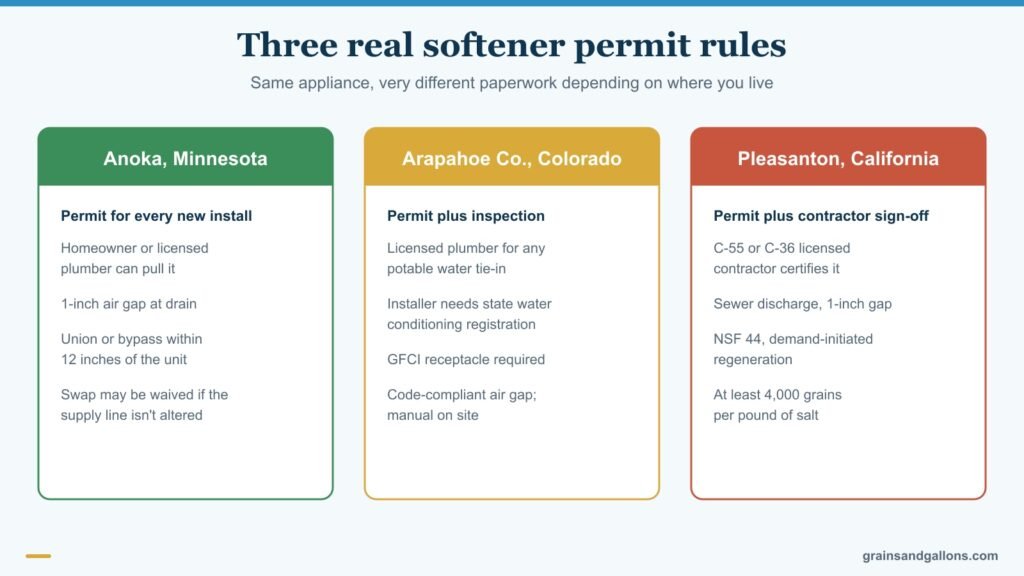
Looking at how three jurisdictions actually write the rule shows how wide the range is.
| Jurisdiction | Permit? | Who can install | Notable requirements |
|---|---|---|---|
| Anoka, Minnesota (state plumbing code) | Yes, for every new installation | Homeowner or licensed plumber | 1-inch air gap at discharge; union or bypass within 12 inches; replacements may be waived if the supply line isn't altered |
| Arapahoe County, Colorado | Yes, with inspection | Colorado licensed plumber for potable tie-ins; installers need state water conditioning registration | GFCI receptacle (or a separate electrical permit); code-compliant air gap; manual on site |
| Pleasanton, California | Yes | Final sign-off by a C-55 water conditioning or C-36 plumbing contractor | Discharge to sanitary sewer with 1-inch air gap; NSF 44; demand-initiated regeneration; at least 4,000 grains removed per pound of salt |
The City of Anoka's softener FAQ cites the Minnesota Plumbing Code and spells out that a homeowner can pull the permit. Arapahoe County's permit requirements go the other way: interconnection with potable water must be done by a licensed plumbing contractor, and water conditioning installers need a Water Quality Association Certified Installer credential or equivalent to register. Pleasanton's checklist adds California's efficiency and water-conservation rules on top.
What inspectors look at
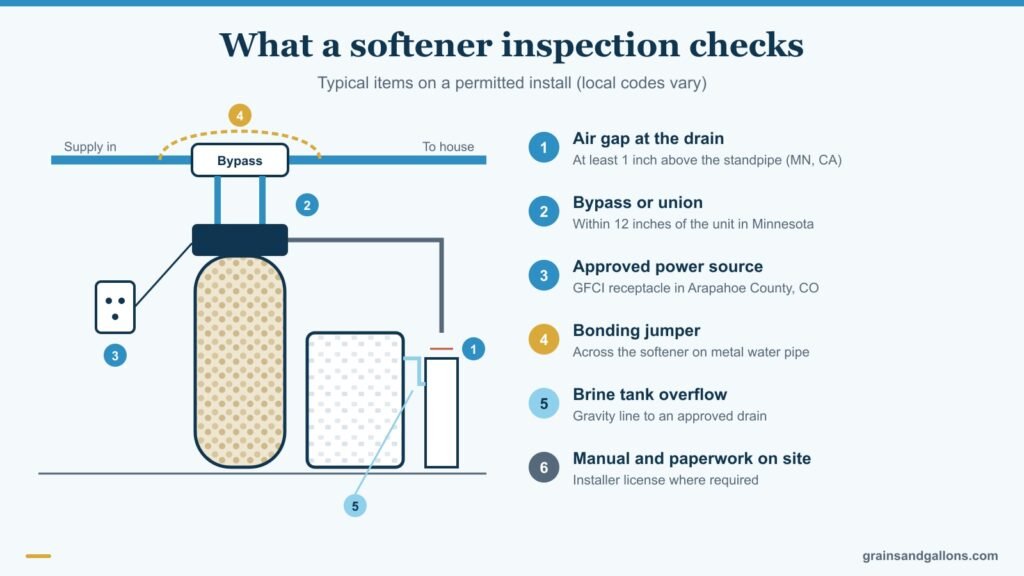
If a permit is required, the inspection usually focuses on a few things:
- Air gap on the drain. The discharge line needs a physical gap above the drain so wastewater can't siphon back into the softener and your water supply. Minnesota and California both specify at least 1 inch. A drain hose stuffed tightly into a standpipe usually fails; an inexpensive air gap fitting for the softener drain line solves it.
- Backflow and cross-connection. Same idea on the supply side. Some areas want specific backflow protection; see water softener backflow protection.
- Bonding. If plastic connections interrupt a metal water pipe used for grounding, a bonding jumper is expected.
- Bypass and shutoffs. Being able to isolate the softener is standard; Minnesota wants a union or bypass within 12 inches of the unit.
- Power. An approved receptacle; Arapahoe County requires GFCI protection.
- Brine tank overflow. Routed by gravity to an approved drain, separate from the backwash line. Our guide to brine tank overflow line requirements covers the details.
- Location and paperwork. Not blocking the water heater or main shutoff, protected from freezing, and the manufacturer's instructions on site for the inspector. Don't conceal anything before the inspection.
Can a homeowner pull the permit, or do you need a licensed plumber?
This is the second half of the permit question, and it varies just as much. Many places let homeowners do plumbing work on their own single-family home and pull the permit themselves, as Minnesota does. Others require a licensed plumber for any tie-in to potable water, or a registered water conditioning installer, as Colorado does. California jurisdictions like Pleasanton require a licensed contractor's certification at final inspection even when the permit is issued.
If you hire a dealer or plumber, they normally pull the permit and schedule the inspection, and the fee goes into the quote. Ask whether it's included. If you DIY where it's allowed, you pull it, pay the fee, and meet the inspector.
Places where softeners themselves are restricted

Most US homeowners never run into this, but it's real in some areas. Softener brine adds salt to wastewater, and some treatment plants and water recycling programs can't remove it.
California is the clearest example. California Water Code § 13148 allows local sewer or water recycling agencies in certain regions, after a regional water board finding and public hearings, to regulate residential self-regenerating softeners. The options include requiring a plumbing permit before installation, requiring high-efficiency certified units, or prohibiting new installations. Some California communities have used it, so California owners should always ask.
Outside California, some cities and sewer districts have their own rules on brine discharge. If you live somewhere with water recycling or salt problems in local rivers, ask specifically. Our explainer on water softener brine restrictions goes deeper, and where efficiency rules apply, the best high-efficiency water softeners is the place to start.
The phone call: three questions to ask
Look up your city or county "building department" or "permit center." Some places list softeners in an online permit lookup. If you're outside city limits, it's usually the county. Then ask:
- "Do I need a plumbing permit to install a water softener at my address?" Give the address and say whether it's a new install or a replacement.
- "Can a homeowner pull that permit, or does it require a licensed plumber or certified installer?"
- "Are there local restrictions on softener discharge or required softener efficiency?" This catches brine rules and septic-related requirements.
Write down who you talked to and the date. If the answer is "no permit needed," that note helps later if a question comes up during a home sale. On a private septic system, also check with your county health department; see running a water softener with a septic system.
Renters, condos and HOAs

A permit is between you and the building department. Your lease or HOA is a separate layer.
- Renters generally need the landlord's written permission before cutting into plumbing. A portable or point-of-use setup is often the realistic option.
- Condos and HOAs may have rules about modifying shared plumbing, adding drain connections or where equipment can sit. Check the governing documents before you buy.
Why skipping a required permit costs more later

Skipping a required permit isn't usually a dramatic problem on day one. It shows up later:
- Home sale. A buyer's inspector may flag unpermitted plumbing work or a missing air gap, and you may have to permit it retroactively or redo it.
- Insurance. If the softener leaks and causes damage, an insurer may ask how it was installed. Unpermitted work can complicate a claim.
- Safety. The things inspectors check (air gap, bonding, backflow) exist because they prevent contaminated water from reaching your taps.
None of that means you have to hire someone where DIY is allowed. Plenty of homeowners pull their own permit and do the work. Our step-by-step softener installation guide walks through a code-friendly install.
FAQ
Do you need a permit to replace an existing water softener?
Sometimes not. Many jurisdictions waive the permit for a like-for-like replacement that doesn't alter the water supply line; Minnesota's code lets the local authority do exactly that. Others require a permit for any replacement, so ask before you assume.
Can a regular homeowner install a water softener?
In many places, yes, on their own single-family home, and they can pull the permit themselves. Some states and counties require a licensed plumber or a registered water conditioning installer for any connection to potable water, so the answer depends on your address.
What do inspectors fail most often on a softener install?
The drain. A missing or inadequate air gap, with the drain hose pushed down into the standpipe, is the classic failure. Codes like Minnesota's and California's require at least 1 inch of open air between the end of the drain line and the receptor.
Are any states banning water softeners?
No state bans them outright, but California law lets certain local agencies require permits, require high-efficiency units, or prohibit new self-regenerating softeners where salt in wastewater is a problem. Some communities there have restrictions in place.
Does a salt-free conditioner need a permit?
It can. Minnesota's rule covers all water conditioning equipment, including filters, not just salt softeners. If the install cuts into the supply line, expect the same permit question.
One phone call beats an unpermitted softener
Do you need a permit for a water softener? For a new install that cuts into the supply line or adds a drain, usually yes; for a swap onto existing connections, often no. The details, including who's allowed to do the work, live with your local building department. Ask the three questions, note the answer, and build in a proper air gap whatever they say.