


Quick Answer: The water softener backflow protection that matters most is an air gap where the drain line empties: open air between the end of the tube and the drain, so dirty water can never be siphoned back into the softener. The brine tank overflow needs its own air gap too. A fitting like the Mr. Drain AG100 air gap makes it easy to do right. Some areas also require a check valve or backflow preventer on the supply; if you add one, plan for a thermal expansion tank.
Disclosure: As an Amazon Associate, Grains & Gallons earns from qualifying purchases.
An inspector failed your install, or a plumber pointed at the drain tube tucked into the floor drain and shook his head. Either way, water softener backflow protection has come up, and it's worth understanding: the risk is rare but real, because a softener is plumbed straight into your drinking water and also connected to a drain. Backflow just means water flowing the wrong way, and for a softener there are three places it can happen.
In this guide
- Why a softener is a backflow risk at all
- 1. The drain line: an air gap, not a sealed connection
- 2. The brine tank overflow: an air gap too
- 3. The supply side: check valves and backflow preventers
- Five-minute check of your softener install
- Air gaps are the water softener backflow protection that counts
- FAQ
Why a softener is a backflow risk at all

Your softener has a direct path from the house's drinking water, through the resin tank, out to a drain. During regeneration, the control valve opens that path on purpose and sends rinse water and brine down the drain.
Now imagine the drain backs up while the tube is sitting down inside it. Or the supply loses pressure, from a main break, firefighters opening a hydrant down the street, or a well pump failure, at the moment the valve has the drain path open. Low pressure can suck water backward through the drain tube into the softener and potentially into your pipes. That's back-siphonage, and if the tube end is sitting in sewage or mop water, that's what gets pulled in.
This isn't theoretical. The Minnesota Department of Health's fact sheet on cross connections and water softeners says its field sanitarians have found softener drain cross connections that actually contaminated drinking water systems. The usual cause is someone trying to stop splashing during regeneration by pushing the tube into the drain.
1. The drain line: an air gap, not a sealed connection
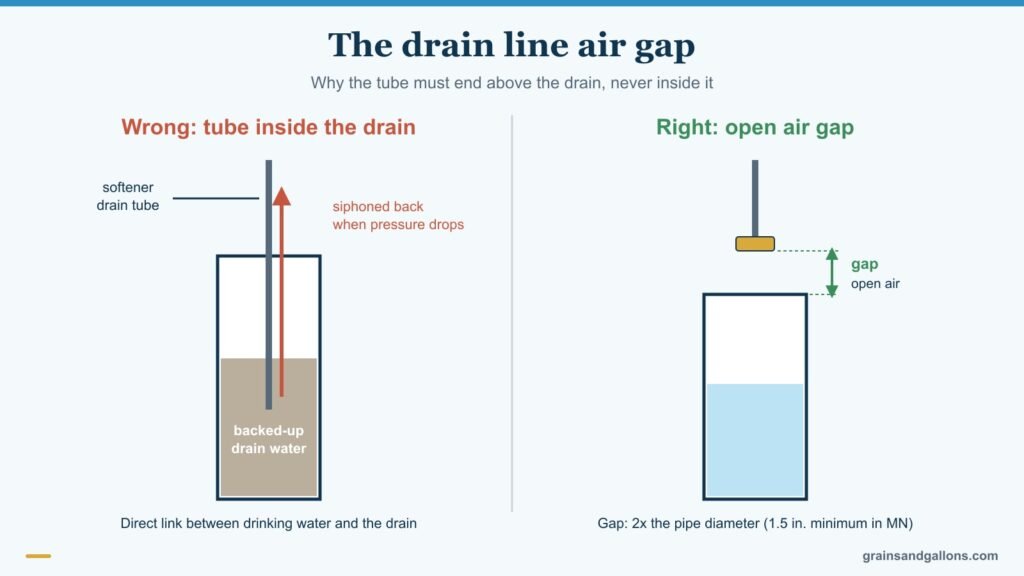
This is the big one, and the one inspectors check. The end of the softener's drain tube must stop above the flood rim of whatever it drains into, with open air in between. It must not be pushed down into a standpipe, taped into a drain, or clamped onto a pipe. An air gap makes back-siphonage physically impossible, because there's no water connection to pull through and no moving part to fail.
How big a gap: Codes commonly require at least twice the inside diameter of the drain line, with a minimum distance. Minnesota's rule, for example, is twice the pipe diameter above the flood rim, or at least 1.5 inches, and for a floor drain the gap is measured from the high point of the floor rather than the strainer. Your local code sets the exact figure, so check with your building department or inspector.
How to do it right:
- Air gap fitting. A purpose-made fitting mounts on the standpipe or floor drain and holds the tube at the right height with a built-in gap. It's the cleanest option and the one most likely to satisfy an inspector. See our picks for softener air gap fittings.
- Fasten the tube above the drain. Clip it to the standpipe or a bracket so it can't slip. A tube that's above the drain on install day and slides down a month later doesn't help. Minnesota requires air gaps built from plumbing components and rigidly mounted.
Common mistakes: pushing the tube a foot down a laundry standpipe "so it won't splash," plumbing the drain line straight into a drain pipe, running it into a sink without an air gap device, or tying into a sump pit so the tube end sits below the water. Our guide to softener drain line requirements covers sizing, length and height, and where a softener can drain covers which drains are allowed.
2. The brine tank overflow: an air gap too

The overflow fitting on the brine tank is a safety outlet. If the tank overfills, the excess runs out by gravity instead of across your floor. It's a separate line from the control valve drain and should stay separate, ending with its own air gap.
Because it isn't pressurized, the overflow must run downhill the whole way. If you tee it into the pressurized valve drain, the valve can push water backward into the brine tank during regeneration. Our guide to brine tank overflow line requirements walks through routing.
3. The supply side: check valves and backflow preventers
This is where rules vary most. The International Plumbing Code (section 608.3) says devices that treat potable water, softeners included, must be protected against contamination. Plumbing engineers disagree about whether that means a backflow device on the softener's inlet. Writing for the American Society of Plumbing Engineers, engineer David Dexter argues that the code doesn't specifically call for backflow devices on potable softeners, and that a reduced-pressure (RPZ) assembly there is overkill that costs pressure. Some local codes and water utilities still require a check valve or dual-check device at the meter or the softener inlet.
How to find out: ask your building department or water utility, or check permit requirements. Our article on whether you need a permit for a water softener explains when inspections come into play.
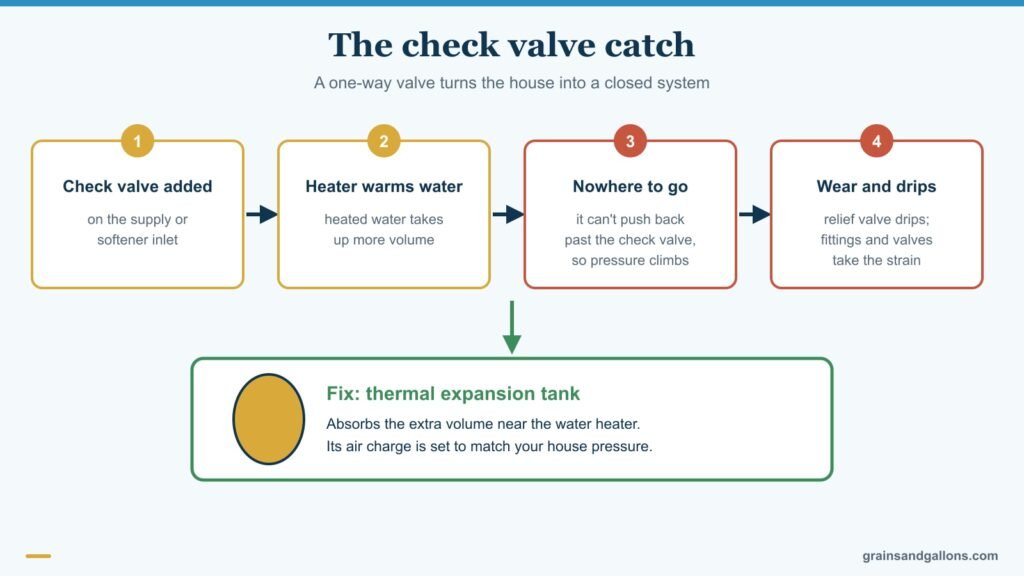
The catch: thermal expansion. Once a check valve or backflow preventer sits upstream of the water heater, the house becomes a closed system. Heated water expands and can't push back into the main, so pressure climbs, the relief valve may drip, and fittings and appliance valves take a beating. Codes generally require a thermal expansion tank in that case, precharged to match your house pressure. A licensed plumber should handle this pairing.
Does the bypass valve count as backflow protection?
No. The bypass valve just routes water around the softener for service. It doesn't stop reverse flow. Some control valves have internal parts that limit backflow during certain cycles, but they don't replace an air gap or any device your code requires.
Five-minute check of your softener install
Walk down to the softener and look for these:
- Drain tube ends above the drain with a visible gap and is fastened so it can't slide down
- Brine overflow runs downhill to a drain, separate from the valve drain, and also ends with a gap
- No tube is submerged in a sump, floor drain or standpipe
- If there's a check valve or backflow preventer on the supply, there's an expansion tank near the water heater
- Hoses, clamps and fittings are tight and in good shape
If you're installing new, a complete softener installation kit often includes drain tubing and clamps, though you'll usually buy the air gap fitting separately.
Air gaps are the water softener backflow protection that counts
For almost every home, water softener backflow protection comes down to two air gaps: one where the valve drain empties and one at the end of a separate brine overflow line. Supply-side check valves depend on your local code, and if you add one, the expansion tank comes with it. Call a licensed plumber for supply-side devices, expansion tanks, inspector corrections you're unsure about, or a drain that may not be allowed, such as a sewer cleanout. Where annual backflow testing applies, a certified tester has to do it.
FAQ
Does a water softener need a backflow preventer?
Almost always it needs an air gap on its drain line, which is the most effective backflow protection there is. A mechanical backflow preventer on the supply side is required only in some jurisdictions, so check with your building department or water utility.
How big should the air gap be on a softener drain line?
Codes commonly require at least twice the drain line's inside diameter above the flood rim of the drain. Minnesota, for example, sets a 1.5-inch minimum. Your local code has the final say.
Can I put the softener drain tube inside the standpipe?
No. A tube pushed into a standpipe or floor drain creates a cross connection, and if the drain backs up while supply pressure drops, dirty water can be siphoned into the softener and your plumbing.
Can the brine overflow tie into the softener drain line?
No. The valve drain is pressurized during regeneration and can push water back into the brine tank. Run the overflow as its own downhill line with its own air gap.
Do I need an expansion tank if I add a check valve?
Usually yes. A check valve makes the plumbing a closed system, so heated water has nowhere to expand. Codes generally require a thermal expansion tank, set to your house pressure, in that case.