


Quick Answer: Water softener salt efficiency is how many grains of hardness a softener removes for each pound of salt it uses, and higher is better. It falls as the salt dose rises: one manufacturer's rated data shows about 3,970 grains per pound at a 3 lb dose but only about 2,360 at 15 lb. An NSF/ANSI 44 efficiency rating requires at least 3,350 grains per pound plus metered regeneration. The two biggest levers are a lower salt dose and regenerating by water use instead of a calendar.
Two households with the same water and the same size softener can go through salt at very different rates. Water softener salt efficiency explains why. It's rarely the salt brand or the tank; it's usually two settings almost nobody touches after install day.
In this guide
What water softener salt efficiency measures
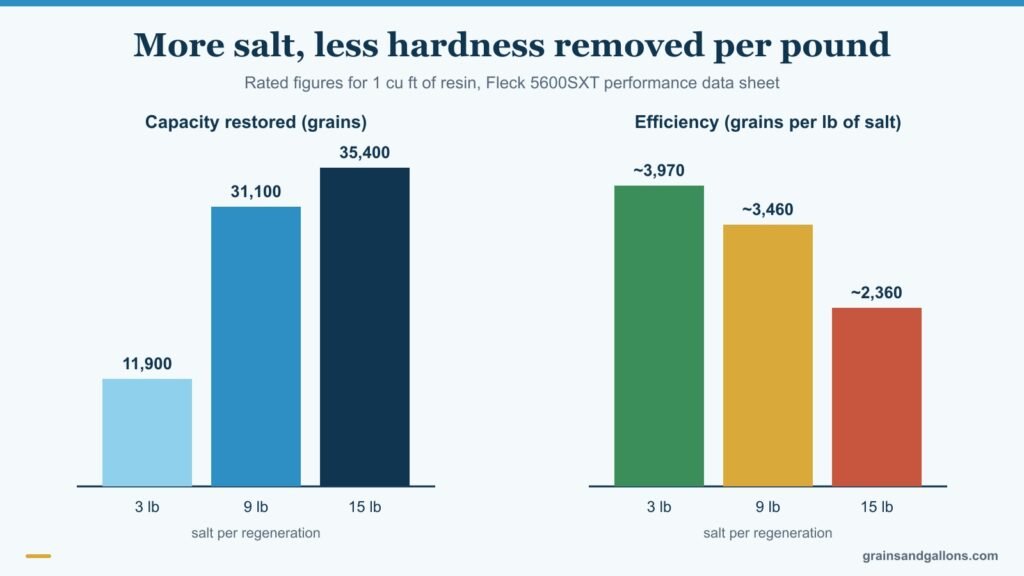
Every regeneration runs brine through the resin to strip off the calcium and magnesium it has collected. Divide the capacity a regeneration restores, in grains, by the salt it used, in pounds, and you have salt efficiency.
Resin doesn't respond to salt in a straight line. The first few pounds restore a lot of capacity; each extra pound restores less. Pentair's 5600SXT performance data sheet shows it clearly for one cubic foot of resin:
| Salt per regeneration | Rated capacity | Grains per pound |
|---|---|---|
| 3 lb | 11,900 grains | ~3,970 |
| 9 lb | 31,100 grains | ~3,460 |
| 15 lb | 35,400 grains | ~2,360 |
Going from 9 to 15 lb adds about 14 percent more capacity for 67 percent more salt. A trade article in Water Conditioning & Purification puts the theoretical maximum for standard softener resin at 6,000 grains per pound, so even the best real settings leave room on the table.
Same house, three ways to spend salt

Take a household running 250 gallons a day of 15 gpg water through a 1.5 cubic foot softener. That's about 1.37 million grains of hardness a year. Using the same data sheet's ratings for that tank size (17,900 grains at 4.5 lb, 53,100 grains at 22.5 lb):
- Timer, weekly, 22.5 lb dose: 52 regenerations whether the capacity was used or not, about 1,170 lb a year.
- Metered, 22.5 lb dose: regenerates only when capacity runs out, about 26 times, roughly 580 lb.
- Metered, 4.5 lb dose: smaller, more frequent regenerations, about 77 of them, roughly 345 lb.
Real use runs higher than lab ratings because of reserve capacity and real-world conditions, but the gap between settings holds. The low-dose setting regenerates more often, which uses more water and cycles the valve more, so it isn't free; our guide to optimizing a softener for salt and water efficiency covers that balance. For typical totals by household, see how much salt a water softener uses.
Four design choices that raise efficiency
A lower salt dose
Some valves let you set pounds of salt per regeneration directly; others ask for a capacity and calculate the dose. Choosing a lower capacity usually means a lower, more efficient dose. Step-by-step instructions are in how to set the salt dose on a water softener. With very hard water or iron, don't jump to the minimum; lower it in steps and test the softened water each time, because very low doses can let some hardness slip through.
Metered regeneration
A timer softener regenerates on schedule, so it either wastes unused capacity or runs out early. A metered, or demand-initiated, valve counts gallons and regenerates only when the resin is nearly spent. That's why the weekly timer in the example used twice the salt of the metered unit at the same dose. Our picks for the best on-demand water softeners all work this way.
Counter-current brining
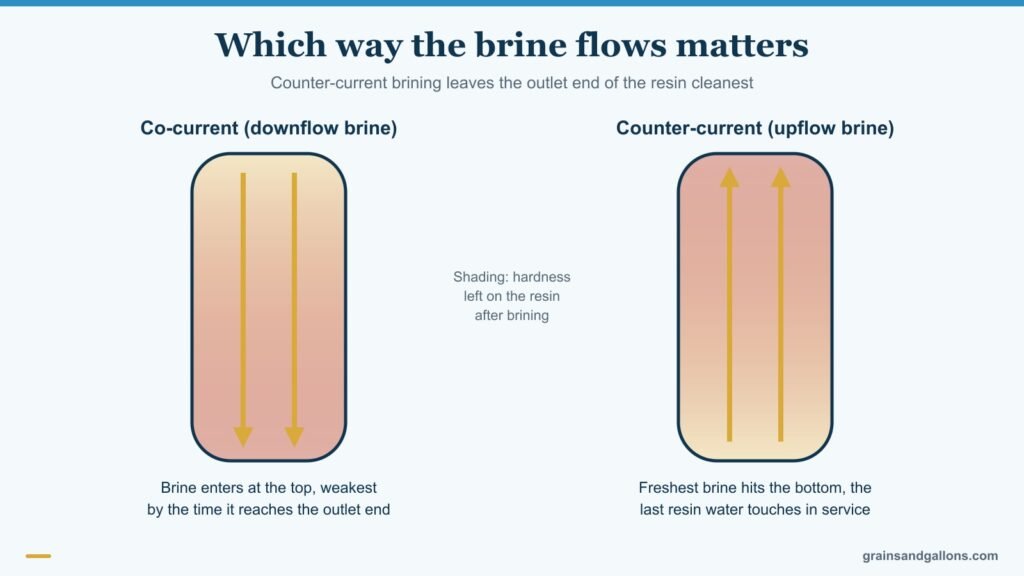
Most home softeners send brine down through the resin, the same direction as service water. Counter-current designs push brine up from the bottom, so the freshest brine reaches the resin at the outlet end, the part that does the final polishing. That gets more usable capacity from less salt, which is why several systems in our best upflow water softeners guide advertise lower salt use.
Proportional brining
Some newer valves refill the brine tank with only as much water as the next regeneration needs, based on how much capacity was used. It's a refinement on top of metering; check the spec sheet, since marketing names vary.
What an NSF/ANSI 44 efficiency rating promises

NSF/ANSI 44 is the main US standard for residential softeners, and its efficiency claim is optional. According to the Department of Energy's Building America Solution Center, an efficiency-rated softener must:
- have a rated salt efficiency of at least 3,350 grains of hardness per pound of salt,
- use no more than 5.0 gallons of water per 1,000 grains of hardness removed, and
- be demand-initiated, using a flow meter or hardness sensor rather than a timer.
California goes further: the WC&P article notes its standard requires at least 4,000 grains of capacity per pound of salt. Two catches apply. The rating holds only at the salt setting it was tested at, so turning the dose up later gives the efficiency back. And plenty of unrated softeners can be set up efficiently; the label means the maker tested it, not that others can't do it. Our roundup of high-efficiency water softeners focuses on units with metering and efficient brining built in.
What doesn't change efficiency much
- Salt type. Pellets, crystals and solar salt all supply sodium chloride. Purer salt leaves less sludge but doesn't change how many grains a pound restores. Potassium chloride is the exception; manufacturers typically have you raise a setting to compensate.
- How full the brine tank is. A full tank only stores more salt. The valve controls how much dissolves per regeneration.
- A bigger tank by itself. An oversized tank can be efficient if it's metered and set low, but a mid-size tank on a timer at maximum salt isn't. More in what grain capacity means.
Lower the dose and let the meter decide
The best water softener salt efficiency comes from a moderate-to-low salt dose and regeneration triggered by actual water use. Check your valve's dose and regeneration mode this weekend, change one setting, and test softened water for a week or two. If salt still vanishes faster than your math says, work through why softener salt dissolves too fast.
FAQ
What is a good salt efficiency for a water softener?
At least 3,350 grains per pound meets the NSF/ANSI 44 efficiency rating, and 4,000 or more meets California's standard. Many softeners set to maximum salt run closer to 2,000 to 2,500 grains per pound.
Does using less salt make my water less soft?
Not if the softener is set correctly. A lower dose restores less capacity per regeneration, so a metered valve simply regenerates more often. With very hard water or iron, lower the dose gradually and test for hardness after each change.
Is a high-efficiency water softener worth it?
Usually, if your current unit is timer-based or set to a high salt dose. Metering alone can cut salt use substantially for households whose water use varies. If your softener is already metered, lowering the dose may get you most of the savings without new equipment.
Does salt type affect water softener salt efficiency?
Not much among sodium chloride types; purer salt mainly means less sludge and fewer bridges. Potassium chloride is less effective per pound, so softeners typically need a higher setting when you switch to it.