


Quick Answer: Water softener salt dissolving too fast is usually a settings or frequency problem, not a salt problem. Salt only leaves the tank as brine, so check the hardness setting and salt dose on the valve first, then how often it regenerates, then whether extra water is getting into the brine tank. Test your hardness with total hardness test strips, correct the setting, mark the salt level and track it for a week.
Disclosure: As an Amazon Associate, Grains & Gallons earns from qualifying purchases.
If you think your water softener salt is dissolving too fast, you need a baseline before you start replacing parts. Plenty of softeners eat salt exactly as they're programmed to. Others really do have a problem: a running toilet on the softened line, a brine tank that keeps filling, or a timer that regenerates every night whether you used water or not. Work out what your system should use, compare, and the gap tells you where to look.
In this guide
Start with what your softener should use

You need four numbers. Most are on the softener's label, in the manual or on the valve's settings screen.
- Daily water through the softener. The EPA's WaterSense program says the average American family uses more than 300 gallons a day at home, but some of that is outdoor water that usually isn't softened. For the example below, assume 250 gallons a day go through the softener.
- Hardness in grains per gallon (gpg). Test the raw water before the softener. If your result is in ppm (mg/L), divide by 17.1 to get gpg. The example uses 15 gpg.
- Resin volume and rated capacity. Pentair's 5600SXT softener manual rates its 1.5 cubic foot model at 17,900 grains with 4.5 lb of salt, 46,600 grains with 13.5 lb and 53,100 grains with 22.5 lb.
- Your salt dose. The pounds of salt the valve uses per regeneration, set on the control.
The math is simple: salt per month = grains removed per month ÷ grains removed per pound of salt. In the example, 250 gallons × 15 gpg is 3,750 grains a day, or about 112,500 grains a month.
How the salt dose changes monthly use

Using those rated capacities for the same house and water:
| Salt per regeneration | Rated capacity | Grains per lb of salt | Regenerates about every | Salt per month |
|---|---|---|---|---|
| 4.5 lb | 17,900 grains | ~3,980 | 5 days | ~28 lb |
| 13.5 lb | 46,600 grains | ~3,450 | 12 days | ~33 lb |
| 22.5 lb | 53,100 grains | ~2,360 | 14 days | ~48 lb |
Two things stand out. First, the highest salt setting uses roughly 70 percent more salt than the lowest for the same water, because resin gets less efficient as you pile on salt. Second, even at the top setting this household lands around one 40-lb bag a month.
These are lab ratings. Whirlpool's WHES softener manual notes that real operating efficiency is typically lower than rated efficiency because of hardness, water use and other contaminants, and metered valves keep a reserve that adds a little more. So treat the table as a floor. If you're within shouting distance of your own math, nothing is broken; you can lower the dose using our guide on how to set the salt dose on a water softener. If you're going through two bags a week, keep reading. For typical ranges by household size, see how much salt a water softener uses.
Water softener salt dissolving too fast? Check these causes in order

Start with the free checks and work toward the parts.
1. The hardness setting is too high
People set hardness "a bit high to be safe," or an installer guessed. On a metered valve every extra grain shortens the time between regenerations. Test the raw water and compare it with the setting. If you have iron, follow your manual's adjustment rather than guessing: Whirlpool's manual, for example, says to add 5 to the hardness number for each 1 ppm of iron.
2. The salt dose is cranked up
Many valves ship with, or get set to, the maximum dose. As the table shows, that buys a little extra capacity per regeneration at a big cost in salt. A moderate dose with more frequent regenerations usually uses less salt overall; our guide to water softener salt efficiency explains the trade-off.
3. It regenerates far more often than it should
Watch the valve's countdown or regeneration log for a few days. Warning signs:
- A timer valve set to regenerate every one to three days regardless of use.
- A metered valve with capacity entered far too low.
- Repeated manual regenerations, or a power outage that reset the clock so it now regenerates at odd times.
Our article on a softener regenerating too often covers each one.
4. Hidden water use went up
Metered softeners regenerate by gallons. A running toilet, a dripping hose bib on the softened line, an irrigation zone tied in after the softener, houseguests or a water-cooled appliance can double usage without anyone noticing. Shut off every fixture and watch your water meter for 15 minutes. If it moves, fix that leak first.
5. Extra water is getting into the brine tank
This looks exactly like salt "disappearing." If water keeps creeping into the brine tank, it dissolves extra salt, and that brine eventually goes out the overflow or gets drawn to drain. Clues: a water level much higher than normal, salt crust around the overflow fitting or a wet floor. Common culprits are a stuck brine tank float and a leaking brine valve; see brine tank full of water or overflowing for the full checklist.
6. A salt bridge just collapsed
Sometimes a tank seems to empty overnight. Usually it was a hollow crust that finally fell in. The salt didn't dissolve faster; the tank only looked full before. Probe the salt with a broom handle when you add more; our guide to the water softener salt bridge shows how.
7. You changed salt type
Different salt forms pack differently, so the same weight of crystals, solar salt or pellets fills the tank to a different height, and the level can seem to drop faster after a switch even when the pounds used haven't changed. Potassium chloride really does use more: Whirlpool's manual says to raise the hardness setting by 25 percent when you use potassium chloride instead of sodium chloride, which means more frequent regenerations.
Track one week to find which it is
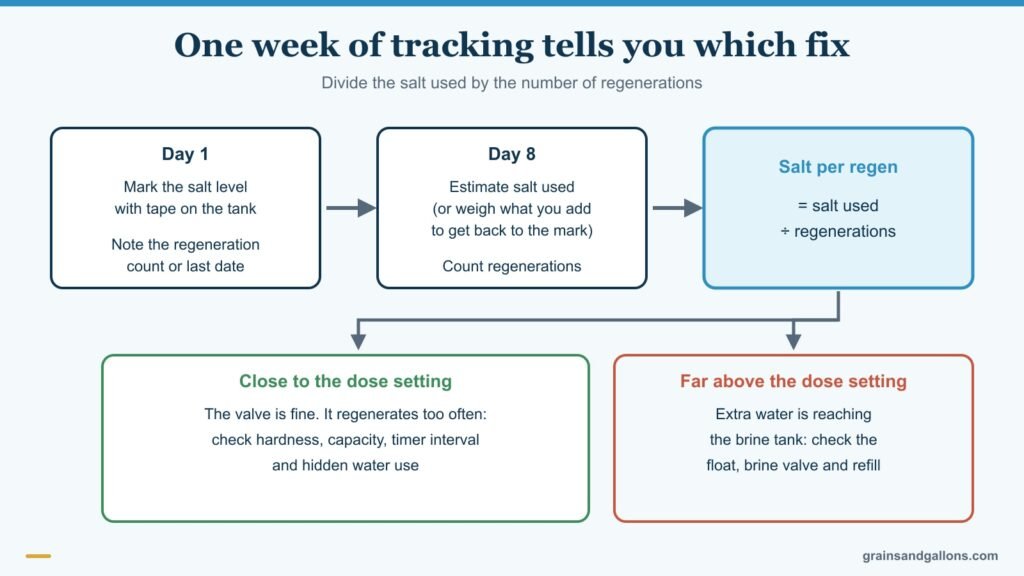
- Fill the salt to a known level and mark it with tape on the outside of the tank.
- Note the regeneration count or the date of the last regeneration if your valve shows it.
- After seven days, add salt back to the mark and weigh what you added, or estimate from the drop. Count how many regenerations happened.
- Divide the salt used by the number of regenerations.
If each regeneration uses roughly what the dose setting says, the valve is fine and the problem is frequency: hardness, capacity, timer settings or water use. If each one uses far more, extra water is reaching the brine tank. A smart salt level sensor can log the level for you and make a sudden drop obvious.
When the softener itself is the problem
Older timer-based softeners regenerate on a schedule whether you used water or not, and units that are badly undersized for the house regenerate constantly. Newer metered valves regenerate only when needed, and many run efficiently at lower salt doses. If your unit is old and your numbers still don't add up after fixing the settings, compare options in our list of high-efficiency water softeners that save salt.
Measure first, then fix the setting or the leak
Water softener salt dissolving too fast almost always comes back to how much brine the softener makes and how often. Do the math for your house, correct the hardness and dose, track one week, and the result points you either to the settings and water use or to water sneaking into the brine tank.
FAQ
How many bags of salt should a water softener use per month?
It depends on hardness, water use and the salt setting. In our example of a 1.5 cubic foot softener treating 250 gallons a day of 15 gpg water, rated figures work out to about 28 to 48 lb a month, so roughly one 40-lb bag. Very hard water or high salt settings push it higher.
Why did my water softener suddenly start using more salt?
The usual causes are a new leak or running toilet, extra people in the house, a hardness or capacity setting that changed after a reset, or water leaking into the brine tank through a stuck float or brine valve. A salt bridge collapsing can also make the level drop suddenly.
Does salt type change how fast the salt goes down?
The level can drop at a different rate because crystals, solar salt and pellets pack differently, even when the pounds used stay the same. Potassium chloride genuinely uses more, because manufacturers such as Whirlpool tell you to raise the hardness setting when you switch to it.
Can a stuck float make a softener use too much salt?
Yes. If the float or brine valve lets extra water into the brine tank, that water dissolves more salt than the valve meant to use, and the excess brine goes to drain or out the overflow. A brine level much higher than normal is the giveaway.
Should I lower the salt setting to save salt?
Often, yes. Lower doses remove more hardness per pound of salt, so a moderate setting with slightly more frequent regenerations usually uses less salt overall. Check that your water stays soft for a week or two after changing it.