


Quick Answer: A brine tank float stuck up keeps the shutoff closed, so the tank won't refill and the softener stops softening within days. A float stuck down can't stop an overfill, so the tank can flood if the refill or power misbehaves. Either way, bypass the softener, pull the float assembly out of the brine well and rinse it in warm water; salt crust or sludge is behind most stuck floats. If the float is cracked, waterlogged or its check won't seat after cleaning, replace the assembly; on Fleck valves that's commonly the Fleck 2310 safety float, 60014.
Disclosure: As an Amazon Associate, Grains & Gallons earns from qualifying purchases.
You opened the brine tank lid, looked down the brine well, and the float is sitting where it shouldn't be. Maybe it's jammed at the top and the tank is bone dry. Maybe it's resting on the bottom while water creeps toward the overflow. A brine tank float stuck in either position is the same part with opposite problems, and both are usually fixed with warm water and a little patience.
In this guide
What the safety float actually does
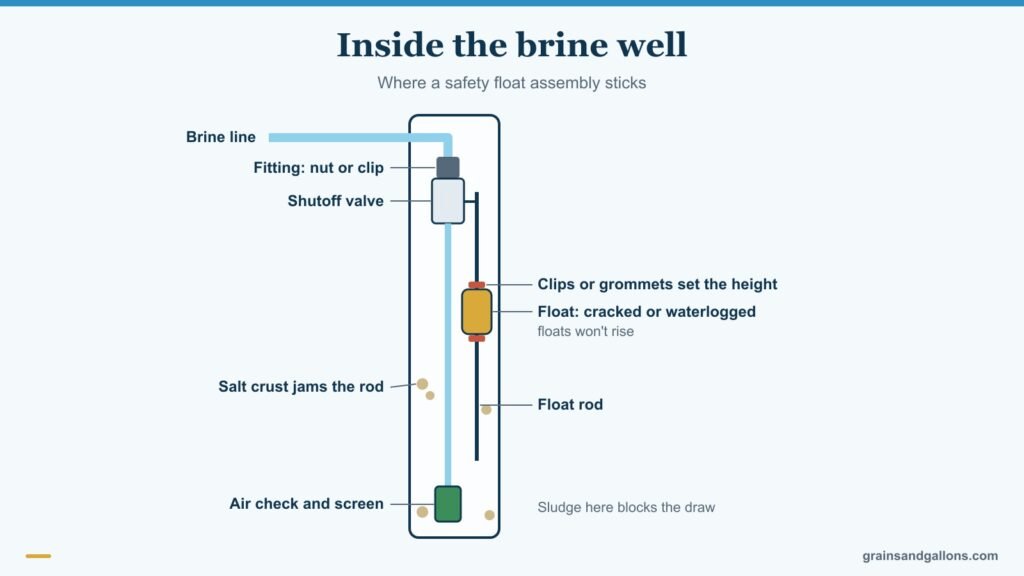
On most two-tank softeners, a tube called the brine well stands in a corner of the brine tank. Inside it is the safety float assembly: a float on a rod, connected to a small shutoff valve at the end of the brine line. It has two jobs:
- Overflow protection. As the water level rises, the float rises. At its set height, it closes the valve and stops more water coming in. Normally the control valve's timed refill stops the water first; the float is the backup.
- Air check (on many assemblies). At the bottom is a check that closes when the brine is drawn down, so the valve doesn't suck air into the system.
That backup matters more than it sounds. Fleck's 5600SXT service manual notes that if power fails during a regeneration, the valve stays where it is until power returns, and says the system should include safety components to prevent overflows from exactly that. The same manual lists the 2310 float assembly and a #500 air check among its brine tank parts.
Cabinet-style all-in-one softeners may use a different float or level-sensing design, and some have no safety float at all. If you can't see a brine well, check your owner's manual. Our explainer on water softener brine tank internals shows the parts in more detail.
Brine tank float stuck up, down or partway: the symptoms

| Float position | What happens | What you'll notice |
|---|---|---|
| Stuck up (valve closed) | Refill water can't get into the tank, and brine may not be drawn | Brine tank dry or very low; salt not going down; hard water within days |
| Stuck down (valve open) | The float can't stop an overfill | Usually nothing at first. If the refill control or valve also misbehaves, water rises toward the overflow |
| Stuck partway | Shuts off at the wrong level | Short refills (weak regenerations) or a water level higher than normal |
The "stuck up" case sends people looking, because it shows up as hard water. If your tank is dry, also read no water in the brine tank, since a clogged brine line or injector can cause the same symptom.
The "stuck down" case is sneaky. A softener can run for months with a stuck-down float because the timed refill works fine. Then a refill control clogs, or the power cuts out mid-refill, and there's nothing to stop the water. Clack's WS1 service manual treats excessive water in the regenerant tank as its own fault, pointing to refill settings and the refill flow control, which is exactly when a working float earns its keep. If a stuck float let the level climb, free it and run a manual regeneration to draw the extra water down. If you're already dealing with high water, go to brine tank full of water or overflowing.
Why floats stick in the first place
- Salt in the brine well. Pellets that fall into the well when you refill pack around the rod and float. This is the most common cause.
- Salt mush and sludge. Low-purity salt or broken-down pellets leave a paste that coats the float guide and the check at the bottom.
- A waterlogged or cracked float. A float that has taken on water can't rise to its shutoff height.
- Loose clips or a missing float weight. After a tank cleanout, a clip or weight left off lets the float drift or bind.
- Iron and sediment. On well water, rust-colored sludge settles in the tank and gums up moving parts.
Free and clean a stuck float

Before you start: Put the softener in bypass and unplug it, and make sure it isn't mid-regeneration, so it can't start a refill or draw while your hands are in the tank. Brine is harsh on cuts, so gloves help.
- Clear the top of the brine well. Scoop out any salt that fell into the well.
- Disconnect the brine line from the fitting at the top of the brine well. It's usually a compression nut or a push-in fitting with a clip. Note how it was routed.
- Lift the float assembly straight out and look for the cause: typically salt crust on the rod or float guide, mushy sludge around the bottom check, or a float that's taken on water.
- Rinse in warm water for a few minutes and work the float up and down until it slides freely. Clean the screen or check at the bottom so the check ball moves.
- Shake the float. If you hear water inside, or it's cracked, it won't rise correctly. Replace it.
- Wipe out the brine well, reinstall and reconnect. Tighten the brine line fitting snug, not crushed. A loose fitting lets air in, which causes its own problems; see our guide to a brine line air leak.
If the tank is full of sludge, the float will gum up again quickly. Take the chance to clean the brine tank properly.
Test the shutoff before you walk away

A float that slides freely in your hand still has to stop water. Return the softener to service and start a manual regeneration (our guide to manually regenerating a water softener covers the common valves).
- During brine draw, the tank level should drop steadily.
- During refill, lift the float by hand to its closed position. Water flowing into the tank should stop completely. Let it go and flow should resume.
- At the end of refill, the level should settle at its usual height with the float not yet closed.
If water keeps flowing with the float held up, the shutoff seat is worn or fouled and the assembly needs cleaning again or replacing.
Setting the float height

Most adjustable floats are set by sliding the float along its rod, or by clips or grommets on the rod. The float should shut off above your normal refill level, so it only acts if something has gone wrong, but well below the overflow fitting.
Your control valve's manual or the softener's installation guide should give a setting for your tank size and salt dose. If you can't find one, watch the next refill: the float shouldn't close before the refill finishes. If it does, raise it. If water can reach the overflow before it closes, lower it.
Don't use the float to "limit" brine on purpose. The salt dose should be set at the control valve. A float that shuts off every refill early makes regeneration unpredictable.
When cleaning isn't enough

Replace the assembly if:
- The float has a crack or water inside it
- The rod is bent or the guide is broken
- The check at the bottom won't seat after cleaning
- The plastic is brittle from age
Match the replacement to your valve and tank height. Floats come with different rod lengths and brine line sizes, and a Fleck-style 2310 assembly isn't the same part as a Clack quick-connect float. Our guide to the best brine tank safety floats sorts them by valve brand and tank height.
Keep pellets out of the brine well
- Pour salt beside the brine well, not over it, so pellets don't fall in.
- Use clean pellets or high-purity crystals. Low-purity salt leaves sludge that coats the float.
- Lift the brine well cap every few months and move the float up and down to make sure it slides freely.
- After any tank cleanout, check that every clip and weight went back on.
FAQ
How do I know if my brine tank float is stuck?
Lift the brine well cap and push the float gently. It should slide up and down its rod with no binding. A float that won't move, a dry tank with hard water, or a water level climbing toward the overflow all point to a stuck float.
Can a stuck float cause hard water?
Yes. A float stuck up keeps the shutoff closed, so the tank doesn't refill and no brine is made. Without brine, the resin can't regenerate and hardness returns within days.
Can a stuck float cause the brine tank to overflow?
It removes the backup. A float stuck down won't close if the timed refill overruns or the power fails mid-refill, so the water can keep rising to the overflow fitting.
What height should the brine tank float be set at?
Use the setting in your valve or softener manual. Without one, set it so it closes above the normal refill level but well below the overflow fitting, then confirm it doesn't close before a refill finishes.
Do I need to replace the float or just clean it?
Clean it first; salt crust and sludge cause most sticking. Replace it if the float is cracked or waterlogged, the rod is bent, the check won't seat, or the plastic is brittle.
A float that slides freely is a float that protects you
A brine tank float stuck up shows itself fast as hard water; one stuck down hides until the day the tank floods. Pull the assembly, rinse off the salt crust, shake-test the float, prove the shutoff by hand during a refill and set the height above the normal fill. Then keep pellets out of the brine well, and it should stay free.