

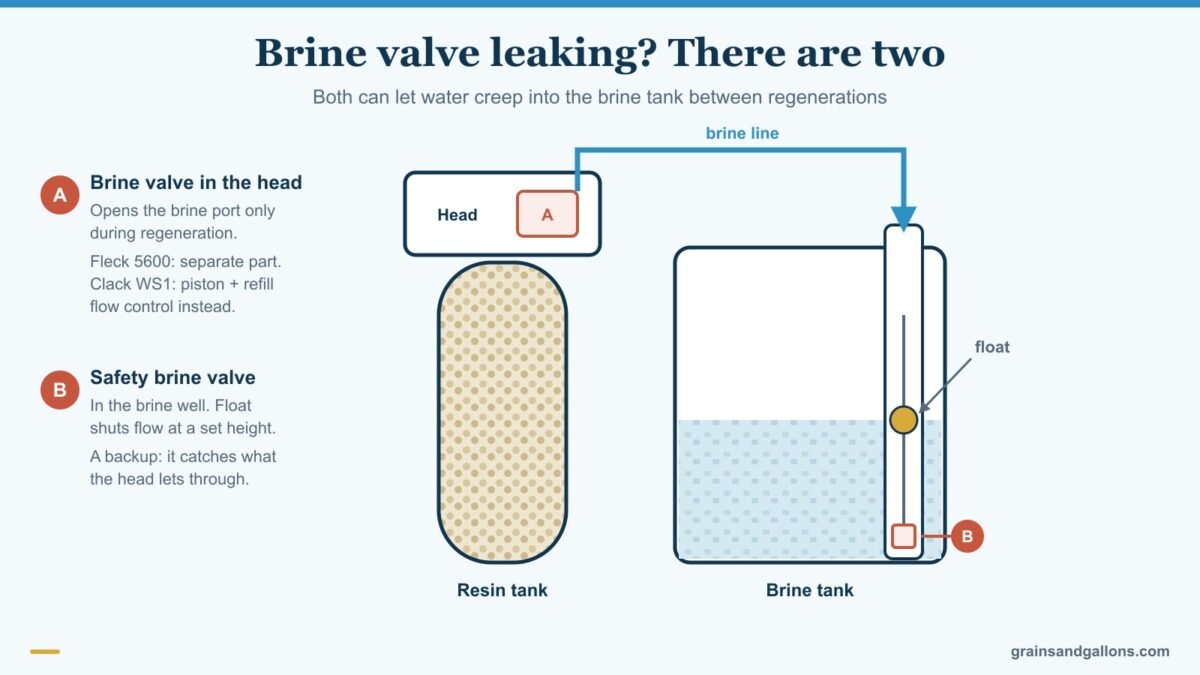
Quick Answer: A brine valve leaking shows up as a brine tank that slowly fills between regenerations. Mark the water level with tape and leave the softener alone for 8 to 12 hours. If the level climbs, water is getting past either the safety brine valve in the brine well (usually salt grit on its seat) or the brine valve, piston or seals in the control head. Pull and rinse the safety valve first and retest. If it still creeps, replace it; on Fleck systems that's typically the Fleck 2310 safety brine valve (60014). If the safety valve tests good, the head is passing water.
Disclosure: As an Amazon Associate, Grains & Gallons earns from qualifying purchases.
A brine valve leaking is confusing for one simple reason: two different parts get called "the brine valve," they sit about three feet apart, and both fail the same way. Water seeps into the brine tank when nothing should be moving. Fix the wrong one and the level keeps rising.
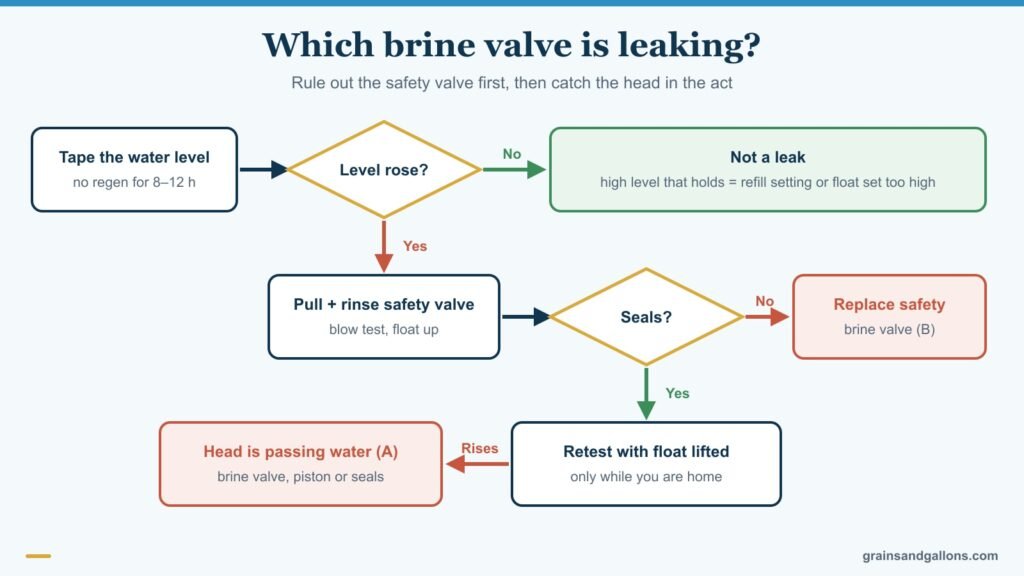
So before you buy anything, figure out which valve is actually leaking.
In this guide
- The two valves that both get called "brine valve"
- Match what you see to the right valve
- Test 1: Is the safety brine valve leaking or just dirty?
- Test 2: Is the control head passing water?
- Fixing a leaking brine valve in the control head
- Not every rising level is a leaking valve
- Keep a slow leak from becoming a flood
- FAQ
- Find the leaking valve before you buy a part
The two valves that both get called "brine valve"
The safety brine valve lives inside the brine well, the tall tube in the corner of the salt tank. It's a float on a rod attached to a small valve body at the end of the brine line. When water rises to the float's set height, the float lifts and shuts the valve. Many also carry an air check at the bottom that closes when the tank is drawn down. Fleck's 2310 is the most common example (the Fleck 5600SXT service manual lists it as assembly 60014), and you'll find similar assemblies on Clack and other systems. Our guide to replacement brine tank safety floats lists the common sizes and which control valves they pair with.
The brine valve in the control head opens and closes the brine port during regeneration. Not every valve has a separate one. The Fleck 5600 does: the manual's parts list shows a brine valve stem, seat, spring, spacer and cap pressed into the injector body, next to the piston. Other heads, Clack included, route brine draw and refill through the main piston and a refill flow control, so there's no separate brine valve to swap. On those, "brine valve leaking" really means a piston, seal or refill flow control problem.
Here's the important bit. On many softeners the safety valve is only a backup. During normal service the control head holds the brine port closed. If water creeps into the tank between regenerations, the head is passing water and the safety valve isn't catching it, or the safety float is set so high it never gets the chance.
Match what you see to the right valve
| What you notice | Most likely culprit | First move |
|---|---|---|
| Level creeps up slowly between regenerations, no overflow yet | Control head brine valve or piston seals passing water | Tape test, then inspect the head |
| Level rises until water runs out the overflow fitting | Head is passing water and safety float isn't shutting it off | Clean and reset the safety valve today; then fix the head |
| Level way above normal right after a regen, then holds steady | Refill running too long or float set too high, not a leak | Check refill setting and float height |
| Level never drops much during regeneration | Clogged injector or drain line flow control, not a leak | Clean the injector and screen |
| Salt water dribbling into the drain line all the time | Head passing brine to drain (piston/seals) | See the control valve section below |
| Drip at the brine line fitting outside the tank | Loose compression nut, cracked ferrule or tubing | Snug the fitting, recut the tubing end |
| Tank won't draw down and valve "sucks air" | Air check stuck or brine line leaking air | Clean the air check; see our brine line air leak guide |
If the tank is close to the top, deal with that first. Put the softener in bypass, scoop or pump water out to a normal level, and read our guide to a brine tank full of water or overflowing for every reason a tank floods.
Test 1: Is the safety brine valve leaking or just dirty?

This takes about 10 minutes and needs no tools.
- Put the softener in bypass and unplug it, so nothing moves mid-test.
- Lift the brine well cap and pull the float assembly straight up. Most come out once you loosen the brine line nut at the valve head or at the tank wall. Some lift out with the tubing still attached.
- Look at the seat and the float. You're hunting for salt crust on the rod, grit on the rubber seat, a float that's cracked and half full of water, or a float stop clip that's slid up the rod.
- Blow through the brine line end of the valve with the float hanging down: air should pass. Lift the float to the top of its travel and blow again: it should seal tight. If air leaks past with the float up, the seat isn't closing.
- Rinse everything in warm tap water. Don't pick at the rubber seat with anything sharp.
If it seals after cleaning, put it back with the float clip where it was. If it still leaks with the float lifted, or the float has water in it, replace the assembly. Match the rod length to your brine well height and the valve body to your brine line size. A float that's sticking rather than leaking is covered in our stuck brine tank float guide.
Test 2: Is the control head passing water?

With the safety valve cleaned and known-good, you can catch the head in the act.
- Return the softener to service and plug it back in.
- Mark the water level in the brine tank with masking tape.
- Temporarily raise the safety float clip a couple of inches higher than normal, or lift the float out of the water and leave it resting dry in the well. That takes the backup out of the picture so you can see the head's leak clearly. Only do this while you're home and watching.
- Don't let it regenerate. Check the tape mark after 8 to 12 hours.
- Put the float back to its normal height when you're done.
If the level rose, the head is letting water into the brine line when it shouldn't. Nothing inside the tank will fix that.
Fixing a leaking brine valve in the control head
What's inside depends on the brand.
- Fleck 5600 / 5600SXT: the brine valve presses into the injector body beside the piston. For "excessive water in brine tank," the manual's troubleshooting chart lists foreign material in the brine valve or brine line flow control, a plugged injector, and an internal control leak, with fixes that include replacing the brine valve seat and cleaning the valve, or changing the seals, spacers and piston. On an older head, a rebuild kit covers most of these.
- Fleck 7000, 2510, 9100 and others: layouts differ. Check the service manual for your exact model before you pull anything apart.
- Clack WS1 and similar: leakage into the brine tank usually traces to the piston, spacer stack, or debris in the refill flow control. The Clack WS1 drawings and service manual shows the refill flow control assembly and piston stack.
Whatever the brand, the basics are the same: bypass, unplug, relieve pressure by opening a softened-water tap, and only then open the valve. Both Fleck and Clack call for silicone lubricant only. Use a silicone compound such as Molykote 111, never petroleum jelly, which can swell rubber seals. Our walkthrough on servicing a water softener control valve covers pulling a piston and seal stack, and the guide to leaking O-rings helps if you also find water outside the valve.
When the head is old, the piston is scored, or the timer is acting up too, a rebuild isn't always the cheapest path. If you're weighing it, see our picks for the best replacement control valves, which fit a standard 2.5" tank thread.
Not every rising level is a leaking valve

A clogged injector can mimic a leak
If the level rises a little after every regeneration but holds steady between them, the problem may be brine draw, not a valve leak. A plugged injector, injector screen or drain line flow control weakens the suction that pulls brine out, so each refill lands on top of water that never left. The Fleck manual lists both as causes of excessive water in the brine tank.
The quick check: start a manual regeneration and watch the brine tank during the brine draw step. The level should drop noticeably. If it barely moves, clean the injector before you replace any valve; our injector cleaning guide shows how.
Settings and salt that look like a leak
- A refill setting that's too long. On digital heads, the refill time or salt dose sets how much water goes in. If the salt setting got bumped up, the tank fills higher after every regen, then stays put. That's a setting, not a leak.
- A float set too high. If the float clip sits near the top of the rod, the backup only shuts off near the overflow. Lower it to a few inches above your normal post-refill level, following the manual for your system.
- A salt bridge. When salt crusts over, water sits under a hollow dome and the level can look odd. Break the bridge before you diagnose anything.
Keep a slow leak from becoming a flood
A leaking brine valve is a slow problem until the day the safety float sticks too. Three habits keep it slow:
- Plumb the overflow. The elbow on the side of the brine tank only protects your floor if a hose runs from it, downhill, to a drain. Our guide to brine tank overflow line requirements covers sizing and the air gap.
- Pull the safety valve once a year. A rinse in warm water clears the salt grit that causes most seat leaks.
- Keep salt below the float. Salt piled against the float and rod can jam it.
Call a water treatment tech or plumber if water is escaping faster than the overflow can drain it, if the overflow isn't plumbed to a drain, or if you're not comfortable opening a pressurized valve. Until then, bypass stops the leak; you'll just have hard water.
FAQ
Why does my brine tank keep filling with water?
Water is getting past a valve that should be closed. The usual causes are grit on the safety brine valve seat, a float set too high, or a control head passing water through a worn brine valve, piston or seals. A clogged injector can also leave water behind after each regeneration.
How do I know if my safety brine valve is bad?
Pull it out, let the float hang and blow through the brine line end, then lift the float and blow again. It should pass air when down and seal tight when up. If it still leaks after a warm-water rinse, or the float has water inside, replace it.
Can I keep using a softener with a leaking brine valve?
For a short time, if the overflow is plumbed to a drain and you watch the level. If water is near the top or the overflow isn't connected, put the softener in bypass until it's fixed.
Is it normal to have water in the brine tank?
Yes, most softeners keep some water in the brine tank so salt can dissolve before the next regeneration. What isn't normal is a level that keeps rising between regenerations.
Can I use Vaseline on brine valve O-rings?
No. Fleck and Clack both specify silicone lubricant only. Petroleum products can swell rubber seals and damage plastic parts.
Find the leaking valve before you buy a part
A brine valve leaking almost always comes down to one of two parts. Rinse and blow-test the safety valve, then use the tape test with the float lifted to catch the control head. Clean or replace whichever one fails, rule out a clogged injector and a high refill setting, and keep the overflow plumbed so a stuck float never reaches your floor.