

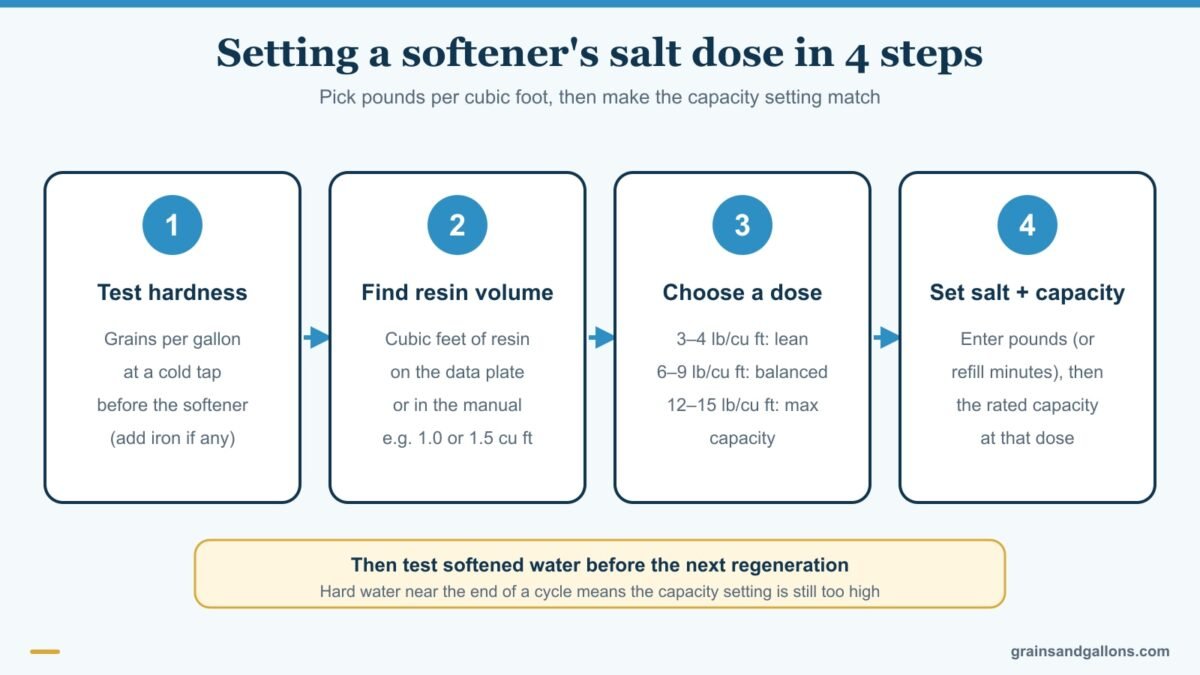
Quick Answer: Here's how to set the salt dose on a water softener: test your hardness, look up how many cubic feet of resin the unit holds, and pick a dose in pounds per cubic foot. About 6–9 lb/cu ft suits most homes. Lower doses save salt but regenerate more often; very high doses buy little extra capacity. Enter the dose (pounds, or brine refill minutes on many Fleck valves), then lower or raise the capacity setting to match your manual's chart.
If a 40-lb bag disappears every week or two, the softener usually isn't broken. It's set to a heavy, factory-style dose. Knowing how to set the salt dose on a water softener saves money every month without new hardware, as long as you change the capacity setting with it.
In this guide
How salt dose relates to softener capacity

The salt dose is the pounds of salt dissolved into brine for each regeneration. It's quoted per cubic foot of resin: a 1.5 cu ft softener at 6 lb/cu ft uses 9 lb.
Each extra pound restores less capacity than the last. Pentair's performance data for a 1.0 cu ft Fleck system shows the curve (Pentair 5600SXT IOM):
| Salt per regeneration (1.0 cu ft) | Rated capacity | Grains per pound of salt |
|---|---|---|
| 3 lb | 11,900 | about 3,970 |
| 9 lb | 31,100 | about 3,460 |
| 15 lb | 35,400 | about 2,360 |
Going from 9 to 15 lb adds two-thirds more salt for about 14% more capacity. The control divides that capacity by your hardness to decide how many gallons it can deliver, so changing the dose without changing capacity breaks the math.
Pick a dose band from your hardness and resin volume
First, test raw water hardness in grains per gallon ahead of the softener (see testing water hardness at home), adding any iron. Then find the resin volume in cubic feet on the data plate or in the manual. Most manuals' salt dosage charts read across from those two numbers. Then choose a band:
- Lean, about 3–4 lb/cu ft. Lowest salt per grain, but more regenerations and more drain water. Best on metered softeners with enough resin to still go several days. See our salt efficiency explainer.
- Balanced, about 6–9 lb/cu ft. The middle of the curve, where many installers land for typical homes.
- Maximum, about 12–15 lb/cu ft. For very hard water or a small softener, at much more salt per grain. Check the signs a water softener is undersized before settling for it.
One softener seller's rule of thumb is about 6 lb/cu ft up to 12 gpg, about 10 lb from 12 to 25 gpg, and about 15 lb above that, starting low and raising it only if softening suffers. Treat it as a starting point, not a replacement for your maker's chart. For any dose, usable capacity divided by daily grain load should give a regeneration every few days to about a week.
Worked example: same house, two doses

Four people, 300 gallons a day at 15 gpg = 4,500 grains per day, on a 1.0 cu ft softener.
- At 9 lb: 31,100 grains, minus a day of reserve (4,500) = 26,600 usable. That's about 6 days between regenerations: 9 lb every 6 days, or roughly 45 lb a month.
- At 3 lb: 11,900 grains, minus the same reserve = 7,400 usable. The meter trips in under 2 days, so it regenerates about every 2 days: 3 lb every 2 days, also roughly 45 lb a month.
The lean dose saved no salt and doubled the regenerations, because holding back a full day's reserve from a small capacity wastes much of each cycle. On a 2 cu ft bed, which Pentair rates at 23,900 grains with 6 lb, the same 3 lb/cu ft dose regenerates about every 5 days on roughly 36 lb a month. More math in how much salt a water softener uses.
How to set the salt dose on a water softener, valve by valve
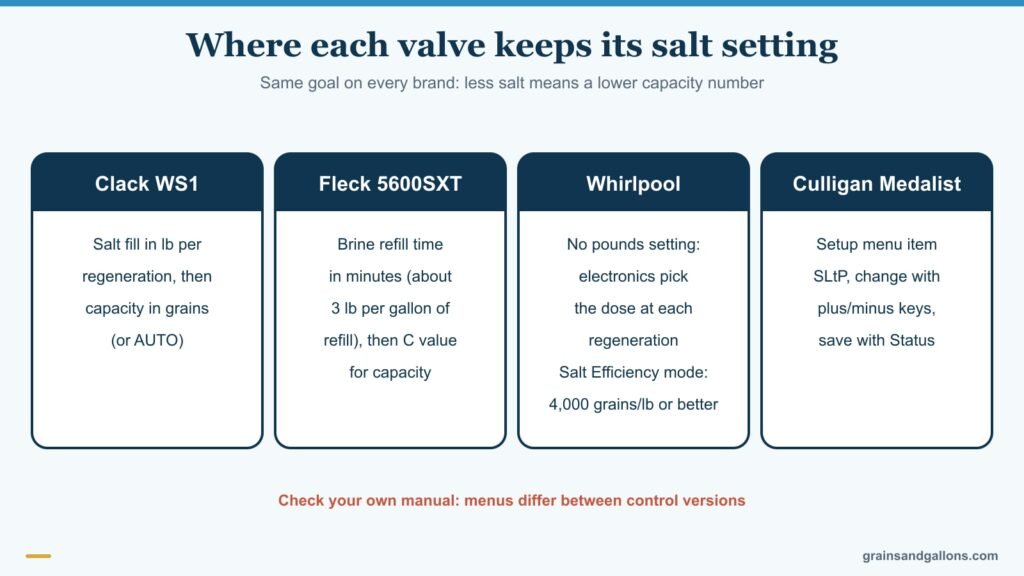
Clack WS1. The installer settings ask for the salt fill in pounds per regeneration, followed by capacity in grains, which Clack says should come from the equipment maker's testing. If you lower the pounds, lower the capacity to match the seller's chart. There's also an AUTO option that calculates capacity and reserve for you (Clack WS1 manual).
Fleck 5600SXT and similar. The salt dose is set by brine refill time in minutes. A refill flow control meters a fixed flow into the brine tank, and installers commonly figure each gallon of refill water dissolves roughly 3 lb of salt. Use the seller's minutes-to-pounds chart for your flow control, then set the C (capacity) value in Master Programming to the rated capacity at that dose.
Whirlpool (WHES3T and similar). You don't set pounds directly. The electronics choose the dose at regeneration time. A Salt Efficiency mode, shipped OFF, runs the softener at 4,000 grains per pound of salt or better through more frequent, smaller regenerations. California requires it ON.
Culligan Medalist. Enter setup, scroll to the salt dosage item (shown as SLtP), change it with the plus and minus keys, save with the Status key and exit. Culligan's Salt Economizer is set by the dealer, so leave that to them.
After any change, follow our guide to setting capacity and reserve. On older dial timers, the salt dial on the brine valve does the same job.
Check the result after a few days of use

Give any change a few regenerations, then test softened water the day before a regeneration, when the resin is closest to exhausted.
- Salt disappearing fast, water always soft: the dose is likely higher than needed. Step down 1–2 lb/cu ft and lower capacity to match.
- Hard water the day before regeneration after lowering the dose: the capacity setting wasn't lowered enough.
- Regenerating daily: dose too low for the bed, or the softener is undersized.
- Salty taste after regeneration: usually a slow-rinse or injector issue rather than dose (see why softened water tastes salty), though a heavy dose makes it more noticeable.
Salt quality matters too: low-purity rock salt leaves residue that clogs the brine system and weakens the brine. Penn State Extension has a plain-English primer on how regeneration works. Our softener salt guide covers which pellets dissolve cleanly.
Lower the salt, then lower the capacity
The whole trick to how to set the salt dose on a water softener is that two numbers move together. Pick the dose band that fits your hardness and resin volume, enter it in the form your valve uses, and then set the capacity your manual lists for that dose. To skip the fiddling, start with our best high-efficiency water softeners.
FAQ
What is a good salt setting for a water softener?
For most homes, about 6–9 lb of salt per cubic foot of resin is a sensible middle ground. Go lower if you have a large resin bed and moderate hardness, and higher only if the water is very hard or the softener is small for the house.
Does a higher salt setting make water softer?
Not really. A higher dose mainly lets the softener treat more gallons between regenerations. If water is hard right after regeneration, check brine draw, the injector or the bypass instead.
Do I need to change the capacity when I change the salt dose?
Yes. The control uses capacity and hardness to count down gallons. Lowering salt without lowering capacity means the softener runs out before it regenerates, and you get hard water at the end of each cycle.
Does switching to potassium chloride change the salt setting?
Usually yes. Potassium chloride regenerates resin less effectively per pound than sodium chloride, so many manufacturers suggest raising the dose when you switch. Check your manual for the exact adjustment.