

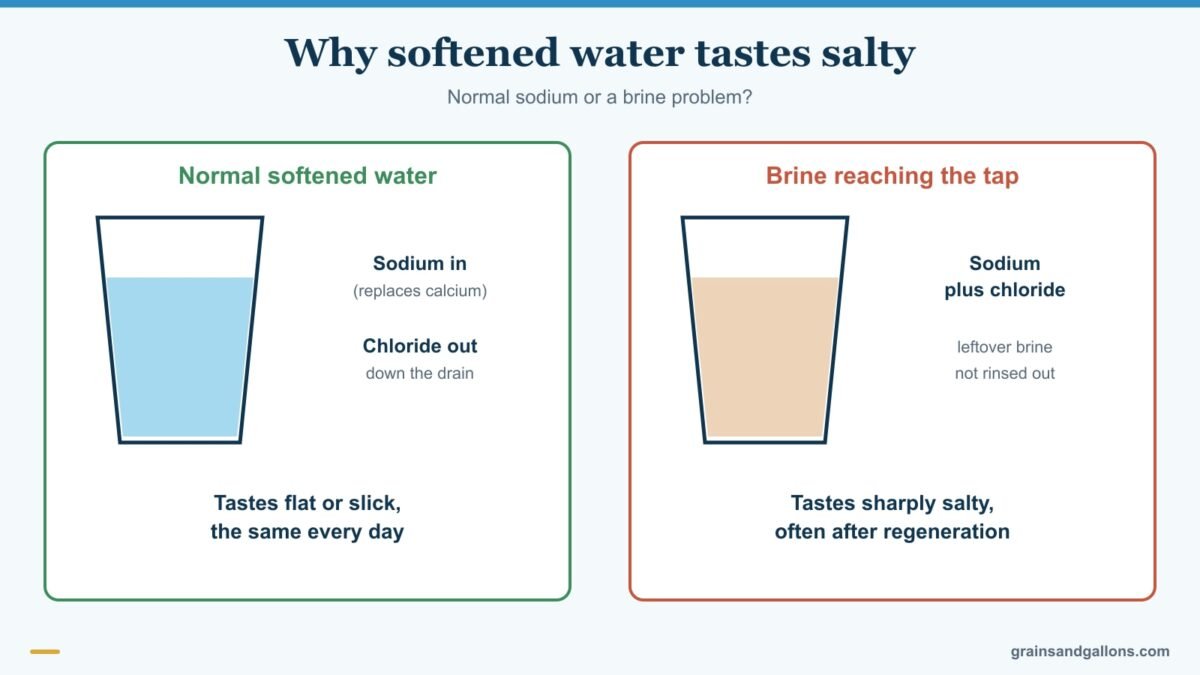
Quick Answer: Here's why softened water tastes salty, and when it shouldn't. A softener adds some sodium but no chloride to your water, so properly softened water usually tastes flat or slick, not like seawater. If yours tastes clearly salty, brine is probably reaching the house because a regeneration didn't finish rinsing. Run a manual regeneration, let it complete without using water, then flush a cold tap for a few minutes. A cheap HM Digital TDS-3 meter shows the difference fast: brine spikes the reading far above your normal softened water.
Disclosure: As an Amazon Associate, Grains & Gallons earns from qualifying purchases.
You filled a glass, took a sip, and it tasted like the ocean. Or maybe it's subtler: a faint saltiness you never noticed before the softener went in. Working out why softened water tastes salty starts with telling those two situations apart, because the fix depends on which one you have.
In this guide
- First, decide which kind of "salty" you're tasting
- How much sodium softening adds
- Why softened water tastes salty right after regeneration
- If it tastes like actual salt water, check these in order
- Confirm it with a TDS meter and a bypass test
- Is salty softened water safe to drink?
- When it's normal sodium and you still don't like it
- FAQ
- Rinse out the brine, then decide about the sodium
First, decide which kind of "salty" you're tasting

A softener swaps calcium and magnesium for sodium. It does not add the chloride half of the salt to your water during normal operation; the chloride leaves down the drain with the spent brine. That's the key to telling normal from not normal.
| What you notice | What it most likely is |
|---|---|
| Water tastes slightly flat, soft or "slick," same every day | Normal sodium from softening |
| Faint salty note, stronger on very hard water | Normal, but your starting hardness is high, so more sodium is added |
| Sharp, briny taste, like a pinch of salt in the glass | Brine reaching the house |
| Salty mainly in the morning or right after the softener cycles | Incomplete rinse after regeneration |
| Salty constantly, and the brine tank water level keeps rising | Brine draw or refill problem, possibly brine leaking through the valve |
| Salty even with the softener in bypass | Sodium in the source water itself |
How much sodium softening adds

You can estimate it. North Dakota State University Extension's guide to ion-exchange water softening puts it at about 8 mg/L of sodium for every grain per gallon of hardness removed. That follows from the chemistry: two sodium ions replace each calcium ion.
- 10 gpg water → about 80 mg/L sodium
- 20 gpg water → about 160 mg/L sodium
- 30 gpg water → about 240 mg/L sodium
For comparison, EPA's drinking water advisory on sodium recommends keeping sodium at or below 30 to 60 mg/L to avoid taste problems, describing that range as a threshold for taste-sensitive people. So on very hard water, some people really can taste properly softened water. That's the softener doing its job, not a fault. Our breakdown of sodium in softened water goes deeper.
Why softened water tastes salty right after regeneration
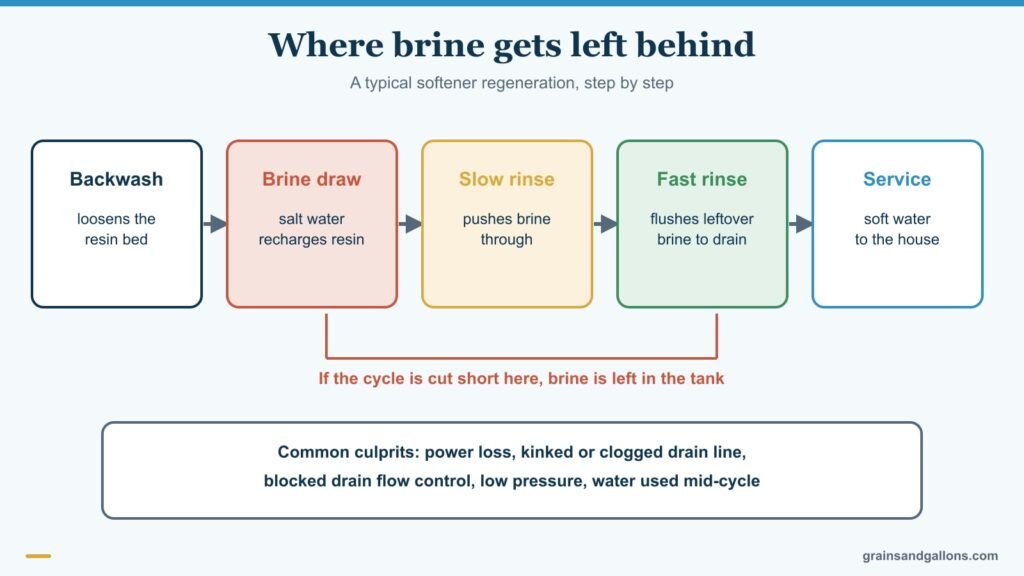
Regeneration pulls concentrated brine through the resin to recharge it, then rinses that brine out to the drain before the valve returns to service. Anything that cuts the rinse short leaves brine sitting in the resin tank, and the next water you draw pushes it into your pipes. That's the classic "salty in the morning" pattern, since most softeners regenerate overnight.
The usual reasons a rinse falls short:
- Power loss mid-cycle. The valve may stop or reset partway through. On many valves a flashing clock is the giveaway.
- Water used during regeneration. Running a shower or dishwasher while the softener is brining can pull brine straight into the house.
- A restricted drain. A kinked, clogged, frozen or overly long drain line, or a blocked drain flow control, weakens the rinse.
- Low water pressure. Softeners need enough pressure to draw brine and rinse properly; when it sags, the cycle doesn't clear the tank.
- Rinse settings cut too short. Some valves let you set rinse times, and a setting that's too short leaves brine behind.
If it tastes like actual salt water, check these in order
Work from the quickest checks to the ones that need tools. Put the softener in bypass before you take anything apart.
1. Flush it out and run a clean regeneration
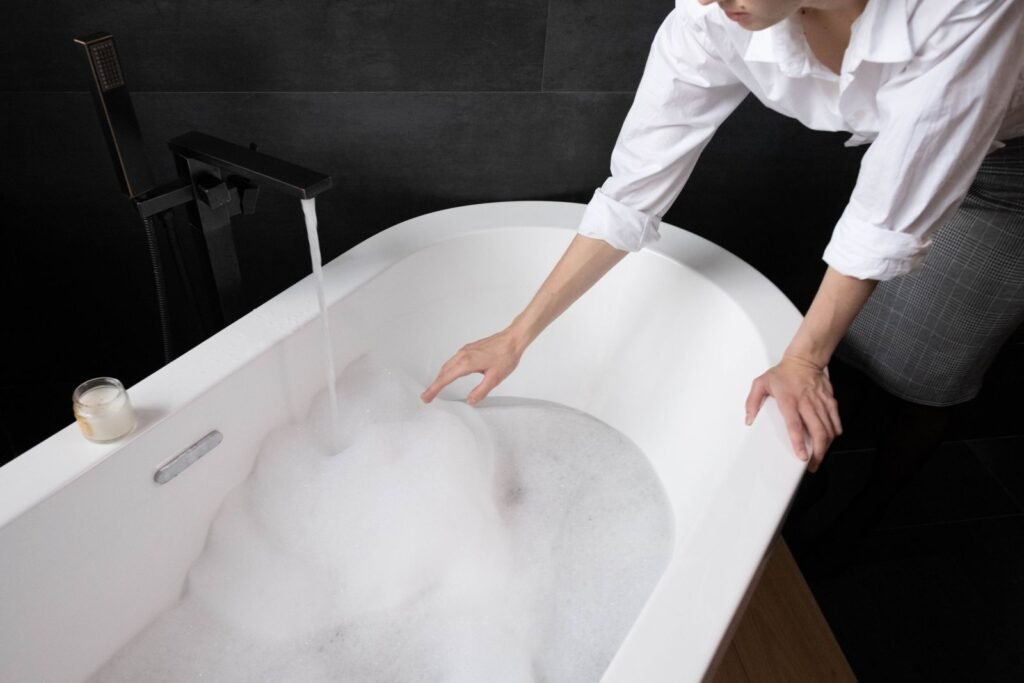
Run a manual regeneration and let it finish without using any water. Then open a cold tap (a bathtub is good, since it flows fast) and run it for several minutes. If the taste clears and doesn't come back, it was a one-off, often a power blip.
2. Check the drain line and rinse flow
The fast rinse is what flushes leftover brine and packs the resin bed. Look along the drain line for kinks, crushed spots or a frozen section, and during the next regeneration check that water flows strongly out of the drain during rinse. Our guide to fast rinse cycle problems covers the drain flow control and rinse settings.
3. Clean the injector
The injector (venturi) uses water flow to suck brine out of the tank. When salt grit or sediment partly blocks it, brine draw and rinse can both go wrong. Soak the injector parts rather than poking the tiny nozzle with metal. Our walkthrough on how to clean a water softener injector shows where it lives on common valves.
4. Look at the brine tank water level
If the tank overfills, each regeneration can draw more brine than the rinse was designed to clear. A rising water level, or water close to the overflow fitting, is the giveaway. See brine tank full of water or overflowing.
5. Suspect the valve if the taste never goes away
Worn seals and spacers inside the control valve, or a brine valve that doesn't close, can let small amounts of brine bleed into service water between regenerations. This tends to cause a steady saltiness rather than a morning-only taste, often with high salt use. Our guide to a leaking brine valve covers the symptoms; the fix is usually a seal kit or a service call.
6. Confirm the programming
After a power outage or a new install, check that the time of day, regeneration time and hardness setting are right. A softener set to regenerate in the middle of the morning rush will send brine to whoever is in the shower.
7. Check recent plumbing work
After new installs or plumbing changes, make sure inlet and outlet weren't reversed. Look for the flow arrows on the valve or bypass and confirm the supply line goes into the side marked "in."
Confirm it with a TDS meter and a bypass test

Taste is a poor instrument. A handheld TDS meter costs little and makes the call much clearer:
- Read your untreated water. Use the bypass, an outdoor spigot that skips the softener, or a sample from before the softener.
- Read your softened water on a normal day. It'll usually be close to the untreated reading, sometimes a little higher.
- When the water tastes salty, read it again. A brine leak usually pushes the number far above both.
The bypass reading also catches the case where the softener isn't to blame at all. If water still tastes salty with the softener bypassed, the sodium is in your source water, which can happen with some wells and coastal supplies. A lab test for sodium and chloride will tell you how much. If you need a meter, our list of the best TDS meters covers reliable pocket models.
Is salty softened water safe to drink?

Normal softened water is generally fine for healthy adults; the sodium it adds is small compared with most diets. But two groups should take it seriously:
- People on sodium-restricted diets. EPA's guidance level for people limited to 500 mg of sodium a day is 20 mg/L in drinking water, a number softened hard water easily passes. If you've been told to limit sodium for blood pressure, heart or kidney reasons, ask your doctor and see our guide to water softeners for low sodium diets.
- Infants. Ask your pediatrician what water to use for formula; many parents use unsoftened or bottled water.
Water that tastes sharply briny is a different matter. That's a softener fault, and it's worth fixing rather than drinking around.
When it's normal sodium and you still don't like it
Plenty of people simply prefer drinking water without the extra sodium. Three good options:
- Leave the kitchen cold tap unsoftened. NDSU recommends exactly this for avoiding sodium from softened water, and many installers plumb it that way. Our article on whether a kitchen tap should bypass the softener weighs the trade-offs.
- Add reverse osmosis for drinking water. RO removes most of the sodium. If you can't plumb under the sink, a countertop reverse osmosis system gives you the same benefit without a drill.
- Switch to potassium chloride. It replaces sodium with potassium, though it costs more, and NDSU notes you'll need roughly 10% more of it, so adjust your salt setting.
FAQ
Should softened water taste salty?
No. Properly softened water may taste a little flat or slick, and people on very hard water may notice the added sodium, but it shouldn't taste like salt water. A distinctly salty or briny taste points to brine that wasn't rinsed out.
Why does my softened water taste salty only in the morning?
Most softeners regenerate overnight. If the cycle was cut short, or someone used water while it was brining, leftover brine sits in the tank and comes out with the first water of the day. Run a manual regeneration with no water use and check the drain line.
How do I flush salt out of my water softener?
Run a complete manual regeneration without drawing any water, then run a cold bathtub tap for several minutes until the taste clears. If saltiness keeps returning, check the drain line, injector and brine tank water level.
Can a water softener make well water taste salty?
Yes, if it isn't rinsing properly, the same as on city water. But some well water carries natural sodium, so test with the softener in bypass. If it's still salty bypassed, the source water is the cause.
How do I reduce sodium in softened water?
Leave one kitchen tap unsoftened, add a reverse osmosis filter for drinking water, or switch to potassium chloride salt. Setting the softener's hardness correctly also avoids over-regenerating.
Rinse out the brine, then decide about the sodium
The answer to why softened water tastes salty is usually one of two things: normal sodium you can taste because your water started very hard, or brine that a short or interrupted rinse left behind. Brine is a fault you fix with a clean regeneration and a check of the drain, injector and brine tank; normal sodium is a preference you handle with an unsoftened tap, RO or potassium chloride.