

Quick Answer: Upflow (counter-current) softeners send brine up through the resin, against the direction of service flow. That lets them regenerate well on smaller salt doses. Our top pick is the SoftPro Elite HE 64k, with the smaller SoftPro Elite HE for Well Water 32k for smaller well homes. For one or two people, the Genesis 2 Premier 24k is a well-sized upflow option. One honest caveat: most of the salt savings come from demand regeneration and a low salt setting. Upflow adds to that, but by itself it isn't magic.
Disclosure: As an Amazon Associate, Grains & Gallons earns from qualifying purchases.
Here's something upflow sellers rarely say up front: a good downflow softener on a low salt setting can already be very efficient. Whirlpool's manual for its WHES40 platform, a conventional cabinet unit, lists a rated efficiency of 5,094 grains per pound of salt at the minimum dose. NSF/ANSI 44 only awards an efficiency rating to softeners that remove at least 3,350 grains per pound. So "low salt" isn't exclusive to upflow.
Upflow still makes sense for some homes. The point is to buy it for the right reasons and set it up so it actually saves salt. If you'd like the mechanics first, our guide on how softener regeneration works explains each cycle.
In this guide
What changes when brine flows up
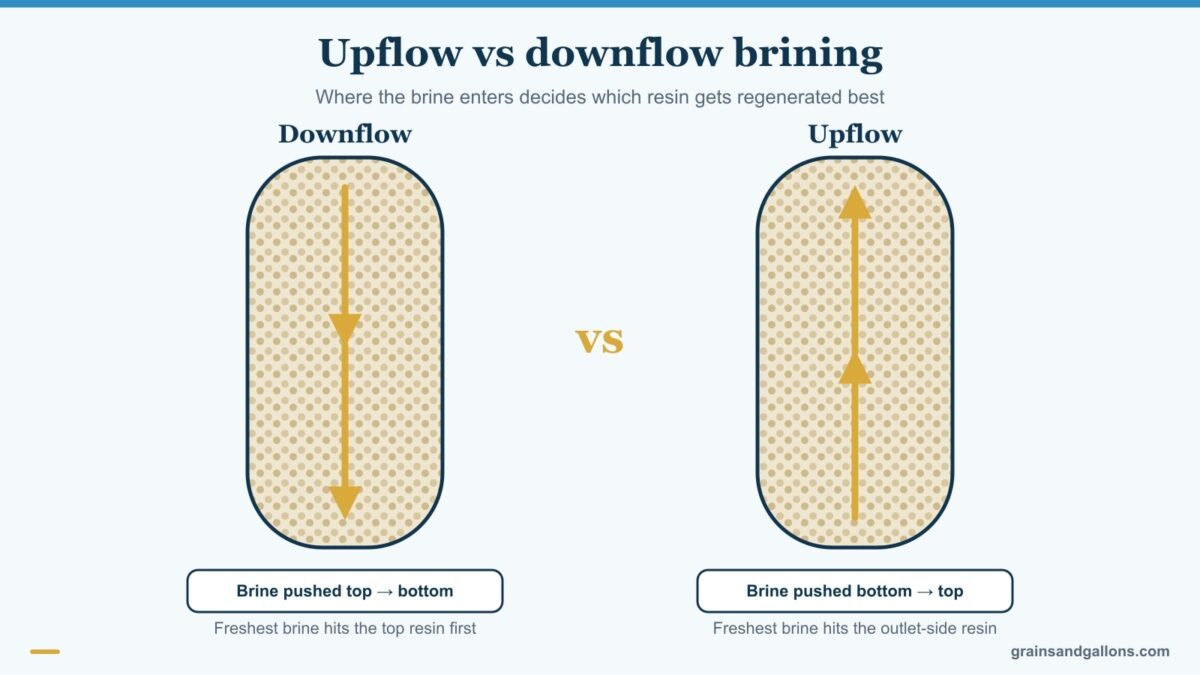
In a downflow (co-current) softener, brine enters at the top and pushes down, the same direction as service water. The resin at the bottom of the tank, the last resin water touches before it leaves, gets the weakest, most-used brine. To make sure that bottom layer is fully recharged, downflow units lean on bigger salt doses.
In an upflow (counter-current) softener, brine enters at the bottom and rises. The freshest brine hits the bottom "polishing" layer first. That's the layer that decides how much hardness leaks into your house. You get low leakage even on a lighter salt dose.
Some numbers from published industry sources (via SoftPro's summary of trade literature):
- Downflow: roughly 6–15 lb of salt per cubic foot of resin per regeneration
- Upflow: around 4 lb per cubic foot or less
- Industry write-ups put the salt saving from counter-current regeneration at up to about a third
And the counterweight, from SoftPro's own "upflow myths" page:
- The upflow edge in grain-capacity efficiency is modest, under 10%
- It helps little above about 25 gpg, or when iron, manganese or sediment is present
- Demand-initiated regeneration does most of the salt-saving work, whichever way the brine flows
So upflow pays off most in homes with moderate hardness (roughly 8–25 gpg), clean water, and an owner willing to set a low salt dose. Our guide on water softener salt efficiency shows how to work out grains per pound for any unit.
The five upflow softeners
Only a few brands sell genuine upflow residential softeners direct to consumers on Amazon, mainly SoftPro and Discount Water Softeners' Genesis line. So instead of padding this list with downflow units marketed as "high efficiency," we picked the best upflow model for each type of household.
SoftPro Elite HE 64k: best overall
What you get: SoftPro's high-efficiency Elite softener in a 64,000 grain size, with fine mesh resin, a 1-inch bypass valve and an automatic refresh that flushes stagnant water after seven days of non-use. SoftPro lists a 10-year warranty on the valve and lifetime coverage on the tank. Read the warranty terms before you buy so you know what each term covers. It's sold as a well-water model, and the fine mesh resin suits clean well water with a little iron, but it softens city water just as well.
Who it's for: 3–5 person homes at moderate to high hardness on city or clean well water. The 64k bed also lets you run a low salt dose and still go several days between regenerations. That's where the upflow advantage shows up.
The catch: SoftPro's headline figure ("up to 75% on salt and 64% on wastewater") compares the Elite with older conventional units, and the company doesn't publish its test method. Your savings depend on what you're replacing and how you set the salt dose.
SoftPro Elite HE for Well Water (32k): best for smaller well homes
What you get: the same Elite HE platform in a 32,000 grain size, with 10% crosslink high-capacity resin, a 1-inch bypass valve and the seven-day automatic refresh, which matters on a well where a vacation home or guest house can sit unused. SoftPro lists a 10-year valve warranty and lifetime coverage on the tanks.
Who it's for: 2–3 person well homes with moderate hardness and clean water.
The catch: here the marketing and the physics pull in different directions. Iron and high hardness are exactly the conditions where SoftPro's own myths page says upflow helps least. You'd be buying this for the demand control and the warranty. This size uses standard 10% resin, not the fine mesh in the 64k, so above a couple of ppm of iron plan on an iron filter or regular resin cleaning anyway.
Genesis 2 Duo Platinum 48k with KDF 85: best for chlorinated city water
What you get: a Genesis 2 Platinum softener with internal KDF 85 filtration, in a 48,000 grain size with a 1.25-inch valve. Listings for the Duo line say the KDF 85 media targets chlorine and heavy metals. On city water, chlorine and chloramine slowly break down softener resin. The filter stage is there to cut that exposure, and it improves taste at the tap too.
Who it's for: 3–4 person city-water homes that want one system for both hardness and chlorine.
The catch: KDF does well with free chlorine but less well with chloramine, which many utilities now use. Check your water report, and read how chloramine affects a water softener before counting on this stage. The listing is also thin on specs, so confirm the flow rate and warranty with the seller before you order. Like the other Genesis units, it uses Genesis's own control, so parts come through the seller.
Genesis 2 Premier 24k (1.25" high flow): best small-household upflow
What you get: the Genesis Premier upflow on-demand metered control with integrated turbine meter. For the Premier line, the seller lists a 10-year warranty on the control valve and lifetime coverage on resin and brine tank. The 1.25-inch valve body is a nice touch on a small bed, because it keeps pressure drop low.
Who it's for: 1–2 people, or a cabin or condo, at moderate hardness. A small bed matched to low water use keeps regenerations regular instead of letting the resin sit for two weeks.
The catch: Genesis uses its own control, not a Fleck or Clack, so parts and support come through the seller. The seller also makes big efficiency claims (up to 75% salt savings versus other on-demand systems) without independent test data.
Genesis 2 High Efficiency 80k: best for large homes
What you get: an 80,000 grain upflow, on-demand, digitally metered softener. That's a big resin bed for big houses or hard water.
Who it's for: 5+ people, homes with 3+ bathrooms, and water in the high teens to 20s gpg.
The catch: big beds still need big total salt doses per regeneration, upflow or not. The savings come from regenerating less often with a lower dose per cubic foot. Don't buy 80k for a three-person home at 10 gpg. The resin will sit for weeks.
What "low salt" looks like in pounds per year
Percentages are hard to picture, so here's one household run at three efficiency levels. Take 3 people at 15 gpg using about 70 gallons each per day. That's 3,150 grains a day, or roughly 1.15 million grains a year.
| Softener setup | Grains removed per lb of salt | Salt per year |
|---|---|---|
| Older timer unit at a heavy salt dose | ~2,000 (illustrative) | ~575 lb |
| Meets the NSF/ANSI 44 efficiency floor | 3,350 | ~345 lb |
| Well-tuned efficient unit (e.g., Whirlpool's rated 5,094 at min. dose) | ~5,000 | ~230 lb |
The biggest drop comes from moving off a heavy-dose timer unit. Upflow helps you land in the bottom row and stay there without hardness leakage. It doesn't create a fourth row far below it. If a seller's numbers imply far less salt than this for your hardness and water use, ask how they measured it.
Questions to ask before you buy any upflow softener
- What's the salt dose per cubic foot at the default setting? If they can't tell you, you'll have to work it out yourself after install.
- Is the efficiency claim from an NSF/ANSI 44 or WQA certification, or from in-house testing? The two aren't the same.
- Which valve parts are upflow-specific, and where do I buy them? You want an answer before year five, not during it.
- What does the warranty require of me? Some lifetime warranties call for specific salt, pre-filtration, or registration.
Setup details that matter more on upflow units
- Set the salt dose low on purpose. An upflow softener left at a high factory salt setting saves almost nothing. Start low and only raise it if you see hardness leaking near the end of a cycle. See how to set the salt dose.
- Parts are specific to flow direction. Upflow and downflow valves use different pistons and often different injectors. On Clack valves, for example, injectors are sized differently for downflow and upflow brining. When you order replacements, match the upflow part.
- Rebedding has to be done right. When you replace resin years from now, follow the maker's instructions on distributor and riser setup. Upflow beds don't do well with improvised fixes.
- Pre-treat dirty water. Sediment and iron hurt any softener, but the gains you paid for with upflow go away fastest when the bed is fouled.
Picking a size so upflow can do its job
Upflow efficiency depends on running a light salt dose. That only works when the bed is big enough for your daily load at that light dose. Undersize the tank and the controller has to regenerate constantly, and you lose most of the savings.
A simple way to choose: multiply people × 70 gallons × your hardness in gpg to get your daily grain load. Then pick a size whose reduced-salt capacity (roughly three-quarters of the nameplate rating) lasts about 4–7 days.
- 2 people, 12 gpg: 1,680 grains a day. A 24k bed at reduced salt (~18,000 usable) lasts about 10 days, which is fine. The Genesis 2 Premier 24k fits.
- 4 people, 18 gpg: 5,040 grains a day. A 48k bed (~36,000 usable) lasts about 7 days. The Genesis 2 Duo 48k fits; the Elite HE 64k gives you more room.
- 6 people, 20 gpg: 8,400 grains a day. You're in 64k–80k territory, which means the Elite HE 64k or the Genesis 80k.
Who should skip upflow
- Hardness above about 25–30 gpg with iron: put the money into capacity, pre-filtration or a twin-tank metered system. The upflow benefit is smallest here.
- Anyone happy with a metered downflow unit on a low salt setting: the gap is small. Tune what you have first.
- DIYers who want parts at every plumbing counter: a Fleck or Clack downflow system is easier to service in most towns.