

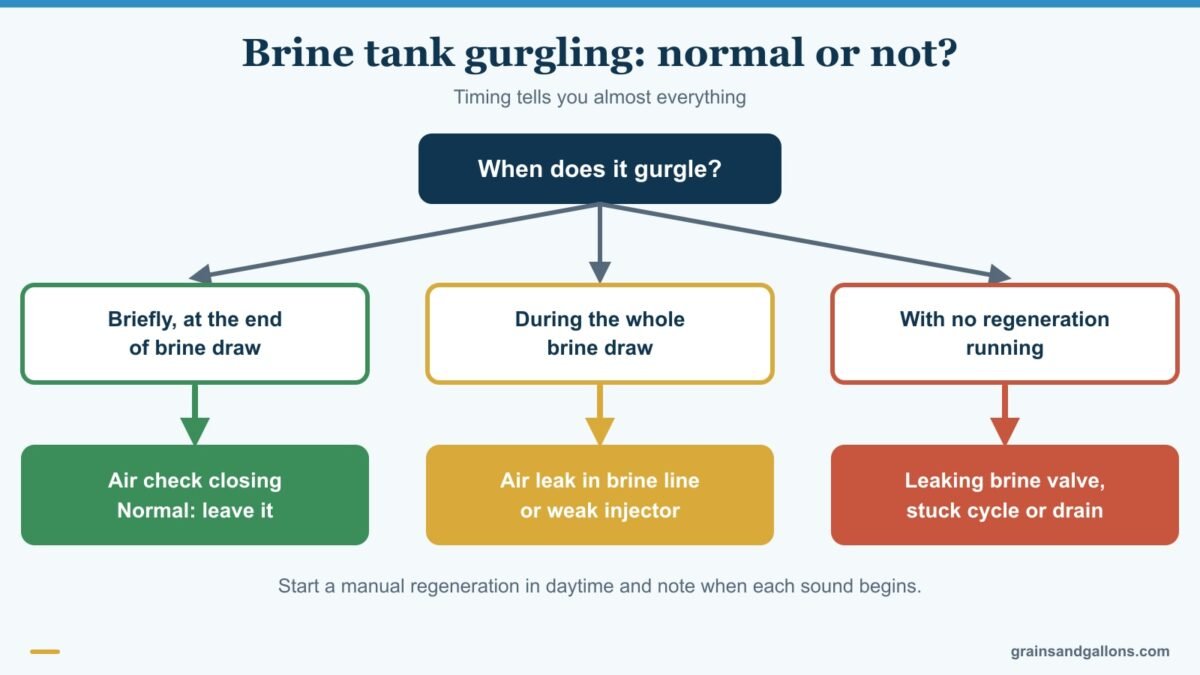
Quick Answer: Water softener brine tank gurgling for a short time near the end of the brine-draw step is normal. That's the valve pulling the last of the brine and the air check closing. Gurgling that lasts for most of brine draw, happens outside regeneration, or comes with hard water or a brine tank that never empties usually means air is getting into the brine line or the injector is partly blocked. Check every brine line fitting first, then clean the injector.
Water softener brine tank gurgling tends to announce itself at 2 a.m., when the house is quiet and the utility room starts making a noise like someone finishing a milkshake through a straw. Before you take anything apart, figure out when the sound happens. With a softener, timing tells you almost everything.
In this guide
- Match the sound to the step it happens in
- The normal gurgle: what the air check is doing
- Why water softener brine tank gurgling runs long: air in the brine line
- Weak suction? Clean the injector and check pressure
- Gurgling when nothing is running
- Bubbling you can see in the brine tank
- When it's the valve itself
- FAQ
- A short gurgle is fine; a long one means air or a clog
Match the sound to the step it happens in

A typical downflow softener regenerates in this order: backwash, brine draw (with a slow rinse), rapid rinse, then brine refill. Some valves refill first. Our walkthrough of how softener regeneration works covers each step in more detail. Here's what each step sounds like when things are fine, and what should make you suspicious.
| When you hear it | What's usually going on | Normal? |
|---|---|---|
| Steady rushing at the drain early in regen | Backwash, water flowing up through the resin to the drain | Yes |
| Soft sucking or slurping at the brine tank | Brine draw, the injector creating suction to pull brine | Yes |
| A gurgle, then a click or quiet stop near the end of brine draw | The tank's brine is nearly gone and the air check is seating | Yes |
| Gurgling or bubbling that goes on the whole brine draw | Air leaking into the brine line, or the injector struggling | Look into it |
| Gurgling at the brine tank when no regen is running | Water moving through a leaking brine valve, or the drain backing up | No |
| Gurgling at the drain hose or standpipe | Drain air gap, a long drain run, or a partly blocked drain | Sometimes |
The easiest way to pin this down: start a manual regeneration during the day, stand next to the unit, and note the time each sound starts. If the noise lines up with brine draw and stops when the valve moves to rinse, you're most likely hearing normal operation.
The normal gurgle: what the air check is doing
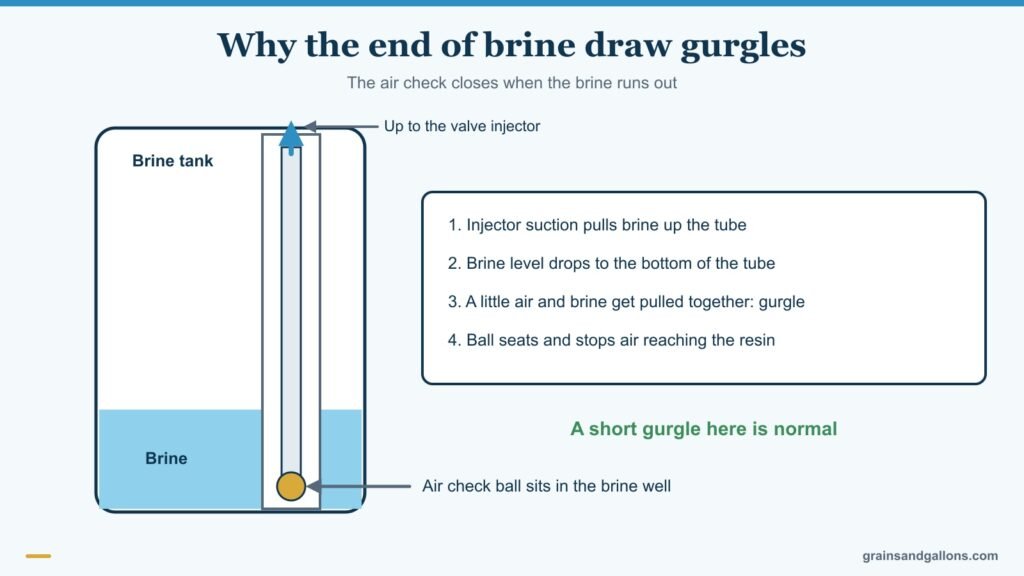
Inside the brine well there's a tube with a float or check assembly at the bottom. During brine draw, the injector in the control valve creates suction and pulls brine up that tube. When the brine level drops to the bottom of the tube, the check closes so the valve doesn't suck a slug of air into the resin tank.
In the second or two before it closes, a little air and brine get pulled together. That's the gurgle. Some systems are quieter than others because of the tank size and how the tube sits. A short gurgle, maybe 10 to 30 seconds, at the end of the draw is nothing to fix.
Height matters too. Pentair's Fleck 5600SXT manual says to cut the air check even with the grid plate when a grid is used, which it calls critical on small 6- to 9-inch tanks (Fleck 5600SXT manual). An air check that sits wrong can close early or late and change the sound.
The brine well usually also holds a separate safety float that shuts off refill if the tank overfills. It isn't what makes the gurgle, but if yours is cracked or missing, our picks for the best brine tank safety floats cover common replacements.
Why water softener brine tank gurgling runs long: air in the brine line
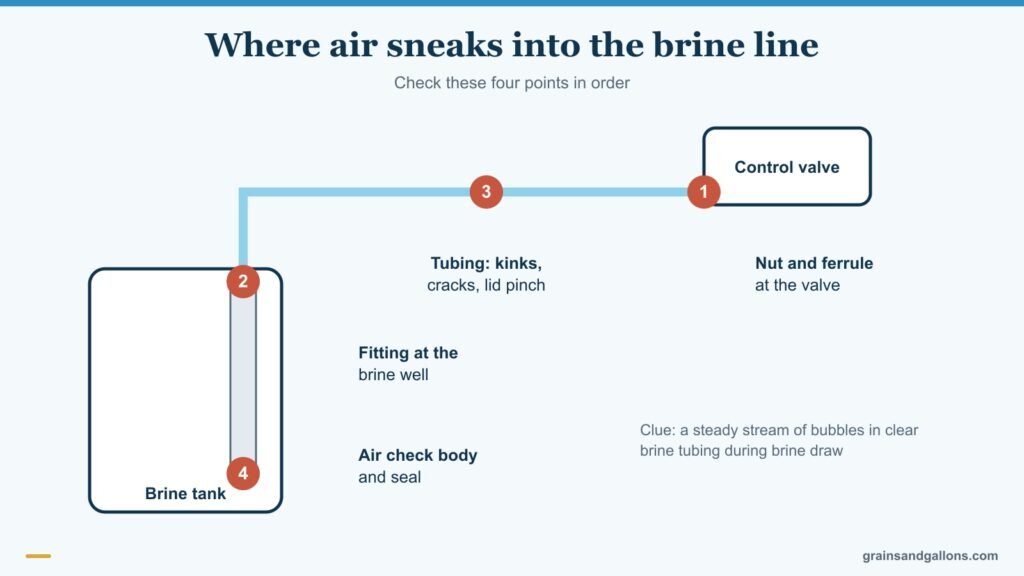
If you hear bubbling for most of the brine draw, or see a steady stream of bubbles in the clear brine tubing, air is getting in somewhere between the brine tank and the valve. That cuts suction and brine flow. You'll often notice the other signs too:
- Water level in the brine tank barely drops during regen.
- Soft water runs out early, or hardness creeps in.
- Salt usage drops while the unit still "regenerates" on schedule.
Common leak points, in the order we'd check them:
- The compression nut on the brine line at the valve. It looks tight, but a cracked ferrule or a tube that isn't fully seated lets air in.
- The brine line at the brine well. Same fitting type, often loosened when someone moved the tank.
- The tubing itself. Look for kinks, cracks or a cut from a lid that pinches it.
- The air check or float assembly. A cracked body or a worn seal can leak air.
Turn off the softener by putting it in bypass and unplugging it. Pull the tubing, trim a clean square end if it's chewed, reseat the insert and ferrule, and hand-tighten plus a little. Our guide to finding an air leak in the brine line has more detail on testing each joint.
Weak suction? Clean the injector and check pressure
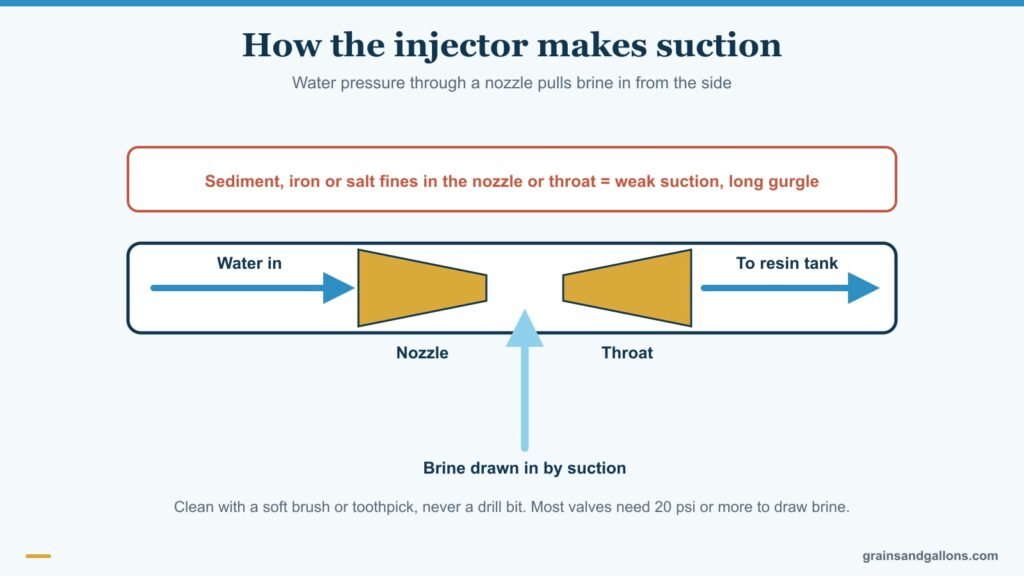
The injector is a small nozzle and throat in the control valve. It uses water pressure to create the suction that draws brine. When it's partly clogged with sediment, iron or salt fines, suction gets weak. You may hear long, labored gurgling because the valve is pulling a mix of air and brine slowly, or you may hear almost nothing and find the brine tank still full.
Cleaning it is a 20-minute job on most valves. It needs the water off, pressure relieved, and a soft brush or toothpick, never a drill bit, which can change the bore. Our step-by-step injector cleaning guide shows where it sits on common Fleck and Clack valves.
Low water pressure makes the same symptoms. Fleck's troubleshooting chart lists a plugged injector, a plugged injector screen, line pressure below 20 psi and an internal control leak as the causes when a unit fails to draw brine. Clack lists 20 to 125 psi as the operating range for its WS1 valve (Clack WS1 service manual). On a well, check where the pressure sits when the pump is near its cut-in point during regen; that's when suction is weakest.
A hard salt crust across the tank, called a salt bridge, can also leave the brine tube pulling air instead of brine because the water under the crust never gets salty enough or the level is off. If you can push a broom handle down and hit a hollow shell, see our guide to breaking a water softener salt bridge.
Gurgling when nothing is running
A softener should be quiet between regenerations. If the brine tank gurgles or trickles in the middle of the day:
- The brine valve isn't sealing. Water creeps into or out of the brine tank through the valve. You may see the water level in the brine tank slowly rise over days. Left alone, that ends with an overflowing tank. Our guide to a leaking brine valve walks through the fix, and a working safety float is your backstop.
- The valve is stuck mid-cycle. If the display shows a cycle step that should have ended, water may be flowing to drain and through the brine side. Check the display before anything else.
- The drain is backing up. If the softener drain shares a standpipe or floor drain with a washing machine or the water heater relief line, air and water moving through that drain can gurgle back toward the softener. See drain line backing up into the softener for how to tell, and our guide to water softener drain line noise if the sound is at the hose rather than the tank.
Bubbling you can see in the brine tank
A few bubbles rising during refill are just fresh water carrying a little dissolved air into the tank. That's fine, and they clear within minutes.
Constant fizzing or bubbling with a smell is different. If the tank smells like rotten eggs or sewage, bacteria may be growing in the brine, especially with low salt levels or warm rooms. Cleaning and sanitizing the tank usually solves it; our guide to a brine tank that smells bad covers the steps. Wear gloves and eye protection, ventilate, and never mix bleach with other cleaners.
When it's the valve itself
If the brine line holds tight, the injector is clean, pressure is fine, and you still get long gurgling or a brine tank that won't draw down, the internal seals and spacers in the control valve may be worn. That matches the "internal control leak" line in Fleck's chart. Many Fleck and Clack valves can be rebuilt with a seal kit. On an older valve, or one with a failing motor or timer too, a full head swap can make more sense. Our roundup of the best replacement control valves covers Fleck and Clack heads that fit standard tanks. Before ordering, match the tank thread size and the distributor tube diameter.
If you're not comfortable working on a pressurized valve, call a water treatment tech. Always bypass and unplug the unit first, and relieve pressure before opening anything.
FAQ
Is it normal for a water softener to gurgle?
Yes, briefly. A soft slurping during brine draw and a short gurgle as the brine runs out are part of normal regeneration. Gurgling that lasts most of the draw, or happens when no cycle is running, is worth checking.
Is gurgling at the drain line during backwash a problem?
Usually not. A drain line with a long run, an air gap, or a vertical lift can gurgle as water and air move through it. If it also backs up or leaks, look at the drain setup.
Can I just ignore a gurgling brine tank?
If it's short and at the end of brine draw, yes. If it's long or happens outside regen, check it, because both air leaks and leaking brine valves get worse and can end in hard water or an overflowing tank.
Does a louder brine tank mean more salt is being used?
No. Noise has more to do with suction and air than with how much salt goes through. A unit that gurgles for the whole draw is often using less brine than it should.
What about banging or knocking during regeneration?
That's a different problem. A bang when the valve changes position is usually water hammer in the house plumbing, not the brine tank. See our guide to water hammer after a water softener.
A short gurgle is fine; a long one means air or a clog
Water softener brine tank gurgling is normal when it's short and lands at the end of brine draw. If it runs through the whole draw, look for an air leak at the brine line fittings, then clean the injector and confirm you have at least 20 psi. If it happens with no regeneration running, suspect a leaking brine valve, a stuck cycle or a backed-up drain. Work through those in order and most noises are fixed with a wrench, a toothpick and a new ferrule.