


Quick Answer: What time should a water softener regenerate? During the longest stretch when nobody uses water, which for most homes is between 2 and 3 a.m. That's why many control valves come set to 2:00 a.m. Then check three things: that the cycle finishes before the first shower, that no appliance (dishwasher, sprinkler, ice maker refill) runs on a timer during it, and that the clock on the valve shows the correct time.
The softener was installed, the tech left, and now you see "REGEN TIME 2:00" in the settings and wonder what time a water softener should regenerate in your house. It matters. During those hours your softener isn't softening. Most single-tank units send untreated hard water to the house while they regenerate, and some cut water off at certain steps. When it happens is your call.
In this guide
- What happens during the regeneration window
- Find your household's quiet window
- Overnight timers that clash with regeneration
- What time should a water softener regenerate on your schedule?
- Delayed or immediate: which mode respects your hour?
- When the valve picks a different hour
- Changing the regen time on your valve
- Pick the quiet window, then check the clock
- FAQ
What happens during the regeneration window

Regeneration is a series of steps: backwash, brine draw, slow rinse, fast rinse and brine refill. Depending on how the valve is programmed, the whole thing commonly takes somewhere between about an hour and two hours. Your control valve shows each step's time in the settings, or your manual lists the defaults. On a Fleck SXT, for example, each step is adjustable from off to 199 minutes, according to the Pentair SXT control manual. Add the steps up and you know how long your window needs to be. Our walkthrough of how softener regeneration works explains each step.
During that window:
- Hot water drawn in the house is refilled with hard water in many setups. Refilling the water heater with untreated water adds scale.
- Using water can lower pressure or interrupt the cycle on some valves, especially during the brine draw. Our guide on using water during regeneration explains what you'll notice.
- The softener sends water down the drain for backwash and rinse. If your drain is slow or shared with a washing machine, timing matters for that too.
- Some valves are noisy while they cycle. If the softener sits next to a bedroom, a 2 a.m. cycle may wake someone, which is another reason to pick the hour on purpose.
So the goal is simple: put the cycle in a quiet window long enough to finish.
Find your household's quiet window

Answer these questions, and your hour usually picks itself.
When does the first person get up? If the earliest shower is at 5:00 a.m. and your cycle is two hours, regeneration has to start by 3:00 a.m. at the latest. Build in a little margin.
When does the last person go to bed? A late dishwasher load at 11 p.m. or a teenager's 1 a.m. shower pushes the window later.
How long is your cycle? Time it once. Note when the valve leaves the service display and when it returns. That real number beats any default.
Does anyone work nights? Shift workers often shower at 2 a.m., which is exactly when most softeners are busy. Their sleep window is the better slot.
Overnight timers that clash with regeneration

Plenty of water use happens while everyone is asleep. Check for:
- Delay-start dishwashers and washing machines
- Lawn sprinklers (if they're on softened water)
- Pool auto-fill or hot tub top-ups
- A refrigerator ice maker refilling
Any of these can pull hard water through during regeneration or fight it for pressure. Move the appliance or move the regeneration.
Is it a well? Backwash needs steady flow. If your well pump or pressure tank struggles with long runs, don't stack regeneration on top of an overnight irrigation cycle. Give the softener the well to itself, and check that your well can supply the backwash flow rate listed in the softener's specs.
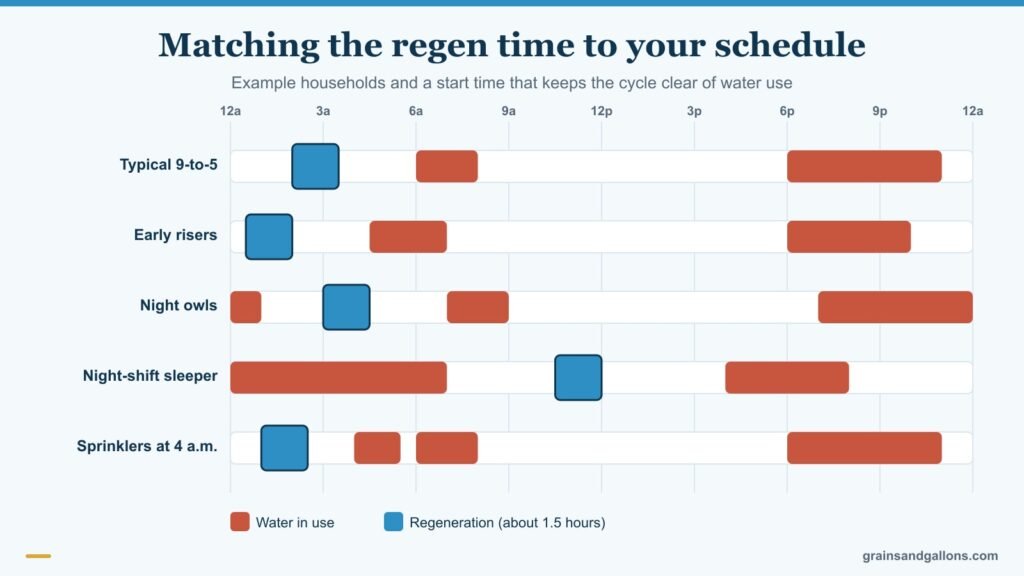
What time should a water softener regenerate on your schedule?
| Household pattern | A regen time that usually fits |
|---|---|
| Typical 9-to-5, everyone asleep by 11 | 2:00 a.m. |
| Early risers (shower before 5) | 12:30 to 1:00 a.m. |
| Night owls (up past 1 a.m.) | 3:00 a.m., if the cycle ends before the first shower |
| Night-shift worker sleeps 8 a.m. to 3 p.m. | Late morning, in their sleep window, if no one else is home |
| Sprinklers at 4 a.m. on softened water | 1:00 a.m., so it's done first |
| Vacation home or cabin | Any time you're not there, but watch the day override setting |
These are starting points. If your cycle is long, say two hours or more, adjust so it definitely finishes before anyone's up.
Does the hour change how well it works? Not much, as long as it finishes. Water pressure overnight is usually steady, which helps brine draw. If your utility's pressure drops at night, as it sometimes does during maintenance, you might see a cycle that doesn't draw brine properly. Low pressure is worth checking if regeneration seems to fail at a particular time.
Delayed or immediate: which mode respects your hour?
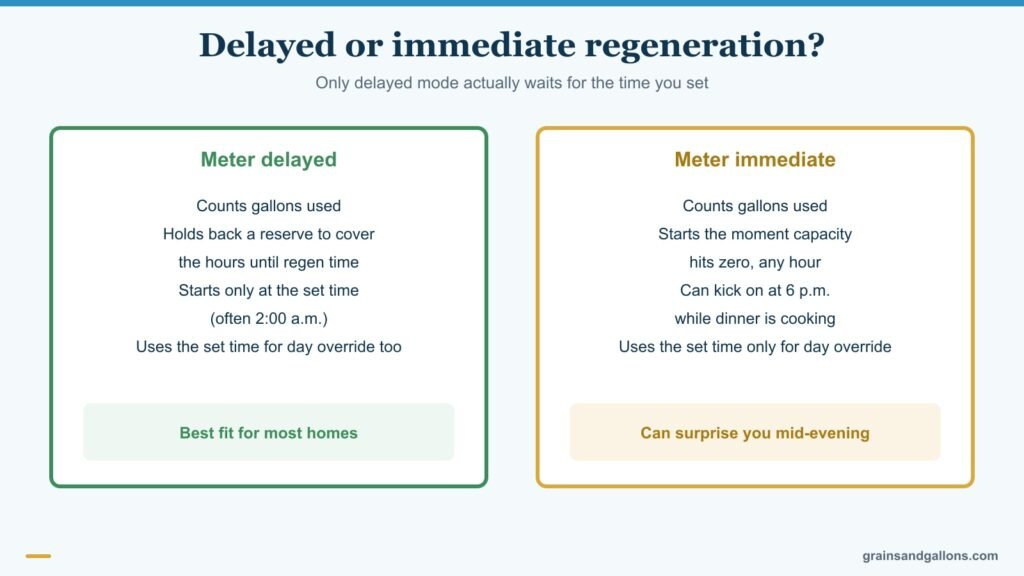
Your regen time only matters if the valve is set to use it. The Pentair SXT manual describes the main modes:
- Meter delayed. The valve counts gallons, keeps a reserve so you still have soft water until the set time, then regenerates at that time. This is the right choice for most homes.
- Meter immediate. The valve regenerates the moment calculated capacity hits zero, whatever the hour. It uses the set time only when the day override kicks in. That can mean a cycle at 6 p.m. while dinner is cooking.
- Time clock. The valve regenerates on set days at the set time, whether you used water or not.
A time clock wastes salt and water because it regenerates whether the resin needs it or not, a drawback Penn State Extension also points out. The EPA's WaterSense softener sheet recommends demand-initiated regeneration for the same reason. How often matters more than what hour; our guide on how often a water softener should regenerate covers that. If you're still on a timer-only unit, our list of the best metered (on-demand) water softeners shows the alternatives.
When the valve picks a different hour
The clock is wrong. After a long power outage, some valves lose the time of day. Others drift. The SXT keeps time for at least 48 hours on its backup and flashes the time of day after any power failure as a prompt to check it. A regeneration missed during the outage is queued until the clock next reaches the set time, which usually means a day late. An hour off for daylight saving time puts regeneration closer to the morning rush. Our page on adjusting your softener for daylight saving time shows how.
It's set to immediate. If yours keeps kicking on in the daytime, check the mode first, then see softener regenerating in the middle of the day.
Someone pressed the regen button. On many valves a single press queues a regeneration for tonight's set time, while holding the button starts one right away. Our guide to the immediate regeneration button explains the difference.
Changing the regen time on your valve
The exact buttons vary by valve and brand. On most digital valves you enter a programming mode, step to a setting labeled something like "Regen Time," "RT" or "Recharge Time," set the hour, and save. Some models need you to hold two buttons at once to enter that menu. Check your owner's manual, or find it on the maker's website using the model number on the valve label. Don't guess at button combinations on an unfamiliar valve. Some menus also hold settings like hardness and capacity that you don't want to change by accident.
After you set it:
- Confirm the current time of day is correct.
- Note when the next regeneration should happen.
- The next morning, check the display or a regeneration counter, if your valve has one, to confirm it ran.
- Listen for the drain line or check the brine tank level if you're unsure. A refilled brine tank means the cycle completed.
Pick the quiet window, then check the clock
What time should a water softener regenerate? Whenever your house is reliably quiet for the full length of the cycle, which is 2 a.m. for most families and something else for shift workers, early risers and sprinkler owners. Set the valve to delayed mode so it honors that hour, and recheck the time of day after outages and clock changes.
FAQ
Is 2 a.m. the best time for a water softener to regenerate?
For most households, yes. It's usually the longest stretch with no showers, laundry or dishwashing, which is why many valves ship set to 2:00 a.m. Move it if anyone in the house uses water at that hour.
Can I shower while my water softener is regenerating?
Usually yes, but on most single-tank softeners you'll get unsoftened water, and pressure may drop during some steps. Hot water you use gets replaced with hard water in the heater, so it's better to wait if you can.
How long does a water softener take to regenerate?
Commonly about one to two hours, depending on how the valve's step times are programmed. Add up the backwash, brine, rinse and refill times in your settings to get your exact length.
Why did my softener regenerate during the day?
The most common causes are a wrong clock after a power outage, the valve being set to immediate regeneration, or someone holding the manual regen button. Check the time of day and the regeneration mode first.
Does a water softener regenerate every night?
Not usually. A metered valve regenerates only after you've used up most of its capacity, which might be every few days. A time-clock valve regenerates on the days it's programmed for, whether you used the water or not.