


Quick Answer: How often should a water softener regenerate? For most homes, a correctly sized and programmed softener regenerates every few days to about a week. Small households with modest hardness can go one to two weeks. The exact interval comes from math, not habit: usable capacity divided by the grains of hardness your household uses per day. Nightly regeneration usually means the softener is undersized or the hardness setting is too high. If yours goes longer than about two weeks, set a days-override as a backstop.
There's no single right number of days for every house, but there is a right range for yours, and it takes five minutes to work out. Once you know how often a water softener should regenerate in your home, you can tell at a glance whether it's doing its job or wasting salt. The figures below come from the softener's own capacity, your water hardness and your household's water use.
In this guide
- How often should a water softener regenerate in your house?
- Three households, three different answers
- What happens each time it regenerates
- Metered, timer or sensor: who decides when
- Why a few days to a week is the target
- Settings that push the interval off
- Signs the regeneration schedule is wrong
- Check your own softener in five minutes
- FAQ
- Let the math, not the calendar, set the schedule
How often should a water softener regenerate in your house?

Days between regenerations ≈ (capacity at your salt setting − reserve) ÷ grains used per day
- Capacity at your salt setting. Not the number on the box. A "32,000-grain" softener usually reaches that only at its highest salt dose. At a moderate setting it may deliver closer to 20,000–24,000 grains. Your spec sheet lists capacity for each salt setting.
- Reserve. Metered softeners hold back some capacity so you don't run out of soft water before the overnight regeneration. It's commonly sized to about a day's worth of water use.
- Grains used per day. People × gallons per person per day × hardness in grains per gallon (gpg). About 75 gallons per person per day is a common sizing assumption; the EPA's WaterSense figures put average use at home at about 82 gallons per American per day, so 75 is a reasonable working number.
If your water report lists hardness in mg/L or ppm, divide by 17.1 to get grains per gallon.
Three households, three different answers

| Household | Daily grains | Usable capacity | Interval | Read on it |
|---|---|---|---|---|
| 2 people, 10 gpg, 32k-class unit at moderate dose | 2 × 75 × 10 = 1,500 | about 24,000 − 1,500 reserve | about 15 days | Long. A days-override will likely trigger before the meter does |
| 4 people, 15 gpg, 32k-class unit at moderate dose | 4 × 75 × 15 = 4,500 | about 24,000 − 4,500 reserve | about 4 days | Right in the sweet spot |
| 5 people, 25 gpg, 24k-class unit | 5 × 75 × 25 = 9,375 | about 18,000 − 9,375 reserve | about 1 day | Undersized; regenerating nightly at a heavy salt dose |
The middle house is what you want: a few days between cycles at a moderate salt dose. The third house can only keep up by regenerating every night, probably at a high salt setting, which burns salt and water. The fix there is a bigger resin tank, not a different setting. If that sounds like your situation, our list of the best 48,000-grain water softeners covers the size most families of three to five end up needing.
What happens each time it regenerates
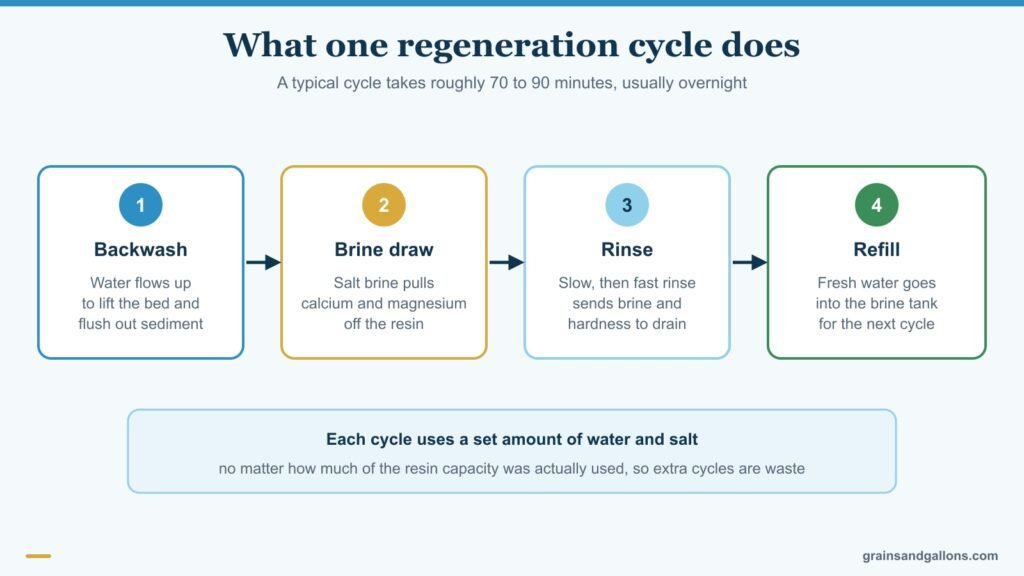
Regeneration is the softener cleaning its resin. The beads trade sodium for calcium and magnesium until they're loaded with hardness; then the valve runs a cycle, usually in the small hours:
- Backwash. Water runs up through the bed to loosen it and flush sediment to drain.
- Brine draw. The injector pulls salt brine from the brine tank through the resin, stripping off the hardness.
- Rinse. A slow rinse pushes the brine through, then a fast rinse repacks the bed and clears leftover salt.
- Refill. The valve sends fresh water to the brine tank so brine is ready for next time.
A full cycle typically takes around 70 to 90 minutes. The important part for frequency is that each cycle uses a set amount of water and salt whether the resin was nearly exhausted or only partly used. That's why "more often" is never "safer". Our explainer on how water softener regeneration works goes deeper into each stage, and how much water regeneration uses puts numbers on the waste.
Metered, timer or sensor: who decides when
How your softener decides to regenerate matters as much as how big it is.
- Metered (demand-initiated). A turbine counts gallons. When the remaining capacity drops below the reserve, the valve schedules a regeneration for the set time. This is the efficient option, and the interval follows your actual water use: a week away means no regeneration, a houseful of guests means an extra one.
- Timer (clock-only). The valve regenerates on fixed days whether or not you used the capacity. You set the interval yourself using the formula above, and you have to change it if your household or hardness changes. Many older units were set to every two or three days and never touched again.
- Sensor-based. Some dealer systems use a probe in the resin bed to detect exhaustion directly instead of estimating it from gallons.
Penn State Extension's water softening fact sheet describes the same trade-off: demand-initiated controls avoid the wasted salt and water of regenerating on a schedule. Most metered valves still let you pick the time of day; see what time a water softener should regenerate if yours runs while people are showering.
Why a few days to a week is the target
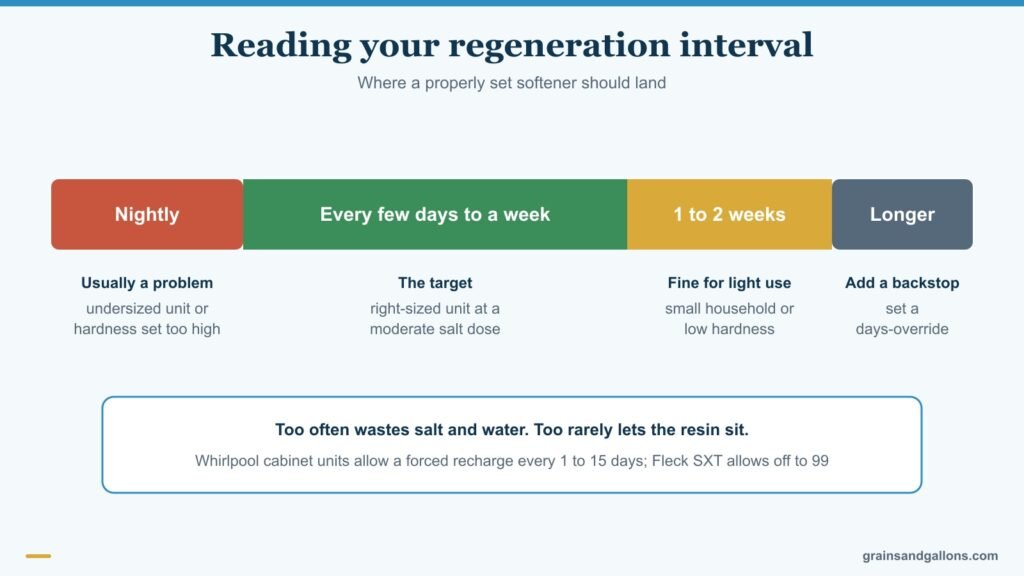
Too often is wasteful. A small softener cycling every night spends far more water and salt per gallon of soft water than a right-sized one cycling twice a week, because the fixed backwash and rinse volumes are repeated every time.
Too rarely has its own issues. Very long gaps let resin sit in one position for a long time, and installers worry about channeling, compaction and bacterial growth in a stagnant bed, especially on well water. Some dealers suggest going no longer than about two weeks between cycles. That's why most valves include a days-override (or "maximum days between regenerations") setting. Whirlpool's cabinet units let you force a recharge every 1 to 15 days. Fleck SXT valves allow a range from off up to 99 days; the Fleck 5600SXT manual walks through setting it. Our guide on the water softener days-override setting explains how to pick a value.
Settings that push the interval off
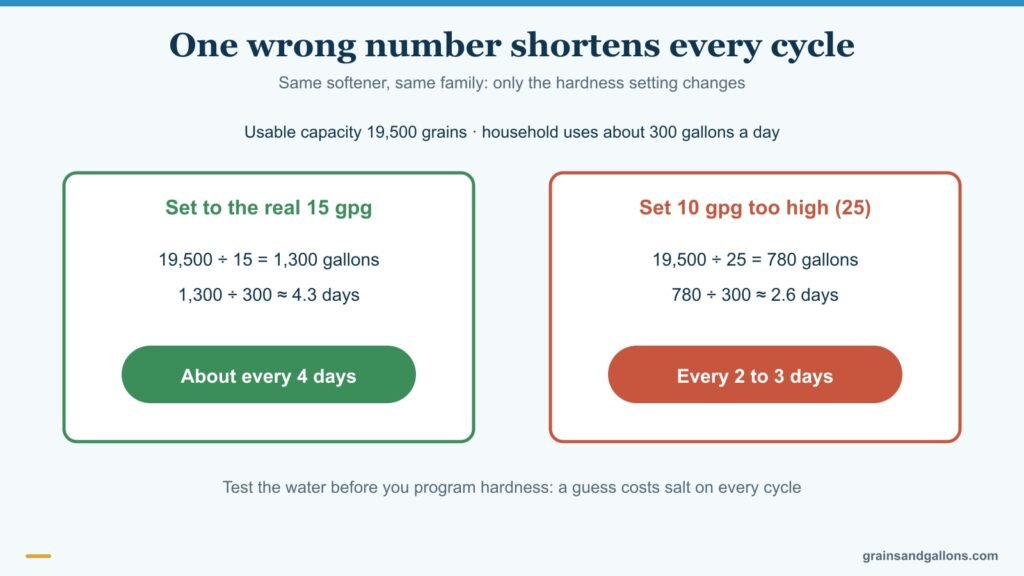
If your softener's water softener regeneration frequency looks wrong, one of these is usually why:
Hardness setting. The valve divides capacity by this number to decide how many gallons you get between cycles. Set it 10 gpg too high and you'll regenerate far more often than needed. Test your water first; a cheap strip can be off by several grains, so a drop-count kit is a better tool. We compare options in the best water hardness test kits.
Capacity and salt dose. On valves where you enter capacity and salt separately (like Fleck SXT), the two have to match. Entering 32,000 grains with a light salt dose tells the softener it can go further than it actually can, and you'll get hard water before regeneration.
Reserve. Too much reserve throws away capacity on every cycle. Too little and you run out of soft water on busy days. See how to set softener capacity and reserve for valve-by-valve guidance.
Iron. If you have clear-water iron, many manufacturers tell you to add to the hardness setting for it, which shortens the interval on purpose so iron doesn't build up on the resin.
Signs the regeneration schedule is wrong

Regenerating too often:
- You hear it at night more than a couple of times a week in a small household
- Salt use is well above what the math says
- The display shows very few gallons between cycles
Not regenerating often enough (or not effectively):
- Hard water, soap scum or spotty glasses show up a day or two before each regeneration
- Scale comes back even though salt is going down
- Capacity is set higher than the salt dose can deliver
If it's regenerating constantly and you can't figure out why, a water softener regenerating too often goes through the less obvious causes: leaks, stuck meters and settings that got wiped.
Check your own softener in five minutes
- Find your hardness (test or water report) and the number of people in the house.
- Calculate grains per day.
- Look up your softener's capacity at its current salt setting.
- Subtract the reserve and divide.
- Compare the result to how often it actually regenerates. Many valves show a regeneration count or days since the last one; otherwise note the date of the next cycle you hear.
If the real interval is about half the calculated one, look for a hardness setting that's too high or a hidden water user like a running toilet. If it's much longer and you're getting hard water, check the basics before calling anyone: the unit has power and the right time of day, the drain line isn't kinked, the brine tank has salt, and brine is actually being drawn.
FAQ
Is it bad if my water softener regenerates every night?
It won't damage the softener, but it's usually a sign of an undersized unit, a hardness setting that's too high or a hidden leak. Either way it costs you extra salt and water on every cycle.
Can a water softener go too long without regenerating?
Yes. Going two weeks or more is usually fine for softening in a small household, but resin that sits for long stretches can compact or grow bacteria, especially on well water. Set a days-override so it never goes indefinitely.
How many gallons should a softener go between regenerations?
Divide usable capacity by your hardness. A softener with 19,500 usable grains on 15 gpg water delivers about 1,300 gallons between cycles. Metered valves do this math for you once hardness and capacity are entered correctly.
How long does a water softener regeneration cycle take?
Most cycles take roughly 70 to 90 minutes from backwash to brine refill. Water used during that time bypasses the resin, which is why valves default to regenerating overnight.
Should I regenerate manually after a vacation?
It's not required, but many people run a manual regeneration after a long trip so the bed starts fresh. It's also worth doing after adding salt to a tank that ran empty.
Let the math, not the calendar, set the schedule
So how often should a water softener regenerate? Often enough that you never see hard water, and rarely enough that each cycle uses most of the resin's capacity. For most homes that means every few days to about a week. Work out your number with the formula, set an accurate hardness and a sensible days-override, and if the only way to keep up is regenerating every night, the softener is too small for the house.