

Quick Answer: Water softener regeneration while using water is safe. It won't hurt the softener, and you won't get salt water at the tap. On most single-tank softeners, though, the valve sends untreated hard water to the house until the cycle ends, often around two hours. Cold water for a toilet flush, a drink or washing hands is fine. Avoid hot water if you can, because the water heater refills with hard water. Twin-tank softeners keep supplying soft water.
Someone is always up at 2 a.m.: a night-shift nurse, a new parent, a teenager who decided that's shower time. The softener is chugging away in the basement, so is the water OK? If you've wondered about water softener regeneration while using water, the short version is that the water is fine. It just isn't soft.
In this guide
Where your water goes while the valve is busy

A single-tank softener has one resin tank. During regeneration that resin is flushed backward, soaked in brine and rinsed, so it can't soften water at the same time. The control valve does two jobs at once. It sends a stream through the resin tank to the drain, and it lets incoming water flow straight past the resin to your house.
GE says this plainly in its GXSF23Z01 and PNSF35B owner's manual, under "Automatic Hard Water Bypass During Regeneration": "For emergency needs, hard water is available to the home during the regeneration cycles." The Clack WS1 service manual describes the same design from the valve side. If there's a water demand while the valve is in regeneration mode, "that water usage is not metered."
That matters on metered softeners. The gallons you use mid-regeneration don't count against the freshly regenerated resin, because they never touched it. It's one more reason to like the best metered on-demand softeners: they regenerate only when needed, so the overlap with your day happens less often.
What comes out of the tap at each step
The order varies by brand. GE's cabinet units fill the brine tank first, while many downflow valves refill at the end. Your taps get the same thing throughout:
| Regeneration step | What the resin tank is doing | What comes out of your tap |
|---|---|---|
| Fill (start or end) | Brine tank takes on water for the salt to dissolve | Hard water |
| Backwash | Water flows up through the resin and out the drain | Hard water, maybe slightly lower pressure |
| Brine draw and slow rinse | Brine is pulled through the resin, then rinsed slowly | Hard water |
| Fast rinse | Resin bed is rinsed and packed down | Hard water |
| Service | Normal softening resumes | Soft water |
GE's manual says its cycle is done in about two hours. Anything other than hard water during the cycle isn't normal. Salty water at the tap points to a valve or injector fault, covered in our guide to softened water that tastes salty. Brown water after regeneration is usually iron flushing out. For the full picture of each step inside the tank, see how softener regeneration works.
Hot water is the real cost of using water during regeneration
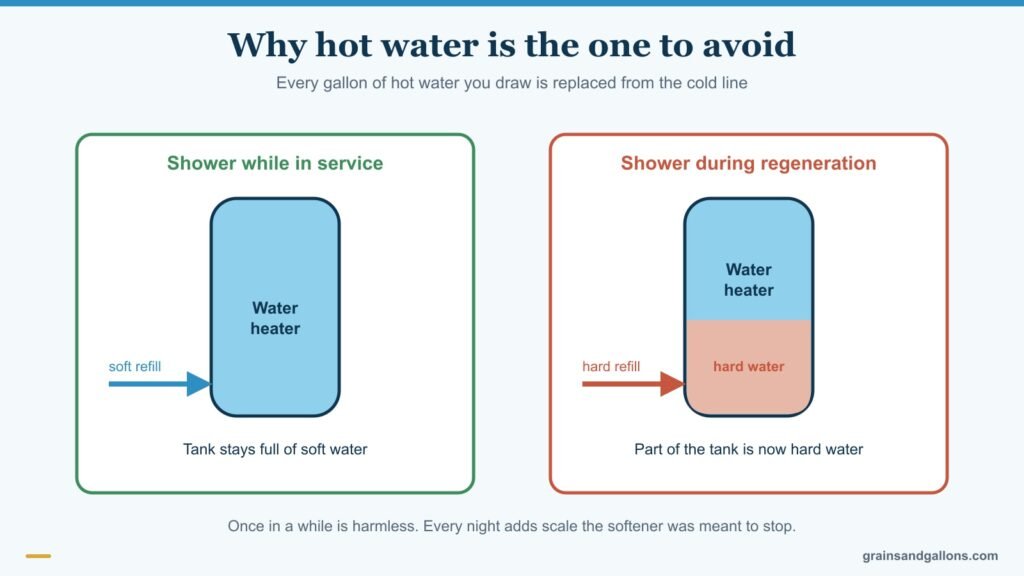
Using a little cold water during regeneration costs you nothing. Hot water costs a bit more, because every gallon you draw is replaced in the heater by whatever the cold line delivers. During regeneration, that's hard water.
Whirlpool's cabinet softener manual puts it directly: "Avoid using hot water while the softener is regenerating, because the water heater will refill with bypass hard water." GE gives the same advice.
One shower's worth of hard water in a tank heater won't wreck anything. GE notes that as you keep using hot water afterward, the tank refills with soft water again. Do it every night, though, and the heater runs partly on hard water, which is the scale problem you bought the softener to prevent. Tankless heaters are more sensitive to scale, so keep regeneration out of your hot-water hours if you have one. Our guide to softened water and tankless heaters explains why.
Can heavy water use weaken the brine draw?

Usually not, but there's one case worth knowing about. The brine injector relies on line pressure to pull brine from the salt tank. The Fleck 5600SXT service manual requires at least 20 psi and lists low line pressure as a cause of a softener that fails to draw brine. On a well with marginal pressure, a big draw during the brine step, such as a washing machine filling or a lawn sprinkler, could drop pressure enough to weaken the brine draw. The softener then regenerates poorly and the water turns hard early. On city water with healthy pressure, this is rarely an issue.
Keep regeneration out of your waking hours
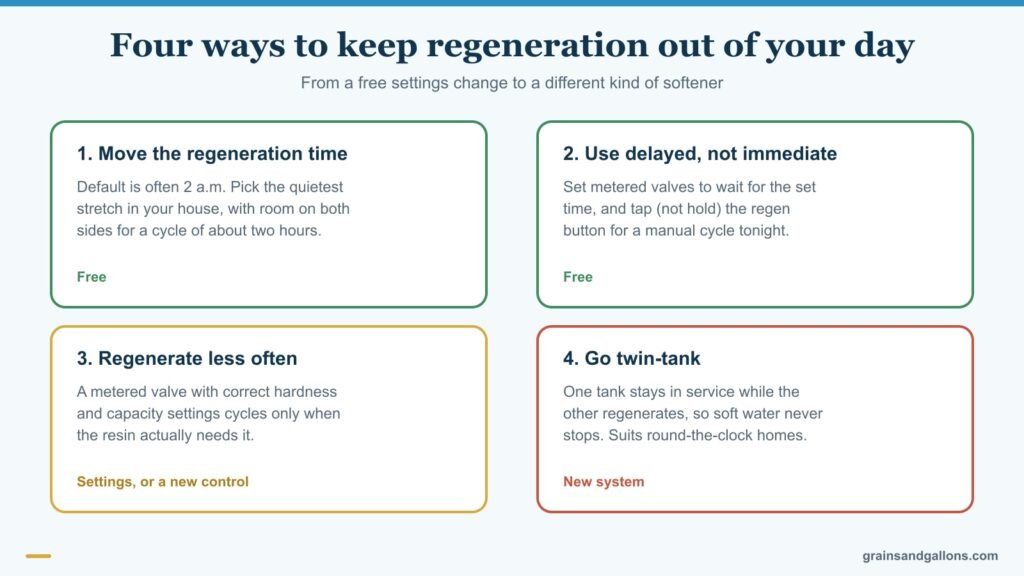
- Move the regeneration time. Many softeners default to 2 a.m. If your household is up then, pick a quieter window. Our guide on what time a softener should regenerate helps you choose.
- Use delayed, not immediate, regeneration. For a manual cycle, tap the button for a regeneration tonight instead of holding it for one right now.
- Check for daytime cycles. Hard water in the afternoon usually means the clock is wrong after a power outage, or the valve regenerates immediately when capacity runs out. See our guide to a softener regenerating during the day.
- Regenerate less often. A metered valve with correct settings overlaps with your life less. Our picks for the best high-efficiency softeners are built around that idea.
- Consider twin tanks if your home uses water around the clock. One tank stays in service while the other regenerates.
Cold water is fine; save the hot shower for later
Water softener regeneration while using water causes no harm and never sends brine to your taps. On a single-tank unit, you get hard water until the cycle ends. Use cold water freely for drinking, flushing and washing hands. Put off hot showers and laundry when you can so the water heater doesn't refill with hard water. If the overlap happens often, move the regeneration time or switch to delayed regeneration.
FAQ
Is water softener regeneration while using water bad for the softener?
No. The valve is built to send incoming water around the resin during the cycle, and on valves like the Clack WS1 that water isn't even metered. The only costs are hard water at the taps and in the water heater until the cycle ends.
Can you shower while a water softener is regenerating?
Yes. The water is safe, but it's hard, so soap lathers less, and the water heater refills with hard water as you use hot water. Once in a while is fine. If it happens nightly, move the regeneration time.
Will I get salt water if I run the tap during the brine cycle?
Not on a working valve. The brine goes through the resin tank to the drain, while your tap water bypasses the resin. Salty water at the tap means a valve or injector problem.
Is the hard water during regeneration safe to drink?
It's the same water that comes into your house before softening, so it's as safe as your untreated supply. On a private well, that depends on your well's test results.
How long does a water softener take to regenerate?
Often around two hours, depending on the valve, the salt setting and the backwash times. The display usually counts down the time left in each step.
Can I run the dishwasher or washing machine during regeneration?
You can, but both use hot water and both get hard water, so you may see more spotting or need more detergent for that load. Running them after the cycle finishes is better.