

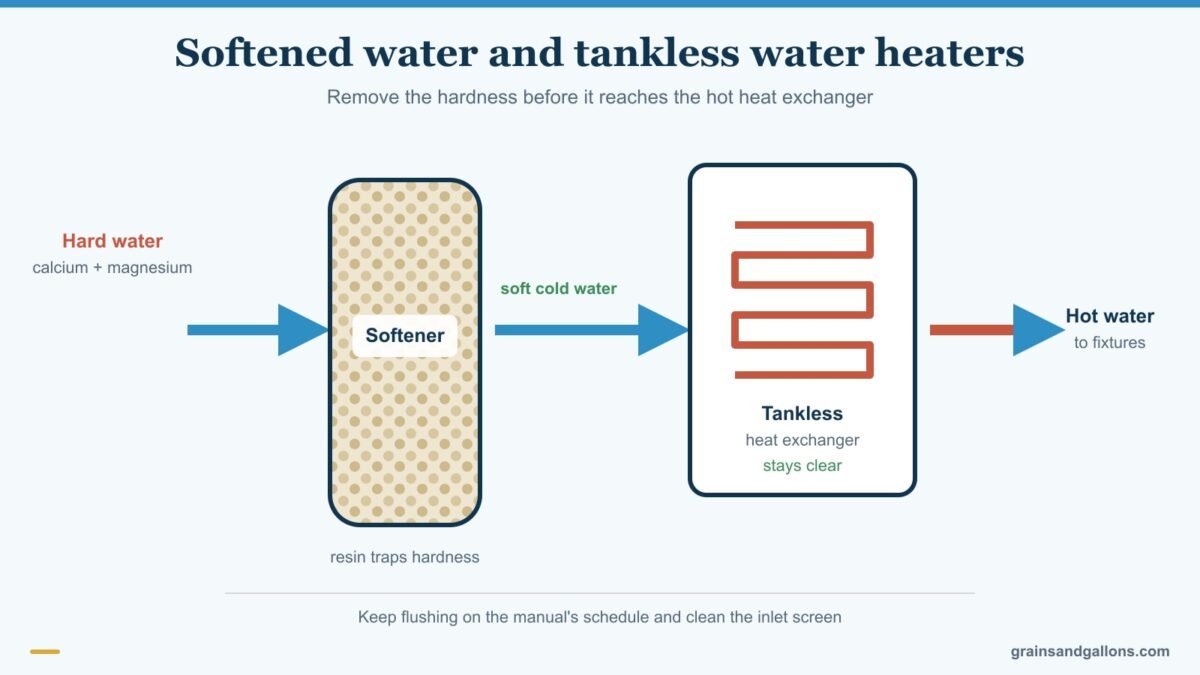
Quick Answer: Softened water and tankless water heaters are a strong pairing in hard-water areas. Tankless units heat water fast through narrow heat-exchanger passages, exactly where calcium scale forms and does the most harm, and a working softener removes the calcium and magnesium that make that scale. It doesn't replace the manufacturer's maintenance: keep cleaning the inlet screen and flush on the schedule in your manual.
The installer finished the new tankless unit, handed you a card with a phone number, and said something like "you'll want to get it flushed every year, especially with your water." If you already have a softener, or you're deciding whether to add one, here's how softened water and tankless water heaters actually interact, what the warranty says, and which maintenance never goes away.
In this guide
Why hard water is rougher on tankless than on a tank
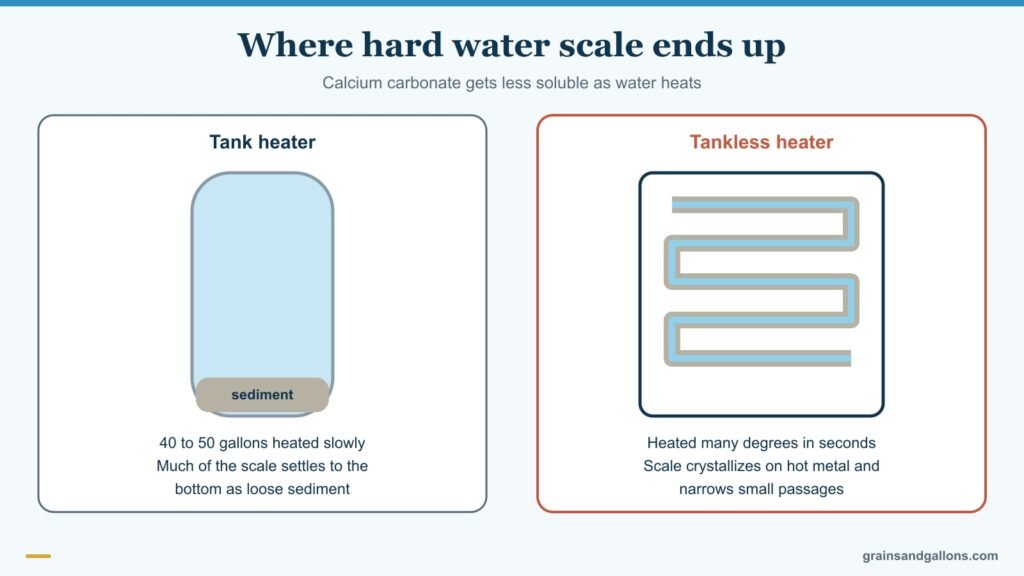
A tank-type heater warms 40 or 50 gallons slowly, and much of the scale that forms falls to the bottom as sediment. A tankless heater is more aggressive: it heats cold water by many degrees in a few seconds as it flows through a compact heat exchanger. Calcium carbonate gets less soluble as water gets hotter, so that rapid heating is ideal for scale to crystallize right on the hot metal. We explain the chemistry in why hot water causes more scale.
Noritz notes that scale buildup lowers a tankless heater's efficiency and life span, and some of its units carry software that flags slowing heat transfer (Noritz on scale deposits). In practice, scale shows up as:
- Lower efficiency, since scale insulates the metal from the water.
- Restricted flow in small passages.
- Overheating and error codes as the unit struggles to move heat into the water.
- Fluctuating hot water temperature.
Our troubleshooting guide to scale in a tankless water heater walks through those symptoms if you're already seeing them.
Does a tankless water heater need a softener?
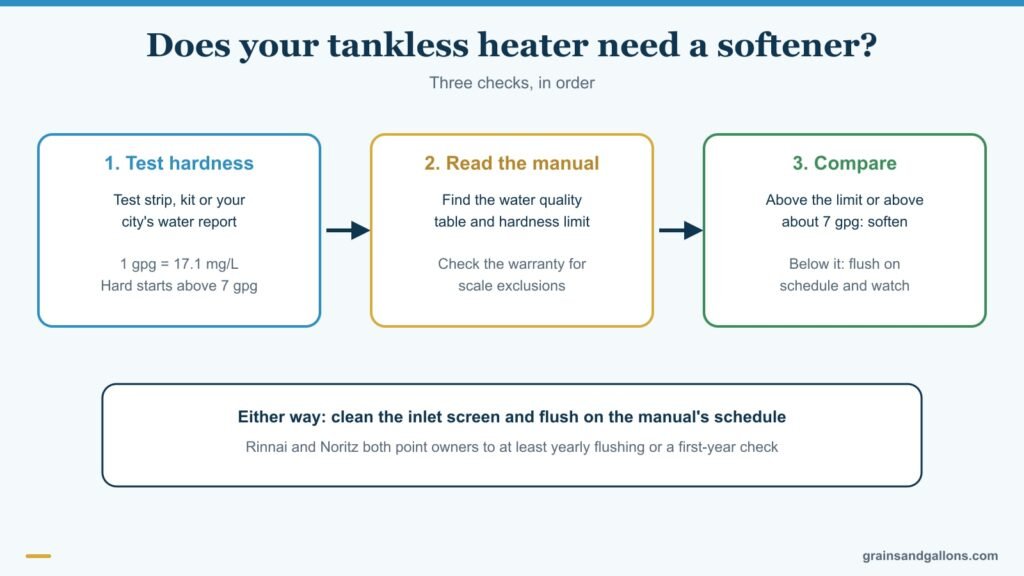
Not automatically. It depends on your hardness and on what your heater's maker allows.
Test your hardness first. Use a test strip or kit, or look up your city's annual water quality report. Water above about 7 grains per gallon (120 mg/L) is generally considered hard; 1 gpg equals 17.1 mg/L. Our guide on how to test water hardness at home covers the options.
Then read the warranty. Tankless makers commonly treat scale as a water-quality or maintenance issue, not a defect. Navien's NPN-E warranty, for example, offers a 15-year limited warranty on the heat exchanger but excludes damage from local water conditions, naming hard water deposits and lime or mineral build-up, and lists scale buildup under improper maintenance. Other brands use similar language, and many installation manuals include a water quality table with a hardness limit.
If your hardness is above the limit in your manual, or above about 7 gpg when no limit is listed, softening is cheap insurance for an expensive heat exchanger. If your water is near soft, flushing on schedule may be all you need.
How softened water and tankless water heaters work together
| Claim | Reality |
|---|---|
| "Softened water stops scale in a tankless heater." | Largely true, as long as the softener is working and sized for your flow. Calcium and magnesium are what form the scale. |
| "With a softener, you never need to flush." | Not safe to assume. Follow the manual. Flushing also clears debris, and with softened water the flush comes out much cleaner. |
| "Softened water corrodes tankless heat exchangers." | A softener doesn't make water acidic. Corrosive water is a pH or chemistry issue to test for separately; check your heater's limits for pH and chloride as well as hardness. |
| "Any softener will do." | A tankless heater can call for high flow during showers. The softener must handle that flow without letting hardness slip through. |
| "A salt-free conditioner works just as well." | Different technology. Some are marketed for tankless use, but they don't remove hardness. See salt-free conditioning for tankless and boilers. |
The efficiency payoff has been tested. In a Battelle study funded by the Water Quality Association's research foundation, tankless gas heaters on softened water kept their original efficiency, while units running on hard water failed during accelerated testing. The trade group's interest is obvious, but the result lines up with what installers see in heat exchangers.
Size and place the softener for tankless flow
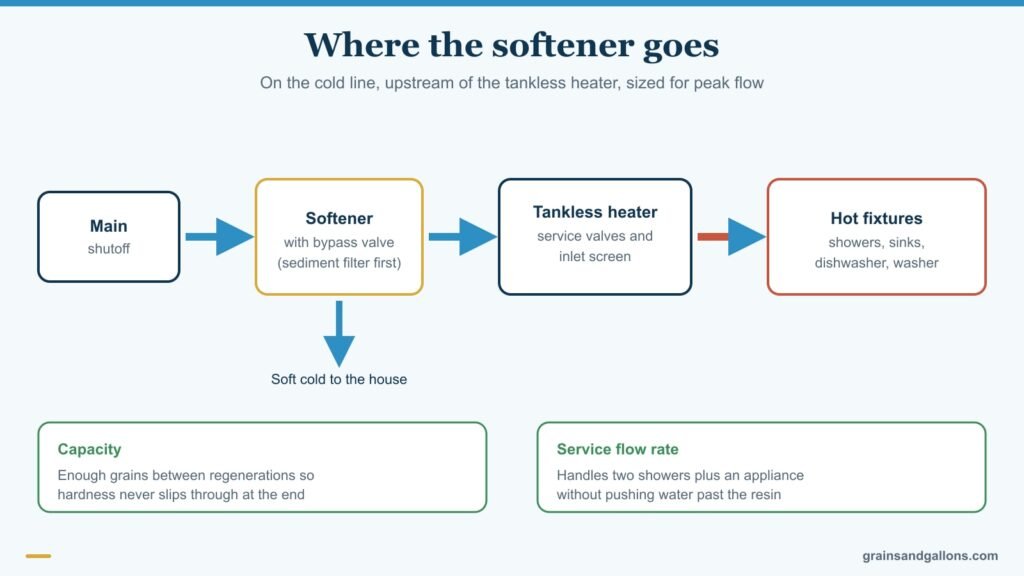
The softener goes on the main cold line, upstream of the heater, so every gallon that reaches the heat exchanger is already soft. Put a sediment filter ahead of it if your water carries grit, and keep the softener's bypass valve accessible for service.
Two numbers matter when you size it:
Capacity, so the softener isn't letting hardness through near the end of each cycle. Hardness that slips through on the last day before regeneration still ends up in the heat exchanger.
Service flow rate, so two showers plus the dishwasher don't push water through the resin faster than it can soften it. Tankless homes often run several fixtures on hot at once. Our guide on how to size a water softener shows the math.
A metered (demand-initiated) softener is a good fit because it regenerates based on actual gallons used; see our picks for metered on-demand softeners. If you're shopping specifically to protect a new unit, our guide to the best water softeners for a tankless water heater compares models on capacity and flow.
Maintenance a softener doesn't replace
- Clean the inlet water filter screen on the heater's cold inlet. It catches debris; the manual gives the interval.
- Flush the heat exchanger on schedule. Rinnai recommends flushing at least once a year, using 4 gallons of undiluted white vinegar circulated through the service valves, which can take up to 45 minutes. Noritz suggests a check one year after installation and at least yearly descaling if significant buildup is found. With softened water, you'll often find very little scale, which confirms the softener is doing its job.
- Test softened water a few times a year at a hot tap. A softener that has quietly stopped working lets scale start building again.
- Keep the softener working. Salt in the brine tank, no salt bridges, correct hardness setting. A tankless heater is one of the first things to suffer when the softener slips.
If the heater has already run on hard water
Adding a softener stops new scale from forming, but it doesn't dissolve scale that's already there. Flush the unit with a descaler first, then put softened water through it. If the heater shows temperature swings or scale-related errors, have it serviced before you assume the softener will fix it.
FAQ
Do I need a water softener for a tankless water heater?
Not always. Test your hardness and check the manual's water quality limits. If your water is hard, roughly above 7 gpg, or above the manual's limit, a softener protects the heat exchanger and may matter for warranty coverage.
How often should I flush a tankless water heater with softened water?
Follow your manual. Rinnai's general guidance is at least once a year; with softened water the flush usually comes out clean, and some owners can stretch intervals if the manual allows it.
Will softened water void my tankless warranty?
No. Softened water is generally what manufacturers want. Warranty problems come from scale damage on hard water, which brands such as Navien exclude.
Is a salt-free conditioner enough for a tankless heater?
Salt-free conditioners don't remove hardness. Some may reduce how scale sticks, but they aren't the same as softening; check what your heater's manual accepts.
Where should the softener be installed relative to the tankless heater?
Upstream, on the cold supply line, so all water entering the heater is already softened.
Soften first, flush anyway: the tankless rule
For hard water, softened water and tankless water heaters belong together: the softener keeps calcium off the heat exchanger, and the heater lasts and performs as rated. Size the softener for your peak flow, test its output now and then, and keep cleaning the inlet screen and flushing on your manual's schedule. A clean flush is your proof it's working.