


Quick Answer: When you find a water softener flow restrictor clogged with iron or grit, it's almost always the drain line flow control (DLFC), a small rubber washer in the drain fitting on the control valve. Bypass and unplug the softener, take the drain fitting off, note which way the washer faces, and lift it out. Soak it in white vinegar, rinse it without a wire brush or anything sharp, and put it back the same way. Then run a manual regeneration and check for a strong, steady stream at the drain.
The flow restrictor most people mean is the drain line flow control. It's a small rubber washer, usually with its flow rate in gallons per minute molded or printed on it, that sits in the drain fitting. Its job is to cap how fast water leaves during backwash and rinse. Too little flow and the resin bed never gets lifted and cleaned. Too much and the resin itself goes down the drain.
Because every drop of backwash water passes through that one small hole, it's also where iron, sediment, scale and resin fines pile up.
In this guide
- Is your water softener flow restrictor clogged? Four signs
- Drain flow control or house-side restriction? Run the bypass test
- Time the backwash with a bucket
- Find the washer on Clack, Fleck and cabinet valves
- Soak the washer clean in five steps
- Replace the washer, but never run without one
- FAQ
- Clean it gently, seat it right, then fix the source
Is your water softener flow restrictor clogged? Four signs
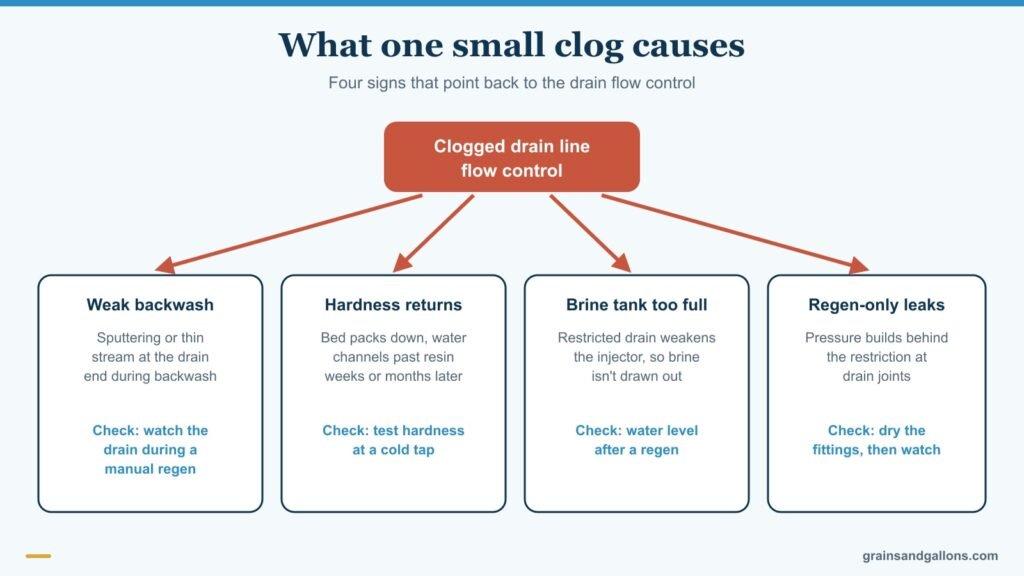
You probably won't see the washer, but you'll see what it does to the softener:
- Weak or sputtering flow at the drain end during backwash, instead of a steady stream.
- Hardness creeping back a few weeks or months after the softener worked fine. A poorly backwashed bed packs down and lets water channel around the resin. See backwash cycle not working for the other causes.
- More water than usual in the brine tank. The injector that pulls brine out of the tank depends on water flowing freely to drain, so a restricted drain can leave brine behind. Our guide to a brine tank full of water covers the other suspects, such as a stuck float.
- Leaks at drain joints that only happen during regeneration, because pressure builds behind the restriction.
- Iron-stained or slimy debris around the drain fitting.
Pentair's Fleck 5600SXT manual lists a plugged drain line flow control in its troubleshooting table, and the fix is short: "Clean flow control." Clack's WS1 manual lists a plugged backwash flow controller with the same advice: remove it, then clean or replace.
Drain flow control or house-side restriction? Run the bypass test
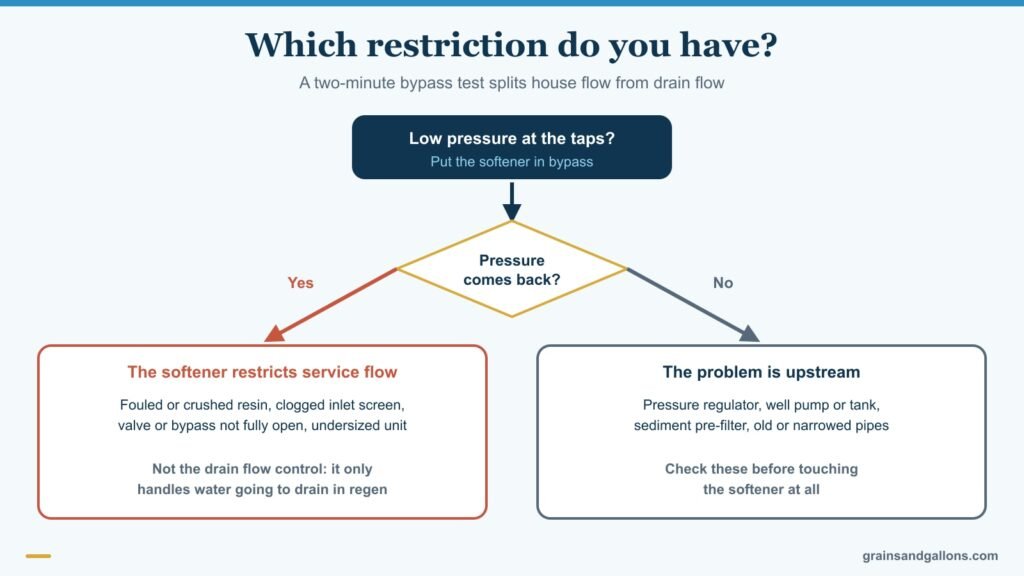
Some people search for a clogged flow restrictor because the whole house has weak pressure. That's a different problem. The drain line flow control only handles water going to drain during regeneration. It has no effect on the water reaching your taps.
To tell them apart, open a cold tap, then switch the softener to bypass:
- Pressure jumps back to normal: the softener is restricting service flow. Likely causes are fouled or crushed resin, a clogged inlet screen, a bypass valve that isn't fully open, or a unit that's too small for your flow. Our guide to low water pressure after a water softener walks through each.
- No change: the restriction is upstream, at the pressure regulator, well pump and pressure tank, a sediment pre-filter or old pipes.
If house pressure is fine and the symptoms only show up around regeneration, keep going: it's the drain side.
Time the backwash with a bucket
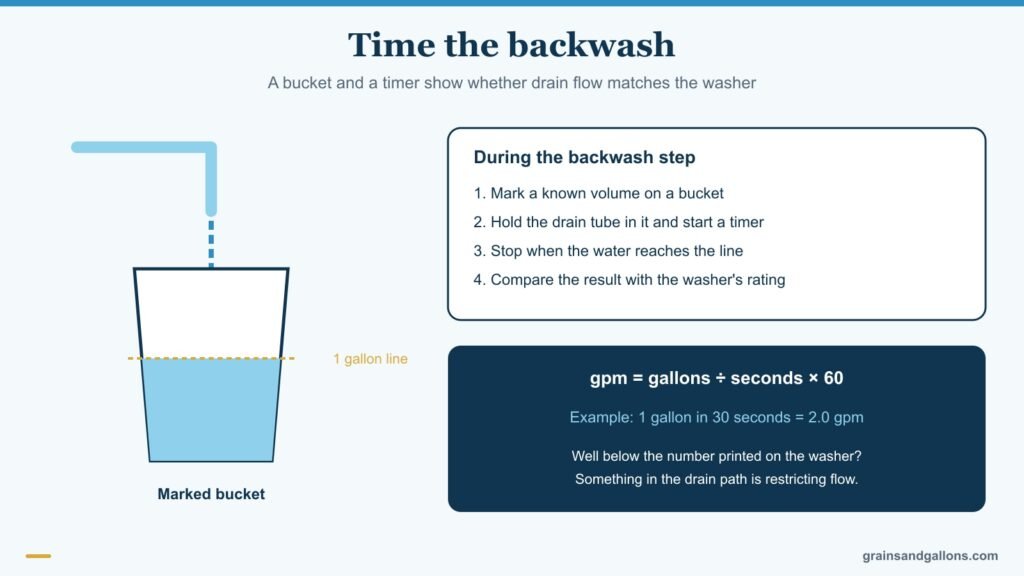
You can measure drain flow without taking anything apart. Start a manual regeneration and, once the valve is in backwash, hold the drain tube in a bucket with a marked volume and time how long it takes to fill. Divide gallons by seconds and multiply by 60 to get gallons per minute. One gallon in 30 seconds is 2.0 gpm.
Compare that with the number on your washer or in your system's spec sheet. A reading well below the rating means something in the drain path is restricting flow: the washer, the fitting, kinked tubing, slime, or a drain line that rises too high or runs too far. If the tube is full of growth, see our guide to water softener drain line slime.
Find the washer on Clack, Fleck and cabinet valves

On a Clack WS1, the Clack service manual shows the drain line flow control and its fitting on top of the control valve. The washer sits in a retainer inside the standard 3/4" drain elbow, or on high-flow setups the 1" straight fitting acts as the retainer. The elbow is held by a clip. Pull the clip and lift the elbow off.
On Fleck valves, the washer sits in the drain fitting at the valve's drain port. The 5600SXT parts list shows several washer sizes, including 2.0, 2.4 and 3.5 gpm. Check your manual's exploded drawing to see how your housing comes apart; some are clipped, some threaded.
On cabinet softeners from big-box brands, the drain flow control is often molded into the drain fitting or valve. Your owner's manual will show it, if it's serviceable at all.
Soak the washer clean in five steps
- Shut it down. Put the softener in bypass and unplug it, so it can't start a cycle while the fitting is off. Open a cold tap downstream for a few seconds to bleed pressure out of the valve. Have a towel, a cup of white vinegar, a soft toothbrush and a plastic or wooden pick handy. If you have iron or manganese, wear gloves; the sludge stains.
- Note the orientation, then lift it out. Look at which side faces up before you pull it. Clack's manual is specific: water should flow toward the washer face with the rounded edge, and when it's seated, the identifying number and rounded inside edge should be visible. Get it backwards and the flow rate won't be right. Ease it out with the pick; a screwdriver can nick the rubber, and a nick changes the flow.
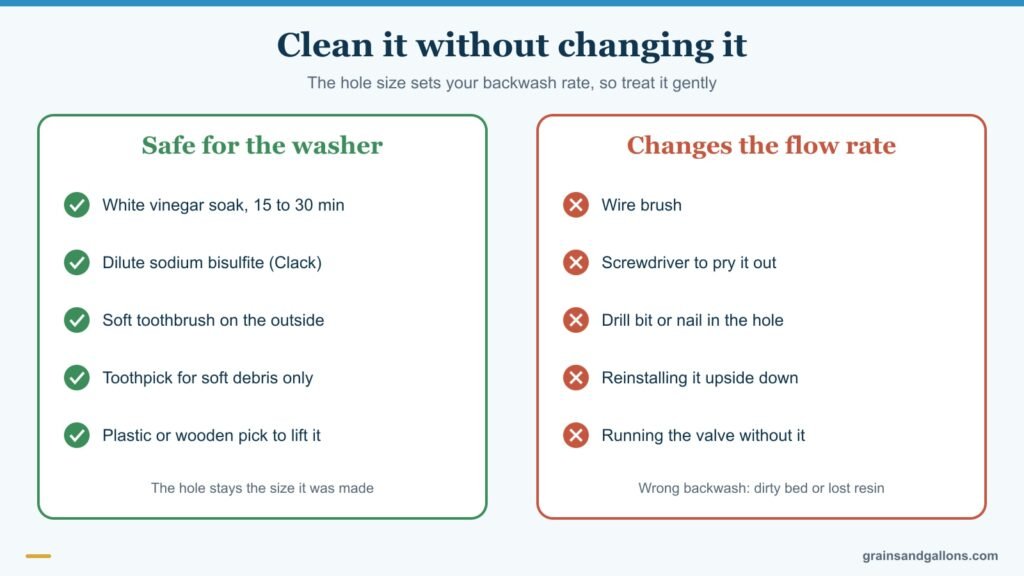
- Soak, don't scrub. Drop the washer and retainer into white vinegar for 15 to 30 minutes, longer if they're crusted with scale. Clack says they can be cleaned in dilute sodium bisulfite or vinegar, and warns: "Do not use a wire brush." The size of that hole sets your backwash flow, so anything that enlarges or scores it changes how your softener works. Rinse, brush the outside softly, and use a toothpick on the hole only if something soft is stuck in it.
- Flush the fitting and the tubing. Debris you leave in the drain elbow or the first few feet of tubing will lodge right back in the washer.
- Reinstall and test. Seat the washer the right way around, refit the fitting and clip, and give any O-ring a light coat of 100% silicone grease. Plug in, take the softener out of bypass slowly and start a manual regeneration. You want a steady stream at the drain end, no leaks at the fitting and no resin beads in the discharge. A few fines can be normal on a new bed, but whole beads mean too much flow or a problem inside the tank. See resin beads in the softener drain line.
While the valve is open, it's worth cleaning the injector too. It clogs from the same debris and causes the same brine-draw problems. See how to clean a water softener injector.
Replace the washer, but never run without one
Replace the washer rather than reuse it if it's hard, cracked or warped, the hole is out of round or scored, or you can't read the flow rating and aren't sure it matches your tank.
The rating has to match your tank size and resin volume. Clack makes them from 0.7 to 10 gpm for the 3/4" fitting and says to pick the one closest to the calculated backwash rate. If the old one is unreadable, check your system's spec sheet or call the dealer rather than guessing.
It's tempting to pull the flow control out when backwash looks weak. Don't. Clack ships its valves without one and warns that you have to install it before use. Without the restriction, backwash flow can lift resin out of the tank and into your drain, and then you're replacing resin as well.
FAQ
What does a drain line flow control do?
It limits how fast water leaves the softener during backwash and rinse. That keeps the flow high enough to lift and clean the resin bed but low enough that resin beads don't wash out to drain.
Can a clogged flow restrictor cause low water pressure in the house?
Not the drain line flow control. It only sees water going to drain during regeneration. If the whole house has weak pressure, put the softener in bypass: if pressure returns, look at the resin, inlet screen and bypass valve instead.
How often should I clean the softener flow control?
There's no fixed schedule. On clean city water it can go years. On well water with iron or sediment, check it once a year or whenever backwash looks weak, and clean the injector at the same time.
Can I use CLR or another acid cleaner on the washer?
Stick to what the manufacturer allows. Clack names vinegar and dilute sodium bisulfite. Other cleaners aren't on that list, and anything that changes the rubber or the hole changes the flow rate, so it isn't worth the gamble on a part this cheap.
What happens if I put the flow washer in upside down?
The flow rate won't match its rating, so backwash may be too weak to clean the bed or strong enough to push resin out. Pull it and reseat it with the number and rounded edge facing the way your manual shows.
Clean it gently, seat it right, then fix the source
A water softener flow restrictor clogged once is bad luck; one that clogs every few months is telling you something about your water. Clean the washer with vinegar instead of tools, put it back facing the right way and confirm the backwash stream. Then deal with what's feeding the clog:
- Sediment or sand from a well: a spin-down filter ahead of the softener catches grit before it reaches the valve. See the best spin-down sediment filters.
- Iron: Penn State Extension notes that oxidized iron and manganese foul softener resin, and they foul every small passage in the valve too. A resin cleaner on a schedule helps.
- An old valve with brittle fittings: if the drain fitting cracks while you're getting it off, it may be time for one of the replacement control valves rather than chasing parts.