


Quick Answer: An outdoor water softener installation works in mild climates if you protect the system from the two things manufacturers warn about most: direct sun and freezing. Put it on a level pad near where the main line enters, shade or enclose it, keep the transformer dry on a GFCI outlet, and run the drain to an approved drain with an air gap. A fitted cover such as the Oceanic Water Systems neoprene tank jacket handles UV and condensation on the resin tank, but it isn't freeze protection.
Disclosure: As an Amazon Associate, Grains & Gallons earns from qualifying purchases.
In much of Arizona, Texas, Florida and Southern California, houses sit on slabs with no basement, the garage is full, and the main water line comes up along an exterior wall. There, outdoor water softener installation isn't a workaround; it's normal. In places with real winters it's a much harder call. Here's how to decide, then how to set it up so it lasts.
In this guide
- What manuals say about outdoor water softener installation
- Climate decides whether outside makes sense
- Pick a shaded spot and build a level pad
- Shade, cover or enclose the whole system
- A freeze plan, even in warm states
- Power outside: GFCI, covers and the transformer
- Drain line, air gap and overflow
- An outdoor water softener installation lasts when shade and freeze protection come first
- FAQ
What manuals say about outdoor water softener installation
Most manuals allow outdoor installation only with protection, or not at all, and the warranty language is where it bites:
- The GE GXSF23Z01 owner's manual says to keep the softener out of direct sunlight, which can distort non-metal parts and damage electronics, and not to expose it to freezing or weather. If it's installed outside, the owner must protect it as it would be protected indoors. Freeze damage isn't covered, and the outlet and transformer should be indoors.
- Clack's WS1 valve manual excludes freeze damage from its warranty and says that for outdoor installations where the valve isn't under cover, the weather cover must be used for the warranty to be valid.
- The Fleck 5600SXT service manual labels its installation locations "for dry locations only" and says the unit can't be subjected to freezing.
Your brand will word it differently, so read the installation and warranty sections before you buy, especially if the softener will sit in afternoon sun.
Climate decides whether outside makes sense

Rarely freezes, lots of sun (desert Southwest, Gulf Coast, Florida): outdoor installs are common. Sun and heat are the main enemies, so shade and UV protection matter most.
Occasional hard freezes (much of Texas, the Southeast, Pacific Northwest lowlands): workable with a freeze plan: an insulated enclosure, insulated pipes, and the ability to bypass and drain the system before a cold snap.
Regular freezing winters: the control valve, bypass, brine tank and pipes all freeze. Even a garage corner that stays above freezing is better. Our guides to where to install a water softener and to basement, garage, crawl space or closet installs cover indoor options.
Pick a shaded spot and build a level pad

- Near the main line, and after the branch that feeds irrigation and hose bibs if you can, so you're not softening lawn water. See should outdoor faucets bypass a water softener?
- Shaded most of the day. A north or east wall, under an eave or behind a fence. Afternoon western sun is the worst.
- Close to a legal drain (more below), and away from the roof drip line, downspouts and sprinkler heads.
- Easy to reach. You'll add salt every month or two; a spot behind a thorny hedge gets neglected.
Set both tanks on a flat, firm surface: a concrete slab, pavers on a compacted base, or a sturdy composite platform. Fleck's instructions call for a level unit on a firm base, and a full brine tank settling unevenly on soil strains the plumbing. Slope the pad slightly away from the house so water doesn't pool.
Shade, cover or enclose the whole system
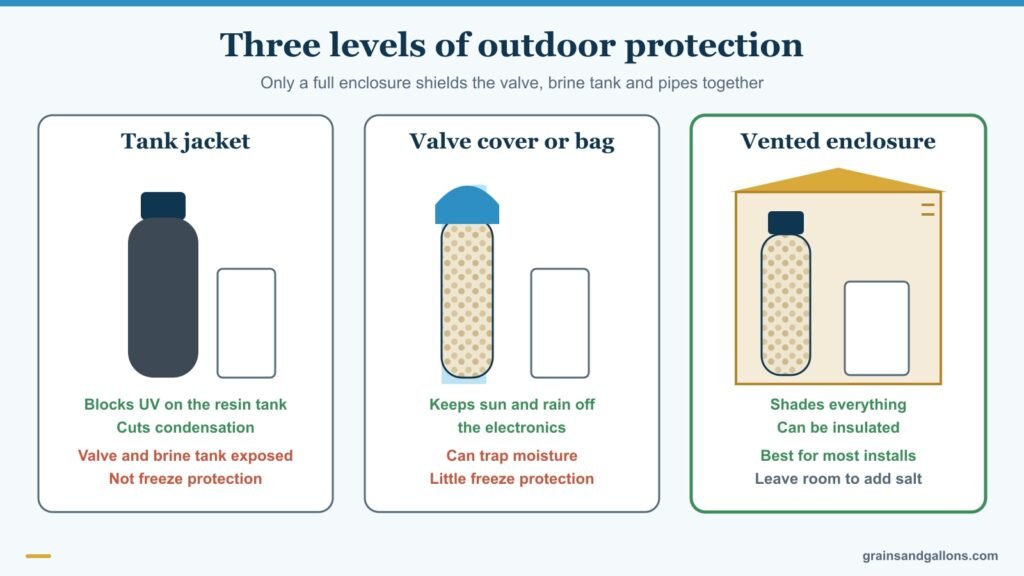
UV breaks down plastics over time: the valve housing, brine tank, bypass and the resin tank's outer finish. Heat also affects electronics. From least to most protection:
- A fitted tank jacket. Neoprene or insulated jackets block UV on the mineral tank and cut condensation, but leave the valve and brine tank exposed and offer little freeze protection.
- A valve cover or full bag. Keeps sun and rain off the electronics. Make sure it doesn't trap moisture against them.
- A ventilated enclosure or cabinet. Shades everything, keeps rain off, and can be insulated in cooler climates. It's the best choice for most installs; leave room to lift the brine lid. Our roundup of the best outdoor water softener covers and enclosures compares jackets, covers and cabinets.
Don't bury the tanks to hide them. Moisture and limited access cause more problems than they solve.
A freeze plan, even in warm states

One night in the low 20s can crack a bypass valve or control body. If freezing is possible where you live:
- Insulate exposed pipes with foam pipe insulation and wrap the bypass and valve area.
- Use an insulated enclosure rather than a jacket alone.
- Know how to put the softener in bypass and drain it before a hard freeze. How to winterize a water softener goes step by step.
- If it freezes anyway, thaw it gently and check for cracks before restoring pressure. See frozen water softener.
If you add heat cable inside an enclosure, use products listed for that purpose, follow the instructions exactly, and keep them off plastic valve bodies unless the maker allows it.
Power outside: GFCI, covers and the transformer

Most softeners run on a low-voltage plug-in transformer. Outdoors, that means:
- GFCI protection and an in-use cover. An outdoor outlet should be GFCI-protected with a weatherproof cover that stays closed while the cord is plugged in. Most local electrical codes require both.
- A dry transformer. Keep it out of rain and direct sun. If your manual says indoors, run the low-voltage cord through the wall instead.
- No permanent extension cords.
If adding an outlet means new wiring, hire a licensed electrician. To skip electrical issues altogether, consider one of the best non-electric water softeners, which regenerate on water flow alone.
Drain line, air gap and overflow

Outdoors, the drain is the part most often done wrong.
- Go to an approved sanitary drain, such as a standpipe or laundry drain. Running brine onto the lawn kills plants, and storm drains are often off-limits for salt discharge.
- Leave an air gap. Fleck specifies an air gap of twice the drain line diameter, at least 1 inch, so drain water can't siphon back.
- Give the brine tank overflow its own gravity line to a drain; never tee it into the valve drain line. See brine tank overflow line requirements.
- Protect both lines from sun and freezing.
Water softener drain line requirements covers distances and what inspectors look for, and discharge rules vary, so check whether you need a permit for a water softener.
An outdoor water softener installation lasts when shade and freeze protection come first
The order of work outside is the same as indoors, with protection added: pour or set the pad, plumb the bypass and connections (our water softener installation guide covers each step), run the drain and overflow, add power, then insulate and enclose. Keep the brine tank lid closed, since outdoor tanks attract ants and collect leaves, and look inside each time you add salt.
Plumbing, a new outlet and a code-compliant drain make outdoor water softener installation a reasonable DIY job for someone comfortable with all three. If any of them is new to you, a plumber for the drain and an electrician for the outlet cost less than replacing a sun-cracked valve or a frozen bypass.
FAQ
Can a water softener be installed outside?
Yes, in climates that rarely freeze, if it's shaded and covered. Check the manual first: many brands require weather protection, and freeze damage is usually excluded from the warranty.
How do I protect an outdoor water softener from the sun?
Install it on a north or east wall or under an eave, and use a vented enclosure or a valve cover plus tank jacket. Direct sun can warp plastic parts and damage electronics.
What is the best enclosure for an outdoor water softener?
A ventilated cabinet that covers the valve, resin tank, brine tank and pipes, with room to add salt. In areas with occasional freezes, choose one you can insulate.
Where should an outdoor water softener drain?
To an approved sanitary drain or standpipe with an air gap, not the lawn or a storm drain. The brine tank overflow needs its own gravity line.
Can I bury a water softener underground?
It isn't recommended. Buried units stay damp, are hard to service and can still freeze. A shaded pad with an enclosure is the better choice.