

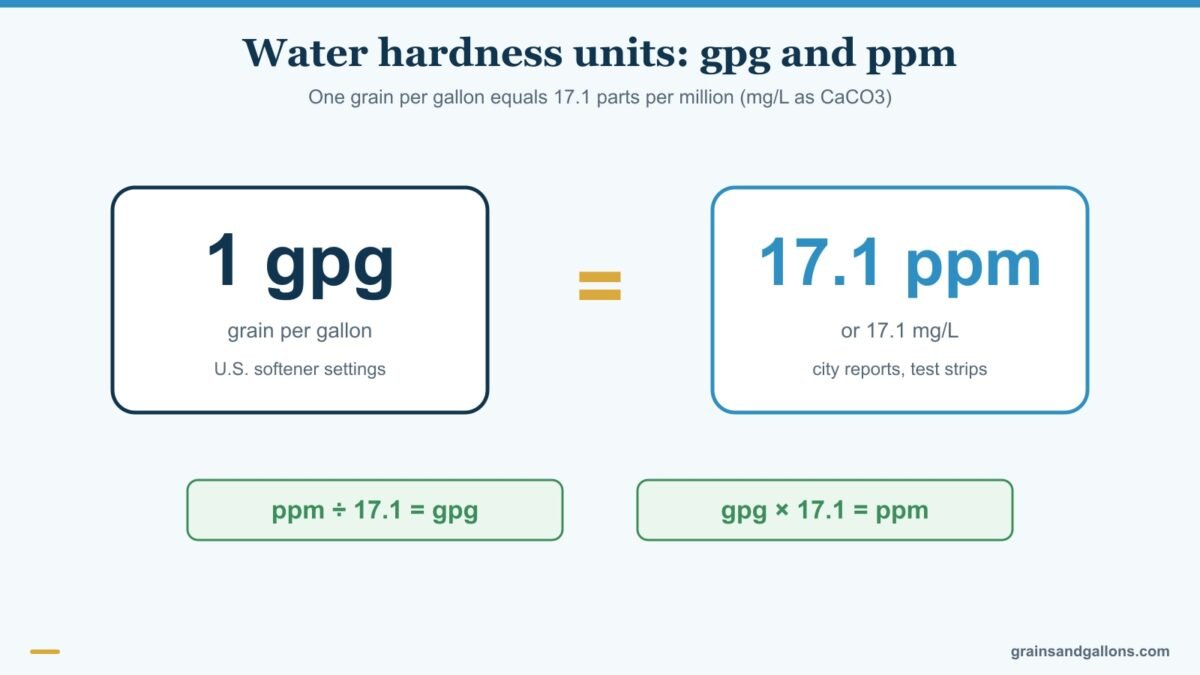
Quick Answer: The two water hardness units you'll meet most in the U.S. are grains per gallon (gpg) and parts per million (ppm, the same as mg/L). Divide ppm by 17.1 to get gpg, or multiply gpg by 17.1 to get ppm. So 170 ppm is about 10 gpg, and 20 gpg is about 342 ppm. Softeners are set in gpg; city reports and test strips usually use ppm or mg/L. A drop-count kit like the LaMotte 4482 total hardness kit saves you the math.
Disclosure: As an Amazon Associate, Grains & Gallons earns from qualifying purchases.
Water hardness units cause more confusion than the hardness itself. Your city's water report says hardness is 205. Your softener's setup screen wants a number around 10 or 20. The test strip in the drawer has color blocks labeled 0, 25, 50, 120, 250 and 425. Same water, three scales, and nobody tells you which is which.
They all measure the same thing: how much calcium and magnesium is in the water, expressed as if it were calcium carbonate (CaCO3). The units are just different-sized buckets.
In this guide
Converting gpg and ppm with the 17.1 rule

1 grain per gallon (gpg) = 17.1 parts per million (ppm) = 17.1 mg/L
A grain is an old weight unit, 1/7,000 of a pound or about 64.8 milligrams. One grain dissolved in a gallon of water works out to about 17.1 milligrams per liter. You'll see 17.1, 17.12 or 17.118 depending on the source; the difference doesn't matter for setting a softener.
ppm and mg/L are the same thing for drinking water. One milligram in a liter of water is one part per million by weight, and reports use the two interchangeably.
- ppm → gpg: divide by 17.1
- gpg → ppm: multiply by 17.1
Worked example: your city report says 205 mg/L as CaCO3. 205 ÷ 17.1 = 11.99, so set about 12 gpg on the softener.
| ppm / mg/L | gpg (approx.) | Category |
|---|---|---|
| 17 | 1 | Soft |
| 60 | 3.5 | Soft (upper limit) |
| 86 | 5 | Moderately hard |
| 120 | 7 | Moderately hard (upper limit) |
| 171 | 10 | Hard |
| 180 | 10.5 | Hard (upper limit) |
| 256 | 15 | Very hard |
| 342 | 20 | Very hard |
| 428 | 25 | Very hard |
| 513 | 30 | Very hard |
The categories follow the scale used by USGS and the World Health Organization, whose hardness background document puts soft water below 60 mg/L as calcium carbonate, 60–120 mg/L moderately hard, 120–180 mg/L hard, and above 180 mg/L very hard. For what those levels mean day to day, see what hardness level is too hard.
Water hardness units by country and appliance

Reports from other countries, European dishwasher and espresso machine manuals, aquarium kits and some lab results use other scales. The conversion chart from the water chemistry reference aqion gives these equivalents:
| Unit | Equals | To convert to gpg |
|---|---|---|
| German degree (°dH or °dGH) | 17.8 mg/L as CaCO3 | multiply by about 1.04 |
| French degree (°f or °fH) | 10 mg/L as CaCO3 | multiply by about 0.58 |
| English / Clark degree (°e) | about 14.3 mg/L as CaCO3 | multiply by about 0.84 |
| mmol/L (calcium + magnesium) | about 100 mg/L as CaCO3 | multiply by about 5.85 |
Example: your espresso machine's manual says to choose level 3 if your water is 14–21 °dH. 14 °dH × 1.04 ≈ 14.6 gpg, and 21 °dH ≈ 21.8 gpg. Going the other way, divide gpg by 1.04 to get German degrees.
Watch for meq/L on lab reports too. One meq/L of hardness is about 50 mg/L as CaCO3, so multiply by about 2.9 for gpg.
Hardness "as calcium" vs hardness "as CaCO3"

Most U.S. reports give hardness "as CaCO3." Some list calcium alone in mg/L, or calcium and magnesium as separate lines. Those numbers are on a different scale, and if you plug them into the table above you'll undershoot.
If you only have calcium and magnesium in mg/L:
- Calcium (mg/L) × 2.5 = calcium hardness as CaCO3
- Magnesium (mg/L) × 4.1 = magnesium hardness as CaCO3
- Add them, then divide by 17.1 for gpg
Example: calcium 60 mg/L, magnesium 18 mg/L. 60 × 2.5 = 150; 18 × 4.1 = 73.8; total ≈ 224 mg/L as CaCO3 ≈ 13 gpg. Dividing the 60 mg/L of calcium by 17.1 would give 3.5 gpg and a softener set far too low.
Our guide on how to read a water hardness report walks through where these lines appear, and types of water hardness explains how calcium and magnesium fit into total hardness.
Why a TDS meter's ppm isn't hardness

TDS meters also read in "ppm," which causes a lot of confusion. TDS (total dissolved solids) counts everything dissolved, including sodium, chloride, sulfate, bicarbonate, calcium and magnesium, and the meter estimates it from electrical conductivity.
- A TDS reading of 300 ppm doesn't mean 300 ppm of hardness. It could be mostly hardness, or mostly sodium and chloride.
- After a softener, TDS barely changes, because the softener swaps calcium and magnesium for sodium rather than removing dissolved solids. People see the same TDS number and assume the softener failed when it's working fine.
Our guide on how to use a TDS meter covers what it's actually good for. To measure hardness, use a hardness test.
Which number goes into your softener
- Use gpg, unless your manual or display explicitly asks for ppm or another unit (some newer valves have a unit setting).
- Use total hardness as CaCO3, not calcium alone.
- If you have iron, many manufacturers tell you to add an allowance for it. The rule varies by brand, so follow the manual.
- Round up slightly rather than down.
City reports give an average, and well water can shift with the seasons, so test your own tap. Strips are fine for a rough category; a drop-count titration kit, where you add drops until the color changes and count them, gives a specific number. Our water hardness test kit picks cover both. Then use our step-by-step on setting hardness on a water softener. If you land above about 20 gpg, sizing matters more; see softeners for very hard water.
FAQ
How do I convert ppm to grains per gallon?
Divide the ppm (or mg/L) value by 17.1. For example, 250 ppm ÷ 17.1 ≈ 14.6 gpg.
Is ppm the same as mg/L for water hardness?
Yes. For drinking water, one milligram per liter equals one part per million, so the numbers are interchangeable as long as both are expressed as CaCO3.
What is 10 gpg in ppm?
About 171 ppm (10 × 17.1). That sits just inside the "hard" band of 120–180 mg/L.
Why does my test strip use different numbers from my softener?
Most strips are printed in ppm (mg/L) and most U.S. softeners take gpg. Divide the strip reading by 17.1 before entering it.
What is a German degree of hardness in gpg?
One German degree (°dH) is 17.8 mg/L as CaCO3, or about 1.04 gpg. Multiply °dH by 1.04 to get gpg.
Divide by 17.1, and use total hardness
Most water hardness units come down to one rule: divide ppm or mg/L by 17.1 to get grains per gallon, and multiply to go back. Convert European degrees with the factors above, turn separate calcium and magnesium readings into CaCO3 before dividing, and never read a TDS meter as a hardness meter. Get those right and the number you enter in your softener will match the water coming out of your tap.