


Quick Answer: Here's how to read a water hardness report: find the line that says "Total Hardness," usually followed by "as CaCO3," and note the unit. If it's in mg/L or ppm (the same thing in water), divide by 17.1 to get grains per gallon, the unit softeners use. If the report gives a range, use the high end. If it only lists calcium and magnesium, multiply calcium by 2.5 and magnesium by 4.1, add them, and you have total hardness as CaCO3.
The PDF from the city, or the lab sheet from your well test, says hardness is "256." That number looks alarming until you notice it's in mg/L, and your softener wants something in the teens. Learning how to read a water hardness report comes down to a few conventions packed into a single line: the parameter name, the "as CaCO3" basis, the unit, and sometimes a range. Once you know them, it takes about a minute.
In this guide
- How to read a water hardness report, starting with Total Hardness
- Convert mg/L to grains per gallon for your softener
- No total hardness line? Add calcium and magnesium
- What the number means on the hardness scale
- TDS, iron, alkalinity and pH: the lines next to hardness
- Is the report even about your tap?
- Read the unit and the range, then round up
- FAQ
How to read a water hardness report, starting with Total Hardness

Here's a made-up but typical set of results, the kind you'd see on a utility's water quality page or a private lab report:
| Parameter | Result | Units | Notes on the report |
|---|---|---|---|
| Total Hardness (as CaCO3) | 256 | mg/L | Range 180–310 |
| Calcium | 68 | mg/L | |
| Magnesium | 21 | mg/L | |
| Total Dissolved Solids | 410 | mg/L | |
| Total Alkalinity (as CaCO3) | 190 | mg/L | |
| pH | 7.6 | s.u. | |
| Iron | 0.12 | mg/L |
"Total Hardness" is the line you want. Hardness is mostly dissolved calcium and magnesium, and "total" means both together. That's the load a softener has to remove.
"As CaCO3" is a unit convention, not a substance. Calcium and magnesium have different weights, so labs express both as the equivalent amount of calcium carbonate. That lets them add up into one number. You don't need to do anything with it.
Where it sits on a city report. Hardness isn't a regulated contaminant, so it rarely appears in the main table of violations and limits. On a utility's annual Consumer Confidence Report, look for a "secondary," "unregulated" or "other parameters" table, or a line called "calcium carbonate." EPA's CCR page links to a lookup tool if you can't find your utility's report, and our guide to reading a Consumer Confidence Report walks through the rest of that document.
Other columns you'll see. Lab sheets usually add an MCL (the legal or guideline limit), a reporting limit or "ND" for not detected, the test method, and the sample date. For hardness, the MCL column is usually blank. Check the sample date: a report from three years ago may not match today's water.
Convert mg/L to grains per gallon for your softener

One milligram per liter equals one part per million in water, so treat mg/L and ppm as the same number. Softeners, though, are programmed in grains per gallon. Divide by 17.1:
256 ÷ 17.1 = 15.0 grains per gallon (gpg)
Penn State Extension's water softening guide rounds the same relationship to "approximately 17 mg/l or ppm" per grain, so either divisor gets you within a fraction of a grain. If your report uses German degrees (°dH), which is rare in the US, 1 °dH is about 17.8 mg/L as CaCO3. Our guide to gpg, ppm and mg/L has a full conversion table.
When the report gives a range, use the top of it
City reports often list an average plus a range, because hardness shifts with the source. A utility that blends river and well water can swing a lot by season. Your softener setting should cover the hardest water you'll get. In the sample, that means 310 mg/L, or about 18 gpg, not 15. Setting a little high costs some salt; setting too low lets hard water through on the worst weeks. Our guide on how to set hardness on a water softener covers what else goes into that final number.
No total hardness line? Add calcium and magnesium

Some lab panels only list the individual metals. Convert each to the CaCO3 basis and add:
- Calcium (mg/L) × 2.497 = calcium hardness as CaCO3
- Magnesium (mg/L) × 4.118 = magnesium hardness as CaCO3
From the sample: 68 × 2.497 = 170, and 21 × 4.118 = 86. Together that's 256 mg/L, which matches the total line. That makes it a handy way to check a report that looks off.
Don't use calcium alone. Magnesium counts as hardness and uses up softener capacity just the same. If you plugged in 170 instead of 256, your softener would be set about a third too low.
What the number means on the hardness scale
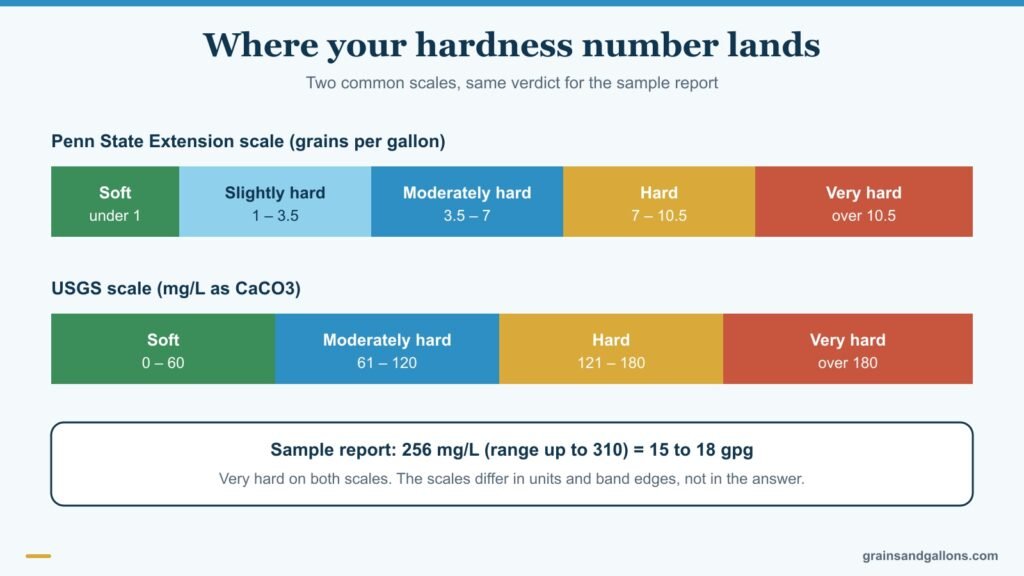
You'll see two scales quoted. Penn State Extension uses grains per gallon:
| gpg | mg/L (approx.) | Description |
|---|---|---|
| Under 1.0 | Under 17 | Soft |
| 1.0–3.5 | 17–60 | Slightly hard |
| 3.5–7.0 | 60–120 | Moderately hard |
| 7.0–10.5 | 120–180 | Hard |
| Over 10.5 | Over 180 | Very hard |
The U.S. Geological Survey's commonly cited version works in mg/L and merges the first two bands: 0–60 soft, 61–120 moderately hard, 121–180 hard, over 180 very hard. The labels shift slightly, but the cutoffs land in the same places.
So the sample house, at 15–18 gpg, is firmly very hard on either scale. Above about 20 gpg, sizing and salt settings matter more; our list of softeners for extremely hard water focuses on units with enough resin for that range. For where you'd actually notice the difference at the tap, see what hardness level is too hard.
TDS, iron, alkalinity and pH: the lines next to hardness
You don't need the whole report to set up a softener, but four nearby lines change how you use the hardness number or tell you whether to trust it:
- Total dissolved solids (TDS). Hardness minerals are part of TDS, so hardness should never be much higher than TDS. If a report shows hardness of 220 mg/L and TDS of 80 mg/L, one of those numbers is wrong; ask the lab or retest. EPA's secondary standards set a guideline of 500 mg/L for TDS, and list hardness as one of the effects above that level, but hardness itself has no federal limit.
- Iron. Clear-water (ferrous) iron uses up softener capacity, so many manufacturers tell you to raise the hardness setting for it. WaterBoss and Whirlpool both say to add 5 for every 1 ppm of ferrous iron. EPA's secondary guideline for iron is 0.3 mg/L, the point where staining starts.
- Alkalinity. This isn't hardness, but it's reported in the same "as CaCO3" units, so people mix them up. It mostly affects how much scale forms when water is heated.
- pH. EPA's secondary range is 6.5 to 8.5. Low-pH water may need an acid neutralizer, which adds hardness back, so test after any neutralizer, not before.
A well water panel will have many more lines, including bacteria, nitrate and arsenic. Our guide to reading a full well water lab report covers those.
Is the report even about your tap?

A city report is an average for the whole system, and it may be a year old. It doesn't account for anything in your house, like a softener already running or a home filter. If the number matters, for setting a softener or troubleshooting one, test your own tap. A drop-count titration kit is more precise than strips for this; see our best water hardness test kits for options. Test raw water from a tap ahead of the softener, or put the softener in bypass first. Then compare: if your result is close to the report's high end, use it; if it's well above the range, trust your own test and recheck in a different season.
Read the unit and the range, then round up
The whole skill of how to read a water hardness report fits on one line: find Total Hardness as CaCO3, confirm the unit, take the top of any range, and divide mg/L by 17.1. Cross-check against calcium and magnesium or TDS if anything looks off, add an allowance for iron, and you have a softener setting you can trust. When the report is old or averaged across a big system, a ten-minute test at your own tap beats it.
FAQ
What does "as CaCO3" mean on a water report?
It means the calcium and magnesium have been expressed as the equivalent amount of calcium carbonate so they can be added into one hardness number. It's a reporting convention; you use the number as is.
How do I convert ppm hardness to grains per gallon?
Divide ppm (or mg/L) by 17.1. For example, 171 ppm is about 10 grains per gallon, and 342 ppm is about 20.
Is 15 grains per gallon hard water?
Yes. Anything over 10.5 gpg (about 180 mg/L) is classed as very hard on both the Penn State and USGS scales, so 15 gpg is well into that range.
Why isn't hardness listed with the regulated contaminants?
Hardness isn't a health-based contaminant, so it has no federal limit. Utilities usually list it in a secondary or "other parameters" table, sometimes as calcium carbonate.
Should I use the average or the highest hardness value?
Use the highest value in the range. Your softener needs to handle the hardest water it will see, and setting it slightly high only costs a little extra salt.