


Quick Answer: If your water feels hard after vacation, first run every softened tap for a few minutes, because water that sat in the pipes and water heater can feel and taste off without being hard. Then test a softened cold tap. If it's truly hard, check three things: the softener display and clock (a power outage), the bypass valve (still set to bypass), and the brine tank (out of salt or bridged). Fix what you find, run a manual regeneration, and test again.
You get home, drop the bags, take a long shower, and something feels off: squeaky skin, spots on the glasses, soap that won't lather. The softener worked fine when you left. When water feels hard after vacation, the cause is almost always one of a handful of things, and the clues are sitting on the softener and in the brine tank. Spend five minutes looking before you change any settings.
In this guide
Flush the stale water before you test anything

Water that sits in pipes and a water heater for a week or two changes. It warms up, loses dissolved oxygen, can pick up a metallic or musty taste, and sometimes looks cloudy. None of that is hardness, but it can feel like something's wrong.
Run the bathtub spout and the kitchen cold tap for several minutes, then do the same with hot. Now test a softened cold tap. Hardness strips give a number in a minute; our guide to the best water hardness test kits covers cheap options. Penn State Extension treats anything under 1 grain per gallon (17 mg/L) as soft, so a softened tap should read at or near zero. If it does, you're done. If not, keep going.
Read the clues on the softener head

A blank or wrong clock. A power outage or a tripped GFCI outlet can leave the softener off, or on with the wrong time, so regenerations happen at odd hours or not at all. Many digital valves ride out short outages: the Fleck 5600SXT manual says its control keeps time for at least 8 hours without power and queues a missed regeneration for when power returns. A longer outage or an older mechanical timer needs the time reset. Check the outlet and breaker, set the clock, and run a manual regeneration.
The bypass is still set. Some people bypass the softener or shut the main off before a trip, or a house sitter flips something during a leak scare. Fleck's own troubleshooting table lists an open bypass and an empty brine tank as the first causes of hard water. Turn the bypass back to service and make sure every valve near the softener is fully open.
Vacation mode is still on. Some controls have an "away" setting that pauses regeneration, and the first cycle after you switch it off may not come when you expect. See regeneration skipped after vacation mode for the common cases.
Then lift the brine tank lid

Is there salt at all? If the tank is empty, the softener had nothing to regenerate with, and hard water has been passing straight through.
Is the salt hard as rock on top? Humid weeks with no fresh salt going in are prime time for a salt bridge: a crust across the tank with an empty gap underneath, so no salt touches the water. Push a broom handle down through the salt. If you hit a shelf and then nothing, break it up gently; our guide to a water softener salt bridge shows how.
Does the brine smell bad? Still, warm brine can get musty while a house sits empty. That's not hardness, but if the softened water smells off too, follow our steps on how to sanitize a water softener.
Why water feels hard after vacation with a timer softener

Timer-based softeners regenerate on a fixed day count whether anyone uses water or not. A unit set to regenerate every few days kept burning salt all the while you were away, and on a long trip it can run the tank dry. A metered (demand-initiated) softener counts gallons and regenerates after you've used its capacity, so an empty house uses far less salt. One catch: the Fleck manual describes a "regeneration day override" that triggers a cycle after a set number of days even on metered controls, so a metered unit may still run once or twice on a long trip.
Check your control's settings or label. If it regenerates on days alone, that explains a surprisingly empty brine tank, and it's worth switching to metered regeneration if your valve supports it.
Getting back to soft water
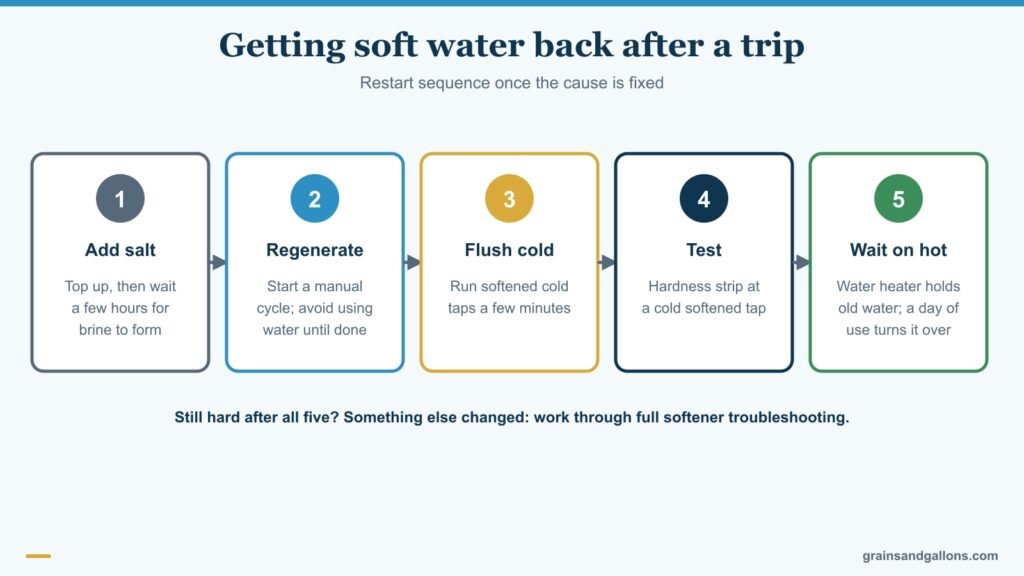
Once you've fixed what you found:
- Add salt if it's low and give it a few hours to form brine.
- Start a manual regeneration and avoid using water until it finishes, usually an hour or two.
- Run softened cold taps for a few minutes, then test.
- If the hot water still feels hard, give it time. The water heater may be holding water that came in while the softener was bypassed or out of salt, and a day of normal use turns it over.
If you found nothing wrong and the water is still hard after a regeneration, the trip may be a coincidence: your utility may have switched sources, or a mechanical problem happened to show up now. Work through the full order in our guide to a water softener not softening water.
Before the next trip
- Top off the salt before you leave, and break up any crust so fresh salt sits on water.
- Check the regeneration schedule. A timer unit wastes salt and water in an empty house; a metered one doesn't.
- Get alerts while away. A smart salt level sensor sends a phone alert when salt runs low; see our picks for smart salt level sensors.
- Plan long absences. For houses that sit for months, softener care for seasonal homes covers bypassing, draining and restarting.
FAQ
Why does my water feel hard after being away for a week?
Most often it's stale water in the pipes rather than real hardness. If a hardness test after flushing still reads hard, the softener likely ran out of salt, lost its clock in a power outage, or was left in bypass.
Should I turn off my water softener when I go on vacation?
A metered softener can usually stay on because it regenerates mainly on water use (apart from any day-override setting). A timer softener wastes salt while you're away, so many owners bypass or unplug it for long trips and run a manual regeneration when they return.
How long does it take to get soft water back after a regeneration?
Cold softened taps are usually soft as soon as the regeneration finishes and you flush the lines. Hot water can take about a day of normal use while the water heater refills with softened water.
Can a softener run out of salt while nobody is home?
Yes, especially a timer model. It regenerates on its fixed schedule and uses salt each time even when no water is used, so a long trip can empty the brine tank.
Does a power outage reset a water softener?
It depends on the control. Many digital valves keep time through outages of several hours and queue missed regenerations; longer outages or older timers need the clock reset by hand.
Flush, test, then check clock, bypass and salt
When water feels hard after vacation, don't start by changing settings. Flush the stale water, test a softened tap, then check the clock, the bypass and the brine tank. Most homecomings are fixed with salt, a reset clock and one manual regeneration.