


Quick Answer: If you have a water softener not softening water, test before you touch anything. Dip a hardness strip like WaterWorks Total Hardness Test Strips in cold water from a softened bathroom tap, then test an unsoftened spigot. If both read the same, check that the bypass valve is in service and the brine tank has salt that isn't crusted over, then run a manual regeneration. Those three checks catch the most common causes.
Disclosure: As an Amazon Associate, Grains & Gallons earns from qualifying purchases.
Spots on the glasses again. Soap that won't lather. That squeaky-dry feeling after a shower. When a softener quits, the signs creep back over a week or two, and by the time you notice, you're not sure when it started. A water softener not softening water almost always comes down to one of a dozen causes, and they're not equally likely or equally expensive. Here they are in the order we'd check them: free five-minute checks first, then the brine tank, then the parts that need tools or a service tech.
In this guide
- Is your water softener not softening water at all, or only partly?
- Round one: five-minute checks
- Round two: lift the brine tank lid
- Round three: brine draw problems
- Round four: settings and the resin itself
- Matching what you see to the likely cause
- A simple routine that keeps it softening
- FAQ
- Test first, then work from free fixes to the tank
Is your water softener not softening water at all, or only partly?

Poor lather, white spots on dishes and fixtures, stiff laundry and scale returning on faucets are the usual clues. A salt level that hasn't moved in weeks is another. But "feels hard" isn't a measurement, so get a reading:
- Test raw water at an outdoor spigot or any tap plumbed before the softener. Penn State Extension's water softening guide notes that outside spigots and toilets are often left unsoftened, which makes them handy raw-water taps.
- Test cold water at a bathroom sink that's definitely softened. Kitchen cold taps and outdoor lines sometimes bypass the softener on purpose.
A working softener should bring the softened tap close to zero, typically under about 1 grain per gallon. If raw is 18 gpg and the bathroom is 17, the softener is doing nothing. If the bathroom reads 4, it's partly working, which points to different causes. Our page on the best water hardness test kits compares strips and drop tests, and how to check if a water softener is working has more ways to confirm it. If the softener is brand new, see water still hard after installing a softener instead.
Round one: five-minute checks

1. The bypass valve is in bypass
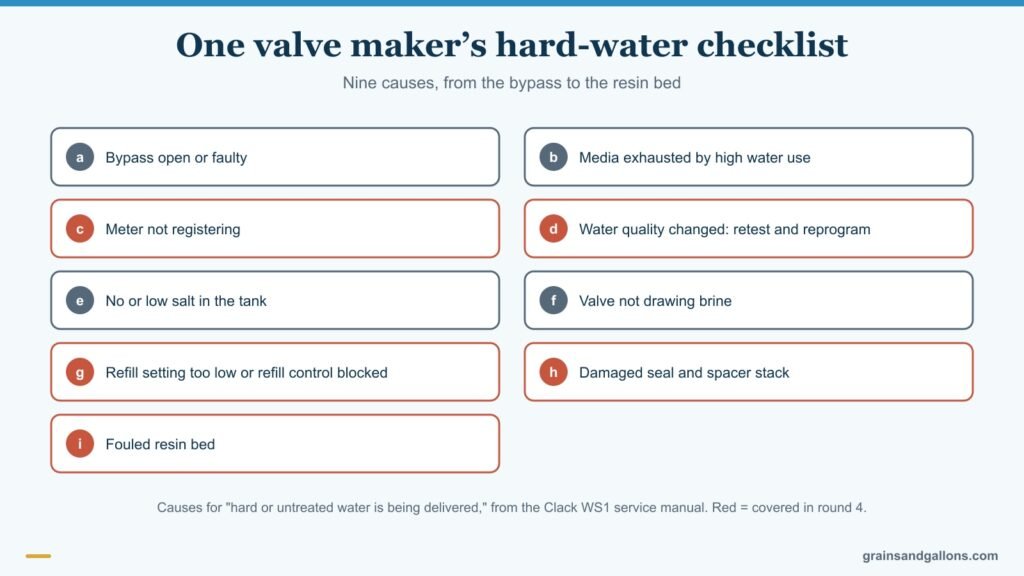
Somebody turned it during a plumbing job, a filter change or a leak scare and never turned it back. On push-button bypasses, "bypass" and "service" are easy to mix up; on a three-valve loop, one handle left half open can send raw water around the softener. Clack lists an open or faulty bypass as the first cause of hard water in its WS1 service manual.
2. The brine tank is empty or nearly so
No salt means no brine, and no brine means the resin never recharges. Look for salt above the water line. If it's been low, add salt, wait a few hours, and regenerate.
3. The display or clock is wrong
A power outage can reset the clock on older units, so the softener regenerates at 2 in the afternoon or off schedule. A blank display means it isn't regenerating at all. Set the time and confirm the schedule. If you see an error code, look it up in your model's manual before going further.
Round two: lift the brine tank lid

4. A salt bridge is hiding an empty tank
A hard crust can form across the tank, leaving a hollow gap underneath. The tank looks full, but the salt never touches the water. Push a broom handle down through the salt. If it hits a solid shelf and then drops, you've found a bridge. Break it up gently without hitting the tank walls; see our guide to breaking up a salt bridge.
5. Mushed salt has turned to sludge
Instead of a crust, the bottom of the tank becomes a thick paste of recrystallized salt. It can block the brine well and stop brine draw. The fix is usually scooping out the sludge and starting fresh with good pellets; our guide to salt mushing in the brine tank covers it.
6. The brine tank water level isn't changing
Note the water level before a regeneration and check again after. If it's the same, the softener isn't drawing brine, which points to the next three causes.
Round three: brine draw problems

7. The injector (venturi) is clogged
The injector is a small nozzle in the control valve that creates suction to pull brine from the tank. Sediment, salt grit or iron can block it. On most residential valves it's reachable with a screwdriver once the softener is in bypass and depressurized. Our walkthrough on cleaning a water softener injector shows what you'll find.
8. The brine line is cracked, loose or clogged
The small tube from the valve to the brine tank has to hold a seal. A loose fitting lets air in instead of brine, and salt crystals or debris can block it. Check both ends and look for bubbles during the brine draw.
9. The float or air check is stuck
The assembly in the brine well can stick and shut off brine draw early. Pull it out, rinse it in warm water and make sure it moves freely. Clack also lists a refill setting that's too low, or a blocked refill flow control, as a reason there isn't enough brine to begin with.
Round four: settings and the resin itself
10. The settings don't match your water or your usage
If the softener is set for 10 gpg but your water is 22, it runs out of capacity long before it regenerates. The same happens when a new baby, houseguests or an irrigation line raise usage. Clack lists "media exhausted due to high water usage" and "water quality fluctuation" as separate causes, and the fix for both is to retest and reprogram. Re-enter your real hardness, add a few grains for iron if you have it, and check the regeneration frequency; see how to set hardness on a water softener. On a metered unit, also confirm the meter is counting.
11. Iron, manganese or chlorine has damaged the resin
Penn State Extension warns that oxidized iron will clog softener resin. Chlorine in city water slowly breaks resin down over years. Either one cuts real capacity, so the softener regenerates "normally" but runs out early. A resin cleaner helps with iron fouling; see water softener not removing iron anymore. If the resin is old, swollen or crumbling, replacing it is often cheaper than a new softener. Our guide to resin life and replacement and our replacement resin picks explain what to buy.
12. Raw water is leaking past the resin
A cracked distributor tube, a failed O-ring where the valve meets the tank, or worn piston seals can let untreated water slip around the resin. Clack lists a damaged seal and spacer stack among its hard-water causes. Telltale signs are resin beads at the taps, hardness that's always partial, or a softener that's ten-plus years old. This is usually a job for a service tech unless you're comfortable pulling the valve head.
Matching what you see to the likely cause
| What you notice | Start with |
|---|---|
| Softened tap reads the same as raw | Bypass valve, empty tank, blank display |
| Salt level never goes down | Salt bridge, clogged injector, brine line |
| Water was soft, slowly became hard over weeks | Settings, usage change, resin fouling |
| Soft right after regeneration, hard a few days later | Capacity setting, worn resin |
| Always partially hard (3–6 gpg) | Internal leak, mixing valve, worn seals |
| Hard water started after a plumbing job | Bypass valve, reversed in/out connections |
Water pressure matters too. Clack rates its valve for 20 to 125 psi, and a valve running below its minimum may not draw brine properly. If your pressure is low, check that before blaming the softener.
A simple routine that keeps it softening
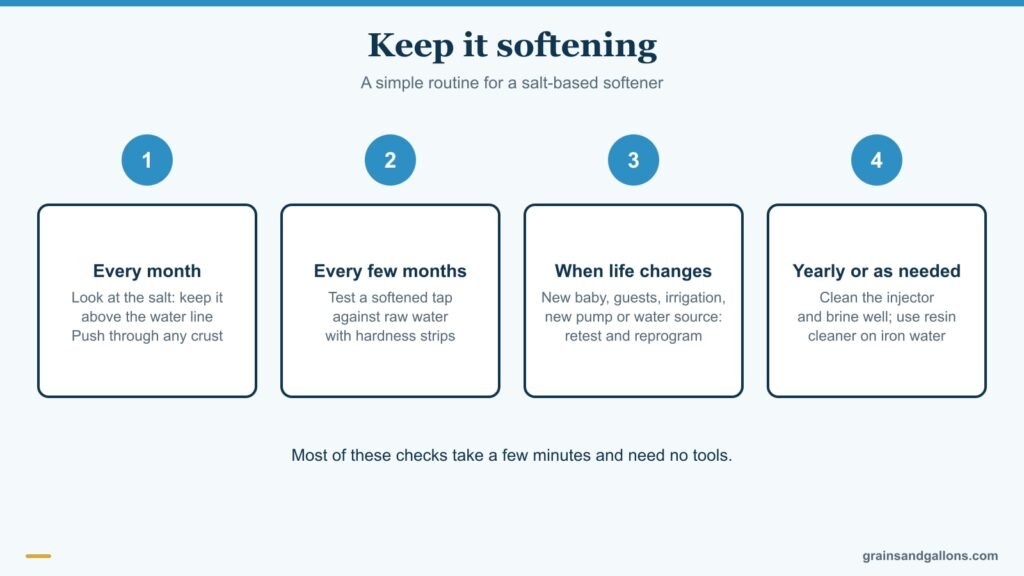
- Monthly: look at the salt, keep it above the water line, and push through any crust before it becomes a bridge.
- Every few months: test a softened tap against raw water so you catch a decline early.
- When life changes: a new household member, irrigation, a new well pump or a new water source means retesting and reprogramming.
- Yearly or as needed: clean the injector and brine well, and use resin cleaner on iron water.
FAQ
Why is my water softener running but the water is still hard?
The most common reasons are a bypass valve left in bypass, a salt bridge, or a softener that isn't drawing brine because of a clogged injector or brine line. Test softened and raw water first so you know whether it's working partly or not at all.
How do I reset a water softener that stopped softening?
Fix the cause first, then set the clock and run a manual regeneration. If the tank was out of salt, add salt and wait a few hours before regenerating so brine can form.
How long does it take a softener to soften water after adding salt?
Brine needs a few hours to form. Run a manual regeneration once it has, and the softened taps should test soft after the cycle finishes.
Can a water softener stop working because of a salt bridge?
Yes. A bridge leaves a hollow gap between the salt and the water, so no brine forms and the resin never recharges, even though the tank looks full.
When should I replace the resin or the whole softener?
If the bypass, salt, brine draw and settings all check out but softened water still tests hard, the resin or internal seals are likely worn. On an older unit, get a repair estimate before deciding.
Test first, then work from free fixes to the tank
A water softener not softening water is usually a bypass, salt or brine-draw problem, and those cost nothing to fix. If you've confirmed the bypass is in service, the tank has salt and draws brine, and the settings match your water, but the softened tap still reads more than a couple of grains, the problem is inside the tank or valve. A good tech can test the resin, check the distributor and rebuild the valve; on an old unit, ask for a repair estimate before you replace the whole system.