

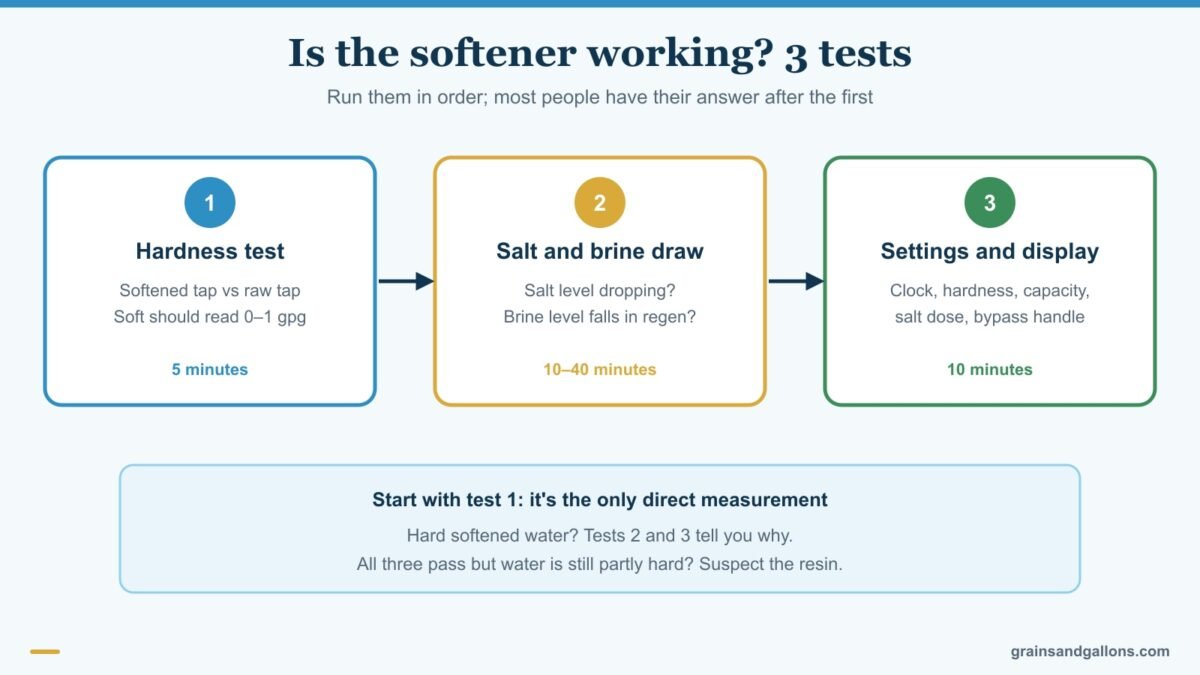
Quick Answer: To check if your water softener is working, test the hardness of water from a cold tap that runs through the softener, then from a tap that doesn't (often an outdoor spigot). Softened water should read 0 to 1 grain per gallon. If it reads close to your raw water, the softener isn't softening. A drop-count kit like the Hach Model 5-EP total hardness test kit gives you a number instead of a color guess. Then check that salt is going down and that the brine tank actually drains during a regeneration.
Disclosure: As an Amazon Associate, Grains & Gallons earns from qualifying purchases.
Your shower feels the same as last year, a white crust is coming back on the faucet, and the salt hasn't moved in a month. Maybe your water softener is working fine and you're imagining it. Maybe it quit weeks ago. You can find out for certain in about an hour, and the first test takes five minutes. Run the checks below in order; most people get their answer from the first one.
In this guide
- Rule out power and bypass first
- Test 1: Compare softened and unsoftened water (5 minutes)
- Test 2: Is it actually using salt and drawing brine? (10–40 minutes)
- Test 3: Check the settings and the display (10 minutes)
- When the tests point to the resin
- Signs you shouldn't rely on
- FAQ
- A hardness number settles whether your water softener is working
Rule out power and bypass first

Two problems make a perfectly good softener look broken, and both take a minute to check:
- Power. Is the display lit and showing the right time of day? Check the outlet, the plug and the breaker. After an outage, many timers lose the clock, so regeneration happens at the wrong hour or not at all.
- Bypass. The bypass valve should be in the "service" position. It's easy to bump during other plumbing work, and in bypass the house gets raw hard water while the softener sits idle.
If both are fine, move on to the tests.
Test 1: Compare softened and unsoftened water (5 minutes)

This is the only test that tells you directly whether the softener is doing its job. Everything else is circumstantial.
What you need: A hardness test kit that reads low. Strips are fine for a rough check, but many step from 0 to 25 or 50 ppm, which is too coarse to tell "soft" from "slightly hard." A drop-count (titration) kit is more precise. Our guide to the best water hardness test kits compares both types.
Steps:
- Pick a softened tap. A cold bathroom sink is a safe choice. Kitchen taps are sometimes plumbed to bypass the softener for drinking water, so don't assume.
- Pick an unsoftened tap. An outdoor hose bib is often on hard water. If you can't find one, put the softener in bypass and run a cold tap for a minute.
- Run each tap for at least 30 seconds to clear water that's been sitting in the pipes.
- Test both samples following the kit's instructions exactly, including the sample volume.
- Write down both numbers.
What the numbers mean:
| Softened tap | Raw tap | What it means |
|---|---|---|
| 0–1 gpg | Your normal hardness | The softener is working |
| 2–5 gpg | Your normal hardness | Partly working: low salt, weak brine draw, near the end of capacity, or worn resin |
| Close to raw | Your normal hardness | Not softening: no salt, a bridge, bypass open, or a failed regeneration |
| Same as raw | Also low | The "raw" tap may be softened too; find another comparison point |
If the kitchen reads soft and the shower reads hard, the plumbing may split before the softener; see hardness test results that differ between faucets. New to testing? How to test water hardness at home covers technique and common mistakes.
Test 2: Is it actually using salt and drawing brine? (10–40 minutes)

If the water's hard, the next question is whether the softener regenerates properly. Regeneration only works if brine is pulled out of the brine tank and through the resin, as Penn State Extension's overview of water softening explains.
Quick look first:
- Lift the brine tank lid. Is there salt, and is the level dropping over time? A level that hasn't moved in weeks is a red flag. So is salt disappearing much faster than usual.
- Push a broom handle down through the salt. It should reach the bottom. A hard layer partway down is a salt bridge, which leaves the softener regenerating with weak or no brine.
- Look at the water level. If it's much higher than usual, brine isn't being drawn out.
Then watch a regeneration:
- Mark the water level in the brine tank with tape on the outside.
- Start a manual regeneration. Our guide on how to manually regenerate a water softener covers the common buttons and knobs.
- Let it reach the brine draw step. On a conventional valve this comes after backwash; the Fleck 5600SXT manual shows the cycle order for that common valve.
- Check the level after 15–20 minutes of brine draw.
What you should see: the water level drops noticeably during the brine step, then rises again during refill later in the cycle. A hum or gurgle during regeneration is normal; silence for days on a metered unit in a busy house is not.
If it doesn't drop: the injector, brine line or brine valve is likely clogged or leaking air. Low water pressure can cause it too, since the injector needs pressure to create suction. Our guide on a water softener not softening water works through each cause.
Test 3: Check the settings and the display (10 minutes)
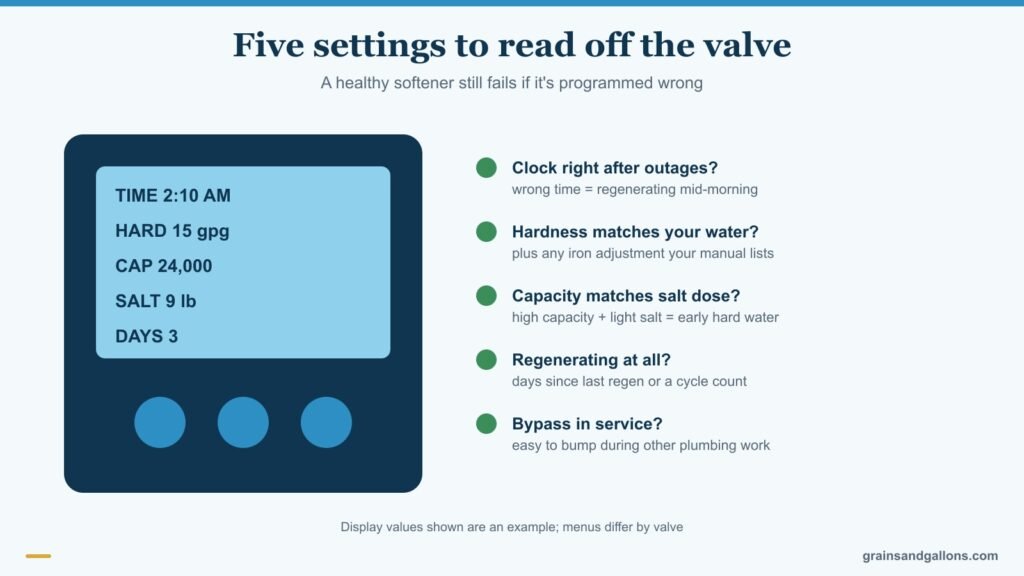
Even a mechanically perfect softener won't keep up if it's programmed wrong.
- Time of day. If the clock is wrong after an outage, regeneration may happen during the morning shower.
- Hardness setting. It should match your raw water hardness, plus any adjustment your manual calls for if you have iron.
- Capacity and salt dose. On valves where you set these separately, they need to match. A high capacity number with a light salt dose leads to hard water before regeneration.
- Regeneration history. Many electronic valves show days since the last regeneration or a cycle count. If it hasn't regenerated in a long time and you use plenty of water, the meter may not be counting.
- Error codes. A flashing code usually points straight at the fault; look it up in the manual before you start replacing parts.
When the tests point to the resin
If the brine tank drains during regeneration, salt is going down, the settings are right, and the water is still partly hard, the resin may be worn out, fouled with iron or damaged by chlorine. Resin lasts many years but loses capacity with age, faster on chlorinated city water. A resin cleaner can help if iron fouling is the issue. If the resin is old and tired, replacing it can be cheaper than a new softener; our roundup of the best replacement water softener resin covers what to buy and what size.
Call a technician if you see resin beads in the plumbing, hear grinding from the valve, find the motor won't advance the cycle, or the softener is old and needs several parts at once.
Signs you shouldn't rely on

A few popular "tests" are misleading:
- The slippery feeling. Soft water usually feels slick, but it's not a measurement, and some people can't tell the difference.
- Soap suds in a bottle. Shaking soapy water in a jar gives a rough clue, but it won't tell you whether you're at 1 gpg or 4.
- A TDS meter. Total dissolved solids barely changes after softening because sodium replaces calcium and magnesium. A TDS meter can't tell you if your water is soft.
FAQ
How can I tell if my water softener is working without a test kit?
Look for the indirect signs: salt going down steadily, rich lather from soap, fewer spots on glasses, and no new white crust on faucets. They're useful clues, but only a hardness test gives you a definite answer.
How often should I test softened water?
Every few months is plenty once you know it's working, plus any time spots or scale return. Testing near the end of a cycle, just before regeneration, shows the worst case.
My softened water reads 1 gpg. Is that OK?
Yes. A little hardness slip is normal, especially near the end of a cycle. Readings that keep creeping up between regenerations are worth watching.
How long after fixing a softener does the water get soft again?
Usually after the next complete regeneration, so often by the next morning if you run one manually. Scale already on fixtures and glassware takes longer to fade.
A hardness number settles whether your water softener is working
Feel, suds and hunches can't prove your water softener is working; a hardness reading from a softened tap can. Start with that five-minute comparison. If the number is high, check power and bypass, watch the brine draw, and read the settings. Most problems turn out to be salt, a clog or a setting, not a dead softener.