


Quick Answer: Here's how to sanitize a water softener: pour a small, measured amount of plain unscented household bleach into the brine well (the tube inside the salt tank), then run a manual regeneration so the bleach is drawn through the resin and rinsed to the drain. Pentair's Fleck manual calls for about 1.2 fl oz of 5.25% bleach per cubic foot of resin; EcoWater's manual for its smaller EEC 1502 units uses about 1.5 oz (2 to 3 tablespoons). Afterward, run a cold tap downstream until you can't smell chlorine. Use your own manual's dose if it gives one.
The well was just shock-chlorinated. Or the softener sat unplugged at a cabin all winter. Or the water from the softened taps has picked up a musty edge that the outside hose doesn't have. Knowing how to sanitize a water softener lets you kill what's growing in the resin bed and brine system without hurting the resin, and it takes about as long as one regeneration. The trick is the dose: too little does nothing, and too much shortens resin life.
In this guide
- Signs your softener needs sanitizing, and signs it needs something else
- Bleach dose by resin size and bottle strength
- Protect yourself before opening the bleach
- How to sanitize a water softener in six steps
- Clean the brine tank first when the smell lives there
- Flush the chlorine out of the house lines
- After a well shock or boil water notice
- Alternatives to household bleach, and media that can't take it
- FAQ
- Sanitize when there's a reason, and measure every time
Signs your softener needs sanitizing, and signs it needs something else
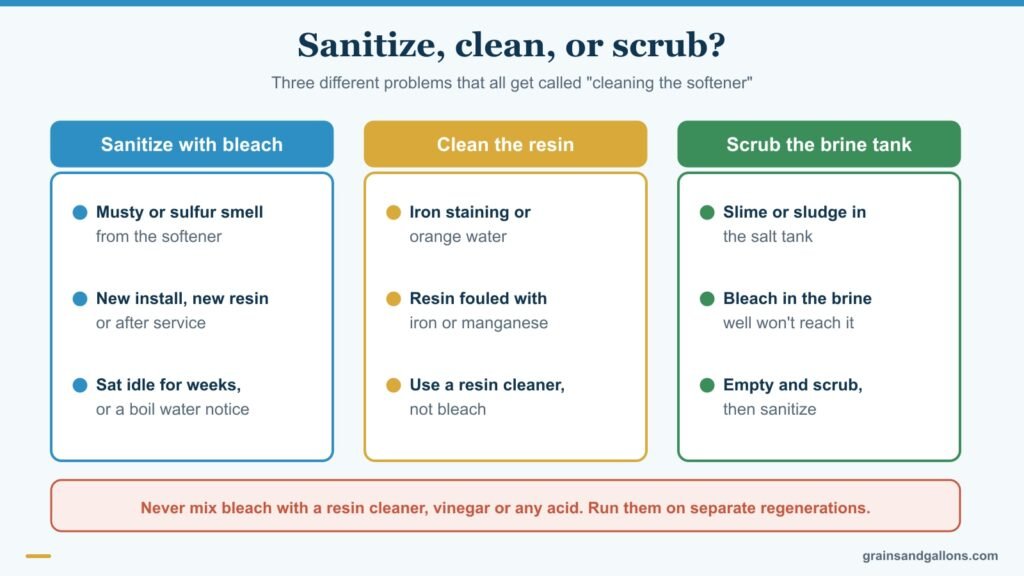
Sanitize when:
- You've installed a new softener or replaced the resin
- The valve or tanks were opened for service
- The softener sat unused for weeks or months, such as at a seasonal home
- The well was shock-chlorinated, or your city issued a boil water notice
- The softened water or brine tank has a musty or sulfur smell that started in the softener
EcoWater's owner's manual suggests sanitizing at installation because bacteria can get in during shipping, storage and installing, and notes that some water supplies may need periodic disinfecting. Penn State Extension's softening guide likewise lists bacterial growth in the resin as a maintenance problem and mentions periodic cleaning with chlorine bleach, while advising you to check the manufacturer's instructions before adding any chemical.
Don't make it a monthly habit. Chlorine is an oxidizer, and repeated exposure breaks down softener resin over time; our page on how chlorine damages softener resin explains the mechanism. An occasional, measured dose is what manufacturers describe.
Sanitizing also isn't cleaning. Orange water, rust stains and resin coated with iron call for a resin cleaner, covered in our resin and iron cleaners guide and the Iron Out vs Res Care comparison. Slime or black sludge in the salt tank needs scrubbing, because bleach poured down the brine well never touches most of the tank walls.
Bleach dose by resin size and bottle strength

Two numbers decide the dose: how many cubic feet of resin you have, and how strong your bleach is.
Pentair's Fleck 5600SXT installation manual specifies 1.2 fl oz of 5.25% sodium hypochlorite per cubic foot of polystyrene resin. Many bleach bottles sold today are stronger than 5.25%, so check the label and scale down:
| Resin volume | 5.25% bleach | 6% bleach | 8.25% bleach |
|---|---|---|---|
| 1.0 cu ft (often "32,000 grain") | 1.2 fl oz (about 2.5 tbsp) | 1.05 fl oz (about 2 tbsp) | 0.75 fl oz (1.5 tbsp) |
| 1.5 cu ft (often "48,000 grain") | 1.8 fl oz | 1.6 fl oz | 1.15 fl oz |
| 2.0 cu ft (often "64,000 grain") | 2.4 fl oz | 2.1 fl oz | 1.5 fl oz |
| 2.5 cu ft (often "80,000 grain") | 3.0 fl oz | 2.6 fl oz | 1.9 fl oz |
One fluid ounce is 2 tablespoons. If you don't know your resin volume, the model number or the tank size on the label usually tells you; grain ratings in the table are common pairings, not guarantees.
Other manufacturers give their own numbers. EcoWater's EEC 1502 owner's manual says to pour about 1-1/2 oz (2 to 3 tablespoons) of common household bleach into the brinewell. Whirlpool's WHES3T manual says about 3 oz (6 tablespoons). When your manual gives a dose, use it instead of the table.
Use plain bleach. Skip scented, "splash-less" and thickened products, since those additives aren't meant to pass through resin and into your plumbing.
Protect yourself before opening the bleach

The dose is small, but the bottle isn't. Wear gloves and eye protection, keep the area ventilated, and pour slowly so nothing splashes back out of the narrow brine well.
The bigger hazard is chemistry. Never combine bleach with an iron-removing resin cleaner, vinegar, or any acid product; some combinations release toxic gas. That includes salt with an iron-removing additive in the tank. If you've used a resin cleaner or rust-control salt recently, switch to plain salt and run at least one ordinary regeneration before you sanitize.
How to sanitize a water softener in six steps

- Check that the brine tank has water in it. Lift the lid and look down the brine well. You need some water in the bottom so the bleach gets drawn in with the brine. If the tank is dry, add a few gallons to the tank (not the brine well) first.
- Optional: backwash first. Pentair's procedure starts with a backwash, which loosens the bed and clears debris. On many digital valves you can start a manual regeneration, let it run through backwash and stop before brine draw. If that's awkward on your model, skip it.
- Pour the measured bleach into the brine well, not onto the salt. The brine well is the tube that holds the float and the brine pickup.
- Replace the cover and put the bypass in service.
- Start a manual regeneration. The valve draws the bleach and brine through the resin bed, then rinses it to the drain. If you're unsure how to start one on your control, see how to manually regenerate a water softener.
- Flush the house side once the regeneration finishes (next section).
You may smell chlorine near the drain during the cycle. That's normal and a sign the bleach actually reached the resin. Don't stop the regeneration partway and leave bleach sitting in the bed; let it run to the end.
Clean the brine tank first when the smell lives there
When the odor comes from slime, mold or sludge in the salt tank, start there. Scoop or vacuum out the old salt and water, scrub the tank and brine well with mild dish soap, rinse, and only then refill and sanitize. Our brine tank cleaning guide walks through it.
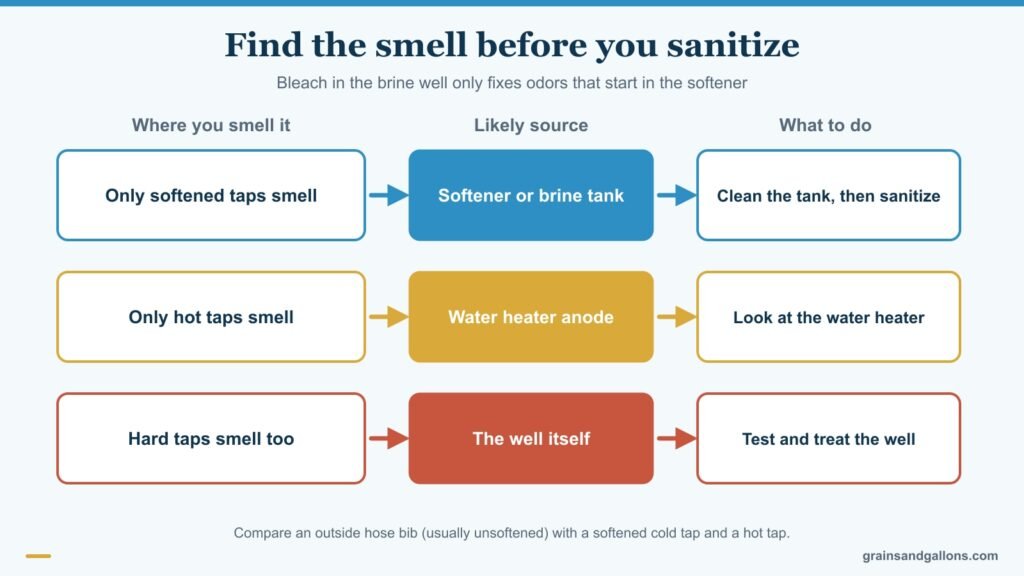
If the smell is rotten eggs and keeps returning after a clean tank and a sanitizing cycle, read brine tank smells bad before blaming the softener. Sulfate-reducing bacteria in the well, or a reaction with the water heater's anode rod, can be the real source. A quick test: compare a softened cold tap, a hot tap and an unsoftened tap such as an outside hose bib. If only the hot side smells, look at the water heater; if the unsoftened tap smells too, it's coming from the well.
Flush the chlorine out of the house lines
When the regeneration ends, open a cold faucet downstream of the softener. EcoWater's manual says to let 50 gallons pass through the system, which should take at least 20 minutes, and Whirlpool's manual gives the same instruction. Keep going until you can't smell chlorine.
Then:
- Refill the salt if the level is low.
- Run the next regeneration on schedule (or force one) so the resin is fully recharged with plain brine.
- Put any equipment you bypassed back in service, such as a carbon filter or RO system, only after the chlorine smell is gone.
- On a private well, if bacteria were the reason you sanitized, retest after the softener and well are flushed. Our guide to testing water for bacteria covers sampling.
After a well shock or boil water notice

When a well is shock-chlorinated, the dose is far stronger than anything you'd put in a brine well, and it can damage resin. The common approach is to put the softener in bypass during the shock, flush the house lines, then bring the softener back and sanitize it separately at the normal dose. Our guide to shock chlorination with a water softener has the full sequence, and boil water notices and your softener covers the city-water version.
If bacteria keep coming back on repeat tests, sanitizing the softener only treats a symptom. The fix is continuous treatment at the well, usually UV after a sediment filter. See our well water systems for bacteria and ask your local health department about retesting.
Alternatives to household bleach, and media that can't take it
Bleach isn't the only option, and for some systems it's the wrong one:
- Manufacturer sanitizer packs. Some dealer brands sell pre-measured sanitizing packets made for their units. They take the guesswork out of the dose, so use them if your manufacturer specifies one.
- Hydrogen peroxide. Some water treatment companies suggest it as a gentler option, but no manufacturer manual we've seen gives a household dose, so treat it as a question for your dealer rather than a DIY swap.
- Combination units. Softeners with a carbon layer or a built-in filter will absorb some of the chlorine, and some specialty media for iron, sulfur or manganese shouldn't see bleach at all. Check the manual before sanitizing anything sold as more than a plain softener.
FAQ
How much bleach do I put in my water softener to sanitize it?
Pentair's Fleck manual uses 1.2 fl oz of 5.25% bleach per cubic foot of resin, so a typical 1 cubic foot softener takes about 2.5 tablespoons. Use less if your bleach is stronger (6% or 8.25%), and follow your own manual if it gives a different number.
Do I put bleach in the brine well or the salt tank?
The brine well. That's the tube inside the salt tank that holds the float and brine pickup. Bleach poured onto the salt mostly stays in the tank and doesn't reach the resin in a controlled way.
How often should a water softener be sanitized?
Only when there's a reason: a new install or new resin, service work, a long idle period, a well shock or boil water notice, or a musty smell that starts in the softener. Routine monthly bleaching shortens resin life.
Is the water safe to drink right after sanitizing the softener?
Flush first. Run a cold tap downstream until the chlorine smell is gone; EcoWater's manual calls for about 50 gallons, which takes at least 20 minutes. After that, the bleach has been rinsed out of the softener and lines.
Can I use vinegar instead of bleach to sanitize a water softener?
No. Vinegar is an acid, not a disinfectant suited to resin, and it must never be mixed with bleach because the combination can release chlorine gas. Use bleach or the sanitizer your manufacturer specifies.
Will sanitizing fix a softener that smells like rotten eggs?
Sometimes. If bacteria in the softener cause the smell, sanitizing helps. If the source is the well or the water heater anode, the smell comes back. Check whether hard taps and hot-only taps smell too before deciding.
Sanitize when there's a reason, and measure every time
That's how to sanitize a water softener without harming it: match the bleach dose to your resin volume and bottle strength, pour it into the brine well, run one full regeneration and flush the house until the chlorine smell is gone. Clean a slimy brine tank before you sanitize, keep bleach away from resin cleaners and acids, and save the whole routine for the moments that call for it, such as a new install, a long idle stretch, a well shock or a smell that starts in the softener.