


Quick Answer: If you find your salt grid broken, get every piece out of the brine tank first so nothing can jam the safety float or the brine well. Then either fit a replacement sized for your tank, or run without one, which many wet-tank softeners do by design. Replace it if your manual or dealer calls for a grid, because the refill setting may assume water stops just above it.
A salt grid broken in half, or collapsed on one side, is a common find when someone finally digs to the bottom of a brine tank. The grid is a flat, perforated plastic platform on short legs a few inches above the tank floor. Salt sits on top, water sits underneath, and brine forms where the two meet. When it fails, the salt drops into the water space and you're left wondering whether the grid ever mattered.
Sometimes it did. Sometimes it really didn't. The answer depends on how your softener was designed to make brine.
In this guide
- What the grid under your salt actually does
- Is your salt grid broken? Signs to look for
- Pull every piece out before you decide anything
- Replacing the grid: measure, notch and match the height
- Running without a grid: what changes in the tank
- Replace or remove: match the choice to your setup
- FAQ
- A broken salt grid is a cleanout first, a part second
What the grid under your salt actually does
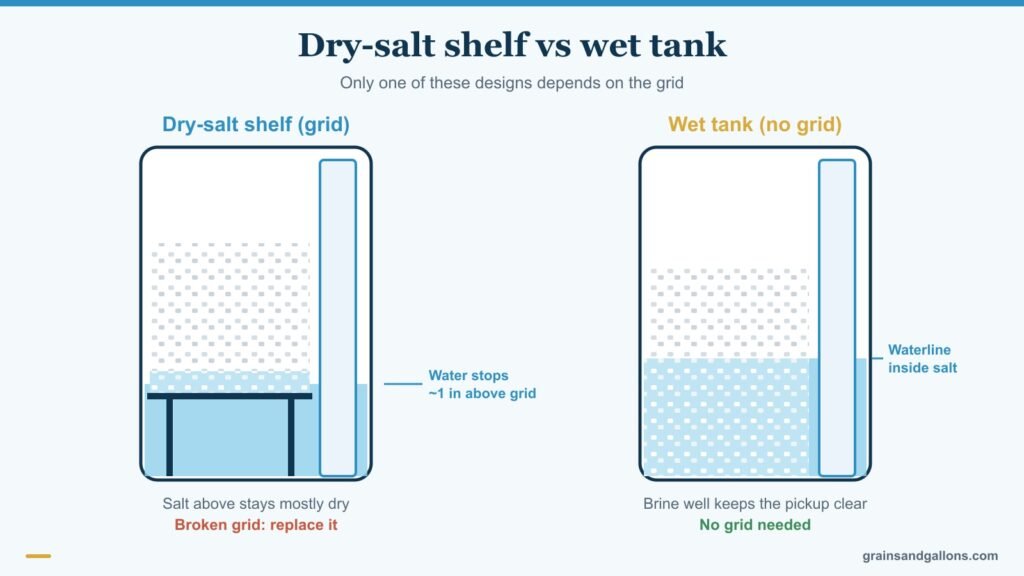
Brine tanks come in two basic designs.
Dry-salt shelf tanks use a grid. The refill puts in only enough water to reach the grid. One salt grid patent (US4235340) describes the float valve limiting the water level to about one inch above the top of the grid, so a large volume of brine sits underneath while the water still touches the bottom of the salt pile to saturate. The salt above stays mostly dry. The idea:
- Less mushing. Salt that isn't soaking in water all day is less likely to break down into sludge.
- A clear pickup. The grid keeps undissolved pellets away from the brine valve, which should only ever draw liquid brine.
- Predictable brine. Strong brine forms at the waterline, under a steady bed of salt.
Wet tanks don't. Salt sits on the floor with water mixed into the bottom of the pile. Plenty of modern softeners ship this way and make perfectly good brine. The brine well, the tube around the float, keeps the pickup clear of pellets.
Grids aren't perfect either. A later patent (US6379630) notes that dirt from the salt passes through ordinary grids, settles on the tank floor and can be drawn into the brine well, plugging it. So the real question isn't "do I need a grid?" It's "was my system set up to use one?" Our guide to what's inside a brine tank shows how the grid, well and float fit together.
Is your salt grid broken? Signs to look for

You rarely see a broken grid until the salt runs low, so watch for the clues:
- The salt level dropped suddenly or unevenly, sagging in one corner or along one side.
- Plastic pieces or a loose leg turn up when you poke into the salt with a broom handle.
- More mush or sludge than usual on the tank floor, because salt now sits in water it used to sit above.
- The water looks higher in the salt than it used to. The water level hasn't changed, but the salt has dropped into it.
- Hard water returned because a broken piece pinched the brine line, blocked the brine well slots or held the float down.
- Salt usage looks off, either barely moving or vanishing fast, depending on where the collapsed salt landed.
Some of these overlap with a salt bridge, a hard crust with a hollow underneath. If a broom handle punches through a crust into empty space, that's a bridge. If it hits loose plastic or the salt is sitting on the floor, the grid is the likelier culprit.
Pull every piece out before you decide anything

Broken plastic loose in the tank can wedge the safety float, block the brine well slots, or slide under the brine line fitting. Whatever you decide later, start here:
- Bypass the softener and unplug it so it can't start a regeneration mid-job.
- Let the salt run low, or scoop it out into a clean bucket. Clean salt can go back in afterward.
- Bail out the water with a cup and wet vac, then lift out every grid section, leg and fragment. Count the legs against the old grid if you can.
- Pull the brine well cap and lift out the float. Check that no plastic slipped inside the well, rinse the float and confirm it slides freely. If the float won't seat, see brine tank float stuck; if it's cracked, our pick of the best brine tank safety floats covers replacements.
- Rinse the tank and look at the floor. Is it level, or does the base rock? A grid on an uneven floor carries the load on two legs and cracks.
With the tank empty, it's the easiest time to do a full clean. Our steps for how to clean a water softener brine tank cover scrubbing and sanitizing. Penn State Extension's water softening guide mentions periodic chlorine bleach cleaning to control bacteria and advises reading the manufacturer's instructions before adding any chemicals to the unit.
Replacing the grid: measure, notch and match the height
Replace the grid if your manual calls for one, a dealer installed it on purpose, or you liked how the tank behaved with it. Getting a replacement that won't collapse again comes down to four checks.
- Match the tank shape and inside dimensions. Round and square tanks take different grids. Measure the inside of the tank a few inches up from the floor, where the grid will sit, because many tanks taper toward the bottom.
- Leave room for the brine well. Grids have a notch or round cutout for the well. It must clear the well without leaving a gap big enough for pellets to slide through.
- Match the leg height. The legs set how much water sits under the salt. Copy the old grid's height or follow the manual, since the refill amount was chosen to suit it.
- Look for an OEM part first. If your softener brand sells a grid for that exact tank, start there. Universal grids exist, but they often need trimming, and an extra leg or two in the center helps on wide tanks.
Why grids break in the first place: brittle old plastic, legs sitting on an uneven floor, and heavy bags dumped from shoulder height. The US4235340 patent notes that older multi-piece grids built from slotted supports can come apart if the tank is tipped or vibrated, which is why one-piece molded grids with ribs replaced them; it rates its ribbed design to carry 100 pounds or more of salt. Pour the first bag gently after a new grid goes in, and don't stack more salt than the tank's fill line.
Running without a grid: what changes in the tank

Skip the replacement if your tank and valve don't need one. Many don't. Here's what to expect:
- Salt sits on the tank floor, in the water. That's how wet tanks are meant to work.
- The waterline sits inside the salt pile rather than below a dry shelf. Same refill, different look.
- Sludge can build a little faster, especially with lower-purity salt, because pellets sit in brine all the time.
Then check three things before you walk away:
- Refill and float. On a dry-salt design, the refill was set to bring water up to the grid. Without the grid, that same volume of water sits in a tank full of salt. It still makes brine, but check your manual for any guidance on refill or float height without a grid, and call the dealer if the system came from one.
- Salt level. Fill to the normal line, not above the top of the brine well. See how full a brine tank should be.
- Brine draw. Run a manual regeneration and confirm the tank draws down during the brine step and refills afterward.
Use clean salt. Without a grid, pellets live in brine. Cheap or crumbly salt mushes faster. High-purity evaporated pellets hold up best; our water softener salt picks lean that way. If mush is already a problem, see salt mushing in the brine tank.
Replace or remove: match the choice to your setup
| Your situation | Best choice |
|---|---|
| Manual or dealer says the system needs a grid | Replace it |
| Older dealer system with a "dry tank" refill setting | Replace it, or ask the dealer before removing |
| Online-bought softener with a standard brine tank and brine well | Running without one is usually fine |
| Tank keeps getting mush with the grid in | Remove it, switch to evaporated pellets, and watch |
| Grid broke because the floor is uneven | Level the base first, either way |
| Dirt keeps plugging the brine well | Better salt and a yearly clean matter more than the grid |
If you can't tell which design you have, look at the old grid's height and the refill setting. A grid with tall legs and a small refill points to a dry-salt design; a short grid buried in a wet salt pile suggests it was optional.
FAQ
Do I need a salt grid in my brine tank?
Only if your softener was designed around one. Dry-salt shelf systems set the refill to stop just above the grid, so they should get a replacement. Wet-tank systems with a brine well make brine with salt sitting directly in the water and run fine without a grid.
Can a broken salt grid stop my softener from working?
Yes. Loose pieces can hold the safety float down, block the brine well slots or pinch the brine line, so the tank never draws brine and the resin isn't regenerated. Hard water after the grid collapses usually means a piece is in the way.
Can I make my own salt grid?
Some owners cut a replacement from rigid plastic, but salt water warps some plastics and pegboard-style materials, and an undersized homemade grid can drop salt into the water space again. A molded grid made for your tank size is the safer bet.
Will removing the grid use more salt?
Not by itself. The control valve sets the salt dose through the refill amount and brine draw, not the grid. Salt use can look different because the salt now sits in the water, but the amount drawn per regeneration stays the same.
How do I get a broken grid out of a full tank?
Let the salt run low or scoop it out first. Trying to pull grid pieces up through a full tank of salt rarely works and can knock the brine well or float out of place.
A broken salt grid is a cleanout first, a part second
With a salt grid broken in the tank, the urgent job is getting the plastic out before it jams the float or brine well. After that, the choice is simple: replace the grid if your softener was built as a dry-salt shelf system, or run without it if it's a wet-tank design with a brine well. Either way, level the tank floor, use high-purity salt and run a manual regeneration to prove the brine draw works.