

Quick Answer: For a water softener motor not turning, first prove the valve has power: test the outlet with a lamp and check that the transformer cord is seated at the circuit board. Then start a manual regeneration and listen. Silence usually means no power, a loose motor plug or a dead motor. A hum or click with no movement usually means the piston is jammed, and a new motor won't fix that. Only swap the motor, like a Fleck-style replacement timer motor, after the piston moves freely.
Disclosure: As an Amazon Associate, Grains & Gallons earns from qualifying purchases.
You hit regenerate, waited, and nothing happened. Or you pulled the cover off because the water turned hard and found the gears sitting still. A water softener motor not turning gets the blame because it's the part you can see. Half the time it's innocent.
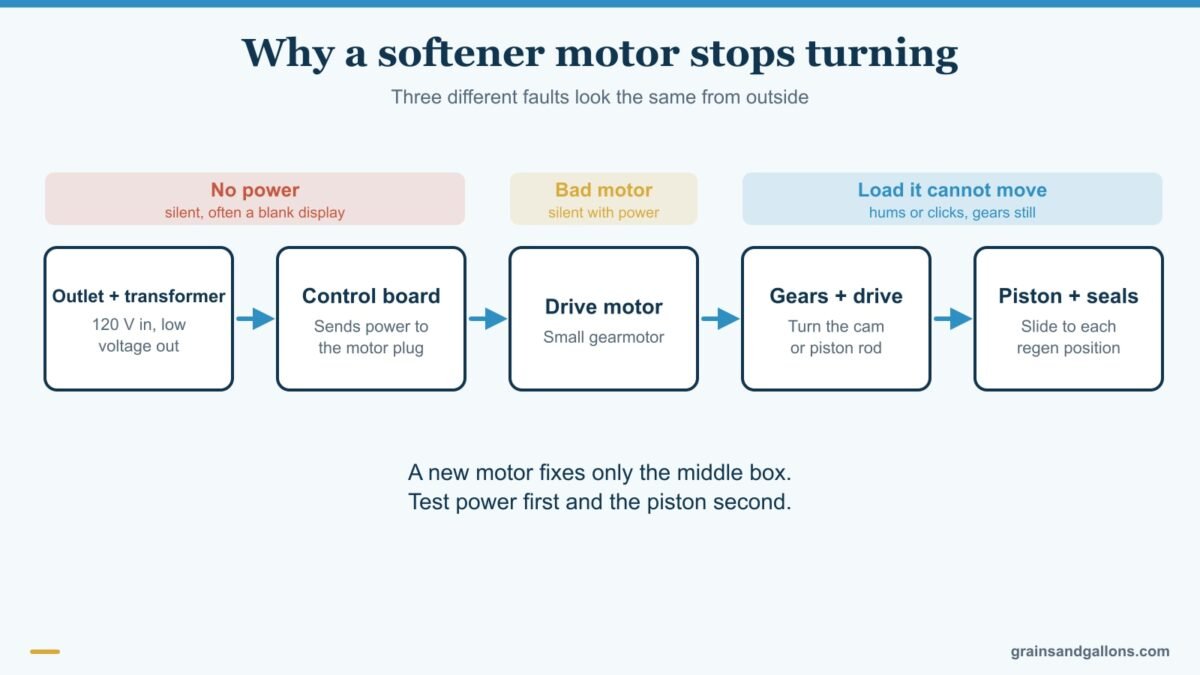
The motor is a small gearmotor. On most valves its only job is to push or rotate the piston from one position to the next (backwash, brine, rinse, refill, service). If the piston can't move, the motor stalls. If the motor gets no power, it does nothing. So "motor not turning" is really three problems: no power, a bad motor, or a load the motor can't move. Work through the checks below in order; the free ones come first. If you already know the head is beyond saving, jump to our picks for the best replacement control valves.
In this guide
- Is power reaching the board at all?
- Start a regeneration and listen to the head
- A silent motor: plug, wires, gear train
- Water softener motor not turning but humming? Suspect the piston
- Read the error code before you buy anything
- Motor, rebuild kit or a whole new head?
- FAQ
- Free the piston before you buy a motor
Is power reaching the board at all?
A blank display tells you right away. A lit display doesn't prove the motor circuit is fine, but it rules out the outlet.
- Plug a lamp or phone charger into the same outlet. GFCI outlets in basements and garages trip often, and the softener is usually the only thing on them, so nobody notices.
- Follow the cord to the valve. Most residential valves run on low voltage (commonly 12 or 24 volts) from a plug-in transformer. Make sure the barrel plug or wire connector is fully seated at the board.
- If you own a multimeter, check the transformer output. A transformer that reads well below its label rating under load can light a display but not run a motor.
Start a regeneration and listen to the head
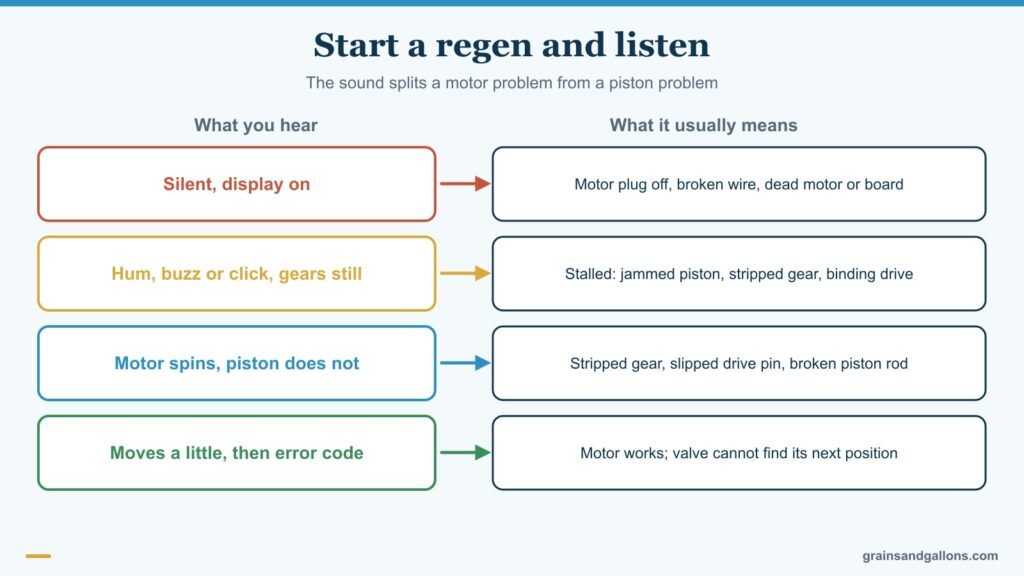
Start a manual regeneration and put your ear next to the head.
| What you hear or see | What it usually means |
|---|---|
| Nothing at all, display on | Motor plug off the board, broken motor wire, dead motor, or a board that isn't sending power |
| A hum, buzz or click, gears don't move | Motor has power but is stalled: jammed piston, stripped or missing gear, binding drive |
| Motor spins, piston doesn't move | Stripped gear, slipped drive pin or broken piston rod |
| Moves a little, then error code | Motor is working; the valve can't find its next position |
That table already splits the problem. If the motor moves but the valve stops partway, see our guide to a softener stuck in one cycle position.
A silent motor: plug, wires, gear train

Unplug the transformer before you touch anything inside the head.
On a Clack WS1, the WS1 service manual lists the first checks for its "unable to sense motor movement" fault: make sure the motor is fully engaged with the pinion, look for broken wires, confirm the motor's two-pin plug is in the connector marked MOTOR, make sure the circuit board is snapped into the drive bracket, and replace any missing reduction gears. Those checks apply to almost any valve.
On Fleck digital valves (5600SXT and similar), the drive motor sits behind the board with a cam and switches that tell the control where the piston is. Look for a connector that's backed partway out, a pinched wire near the cover, and a motor that's loose on its mounting.
If the motor still doesn't turn with good power and a good plug, the motor has likely failed. That's a cheap part on most Fleck valves. Match the part number and voltage printed on your old motor. Mechanical timers often use 120-volt motors and digital controls often use 24-volt ones, and the wrong one won't work.
Water softener motor not turning but humming? Suspect the piston

A motor that hums has power. Something is stopping it, and the usual suspect is the piston and seal stack inside the valve body. Iron, sediment, scale or stray resin beads build up on the piston, the seals swell, and friction climbs until the motor can't push through.
Clack's manual says the same thing. For its stall code it points to foreign material, mechanical binding or a main drive gear that is too tight. For its "motor ran too long" code it lists motor failure, friction from debris on the piston and stack, or a drive bracket that isn't fully snapped in.
To tell a weak motor from a stuck piston, put the softener in bypass, unplug it and open a tap to drop the pressure. Then take the motor or drive off and try to move the piston by hand, or turn the main gear by hand, depending on the valve. If it fights you, the piston is the problem. Our guide to a stuck control valve piston walks through pulling and cleaning it.
Putting a new motor on a jammed piston just gives you a second dead motor.
Read the error code before you buy anything
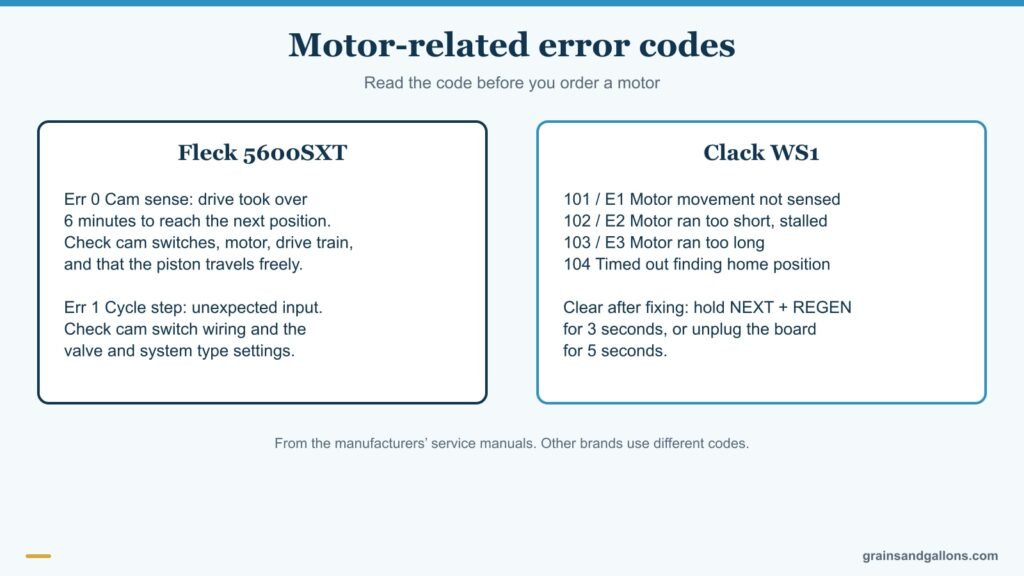
Digital valves usually tell you which side of the problem you're on. These come from the manufacturers' manuals:
Fleck 5600SXT (Pentair downflow service manual):
- Err 0 (cam sense): the drive took longer than 6 minutes to reach the next regeneration position. Pentair says to unplug the unit, check the cam switches, check the motor and drive train, and confirm the piston travels freely.
- Err 1 (cycle step): an unexpected cycle input. Check the cam switch connections and the valve and system type in master programming.
Clack WS1:
- 101 / 1001 / E1: motor movement not sensed (the plug, wire and gear checks above).
- 102 / 1002 / E2: motor ran too short and stalled (binding, debris, drive gear too tight).
- 103 / 1003 / E3: motor ran too long and couldn't find the position (motor failure, fouled piston and stack, or loose drive bracket).
- 104 / 1004: motor timed out looking for the home position, usually because the drive bracket isn't snapped in far enough for the gears to mesh.
To clear a Clack code after fixing the cause, hold NEXT and REGEN for 3 seconds, or unplug the board for 5 seconds. Other brands use different codes; our page on softener error codes and blank displays shows where to look.
Motor, rebuild kit or a whole new head?

Once you know which part failed, the math is usually simple:
- Loose plug or tripped outlet: free fix.
- Dead motor, good piston: replace the motor. It's typically a few screws and one plug.
- Jammed piston: clean it or replace the piston plus seals and spacers. That's a rebuild kit, not a motor.
- Cracked gear, burnt board, or a valve old enough that parts are scarce: consider a new head. Our roundup of the best replacement control valves covers Fleck and Clack heads that fit standard tanks.
If the head is old and the resin is tired too, look at a full system. Many of the best Fleck valve softeners use the same tank sizes as older units, which makes the swap easier.
Safety comes first: always unplug the transformer before reaching into the head, and bypass the softener and relieve pressure before you pull anything that touches the water side. If you're not comfortable with that, a local water treatment dealer can usually sort out a motor-versus-piston problem in one visit. For a wider look inside the head, see our guide to servicing a softener control valve.
FAQ
Why does my water softener motor hum but not turn?
A hum means the motor has power but can't move its load. The usual cause is a piston and seal stack jammed with sediment, iron or resin beads, or a stripped or misaligned gear. Free the piston before replacing the motor.
How do I test a water softener motor?
Confirm power at the outlet and the transformer first. Then start a manual regeneration. If the motor stays silent with good power and a seated plug, and the piston moves freely by hand, the motor has most likely failed.
Can I replace a softener motor myself?
Usually, yes. On many Fleck valves it's a few screws and one plug. Unplug the unit first, and match the part number and voltage on the old motor, since 120-volt and 24-volt motors aren't interchangeable.
What does Err 0 mean on a Fleck 5600SXT?
It's a cam sense error: the drive took more than 6 minutes to reach the next regeneration position. Pentair says to check the cam switches, motor, drive train and piston travel.
Will a softener still soften water if the motor is dead?
For a while. The resin keeps working until it's exhausted, but without the motor the valve can't regenerate, so hard water returns once the capacity is used up.
Free the piston before you buy a motor
A water softener motor not turning is usually a power problem or a stuck piston, and neither is fixed by a new motor. Check the outlet, transformer and plug, listen during a manual regeneration, and do the hand test on the piston. Buy a motor only when power is good and the piston slides freely.