

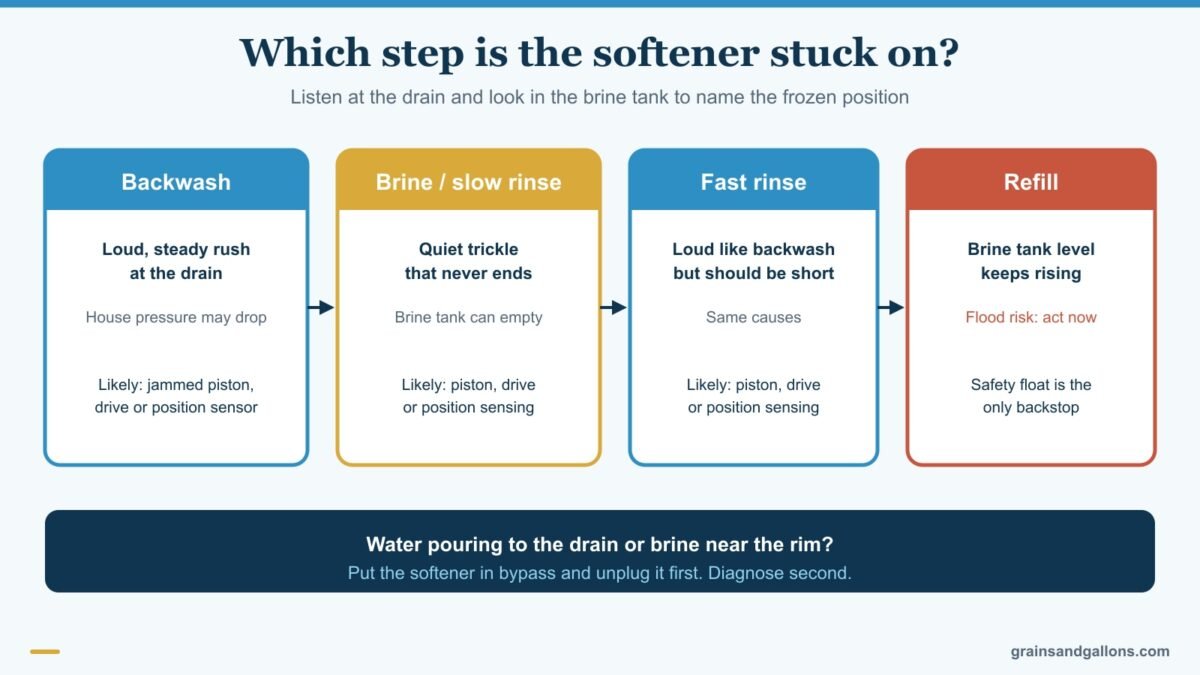
Quick Answer: A water softener cycle position stuck on one step usually means the piston can't move, the drive can't push it, or the control has lost track of where it is. First rule out a power cut: a Fleck SXT holds its position until power returns, and a Clack WS1 finishes the remaining cycle on its own. If it's still frozen, put the softener in bypass, unplug it and note the step. Backwash or rinse points to the piston or drive. Refill means the brine tank keeps filling, so check the safety float before it overflows.
The display has shown the same step for an hour, or the pointer on a mechanical timer is parked on "Brine" and the drain keeps trickling. A water softener cycle position stuck on one step narrows the cause a lot, because each step sounds and behaves differently.
If water is pouring to the drain or the brine tank is close to the rim, put the softener in bypass and unplug it now. Diagnose second.
In this guide
- Is it really stuck, or just slow?
- Stuck in backwash or fast rinse: loud, steady drain flow
- Frozen in brine draw: the quiet one
- A refill that never stops can flood the floor
- Fleck and Clack codes for a valve that can't find its position
- Get the valve back to service and prove it
- FAQ
- Name the stuck step, then free the piston
Is it really stuck, or just slow?

Three things look like a stuck cycle but aren't:
- A long step. Brine draw and slow rinse can run an hour or more. Compare against the step times in your programming before assuming it's frozen.
- A power cut mid-cycle. The Fleck 5600SXT manual says that if power fails during regeneration, "the valve will remain in its current position until power is restored," and it tells installers to include safety parts that prevent overflows in that case. The Clack WS1 service manual says that once power is restored, the control will "finish the remaining regeneration time."
- The clock is wrong. A timer that lost power may now regenerate at 2 p.m. instead of 2 a.m. You're seeing a normal cycle at an odd hour.
If none of those fit, work from the step it's stuck on.
Stuck in backwash or fast rinse: loud, steady drain flow

Backwash sends water up through the resin and out the drain at a high rate, and fast rinse sounds much the same. If either never ends, you'll hear a steady rush at the drain and house pressure may drop. The piston isn't leaving that position, for one of three reasons:
- The piston is jammed with iron, sediment or debris. The Fleck 5600 service manual lists "control valve jammed in brine or backwash position," fixed by replacing seals and/or the piston. Our guide to a water softener piston stuck in the bore covers pulling and cleaning it.
- The drive can't move it. A dead motor, stripped gear or loose drive bracket. On a mechanical timer, see softener cam not turning.
- The control doesn't know where it is. A bad cam switch or position sensor.
If the valve did leave backwash but the water is still bad afterward, that's a different problem. See backwash not working.
Frozen in brine draw: the quiet one
This one's sneaky because it's quiet. Drain flow is low and the cycle just doesn't move on.
On most valves, steps are timed. The control doesn't wait for the brine tank to empty, so a plugged injector usually causes a weak regeneration, not a stuck one. If the valve is truly frozen here, think mechanical: piston, drive or position sensing, same as backwash.
The real risk: a valve parked in brine draw for hours can keep pulling brine through the resin and down the drain until the brine tank is empty. You'll find a low brine level and salty water at the drain.
A refill that never stops can flood the floor

This is the one to catch fast. During refill, the valve sends water into the brine tank. If the valve never leaves refill, water keeps flowing until something stops it. That's the safety float's job in the brine well: it shuts off flow when the level gets too high. If the float is stuck, missing or broken, the tank fills to the overflow fitting and, if that isn't plumbed to a drain, onto the floor.
Check the brine level now. If it's high, bypass the softener and see our guide to a brine tank full of water or overflowing. If the float is cracked or crusted with salt, our picks for the best brine tank safety floats cover common Fleck and Clack styles.
Fleck and Clack codes for a valve that can't find its position

Digital valves usually stop and post a code instead of sitting stuck forever:
- Fleck 5600SXT, Err 0: the drive took longer than 6 minutes to reach the next regeneration position. Unplug, then check the cam switches, motor and drive train, and confirm the piston moves freely. Our Fleck 5600SXT error codes guide covers the rest.
- Clack WS1, E2/102: the motor ran too short, couldn't find the next position and stalled. The manual's first fix is to pull the piston and seal stack and look for foreign material.
- Clack WS1, E3/103: the motor ran too long and couldn't find the next position. Check motor connections, then hold NEXT and REGEN for 3 seconds to resynchronize.
Other brands use other codes. Check the troubleshooting table in your model's manual.
Get the valve back to service and prove it
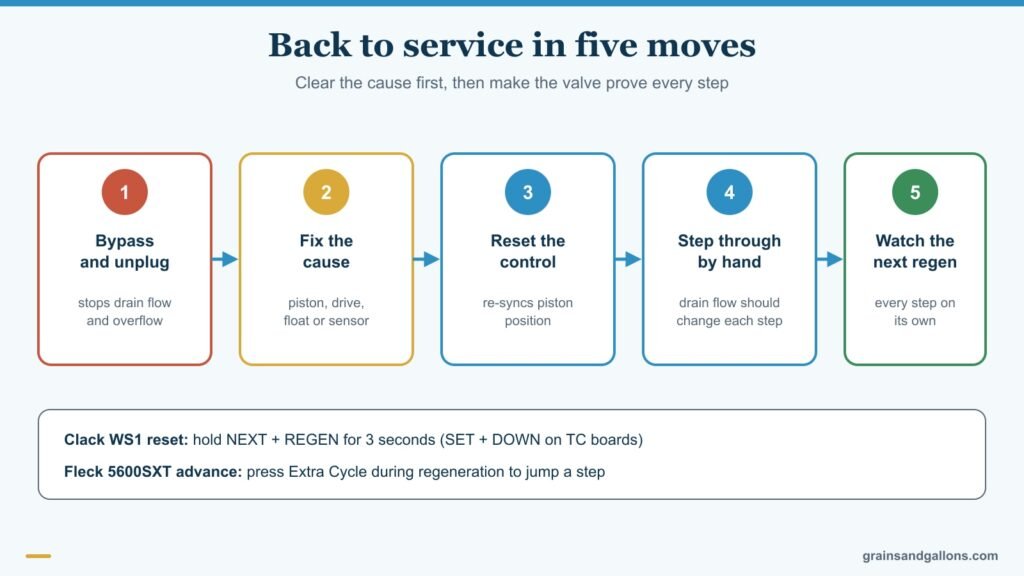
Once you've cleared the cause:
- Reset the control. On a Clack WS1, hold NEXT and REGEN for 3 seconds (SET and DOWN on three-button TC boards), or unplug the board's power jack and plug it back in. Many other valves reset with a power cycle.
- Step through manually. On a Fleck 5600SXT, pressing Extra Cycle during regeneration advances to the next step. On a mechanical Fleck, turn the manual knob clockwise. Pause at each step and confirm the drain flow changes.
- Return to service and take the softener out of bypass.
- Watch the next regeneration, or start one and stay nearby, to confirm it moves through every step on its own.
FAQ
How do I get my water softener out of regeneration mode?
Put it in bypass first. On a Fleck SXT, each press of Extra Cycle jumps one step until it reaches service; on a mechanical timer, turn the manual knob. On a Clack WS1, holding NEXT and REGEN for 3 seconds resets the electronics and sends the piston back to the service position. If it won't move, the piston or drive is jammed.
How long should each regeneration step take?
It depends on programming. Brine draw and slow rinse are usually the longest step, often an hour or more, while backwash and fast rinse are minutes. Compare the display's countdown with the step times in your valve's settings.
Why is my water softener cycle position stuck after a power outage?
On a Fleck SXT, the valve stays where it was until power returns, then carries on. A Clack WS1 finishes the remaining regeneration time once power is back. If it's still frozen several minutes after power returns, treat it as a mechanical fault.
Can a stuck softener flood my basement?
Yes, if it's stuck in refill and the brine tank's safety float fails. A stuck backwash or rinse can also keep sending water to the drain, which floods the floor if the drain backs up. Bypassing and unplugging the softener stops both.
Name the stuck step, then free the piston
A water softener cycle position stuck on one step is a clue, not a mystery. Loud and endless points to backwash or rinse and a jammed piston or drive. Quiet and endless points to brine draw. A rising brine tank is a refill fault and a flood risk. Clear the cause, reset the control, then make the valve step through on its own. If the head keeps sticking after a clean piston and new seals, our list of the best replacement control valves covers heads that fit standard tanks.