

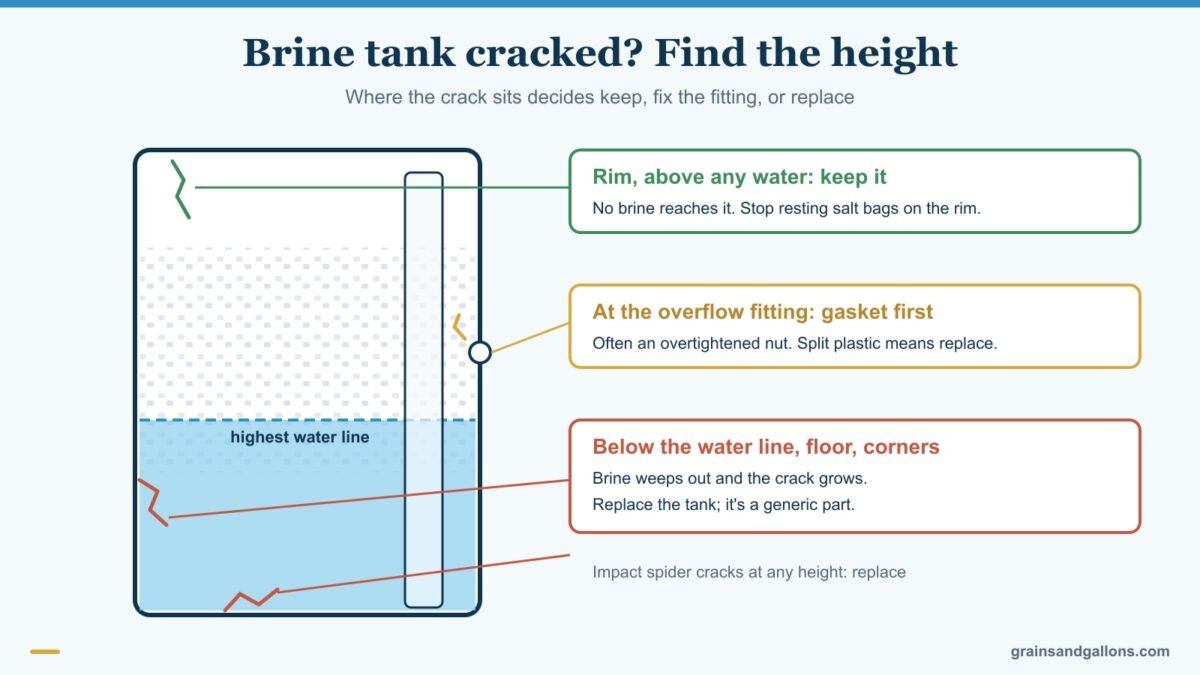
Quick Answer: If you think your brine tank cracked, empty it and find the crack. Above the highest water line (near the rim or lid), you can usually keep using the tank and watch it. Below the water line, in the floor or at a bottom corner, replace the brine tank, because glue rarely holds on softener tank plastic. A new brine tank is a generic part: match the size, move over the brine well and safety float, reconnect the brine and overflow lines, and keep your softener.
A brine tank cracked open feels like a big deal, but for the softener itself it usually isn't. The brine tank is the simplest part of the system: a plastic bin that holds salt and water. The resin tank and control valve, the parts that actually soften, don't care which bin the brine comes from. Penn State Extension's water softening guide notes that the brine is simply mixed and stored in the brine tank before it is flushed through the resin. So "repair or replace" mostly comes down to one question: where's the crack?
In this guide
Confirm it's the tank, not a fitting
Water on the floor doesn't prove the tank is cracked. Overflow fittings, brine line connections and condensation all put water in the same spot. If you haven't confirmed the source, start with our guide to a puddle under the brine tank.
To find a real crack:
- Put the softener in bypass and unplug it.
- Scoop out the salt into a clean bucket or bags. Clean salt can go back in.
- Bail or vacuum out the water. A wet/dry vac is fastest.
- Pull the brine well (it usually lifts out once the brine line is disconnected) and any salt grid.
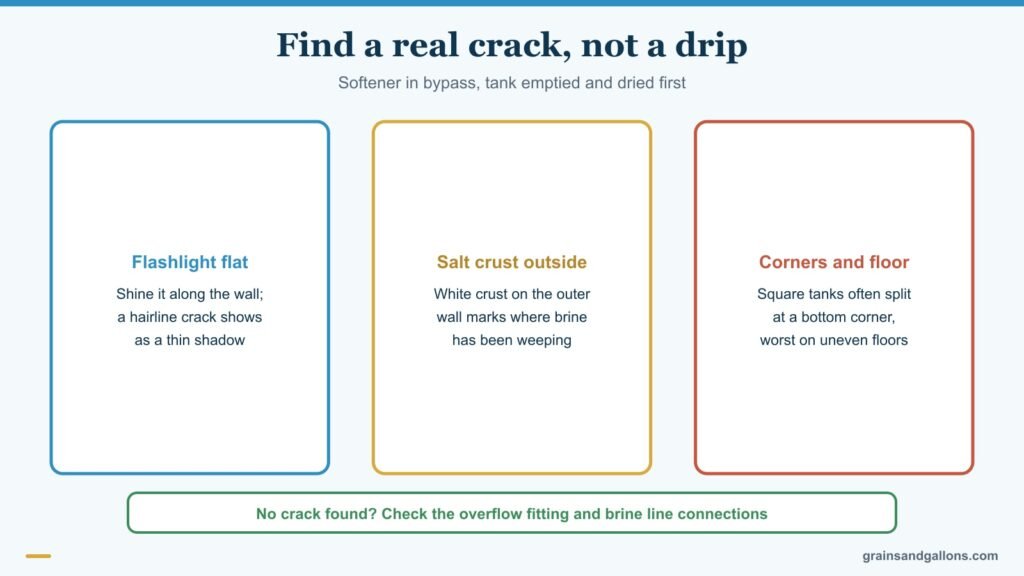
- Dry the tank and shine a flashlight flat along the wall. Hairline cracks show as a thin shadow line. White salt crust on the outside marks where brine has been weeping through.
- Check the corners and floor. Square tanks often crack at a bottom corner, especially on a floor that isn't flat.
Repair or replace, by crack location
| Where the crack is | What it means | Recommendation |
|---|---|---|
| Upper rim or lid edge, above any water | No brine reaches it | Keep the tank. Avoid stacking salt bags on the rim. |
| Around the overflow fitting hole | Usually the fitting nut was overtightened | Replace the fitting gasket first; if the plastic itself is split, replace the tank |
| Side wall, below the water line | Brine will weep out, slowly at first | Replace |
| Floor or bottom corner | Most likely to get worse; hardest to see until it's bad | Replace |
| Spider cracks from impact, any height | The plastic is stressed and brittle | Replace |
Brine weeping from a lower crack does more than wet the floor. As it evaporates it leaves salt crust that corrodes nearby metal, and a slow drip in a finished basement can go unseen for months.
Can a brine tank cracked below the water line be glued?
Not reliably. Most brine tanks are molded polyethylene, a slick, low-surface-energy plastic that ordinary epoxies, silicone and "plastic welder" glues struggle to grip. They often stick at first, then peel once salt water gets behind them. Specialty adhesives made for polyethylene and hot-air plastic welding can work in skilled hands, but you're spending time and money on one of the cheaper parts of the system.
A patch is fine as a stopgap: dry the area, scuff it with sandpaper, and use a sealant labeled for polyethylene. Then plan the replacement. Don't trust a patch below the water line anywhere a slow leak could go unseen.
What cracked it, and will it happen again?
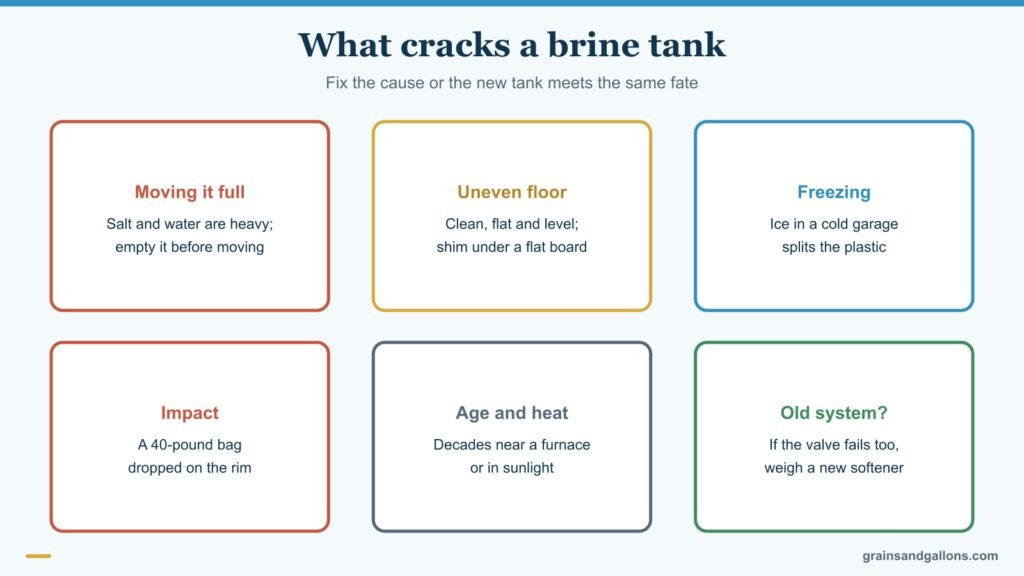
Cracks have causes, and the new tank will meet the same ones.
- Moving a full tank. A tank loaded with salt and water is heavy, and dragging or tipping it stresses the molded plastic. Empty it before moving it.
- An uneven or dirty floor. A pebble or slope under the base lets the bottom flex. The Fleck 5600SXT manual tells installers to make sure the floor under the salt tank is clean and the tank is level. Check with a level and shim under a flat board if needed.
- Freezing. Brine in a garage can freeze in a hard cold snap, and expanding ice splits the tank. Read our garage freeze guide before installing a new tank in the same spot. Warranties often exclude this: Clack's WS1 valve manual, for example, excludes freezing and physical damage from its warranty.
- Age. Plastic gets brittle over decades, especially near a furnace or in sunlight.
- Impact. Dropping a 40-pound bag on the rim is the classic.
If the whole system is 15 or 20 years old and the control valve is also misbehaving, the crack may be your cue to look at the bigger picture. Our guide on whether to repair or replace an old water softener walks through that math. If you land on a new system, our 48,000-grain softener picks suit a typical 3–4 person home and ship with a fresh brine tank.
Measure before you order a replacement tank
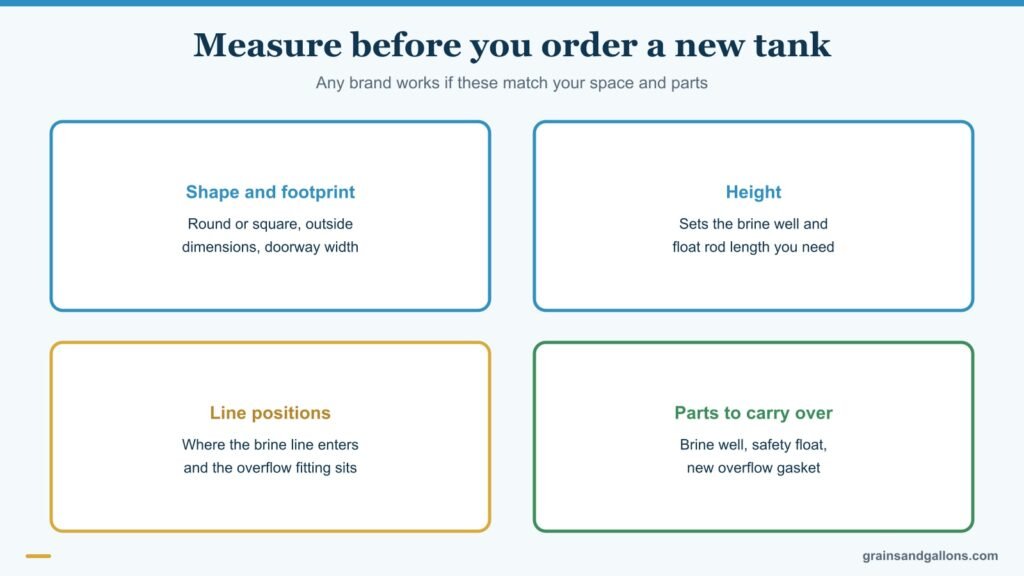
You don't need a tank from the original brand, but it has to fit. Write down:
- The current tank's shape (round or square) and outside dimensions.
- Its height, which matters for your brine well and float rod length.
- Where the brine line enters and where the overflow fitting sits.
- How much floor space and doorway width you have. A bigger tank holds more salt, but it has to get into the room.
What to carry over or buy new:
- Brine well. Reuse it if it's undamaged and fits the new tank's height. Many replacement tanks include one.
- Safety float / brine valve. If yours is crusty or old, replace it now, matching the rod length to the new tank. Our list of the best brine tank safety floats covers common fits by valve.
- Overflow elbow and gasket. Usually included. Use a new gasket either way.
- Salt grid. Only if your system was designed for one; check the manual.
Swap in the new brine tank
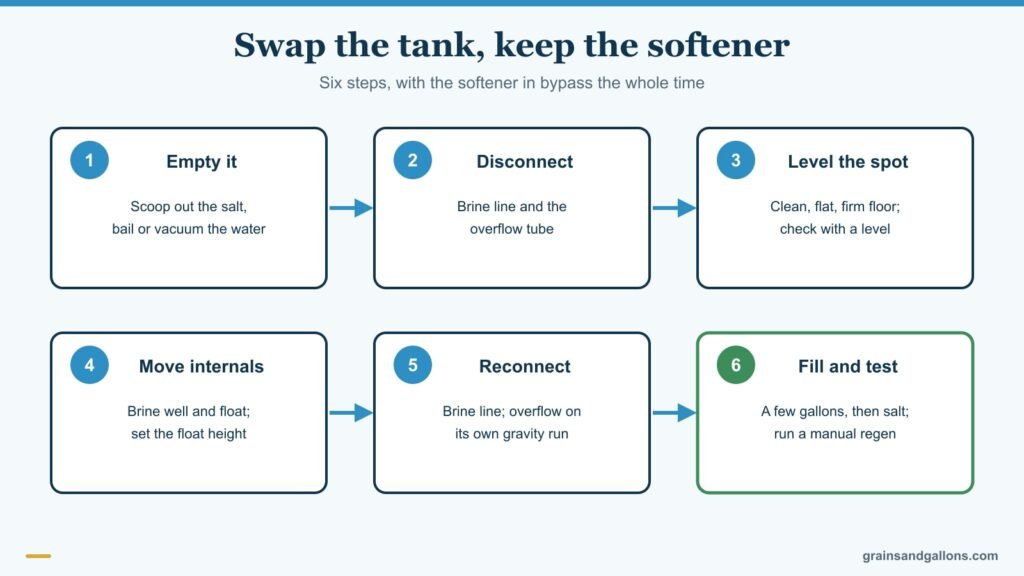
- With the softener still in bypass, disconnect the brine line and the overflow tube.
- Move the old tank out and set the new one on a clean, flat, level spot.
- Install the brine well, lining up its fitting with the tank's brine line hole if it has one.
- Install the safety float and set the float clip at the height the manual specifies. Our brine tank internals guide explains how float height relates to the refill level.
- Reconnect the brine line and overflow. The overflow needs its own gravity line to a drain, not a tie-in to the softener's pressurized drain line; see our brine tank overflow line requirements.
- Add a few gallons of water, then the salt. Return the softener to service, run a manual regeneration and confirm the refill level comes back where it should.
Rinse the old tank before you haul it out; brine residue corrodes metal in a truck bed. Most curbside programs take it as bulky waste, so check your local rules.
FAQ
Can a cracked brine tank be repaired?
A crack above the water line can be left alone or sealed with a polyethylene-rated sealant. Below the water line, patches rarely last because most adhesives don't bond well to polyethylene, so replacing the tank is the reliable fix.
Can I replace just the brine tank and keep my softener?
Yes. The brine tank is a generic container. Match its size and height, move over the brine well and safety float (or buy new ones), and reconnect the brine and overflow lines.
How long does a brine tank last?
Often as long as the softener or longer, since it's a simple plastic bin with no moving parts. Freezing, impact, an uneven floor or decades of brittleness are what usually end it.
Why is my brine tank leaking from the bottom?
Either a crack in the floor or bottom corner, or water running down from a leaking overflow fitting or brine line connection. Empty and dry the tank to tell which.
Is it safe to keep using a brine tank with a small crack?
If the crack is above the highest water level, yes; just keep weight off the rim. If brine can reach it, plan a replacement soon, since it will weep salt water and tend to grow.
A crack below the water line means a new tank, not a new softener
A brine tank cracked below the water line is rarely the end of your softener. Find the crack's height: above the water line, keep the tank; at the overflow, try a new gasket; below the water line or in the floor, swap in a generic replacement tank. Fix the cause too, whether that's an uneven floor, a freezing garage or salt bags dropped on the rim, so the new tank lasts.