

Quick Answer: A water softener leaking during regeneration only is almost always leaking from something that only works hard during the cycle: the drain fitting and tubing (backwash flow), a standpipe or floor drain that overflows, or a brine tank that overfills during refill. Start a manual regeneration in daylight, stay through backwash and refill, and watch the drain connection, the discharge end and the brine tank. You'll usually see the source within the first 15 minutes.
When a water softener is leaking during regeneration and nowhere else, the timing is your best clue. The floor stays dry all week, then one morning there's a puddle that dries by evening. During normal use, only household water passes through the valve. During regeneration, the valve sends water to the drain at full backwash flow, pulls brine from the salt tank, and then refills that tank. Each stage stresses different parts, so don't guess. Watch one cycle.
In this guide
Watch one cycle with paper towels on every joint

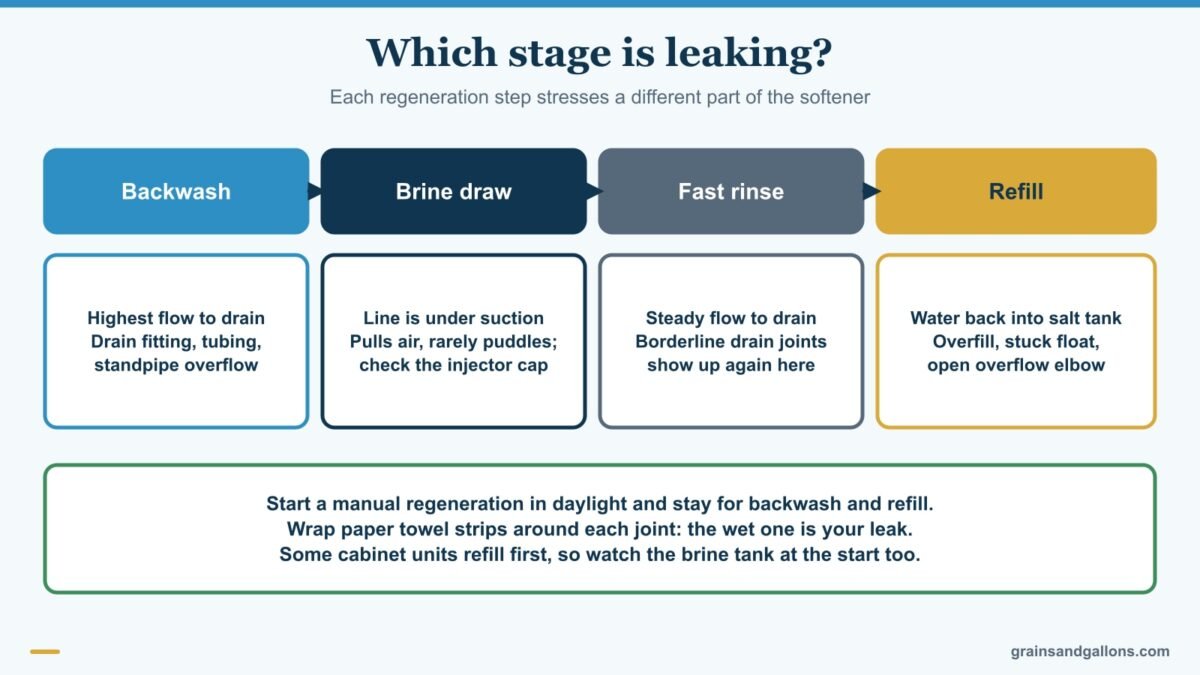
Trigger a manual regeneration during the day. Most valves have a button or knob for it, and our guide to how to manually regenerate a water softener covers the common types. Bring a flashlight and dry paper towels. Wrap a towel strip around the drain fitting, the brine line connection and the bypass so you can see exactly where water shows up first.
Most downflow valves run backwash, then brine draw with slow rinse, a second backwash on some valves, fast rinse, and refill. Some valves, including many demand-initiated cabinet models, refill at the start instead, so watch the brine tank early too. Our explainer on how water softener regeneration works covers each step.
Brine draw rarely makes a puddle
During brine draw, the injector sucks brine out of the salt tank, so the brine line runs under suction. A bad brine line connection usually pulls air in rather than pushing water out; you hear sucking or gurgling, not dripping. The exceptions are a cracked injector cap or a bad injector o-ring, which can weep on the valve body, and a slow drip at a drain joint, since the drain still flows gently during this step.
Backwash and fast rinse push the drain line hardest

Backwash sends more water down the drain than any other stage, often a couple of gallons a minute or more depending on tank size and the drain line flow control. Fast rinse is a shorter, steady stream. A weak joint on the drain side shows itself here.
What you might see:
- Water beading at the drain elbow or tubing barb. A slipped hose, missing clamp or flattened o-ring on the drain fitting. Reseat it, clamp it, and replace the o-ring. Our guide to a softener leaking from the drain line covers the fitting itself.
- The tubing jumping out of the standpipe and spraying. The end isn't secured.
- The standpipe, floor drain or laundry sink overflowing. The drain can't take the flow, or it's partly clogged. Our article on a drain line backing up separates "drain can't keep up" from water flowing back toward the softener.
- Hot or bulging tubing during fast rinse. That's a sign of a restriction downstream.
Size matters too. The Clack WS1 service manual calls for a drain line of at least 1/2 inch and says backwash rates over 7 gpm or runs longer than 20 feet need a 3/4 inch line. An undersized or very long run backs up at the fitting. See our drain line requirements guide for the rest.
A proper air gap fitting stops the whip-out problem and keeps the gap your plumbing code wants; see our roundup of air gap fittings for softener drain lines if the tube is just tucked into the pipe. Also check whether the softener shares a standpipe with the washing machine. If both run on timers overnight, the washer draining during backwash can overflow a standpipe that handles either one alone.
Refill can overfill the brine tank

Refill sends a measured amount of water back into the salt tank. If anything stops it shutting off, the tank keeps filling until it spills over the top, or out of the overflow elbow if nothing is attached to it. Check these in order:
- Is the overflow elbow on the side of the brine tank connected to a hose that runs to a drain? If not, any overfill dumps straight onto the floor. It needs its own downhill gravity line to a drain lower than the elbow; don't tee it into the softener's drain line. Our guide to brine tank overflow line requirements covers the details.
- Is the water level after refill much higher than normal? That points to a refill problem or a refill setting that's too high. Clack's troubleshooting table lists improper refill settings, a plugged injector and a drive cap that isn't tightened properly as causes of excess water in the regenerant tank. See brine tank full of water or overflowing.
- Is the safety float stuck? The float in the brine well should shut off refill if the level gets too high. Salt crust or a bent rod stops it. Our guide to a stuck brine tank float explains how to test it, and our best brine tank safety floats covers replacement assemblies for Fleck and Clack systems.
- Is the brine line fitting at the valve or the float dripping? Under refill pressure, a cracked compression nut can leak where it couldn't during brine draw.
If you find salt crystals or a wet ring on the floor around the tank itself, the tank or its fittings may be cracked. See our guide to a leak under the brine tank.
When water keeps running after the cycle should end
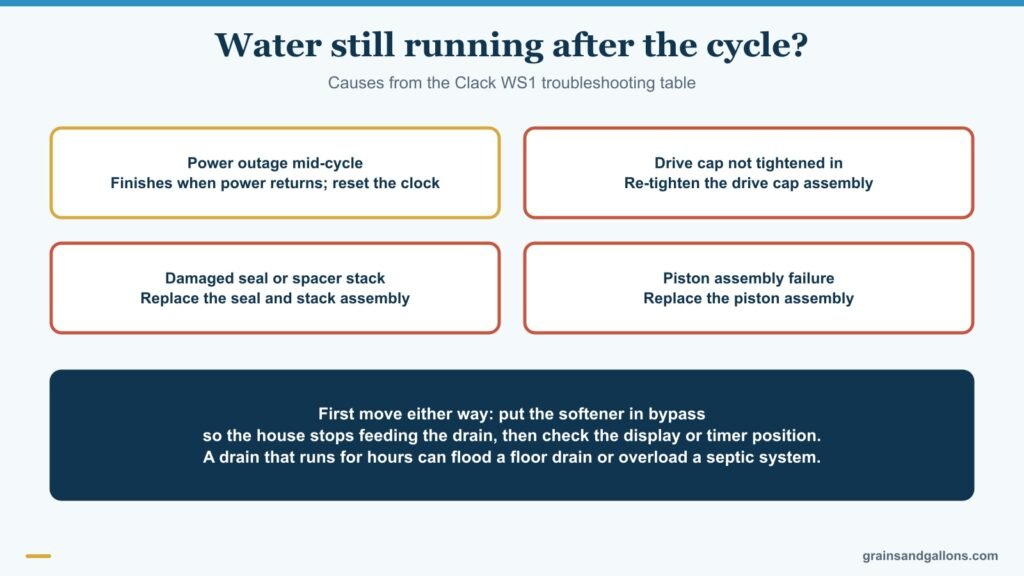
Sometimes the "leak" is a regeneration that never finishes, sending water to the drain for hours until a floor drain or standpipe overflows. Clack's troubleshooting table lists four causes of water running to drain:
- A power outage during regeneration. The control finishes the remaining regeneration time when power comes back; reset the time of day.
- A damaged seal or spacer stack. Replace the seal and stack assembly.
- A failed piston assembly. Replace the piston.
- A drive cap assembly that isn't tightened in properly. Re-tighten it.
The Pentair Fleck 5600SXT manual similarly points to internal valve leaks and calls for replacing the seals and spacers or the piston. A few drips around the piston or end cap only when the valve shifts position, then nothing, usually means the same worn seals. Our guide to a softener leaking from the top walks through valve-head leaks in more detail.
If the drain runs and won't stop, put the softener in bypass first so the house stops feeding the drain, then check the display or timer position. A drain that runs for hours can flood a floor drain or overload a septic system.
Wet floor, but not a softener leak
Some puddles that show up on regeneration nights don't come from the softener at all:
- Condensation. Cold incoming water during a long backwash can make the tanks and pipes sweat in a humid basement. The water is clear, spread out rather than dripping from one point, and mostly a summer problem. See brine tank sweating.
- Splash. A drain end placed too close to a floor drain grate splashes onto the floor. Raise or angle it, keeping the air gap.
- A failed ejector or sump pump. If the softener drains into a basin with a pump, a dead pump lets the basin overflow during the 2 a.m. backwash. Check the pump before you take the softener apart.
- A blocked floor drain. If the floor drain backs up during regeneration even after you've checked the line, a few gallons a minute is revealing a bigger blockage downstream. That's a job for a plumber.
Shut off and bypass the softener and get help if water reaches outlets or a furnace, or if the tank or valve body itself is cracked.
FAQ
Why does my water softener only leak at night?
Most softeners regenerate around 2 a.m., and regeneration is the only time water flows to the drain and back into the brine tank. A leak that appears overnight and dries by evening almost always comes from the drain side or a brine tank overfill. Run a daytime manual regeneration to see it happen.
Is it normal for a water softener to leak during backwash?
No. Backwash sends a lot of water to the drain, but it should all stay inside the drain line. Water at the drain fitting, tubing or standpipe means a loose joint, an unsecured tube end or a drain that can't handle the flow.
Can a clogged drain line make a softener leak during regeneration?
Yes. A plugged drain line flow control or a restricted drain line backs water up at the fitting, and the Fleck manual lists a plugged drain line flow control as a cause of excess water in the brine tank. Clean the flow control and check the line for kinks.
Why is there water around my brine tank after regeneration?
Usually the tank overfilled during refill. Check that the overflow elbow has a hose to a drain, that the refill setting is right, and that the safety float moves freely. Salt crust on the outside of the tank can also point to a cracked tank or fitting.
Should I bypass a water softener leaking during regeneration?
If water is still running or reaching anything electrical, yes. Bypass stops the house from feeding the softener, and you can troubleshoot later with a controlled manual regeneration. Short periods in bypass are fine; you just get hard water.
Find the stage and you've found the leak
A water softener leaking during regeneration is telling you which part to check by when it leaks. Backwash and rinse point to the drain fitting, tubing and standpipe; refill points to the brine tank, its overflow and the safety float; water that never stops points to the valve's seals, piston or drive cap. Watch one daytime cycle with paper towels on every joint, and the wet one will name the repair.