

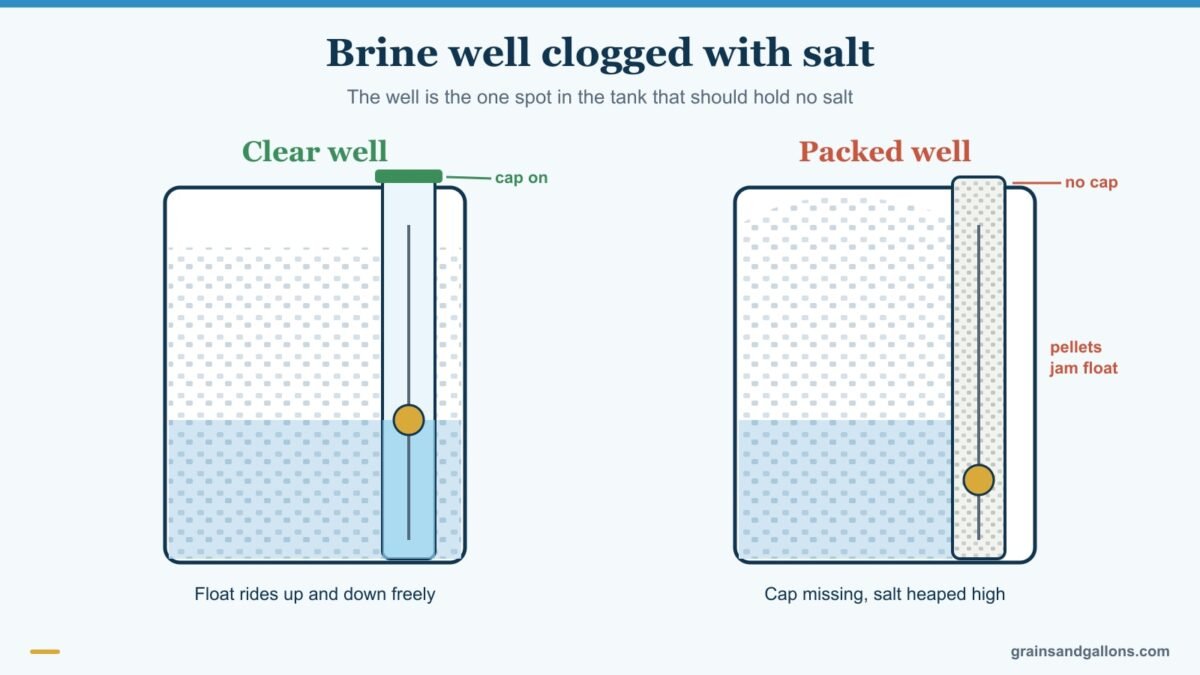
Quick Answer: A brine well clogged with salt is cleared in about 30 minutes. Put the softener in bypass, lift out the safety float, and pour warm tap water down the well while you work the salt loose with PVC pipe or a wooden dowel (never a metal bar against the plastic). Vacuum out the slush, rinse and test the float, flush the brine line, then run a manual regeneration and watch the level drop. Finally, fix how the salt got in, which is almost always a missing well cap or salt piled above the top of the well.
The brine well is supposed to be the one place in the salt tank with no salt in it. When a brine well is clogged with salt, pellets get inside the narrow tube and pack down, the float can't rise or fall, the brine line can choke, and the softener either stops drawing brine or loses its overflow protection.
You'll usually find it one of two ways. Either the softener started making hard water and you went looking, or you lifted the well cap and saw white instead of a float.
In this guide
- What the brine well actually does
- Signs of a brine well clogged with salt
- Why salt ends up inside the well
- Clearing the well, step by step
- If clearing the well isn't enough
- Pick a salt that won't refill the well
- Stop pellets from getting back in
- After the clog: hard water and service calls
- FAQ
- Cap the well and keep salt below its rim
What the brine well actually does
The brine well is the tall plastic tube standing in one corner of the salt tank. It has slots or holes near the bottom so brine can flow in, and a cap on top. Inside sits the safety brine valve: a float on a rod with a small valve body connected to the brine line. On Fleck systems that's the 2310 assembly, which the Fleck 5600SXT service manual lists with its float, rod and air check.
The well does three jobs:
- Gives the float room to move. The float has to rise with the water during refill and shut the valve if the level gets too high.
- Keeps the pickup clear. During regeneration the control valve's injector sucks brine up the brine line from the bottom of the well. Salt around the pickup chokes that flow.
- Separates solid salt from the valve. Pellets around a valve seat stop it sealing.
Penn State Extension's overview of how water softening works explains why that brine matters: it's what strips hardness from the resin and recharges it. No brine draw, no soft water.
Signs of a brine well clogged with salt
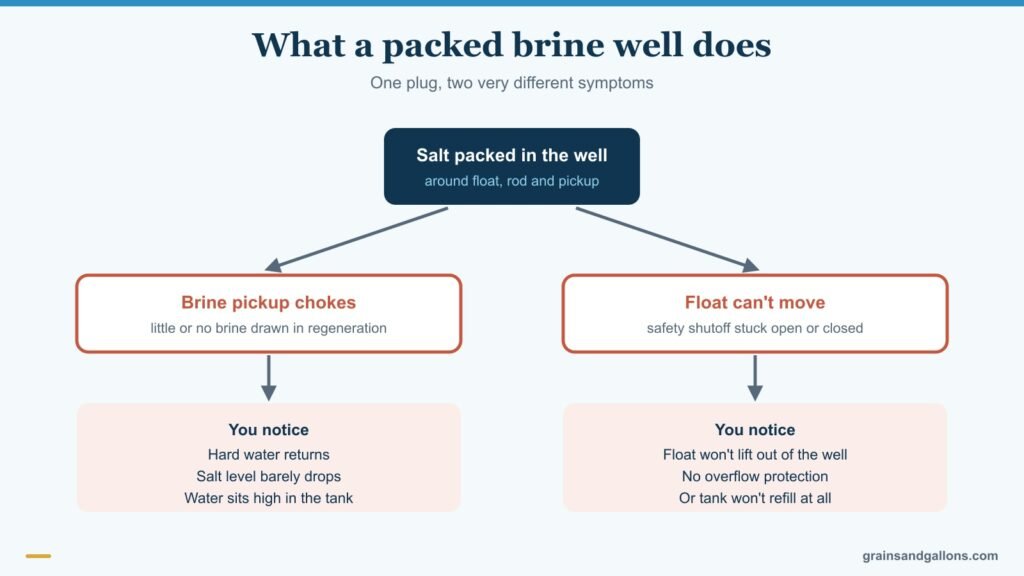
A packed well tends to show up in one of two ways, depending on where the salt is sitting.
If salt chokes the pickup, the softener can't draw brine. You'll notice hard water coming back, the salt level barely dropping from month to month, and water sitting higher than normal in the tank because the brine draw isn't pulling it out.
If salt jams the float, the safety shutoff can't do its job. A float stuck low can leave the valve open, so there's no overflow protection if the control head ever over-fills. A float stuck high can hold the valve shut, so the tank doesn't refill and the next regeneration has nothing to draw.
The giveaway for both: lift the brine well cap and look. If you see pellets or a white crust where the float should be, or the float won't lift out, the well is packed.
Why salt ends up inside the well

- The cap is missing or cracked. Without it, every bag you pour sends some pellets straight down the tube.
- Salt piled above the well. If salt is heaped higher than the top of the well, it spills in. Our guide on how full a brine tank should be covers the right fill line.
- Fines and mush. Cheap or crumbly salt breaks into sand-sized bits that slip through the slots in the well wall and settle at the bottom. That's slower, but it ends the same way. See salt mushing in the brine tank if the whole tank floor looks like oatmeal.
- A salt bridge that collapsed. A crust over an empty pocket can drop suddenly and push salt against the well. Our salt bridge guide covers breaking one safely.
- A split well. Older wells crack along the slots, and salt walks right in.
Clearing the well, step by step

Tools for clearing a packed brine well
- Bucket and a wet/dry vac (or a cup and patience)
- A length of 1/2" or 3/4" PVC pipe or a wooden dowel, longer than the well is deep
- A kettle or pitcher of warm tap water (warm, not boiling, to protect the plastic)
- Gloves; brine dries out your hands fast
- A flashlight
- Your phone, to photograph the float clip position before you move it
Nine steps to a clear well
1. Bypass and unplug. Put the bypass valve in bypass so no regeneration starts mid-job. Unplug the control valve too.
2. Pull the float assembly. Disconnect the brine line where it enters the tank wall or at the top of the well, then lift the safety float out. What you'll see: if the well is badly packed, the float won't come up. Don't yank it, because the rod or float can snap. Pour warm water around it for a few minutes and it'll loosen.
3. Break up the plug. Work the PVC pipe or dowel up and down through the packed salt. Pour warm water down the well as you go. The salt doesn't have to vanish. You just need to turn a solid plug into slush.
4. Remove the slush. Vacuum it out with the wet/dry vac, or scoop it with a cup taped to a stick. What you'll see: the bottom of the well and the slots near the base. If you still feel grit at the very bottom, rinse and vacuum again.
5. Check the well itself. Shine the flashlight down. Look for cracks along the slots and make sure the bottom is open where it's meant to be. If the well is split, it needs replacing. Wells are usually inexpensive and lift out once the tank is emptied.
6. Clean and test the float. Rinse the float, rod and valve in warm water. Lift the float by hand: the valve should close firmly at the top of its travel. If the float is waterlogged, the rod is bent, or the valve won't seat, replace it. Our list of the best brine tank safety floats covers common rod lengths and valve pairings, and our stuck brine tank float guide covers testing one in more detail.
7. Check the brine line. If salt reached the float, it may have reached the tubing. Blow through the brine line from the tank end, or flush it with warm water. If it's tight, our guide to a clogged brine line goes further.
8. Reassemble and put the cap on. Drop the float back in, set the float clip where your photo shows it was, reconnect the brine line, and cap the well.
9. Return to service and run a manual regeneration. Watch the brine draw. The tank level should drop during the brine cycle and come back up during refill. If it does, you're done.
If clearing the well isn't enough

When the mush goes beyond the well
If the slush you pulled out of the well was gray and sludgy rather than crisp pellets, and your dowel hits a soft layer across the whole tank floor, the problem isn't just the well. Salt mush has formed under the salt bed and is creeping in through the well slots. Clearing the well alone will only buy a few weeks.
In that case, empty the tank: scoop out the remaining salt, vacuum the sludge, scrub the walls, the well and the grid plate if your tank has one, rinse, and refill with water and fresh salt. Our step-by-step guide to cleaning a water softener brine tank walks through it, including where to put the old salt.
Still not drawing brine? Check the injector next
A clear well and a clean float don't help if the suction that pulls brine out has stopped. The Fleck 5600SXT manual's troubleshooting chart lists a plugged injector, a plugged injector screen, a plugged drain line flow control and low line pressure among the causes of a softener that fails to draw brine. Salt fines that reached the well can travel up the brine line to the injector.
Run a manual regeneration and watch the brine tank during the brine draw step. If the level barely moves even with the well clear, pull and clean the injector. Our injector cleaning guide shows where it sits on common valves and how to clear it without scratching the nozzle.
Pick a salt that won't refill the well

Salt quality decides how fast fines build up around the well.
- Evaporated pellets are the cleanest, with the least insoluble material. They're the safest choice if you've had mushing or a packed well. See our softener salt pellet picks.
- Solar salt crystals dissolve well but are less uniform; some tanks handle them fine. Our comparison of salt pellets vs crystals covers which tanks suit each.
- Rock salt carries more insoluble grit that settles at the bottom and around the well. Our guide to rock salt in a water softener explains why it usually isn't worth the savings.
Whatever you buy, check that your softener's manual allows it.
Stop pellets from getting back in

The real fix is preventing the next clog.
- Replace a missing cap right away. A cap from the same brand's brine well is the clean answer. A taped-over plastic cup works as a short-term plug, but check it each time you add salt.
- Pour salt away from the well. Aim bags at the far side of the tank and let the salt settle. Don't fill above the top of the well.
- Keep salt at a moderate level. A tank filled to the brim compresses the salt at the bottom and makes bridging and mush more likely.
- Glance down the well when you add salt. Ten seconds with a flashlight catches a problem months early.
After the clog: hard water and service calls
If the softener made hard water while the well was clogged
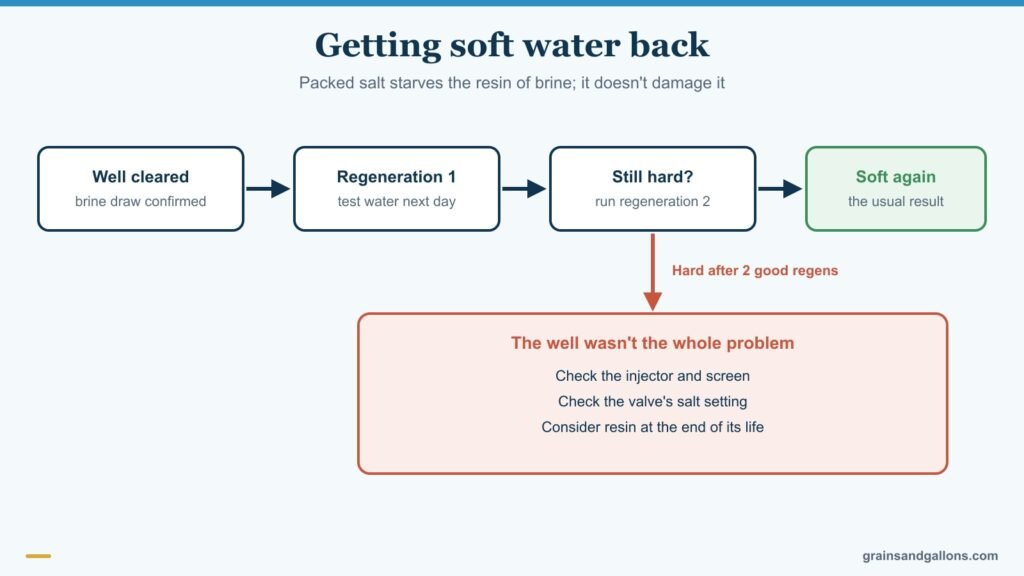
Once the well's clear and you've run one full regeneration, the resin should recover. If water is still hard a day later, test it, and if it's above your expected result, run one more regeneration. Packed salt doesn't damage resin; it just starves it of brine for a while.
If the water stays hard after two regenerations with a good brine draw, the problem is elsewhere: the injector, the valve's salt setting, or resin that's reached the end of its life.
When a service call makes sense
Most packed wells are a DIY job. Call a water treatment tech when:
- The well is cracked or fused to the tank and won't lift out after you've emptied it. Forcing a stuck well can crack the tank floor.
- Water is on the floor. A tank that's overflowed while the float was jammed may also have a control head that's passing water; see what's leaking before you refill.
- The brine draw stays weak after you've cleared the well, the brine line and the injector. That points to the control valve itself, such as worn seals or a piston problem.
- The softener is old and repairs are stacking up. A packed well is cheap to fix, but if the float, injector and valve all need attention, it's worth pricing a replacement.
FAQ
How does salt get into a brine well?
Usually through a missing or cracked cap, or because salt was piled higher than the top of the well. Fine salt particles can also slip through the slots near the bottom over time, especially with crumbly or low-purity salt.
Can I use hot water to dissolve salt in the brine well?
Use warm tap water, not boiling water. Warm water speeds up dissolving, while boiling water can soften or warp the plastic well, float and fittings.
Will a clogged brine well cause hard water?
Yes. If salt blocks the brine pickup, the softener can't draw brine during regeneration, so the resin doesn't recharge and hard water comes through. One or two regenerations after clearing the well usually restores soft water.
Can I run the softener without the brine well cap?
You can, but salt will keep falling into the well every time you add a bag. Replace the cap or cover the well temporarily until you can get the right part.
Is salt in the brine well dangerous?
It's not a safety hazard by itself, but a float jammed by salt can't shut off the refill. If the control head ever over-fills, the tank can overflow, so clear it promptly.
Cap the well and keep salt below its rim
A brine well clogged with salt is a 30-minute fix with warm water, a dowel and a wet/dry vac, followed by a float test and a manual regeneration. The lasting fix is simpler still: keep the cap on, keep salt below the top of the well, use clean pellets, and look down the well each time you add salt.