

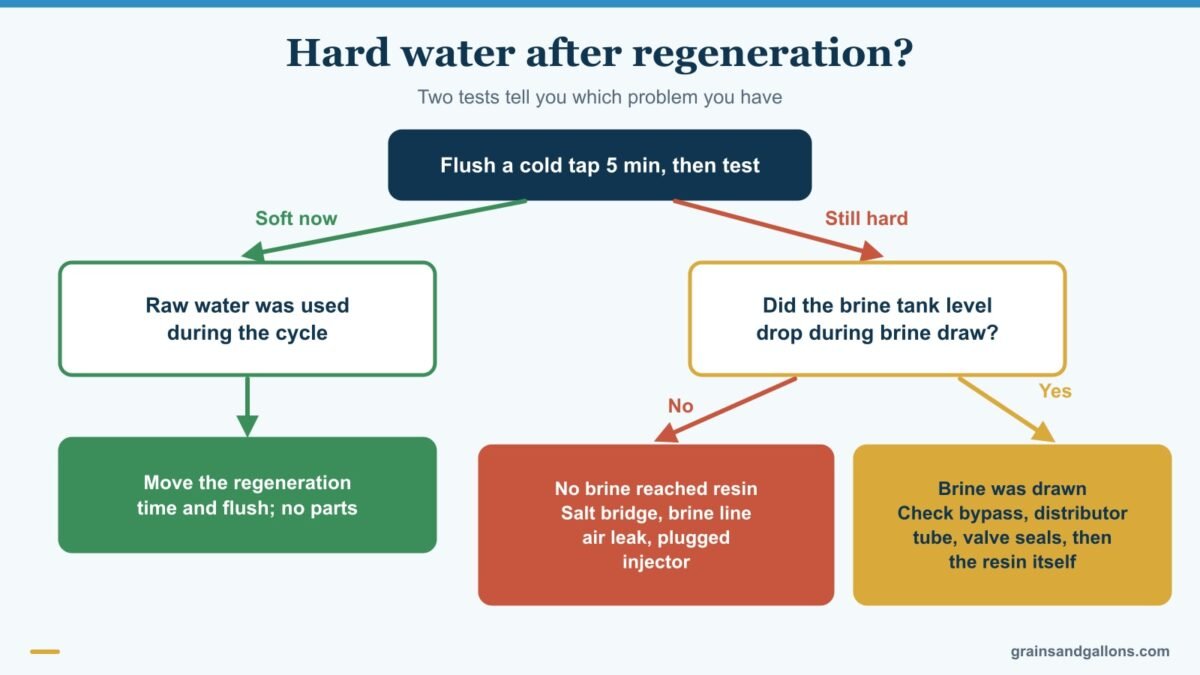
Quick Answer: Hard water after regeneration comes from one of two problems. If a cold tap tests soft after a five-minute flush, raw water was used while the softener was regenerating, and moving the regeneration time fixes it. If the water stays hard, the resin didn't recharge: check for a salt bridge, a leaking brine line or a plugged injector, then look at the bypass, the valve seals and the resin. Test with strips like WaterWorks Total Hardness strips so you aren't guessing by feel.
Disclosure: As an Amazon Associate, Grains & Gallons earns from qualifying purchases.
Hard water after regeneration feels backwards. Regeneration is supposed to be the reset button, so spotty glasses or squeaky skin the morning after a cycle make it look like the softener is broken. Often it isn't. The cause is one of two very different things, and about ten minutes of testing tells you which one you have.
Type 1: hard for a while, then fine. You notice it at the first shower of the morning, or on glasses from a dishwasher that ran overnight. By midday the water feels soft again. This is almost always raw water that got into the pipes while the softener was regenerating.
Type 2: hard and staying hard. The softener ran its cycle, but the water never softens back up, or it softens for a day and fades fast. That means the regeneration didn't recharge the resin, usually because no brine reached it.
In this guide
Flush, then test three samples
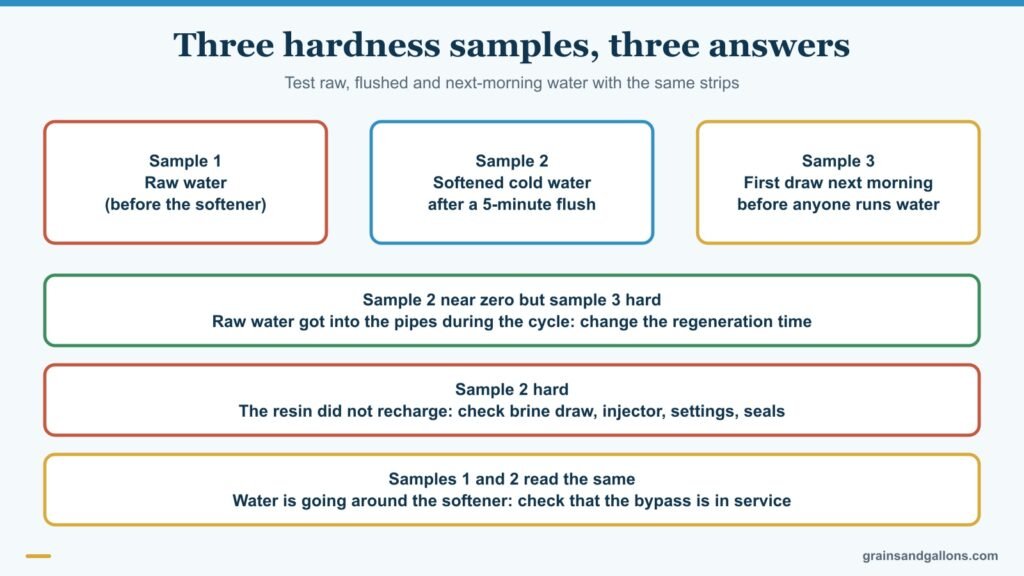
Feel is unreliable. Soap behaves differently in hot and cold water, and people expect regeneration to work instantly. A water hardness test kit settles it. Use the same strips or drops for all three samples:
- Raw water. A tap before the softener, such as an outside spigot that's plumbed around it, or any tap with the bypass briefly set to bypass.
- Softened cold water after a five-minute flush. Use a sink tap downstream of the softener. A kitchen tap that was plumbed to skip the softener won't tell you anything.
- Softened water the next morning, before anyone showers or runs the dishwasher.
Here's how to read the results:
- Sample 2 near zero, sample 3 hard: raw water got into the pipes during the cycle. The softener works; the timing doesn't.
- Sample 2 hard: the resin isn't recharging, or water is getting around it. Work through the brine checks below.
- Samples 1 and 2 about the same: water is skipping the softener entirely. Check the bypass first. It happens more often than anyone admits.
Softened water from a working unit should test at or very close to zero grains per gallon once the final rinse is done. A steady reading of 1 to 3 grains that never goes away points to leakage (covered further down), not to a failed regeneration.
Raw water slipped through during the cycle

Most single-tank softeners send unsoftened water to the house while they regenerate. That's deliberate, so you aren't left without water for an hour or two. Anything that draws water in that window gets hard water: a dishwasher on delay start, an ice maker refilling, a toilet with a slow flapper leak, irrigation, a 2 a.m. shower. That water sits in the pipes and the water heater until someone uses it. Our guide to using water during regeneration goes into what happens in each step.
What you'll notice:
- Hardness is worst at the first draw of the morning and gone after you've run water for a while.
- The salt level drops normally, and the display shows the softener regenerating on schedule.
- Hot taps may stay hard longer than cold ones.
The fix is scheduling. Set the regeneration time for a stretch when nothing in the house runs. Many valves default to 2 a.m., which collides with delayed dishwashers and sprinklers in a lot of homes. Our guide on what time a softener should regenerate helps you pick a better slot.
A twin-tank system shouldn't do this, because one tank stays in service while the other regenerates. If a twin-tank unit gives you hard water after a cycle, skip ahead to the brine checks. The Fleck manual notes that twin-tank systems need a reserve set to cover the water used during regeneration, or hard water can still break through.
A power outage stopped the cycle partway

Check the clock after any storm. According to the Fleck 5600SXT service manual, if power fails during a regeneration, the valve stays in whatever position it was in until power comes back. A cycle that stalls in backwash or brine draw leaves the resin only partly recharged. Older mechanical timers also lose the time of day, and a clock that's twelve hours off means the softener regenerates in the middle of the afternoon, right when people are using water.
Once power is back, set the time of day and run one manual regeneration so the resin starts from a full charge.
Only the hot taps are hard
If cold taps test soft and hot taps don't, the softener may be fine. The water heater refilled with hard water during the cycle (or before the softener was installed), and a large tank takes a lot of use to turn over. The Fleck manual lists "hot water tank hardness" as a cause of hard water and calls for repeated flushing of the tank. Drain a few gallons from the heater's drain valve, or just keep using hot water normally for a day and test again.
When hard water after regeneration doesn't clear
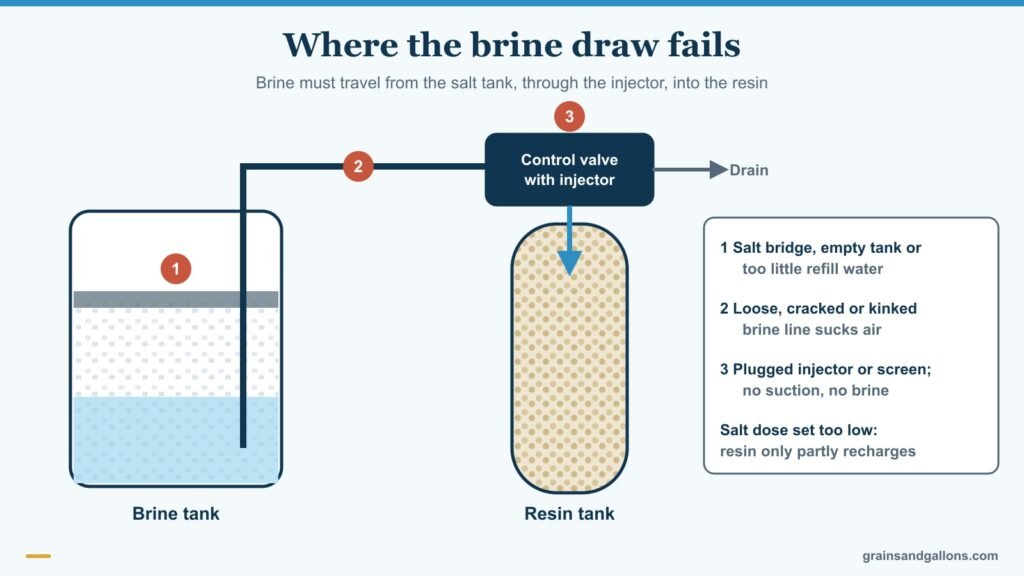
Resin only recharges if concentrated brine actually flows through it. If the valve steps through its cycles but pulls plain water, air or nothing at all, you get a regeneration in name only. The meter resets, the resin is still loaded with calcium and magnesium, and the water stays hard.
The quickest test: mark the water level in the brine tank, start a manual regeneration, and look again after the brine draw step. On most systems the level should drop noticeably and then refill. If it hasn't moved, no brine was drawn. If the salt pile hasn't gone down in weeks, it's the same story. Check these in order; the first ones are free and take seconds.
1. Salt bridge or an empty tank
A hard crust of salt (a salt bridge) can hold the pile up while the water underneath stays too weak to recharge anything. Push a broom handle down through the salt. If it hits a shelf with an empty space below, break it up. Our salt bridge guide shows how to do it without damaging the tank. After clearing a bridge, run two regenerations, since the first one may have started with weak brine.
2. A loose or cracked brine line
Follow the small tube from the brine tank to the valve. If it's popped off, kinked, cracked, or the nut at the valve is loose, the injector sucks air instead of brine. A brine line air leak is one of the most common reasons a regeneration fails silently. Reseat or replace the tubing and snug the nut by hand.
3. A plugged injector or injector screen
The injector is a small venturi nozzle inside the control valve that creates the suction to pull brine. Its opening is tiny, and sediment, iron or salt mush plugs it easily. Both the Fleck manual and most softener troubleshooting charts list a plugged injector screen as a cause of hard water. Put the softener in bypass, relieve the pressure, and follow our injector cleaning guide. Most take ten minutes and a soft brush.
4. Too little water going back into the brine tank
The valve refills the brine tank after each cycle so salt can dissolve before the next one. If the refill flow control in the brine line elbow is plugged, the tank gets less water than it should and makes weak brine. The Fleck manual's fix for this is to check the brine tank fill time and clean the brine line flow control.
5. Salt dose or hardness set too low
If someone turned the salt setting way down to save salt, the resin only partly recharges. You'll get soft water briefly after each cycle and hardness creeping back long before the next one. A hardness setting that's lower than your real water does something similar: the valve waits too long between regenerations. Check both against a fresh raw-water test, and see how to set hardness on a water softener if the number looks off. If hardness only comes back near the end of each cycle, our guide to hardness returning before regeneration covers capacity math.
Hardness slipping past the resin bed
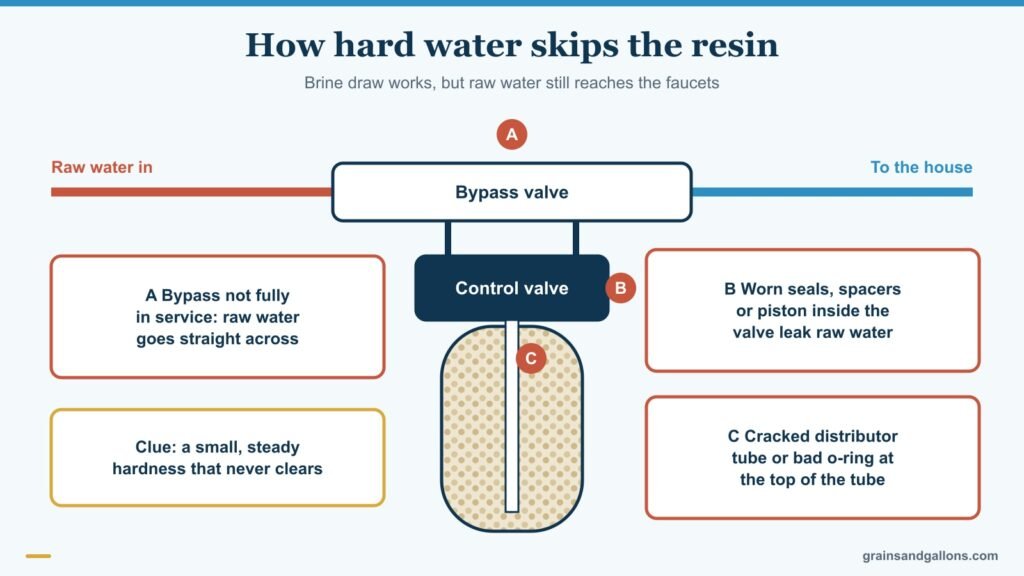
If the brine tank level drops on schedule and salt gets used, but water still tests hard, the resin may be recharging fine while raw water finds a way around it. The clue is usually a small, constant hardness reading that never clears, even right after a fresh regeneration.
The bypass isn't fully in service
A bypass handle that's partly turned, or a push-button bypass that didn't seat all the way, mixes raw water straight into the softened outlet. Turn it fully to service and test again. If the handle won't move or leaks once it does, see our guide to a stuck water softener bypass valve.
Worn seals, spacers or piston in the valve
Inside most control valves, a piston slides through a stack of seals and spacers to direct water. When those wear, raw water can leak from the inlet to the outlet without passing through the resin. The Fleck manual's fix for an internal valve leak is to replace the seals and spacers, the piston, or both. Our explainer on hardness bleed-through shows how to tell valve leakage from the small amount of leakage that's normal for some systems. If a seal kit doesn't fix an old valve, our roundup of replacement control valves covers the swap.
A cracked distributor tube or o-ring
The distributor tube runs from the valve down the center of the resin tank. If it cracks, or the o-ring where it meets the valve fails, raw water can reach the outlet without going through the resin. The same manual lists a leak at the distributor tube and says to check that the tube isn't cracked and to inspect the o-ring and tube pilot. Resin beads at the faucets or in the drain line are another hint that something at the bottom of the tank has failed.
Tired or fouled resin can't hold a charge
When the brine draw works, the bypass and seals check out, and the water is still hard right after a full regeneration, look at the resin. Resin beads wear out over time. Chlorinated city water slowly breaks them down, and iron coats them. Penn State Extension's water softening guide notes that iron that has been exposed to air or chlorine will clog the resin, and that sometimes resin can't be washed clean and has to be replaced.
Signs that point to the resin rather than the valve:
- The softener works for a shorter stretch after each regeneration, even with correct settings.
- Water from a well with iron turns orange or tan, or the resin looks dark and coated.
- The system is well over a decade old and has never had resin service.
If iron is the problem, a resin cleaner plus more frequent regeneration may restore some capacity; our guide to softener resin fouling covers cleaning. If the beads are broken down or mushy, replacing the resin is usually cheaper than a new softener. See how long softener resin lasts before deciding. A water treatment technician can check resin condition and valve seals in one visit, which often costs less than guessing at parts.
What's normal in the first hour after a cycle
Some oddities right after a regeneration are expected; others mean something failed.
| What you see | Normal? | What it means |
|---|---|---|
| Slightly salty taste for a few minutes | Mostly | The final rinse left a little brine. If it lasts more than a few draws, the rinse may be too short or the drain is restricted. |
| Hard water at first draw, soft after flushing | Common | Raw water used during the cycle. Move the regeneration time. |
| Hard water that doesn't clear after flushing | No | Brine didn't reach the resin. Check salt, brine line and injector. |
| Steady 1–3 gpg that never reaches zero | No | Water leaking past the resin: bypass, valve seals or distributor tube. |
| Brown or yellow water at first draw | No | Usually iron fouling the resin or raw well water slipping through. |
| Low pressure for an hour after | Sometimes | Some valves restrict flow during the cycle. If it lasts after the cycle ends, something is stuck. |
For broader checks beyond hardness, our guide on how to check if a water softener is working walks through salt use, cycle timing and simple taste and soap tests.
FAQ
How long after regeneration should water be soft?
Water should test soft as soon as the cycle ends and you've flushed the pipes. Run a cold tap downstream of the softener for about five minutes, then test. Anything that comes out of the tap first may be raw water that sat in the pipes during the cycle.
Why is my water hard in the morning but soft later in the day?
The softener regenerated overnight while something in the house was using water, so raw water filled the pipes and possibly the water heater. Move the regeneration time to a window when nothing runs, including delayed dishwashers, ice makers and irrigation.
Does a salt bridge cause hard water after regeneration?
Yes. A crust of salt can hold the pile above the water so the brine stays weak, and the regeneration runs without recharging the resin. Break the bridge, let the brine re-form for a few hours, then run two regenerations back to back.
Can low water pressure stop a softener from regenerating properly?
It can. The injector relies on water flow to create suction, so very low inlet pressure weakens the brine draw. Check your house pressure gauge and the manual's minimum operating pressure before blaming the resin.
How do I know if softener resin is bad?
If the brine draw works, the bypass is in service and the valve seals are good, but water tests hard right after a full regeneration, the resin is the likely cause. Resin beads in faucet screens or a capacity that shrinks after every cycle also point to worn or fouled resin.
Test before you buy parts
Hard water after regeneration has a cheap answer far more often than an expensive one. A five-minute flush and three hardness tests separate a timing problem from a failed brine draw. From there, the order is simple: salt bridge, brine line, injector, refill and settings, then bypass, seals, distributor tube and finally the resin. Most homeowners find the cause in the first three checks, and none of those cost anything.