

Quick Answer: Hardness bleed through (also called hardness leakage) is the small amount of calcium and magnesium that slips past a softener that still has capacity left. A well-tuned softener keeps it under about 1 grain per gallon (gpg). If you read 1–3 gpg right after regeneration, the usual causes are a light salt dose, very hard or high-sodium raw water, flow above the softener's rating, or fouled resin. A steady reading every day of the cycle usually means raw water is going around the resin, not through it.
Hardness bleed through is the reason your test strip says 2 gpg when the raw water is 22. The softener is clearly working, just not all the way. Ion exchange is never perfectly complete, so a trace of leakage is normal. How much gets through depends on how the softener is set up and maintained, and once it climbs past a grain or so, spots and scale start coming back.
This page is about that partial hardness. If your water goes fully hard late in the cycle, see hardness returns before regeneration; if it's hard right after a regeneration, see hard water after regeneration.
In this guide
- Picture the resin bed as a column, top to bottom
- Five things that push leakage up
- When it isn't bleed-through at all
- Test across the cycle to tell the causes apart
- How much hardness is too much after a softener?
- Fix it in order, cheapest step first
- FAQ
- A grain or two of hardness bleed through has a findable cause
Picture the resin bed as a column, top to bottom

Water enters the top of the mineral tank and flows down through the resin. Each bead holds sodium ions loosely and trades them for calcium and magnesium as water passes. By the bottom of the column, ideally, almost all the hardness has been captured.
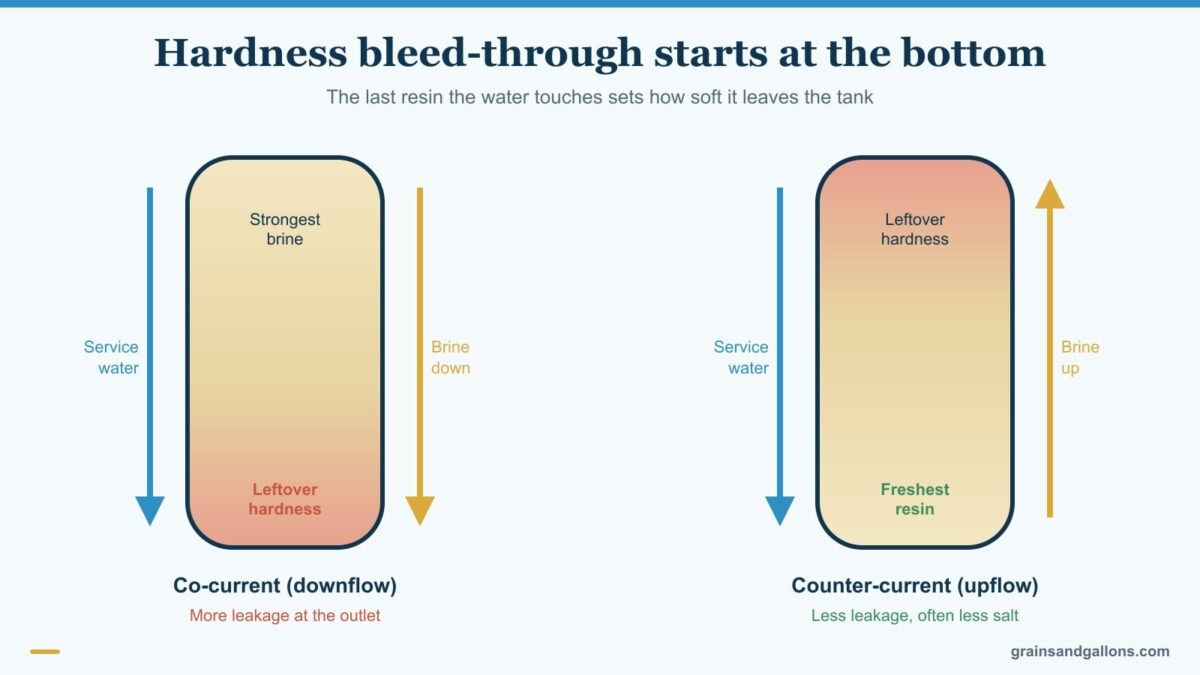
The key idea: the last layer of resin the water touches decides what comes out. If that bottom layer is fully loaded with sodium, the water leaving the tank is soft. If it still holds some calcium and magnesium from the last cycle, a little can trade back into the water on the way out. That's bleed-through.
Now think about recharging. In a conventional co-current (downflow brine) softener, brine enters at the top and flows down, the same direction as service water. The top of the bed gets the freshest, strongest brine. By the time brine reaches the bottom, it's weaker and already carrying calcium from the layers above. So the bottom of the bed, the layer that matters most for output quality, is the least thoroughly regenerated.
Why upflow brining leaks less
Counter-current (upflow) regeneration sends brine up from the bottom. Now the bottom layer gets the freshest brine and ends up the most completely regenerated, which is exactly where the service water exits. Leakage drops, and you can often get there with less salt. That's why upflow designs appeal to people chasing low leakage and good salt efficiency; our picks for upflow water softeners cover models built this way.
Five things that push leakage up
1. A light salt dose
Salt dose is pounds of salt per cubic foot of resin per regeneration. Lower doses are more salt-efficient but leave more of the bed partly regenerated, especially at the bottom of a downflow unit. If someone dialed salt way down to save money, more hardness slips through. Our guide to setting the salt dose on a water softener explains the tradeoff.
2. Very hard or high-sodium raw water
Ion exchange is a balance. When raw water is extremely hard, any leftover hardness on the bed has more chance to show up. When raw water already carries a lot of sodium, the sodium competes and nudges the exchange the other way. Very hard and high-TDS supplies often need a higher salt dose, more resin, or both. Our guide to softeners for very hard water covers sizing for 20+ gpg.
3. Flow faster than the softener is rated for
Every softener has a service flow rating. Push past it and water spends less time in contact with the resin and can channel through paths of least resistance. An undersized softener in a house with several showers running at once leaks more during those peaks than during quiet hours.
4. Weak brine draw
A salt bridge, a clogged injector or a restricted brine line means the resin gets less brine than the dose you set, which acts like a low salt setting. Check for a salt bridge in the brine tank and, if the brine level barely drops during regeneration, clean the injector.
5. Resin that's fouled or worn
Iron, manganese, silt or oil can coat beads and block exchange sites, and chlorine slowly breaks resin down over years. Either way, the bed acts smaller than it is and leaks more. See water softener resin fouling for signs and cleaning.
When it isn't bleed-through at all

Some partial hardness isn't leakage through the resin; it's raw water going around it:
- A blending or mixing adjustment on some valves deliberately adds raw water back.
- A worn seal or O-ring in the control valve lets raw water slip from inlet to outlet.
- A cracked distributor tube, or a gap where it seats into the valve, lets water skip the bed.
- A bypass valve or plumbed loop that isn't fully closed.
The math adds up fast. With 25 gpg raw water, 5% slipping around the resin gives 0.05 × 25 = 1.25 gpg at the tap before any true leakage. At 10%, it's 2.5 gpg. That's why a small internal leak on very hard water can look like a softener that's "mostly working."
Test across the cycle to tell the causes apart
One test tells you very little. Three tell you the cause:
- Test the raw water at an unsoftened tap (or with the softener in bypass) so you know the starting hardness.
- Test a softened cold tap the morning after a regeneration. This is when the bed is freshest and leakage should be lowest.
- Test the same tap again late in the cycle, a day or so before the next regeneration.
Use a drop-count titration kit rather than strips if you can; strips struggle to separate 1 gpg from 3. Our guide on how to test water hardness at home compares the options.
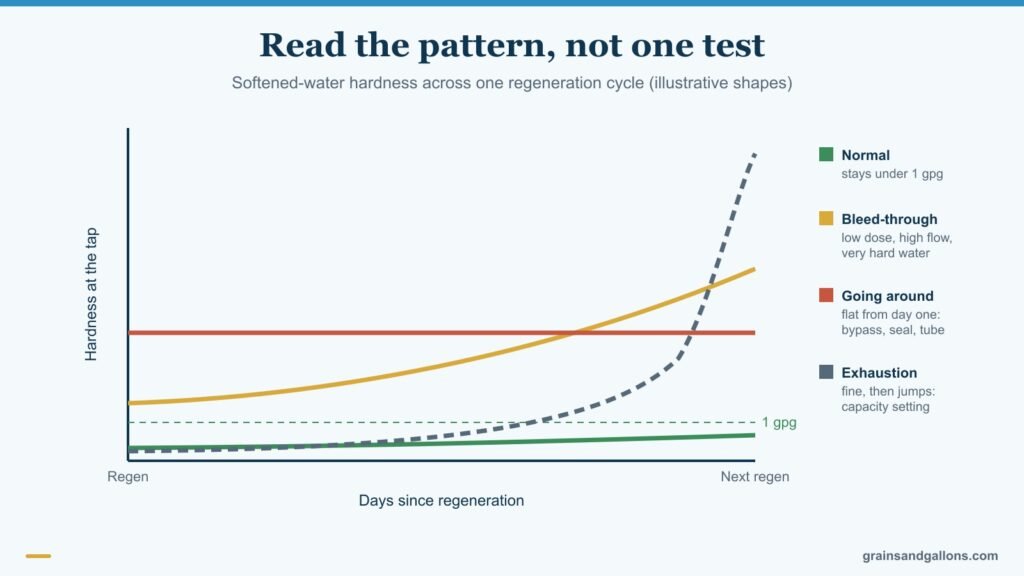
Read the pattern. True bleed-through is lowest right after regeneration and rises as the bed nears exhaustion. Raw water going around the resin shows up as the same partial hardness from day one. Water that's fine for days and then jumps toward raw hardness is a capacity or regeneration-timing problem, not leakage.
How much hardness is too much after a softener?
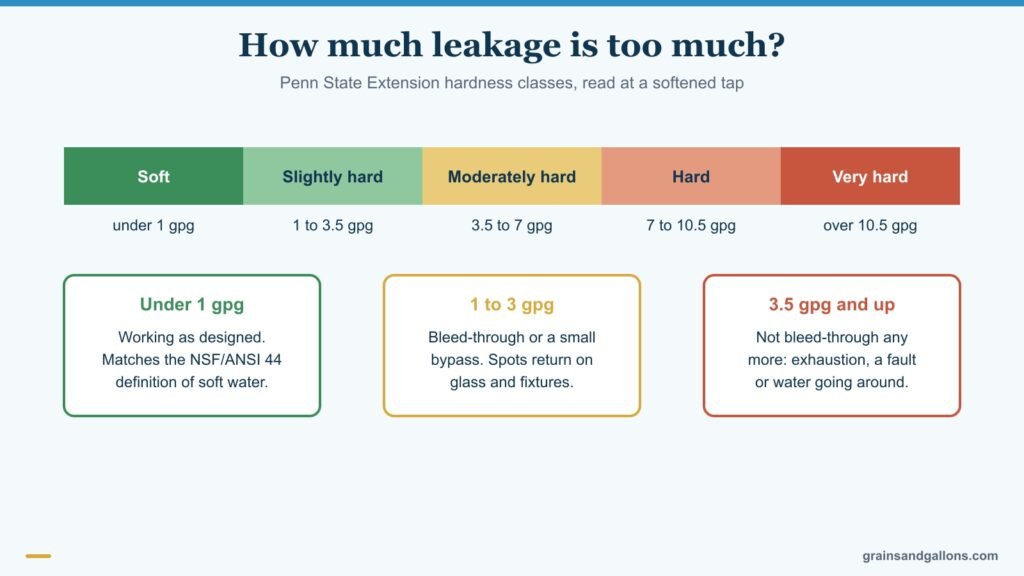
There's no legal limit for homes, but the benchmarks are clear. The Water Quality Association notes that NSF/ANSI 44 defines soft water as under 1 gpg (17.1 mg/L). Penn State Extension classes 1 to 3.5 gpg as slightly hard and says water under 7 gpg will probably not cause major scaling. For how capacity and output are certified, see what NSF/ANSI 44 means.
| Reading at a softened tap | What it usually means |
|---|---|
| 0–1 gpg | Normal; no action needed |
| 1–3 gpg right after regeneration | Light salt dose, weak brine draw, high flow or very hard water |
| Steady 2–5 gpg every day | Raw water getting around the resin: mixing valve, seal, distributor, bypass |
| Rising toward raw hardness | Capacity running out; regeneration settings or resin |
A gpg or two won't hurt pipes much, but it's enough to bring back spots on glassware and shower doors.
Fix it in order, cheapest step first

- Bypass and blend. Make sure the bypass is fully in service and any mixing screw is closed (your valve manual shows where it is).
- Settings. Confirm the hardness entered matches your raw-water test and that the salt dose wasn't set at the bare minimum.
- Brine and flow. Break any salt bridge, clean the injector and screen, and watch whether the brine tank level drops during a manual regeneration. If leakage spikes only during heavy use, the unit may be undersized for your peak flow.
- Valve and tank parts. Steady partial hardness that survives steps 1–3 points to worn seals, spacers or O-rings, or a distributor tube that's cracked or unseated. Many valves have rebuild kits; a dealer can pressure-test the tank.
- Resin and sizing. Clean fouled resin, replace worn-out resin, or move to a larger or upflow-brined unit if very hard water demands it.
Retest the same tap after each change so you know which fix did it.
FAQ
Is some hardness in softened water normal?
Yes. Ion exchange is never 100% complete, so a trace is normal. Most well-set residential softeners deliver under 1 gpg.
Why does my softener leave 2 or 3 gpg?
Usually a light salt dose, weak brine draw, flow above the rating or very hard raw water. If the reading is the same every day of the cycle, check the bypass, mixing screw and valve seals.
Does a higher salt setting reduce bleed-through?
Often, yes, especially on downflow-brined units, because more of the bottom resin gets fully regenerated. The tradeoff is more salt used per regeneration.
Can a water softener remove 100% of hardness?
Not quite, but close. Counter-current (upflow) brining gets nearest to zero because the outlet layer gets the freshest brine.
Does hardness leakage add sodium to my water?
Leakage itself is hardness, not sodium. Softening adds sodium in proportion to the hardness removed; NDSU Extension's water softening guide puts it at about 8 mg/L per grain removed.
A grain or two of hardness bleed through has a findable cause
Hardness bleed through under 1 gpg is normal ion exchange at work. Above that, test raw water and a softened tap early and late in the cycle: rising readings point to salt dose, brine draw, flow or resin, while flat partial hardness means raw water is getting around the bed. Work through bypass, settings, brine, valve parts and resin in that order, and most softeners get back under a grain.