

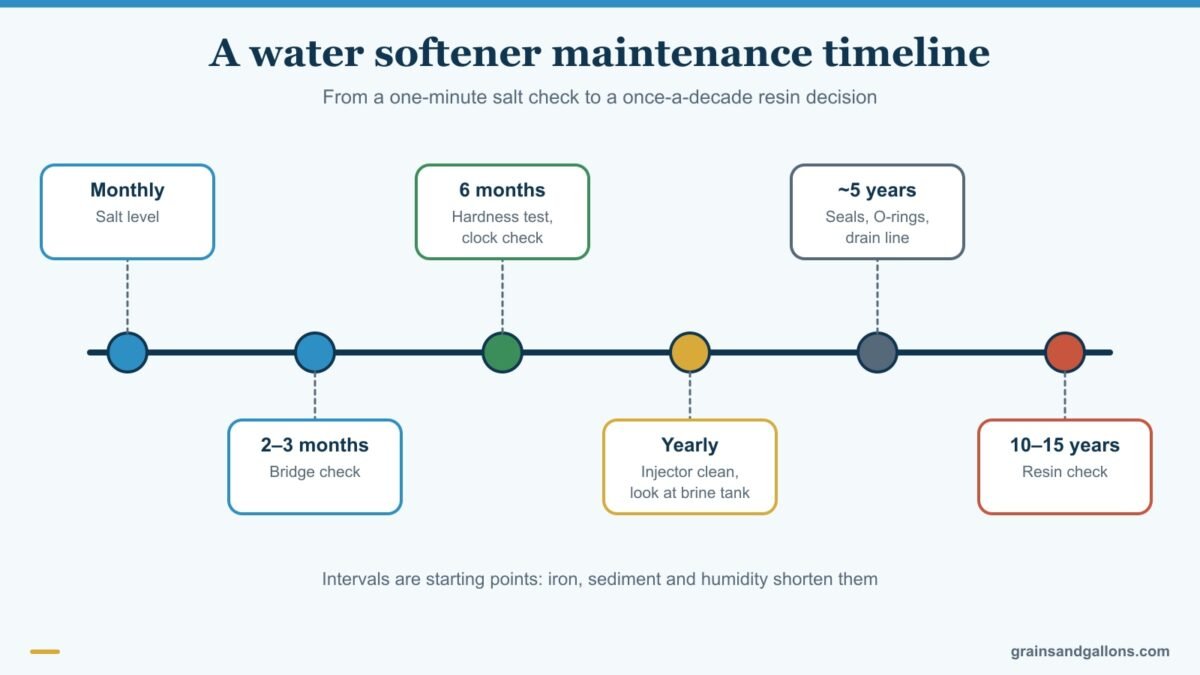
Quick Answer: A practical water softener maintenance schedule is: check the salt monthly, push a broom handle through it every two to three months to catch bridges, test softened water for hardness every six months, and clean the injector screen once a year. Empty and clean the brine tank every few years or whenever sludge builds up, have the valve seals checked around year five, and expect to evaluate the resin at 10 to 15 years. Iron, sediment and humidity all shorten those intervals.
A softener is the rare appliance that fails quietly. There's no noise and usually no warning light, just a slow slide back to spotty glasses and crusty faucets. Every item in this water softener maintenance schedule is there to catch one of those quiet failures early. It assumes a typical salt-based, single-tank softener with a brine tank; all-in-one cabinet models need the same jobs, just inside one box.
In this guide
- The full water softener maintenance schedule at a glance
- Monthly and quarterly: keep the salt working
- Every six months: test the water and check the clock
- Yearly: clean the injector and inspect the brine tank
- Tighten the schedule for iron, sediment, humidity and cold
- Signs that can't wait for the next scheduled check
- Every 5 to 15 years: seals, then the resin
- FAQ
- Ten minutes a month keeps the softener honest
The full water softener maintenance schedule at a glance
| How often | Job | Time it takes | What it prevents |
|---|---|---|---|
| Monthly | Check salt level | 1 minute | Running out of salt, hard water |
| Every 2–3 months | Broom-handle check for salt bridges | 2 minutes | A "full" tank that isn't making brine |
| Every 6 months | Hardness test at a hot tap | 5 minutes | Slow capacity loss nobody notices |
| Every 6 months | Look at the display and clock | 1 minute | Regenerating mid-afternoon after a power outage |
| Yearly | Clean the injector and screen | 20–30 minutes | Weak or failed brine draw |
| Every 1–3 years, or when sludge builds | Empty and clean the brine tank | 1–2 hours | Mushy salt, clogged brine well |
| Per label, if you have iron | Resin cleaner | 5 minutes plus a regeneration | Iron-coated resin |
| Around 5 years | Seals, O-rings, drain line | 1 hour or a service visit | Leaks and slow regenerations |
| Every 10–15 years | Resin evaluation | Testing first, then a decision | A tank that can't hold a charge |
Treat those intervals as starting points. If your manual gives a different one, the manual wins.
Monthly and quarterly: keep the salt working
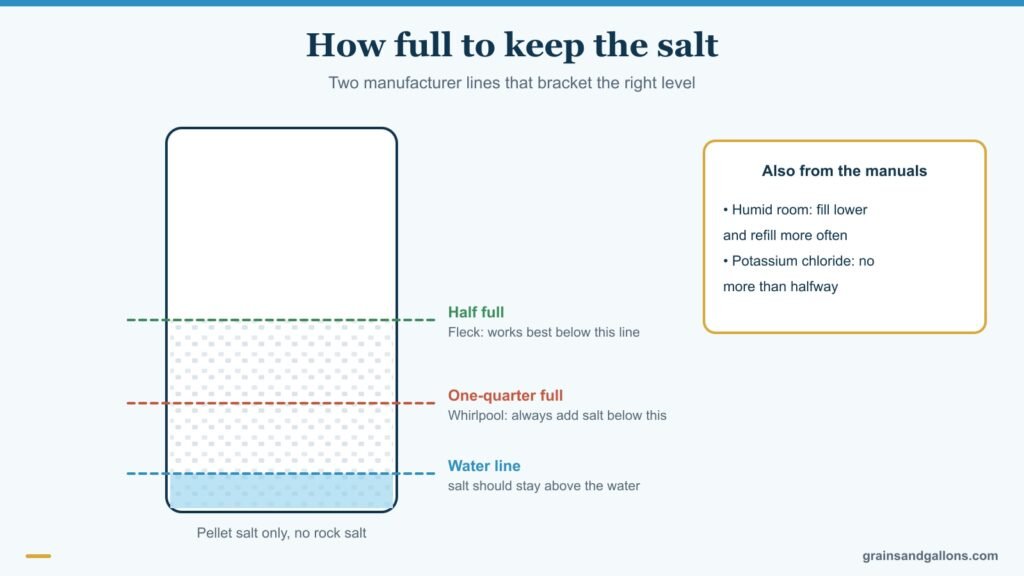
Lift the lid and look. Salt should always sit above the water. Pentair's Fleck 5600SXT manual says the salt tank works best below half full, because a tank packed higher is more likely to bridge. Whirlpool's manual says to check the salt every two or three weeks until you've learned your usage, and to always add salt when the tank is less than one-quarter full. In humid areas it recommends a lower fill and more frequent top-ups, and with potassium chloride, no more than halfway.
Use pellet salt made for softeners. Fleck says other types such as rock or ice-melting salt contain dirt and chemicals that affect the softener, and Whirlpool lists rock salt as not recommended. Our picks for the best water softener salt cover which types leave the least residue. If you find it hard to remember, write the date on the lid in marker each time you add a bag.
The broom-handle bridge check
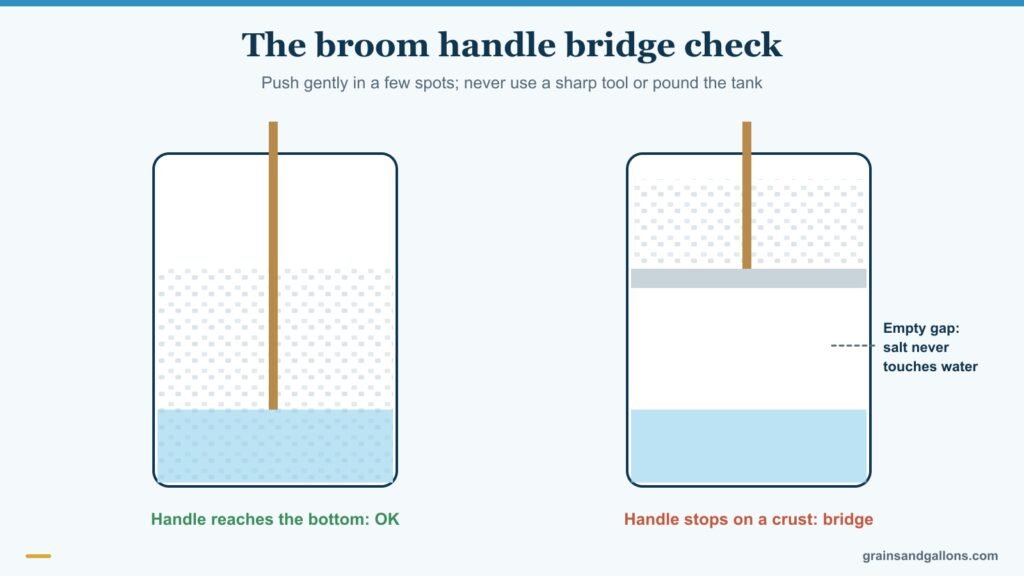
The salt can look fine for weeks while the softener starves. A bridge is a hard crust across the tank with an empty gap underneath, so the salt above never touches the water. Every two or three months, push a broom handle gently down through the salt in a few spots. If it stops on a solid layer, you've found one. Whirlpool warns against sharp tools or pounding on the outside of the tank. Fleck suggests waiting two hours after breaking it up, then regenerating, and notes a second regeneration may be needed. Our guide to the water softener salt bridge has the details.
While you're in there, look at the bottom. A thick, muddy layer that looks like wet oatmeal is salt mushing, and it means a cleanout is due.
Every six months: test the water and check the clock

Test. Run a hot tap until it's warm (the water heater is normally fed softened water), then test with a strip or a drop kit. Softened water should read near zero. If it's high, test again right after a regeneration: hard before and hard after a regeneration are different problems. A drop-count titration kit gives an actual number; see the best water hardness test kits.
Clock and settings. After a power outage, some valves keep time and others start blinking. If yours lost time, it may now regenerate in the middle of the day. Also check that the hardness setting still matches your water if you've moved, changed wells or the city switched sources.
Write each reading down. A log that goes 0, 0, 1, 2 gpg over two years tells you more than any single test.
Yearly: clean the injector and inspect the brine tank
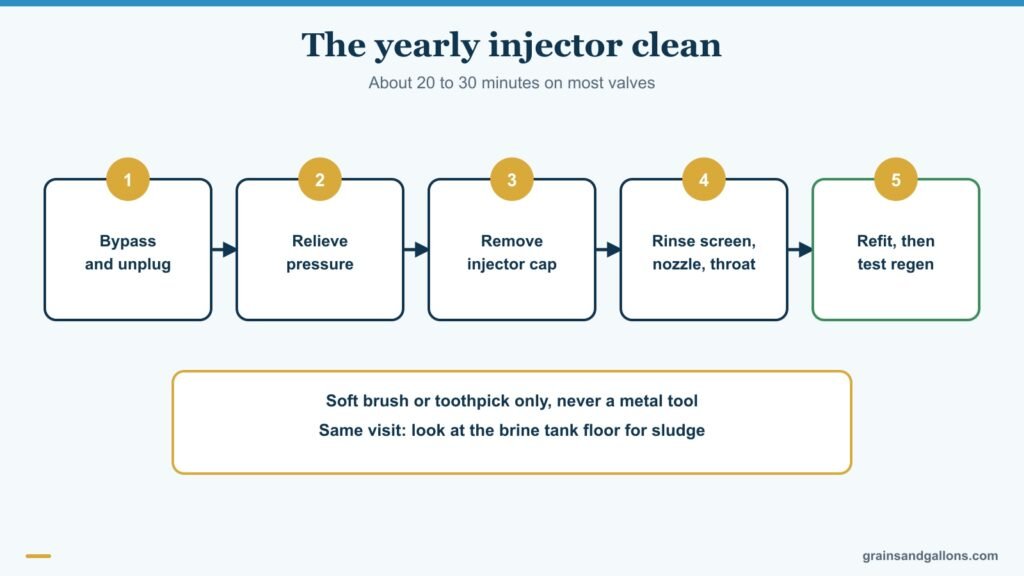
The injector (Whirlpool calls it the nozzle and venturi) is a small nozzle-and-throat assembly in the valve that creates the suction pulling brine from the tank. Whirlpool's manual calls a clean one a necessity, because sand, silt or dirt can plug it and stop brine draw. Put the valve in bypass, relieve pressure, remove the cap, rinse the screen and nozzle, and refit. Our injector cleaning guide shows where it sits on common valves.
Then look at the brine tank floor. Pentair's Fleck manual says to empty and clean the tank every three years. Do it sooner if there's sludge, the water looks dirty or the brine well is crusted. Let the salt run low first, scoop out what's left, bail the water, scrub with mild dish soap, rinse and refill. Penn State Extension suggests periodically cleaning the softener with chlorine bleach to control bacteria, after reading the manufacturer's instructions. How to clean a water softener brine tank has the step-by-step. Wear gloves, ventilate if you use bleach, and never mix it with another cleaner.
Tighten the schedule for iron, sediment, humidity and cold
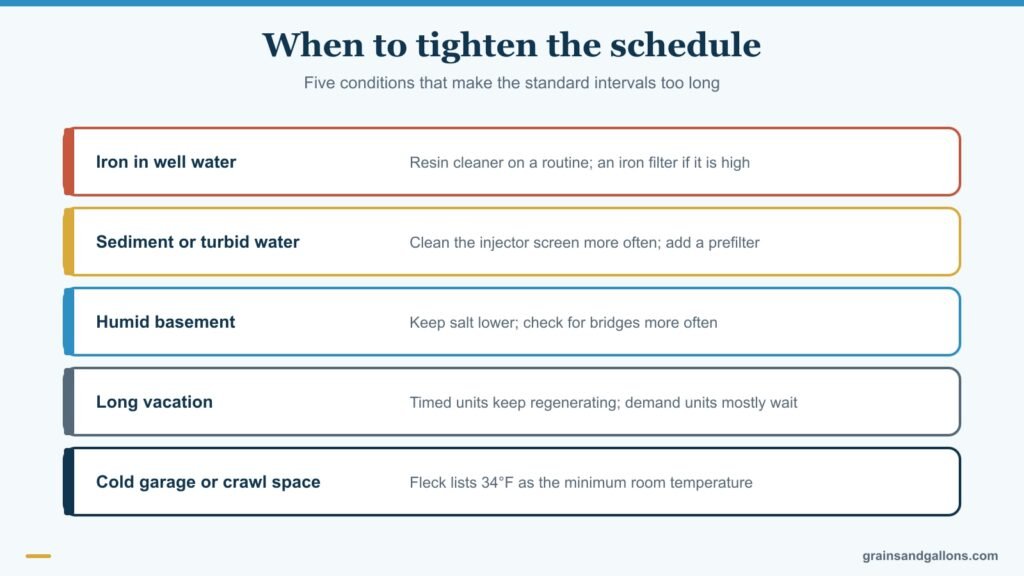
Iron. Penn State notes that iron exposed to air or chlorine will clog the resin and recommends filtering it out before softening. If you're on well water with iron, add a resin cleaner on a routine; our comparison of Iron Out vs Res Care covers doses. If you're cleaning every month, an iron filter ahead of the softener is the real fix.
Sediment. Turbid water clogs the injector screen and resin faster. Clean the injector more often, or add a sediment prefilter.
Humidity. Keep the salt lower and check for bridges monthly instead of quarterly.
Vacations. Penn State points out that timed softeners regenerate on schedule whether the resin needs it or not, while demand units regenerate after a set volume of water. Top up salt before a long trip, and see why water feels hard after vacation if it does when you're back.
Cold spaces. Fleck lists 34°F as the minimum room temperature. In an unheated garage or crawl space, follow our guide on how to winterize a water softener.
Signs that can't wait for the next scheduled check
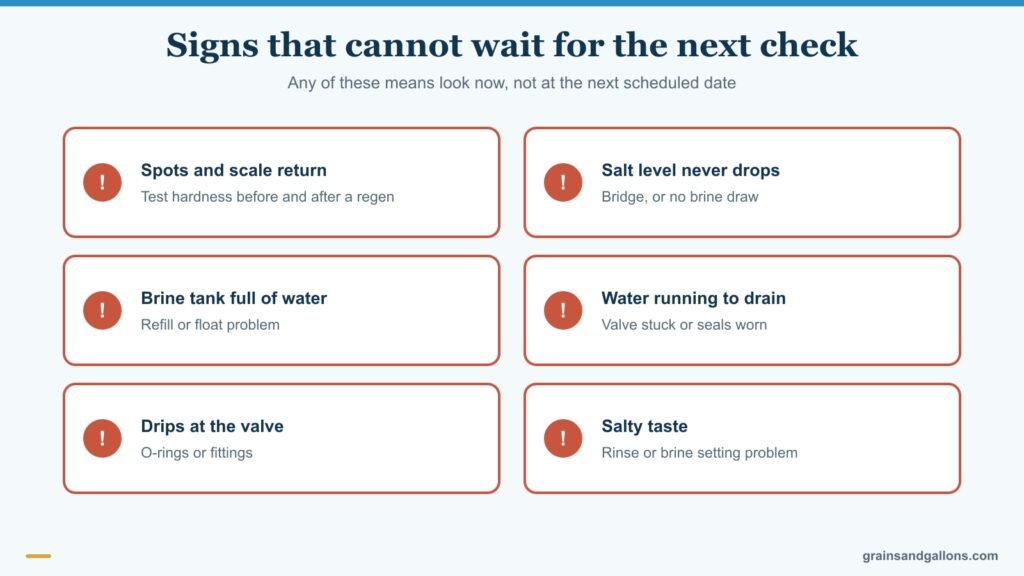
Don't wait for the calendar if you notice any of these:
- Spots and scale coming back. Test hardness before and after a regeneration.
- The salt level hasn't dropped in weeks, which points to a bridge or no brine draw.
- The brine tank is full of water, a refill or float problem.
- Water running to drain long after a regeneration should have ended.
- Drips at the valve or around the bypass.
- Softened water that tastes salty.
Every 5 to 15 years: seals, then the resin
Around year five, plan a closer look at the valve's moving parts. Piston seals and spacers wear, O-rings flatten, and the drain line can collect scale or slime. Signs it's due: drips at the top of the valve, water running to drain after regeneration, or a cycle that takes longer than it used to. On common valves you can do this with a seal and spacer kit; our guide to servicing a water softener control valve shows how, or hand it to a dealer.
Resin doesn't last forever, and chlorinated city water tends to wear it out faster than well water. Penn State notes that resin which can't be washed of contaminants needs replacing, though that shouldn't happen with regular regeneration and maintenance. If your test log shows hardness creeping back early and the salt, brine draw and settings all check out, read resin life and replacement.
FAQ
How often should a water softener be serviced?
Most of the routine work is DIY: monthly salt checks, a hardness test twice a year and a yearly injector clean. A closer look at the valve seals around year five is the job most owners hand to a pro or do with a rebuild kit.
How often should I clean the brine tank?
Pentair's Fleck manual says every three years. Clean it sooner if you see sludge, mushy salt or dirty water at the bottom, which is common with lower-purity salt or in humid rooms.
How full should I keep the salt in my softener?
Between about one-quarter and one-half full, always above the water line. Fleck says the tank works best below half full, and Whirlpool says to add salt whenever it drops below a quarter.
Do I need to add resin cleaner on a schedule?
Only if your water has iron or another fouling problem. City water without iron generally doesn't need a scheduled resin cleaner. Follow the cleaner's label for dose and frequency.
How long does a water softener last with maintenance?
The valve and tanks can last for many years, and the resin is usually the part that wears out first. Expect to evaluate it at 10 to 15 years, sooner on chlorinated water or water with iron.
Ten minutes a month keeps the softener honest
A water softener maintenance schedule doesn't need to be complicated. Check salt monthly, break bridges before they starve the tank, test the water twice a year, clean the injector yearly and the brine tank every few years. Shorten those intervals for iron, sediment, humidity or cold, and act right away on the warning signs. That's most of what keeps a softener running well for its whole life.
Sources: Pentair Fleck 5600SXT installation and operation manual; Whirlpool WHES softener manual; Penn State Extension, Water Softening.