


Quick Answer: Add an iron filter before water softener resin starts fouling: you need one when iron is more than the softener can comfortably handle (as a rule of thumb, above about 2–3 ppm), when the iron arrives already oxidized (orange or cloudy straight from the tap), or when iron bacteria, manganese or a rotten-egg smell are part of the picture. Low levels of clear-water iron can often be handled by the softener alone. Start with a number: a test like the ITS WaterWorks Total Iron test reads 0–5 mg/L.
Disclosure: As an Amazon Associate, Grains & Gallons earns from qualifying purchases.
Someone told you "a softener takes out iron." Someone else told you "you need an iron filter first." Both are right, depending on how much iron you have, what form it's in, what rides along with it, and your pH.
In this guide
- Why a softener handles some iron and chokes on more
- Do you need an iron filter before water softener trouble starts?
- Getting the four numbers that decide it
- The install order: pressure tank, iron filter, then softener
- Which iron filter suits your water?
- Backwash flow and sizing: two traps to check
- When one iron-rated softener is enough
- FAQ
- Test first, then put the iron filter before the water softener
Why a softener handles some iron and chokes on more

A softener removes hardness by ion exchange, and dissolved (ferrous) iron is also a positively charged ion. While it stays dissolved, the resin can grab it alongside calcium and magnesium. That's "clear-water iron": the water comes out of the tap clear and turns orange after it sits.
The trouble starts when iron oxidizes and turns into solid rust particles (ferric iron). Particles don't exchange. They coat the resin beads and clog the bed, and regular brine doesn't fully strip them. The more iron you push through, the faster that happens. Penn State Extension's guide to iron and manganese in private water systems says softeners work best on dissolved iron under 5 mg/L, with pH above 6.7 and hardness of 3 to 20 gpg, and that raw water must not contact air or chlorine before the softener, since oxidized metals foul the resin. For the longer version, see can a water softener remove iron.
An iron filter avoids that by oxidizing iron on purpose, then trapping the particles in a media bed that backwashes them away.
Do you need an iron filter before water softener trouble starts?

Read across from your raw-water test:
| Your water | Softener alone? | Iron filter first? |
|---|---|---|
| Ferrous iron under ~1 ppm, no smell, no manganese | Usually fine. Use an iron-rated resin cleaner and size for iron | Not usually needed |
| Ferrous iron ~1–3 ppm | Often workable with a properly sized softener and regular resin cleaning. Check your softener's iron limit | Worth considering, especially if stains persist |
| Iron above ~3 ppm | Not recommended | Yes |
| Water is orange or cloudy straight from the tap (ferric iron) | No. Particles will foul the resin | Yes |
| Slime in the toilet tank, swampy smell (iron bacteria) | No | Yes, plus treat the well |
| Rotten-egg smell (hydrogen sulfide) | No | Yes, many iron filters handle both |
| Manganese present (black or brown stains) | Small amounts only | Usually yes. See manganese filters |
These cutoffs are rules of thumb, not law. Softener makers publish their own maximum iron ratings, and they vary by model, so read the spec sheet. Penn State's 5 mg/L figure is a ceiling under ideal conditions, not a comfortable operating point.
For reference, the EPA's secondary drinking water standards set 0.3 mg/L for iron and 0.05 mg/L for manganese. Above those, staining and metallic taste become likely, which is why even small amounts of manganese leave black marks. If slime is the main symptom, read iron bacteria in well water first, because no filter fixes a well that needs shock chlorination.
Getting the four numbers that decide it

- Test raw water from a tap before any treatment, ideally the pressure tank drain or an outside spigot on the raw line. Our guide to testing well water for iron shows where to draw the sample.
- Test total iron. An inexpensive color kit gives a ballpark. Our best iron test kits compares strips, color discs and digital checkers.
- Do the glass test. Look at the water right out of the tap and after an hour in a clear glass. Clear-then-orange means ferrous. Orange immediately means some is already ferric.
- Get manganese, pH and hydrogen sulfide tested if you're on a well. A lab panel is worth it before buying an iron filter, because pH decides which media will work. Penn State recommends an accredited lab that reports whether the iron is dissolved or oxidized.
The install order: pressure tank, iron filter, then softener

Well → pressure tank → (sediment prefilter, if needed) → iron filter → softener → house.
The iron filter goes first because its job is to protect the softener. Put it after the softener and the resin takes the full iron load anyway. Give each tank its own bypass valve. Carbon, UV and other add-ons have their own spots in the line. Filter before or after a water softener has the full order.
With a chlorine feed, a carbon filter usually removes leftover chlorine before the softener, since chlorine also damages resin.
Which iron filter suits your water?

Penn State lists these options:
- Catalytic carbon: dissolved iron under 1.0 mg/L, and it needs at least 4.0 mg/L of dissolved oxygen in the water.
- Birm: uses dissolved oxygen and needs no regeneration chemicals, but requires pH of at least 6.8 for iron (7.5 for manganese).
- Manganese greensand: handles dissolved and oxidized iron and manganese, recommended for combined levels of 3 to 10 mg/L. It's regenerated with potassium permanganate, which needs careful handling.
- Aeration and air injection: no chemicals and low maintenance, followed by a filter bed to catch the particles.
- Chlorine, permanganate or peroxide feed plus filtration: for combined iron and manganese above 10 mg/L, with contact time before the filter.
If your pH is low, many of these media won't work well until it's corrected, and an acid neutralizer usually goes ahead of the iron filter.
Backwash flow and sizing: two traps to check
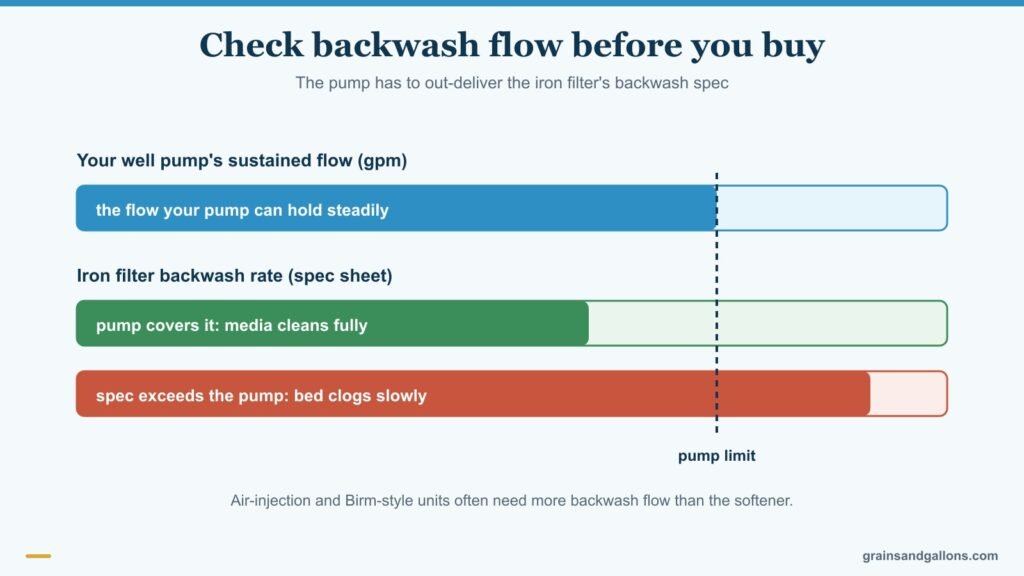
Backwash flow. Most whole-house iron filters, especially air-injection and Birm-style units, need a strong backwash to clean their media, often more flow than the softener needs. A well pump that can't deliver it means the iron filter slowly clogs. Check your pump's sustained gpm against the iron filter's backwash spec before buying. See well pump flow and backwashing.
Softener sizing still counts iron. Size the softener for what reaches it. If you skip the iron filter and let the softener take some iron, add iron to your hardness when sizing. Many sizing guides add a few grains per gallon for each ppm of iron. Our guide to how iron changes softener sizing works through it. And if iron has already reached the resin, see softener resin fouling for cleanup.
When one iron-rated softener is enough
Some systems handle moderate iron with one specialized tank. The SoftPro Iron Master is an example of a softener built for iron-heavy water, using fine-mesh resin. These can work well up to their rated limit and save floor space. Past that limit, or with bacteria, hydrogen sulfide or manganese in the mix, a separate oxidizing filter in front gives you more headroom. If manganese is your main problem, start with our best manganese filters.
FAQ
Can I put an iron filter after a water softener?
You can, but it defeats the purpose. The softener would take the full iron load first, and oxidized iron would foul its resin. The iron filter belongs before the softener so the resin only sees hardness.
How much iron can a water softener remove?
It depends on the model, so check the spec sheet. Penn State Extension puts the practical ceiling at about 5 mg/L of dissolved iron with pH above 6.7. Many homeowners add an iron filter well before that, around 2 to 3 ppm, to keep resin cleaning to a minimum.
Do I need an iron filter if the water is only orange after it sits?
Not always. Water that's clear from the tap and turns orange later has dissolved ferrous iron, which a softener can exchange at low levels. If the level is under about 1 ppm and there's no smell or manganese, a properly sized softener with regular resin cleaning is often enough.
Does an iron filter remove hardness?
No. Iron filters oxidize and trap iron, manganese and often hydrogen sulfide, but calcium and magnesium pass straight through. You still need the softener for hardness.
Will an iron filter reduce my water pressure?
A correctly sized filter shouldn't cause a noticeable drop. Pressure loss usually means the media is clogging because backwash flow is too weak or the filter is undersized for your peak flow.
Test first, then put the iron filter before the water softener
The order is settled: an iron filter before water softener resin keeps the beads clean. Whether you need one at all comes down to your test. Under about 1 ppm of clear-water iron with no smell or manganese, the softener can usually cope. Above about 3 ppm, with orange water, slime, sulfur smell or manganese, put the iron filter first and choose the media by your pH and iron level. Check your pump's backwash flow before you buy.