


Quick Answer: What is hard water? It's water carrying a lot of dissolved calcium and magnesium, picked up as it moves through limestone, chalk and similar rock. It's safe to drink, but it matters at home because those minerals come back out as scale when water is heated or dries. That means crusty faucets, spotty dishes, poor soap lather and water heaters that lose efficiency. Above about 7 grains per gallon (120 mg/L), most households notice it.
If you've ever asked what is hard water, run your finger along the inside of a kettle that's been used for a few months. That chalky, slightly rough layer is the whole story in one spot. It started as rock underground, dissolved into rain, traveled to your tap, and then came back out as rock again when you heated it.
Once you understand that loop, almost every hard water problem makes sense.
In this guide
Rain is soft. The ground makes it hard.
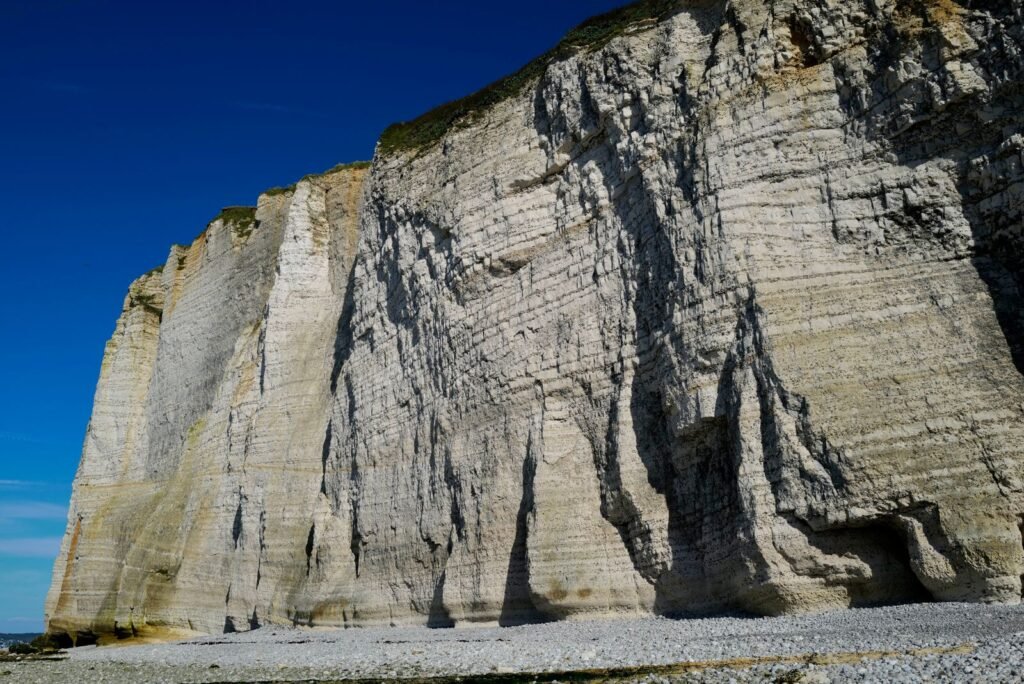
Rainwater has almost no dissolved minerals. It does pick up carbon dioxide from the air and the soil, which makes it slightly acidic. When that mildly acidic water soaks through limestone (calcium carbonate) or dolomite (calcium magnesium carbonate), it dissolves a bit of the rock and carries it along.
That's why hardness tracks geology. Areas sitting on limestone, like much of the Midwest, Texas, Florida and the Southwest, tend to have hard water. Areas with granite or other hard-to-dissolve rock, like much of New England and the Pacific Northwest, tend to have softer water. Wells often run harder than nearby surface water because groundwater spends a long time in contact with rock.
City water and well water get there by the same route. The difference is that a utility reports its hardness to you every year, while a private well owner has to test for it. Virginia Tech Extension points out that private wells aren't regulated by the EPA, so the owner is responsible for knowing what's in the water.
What is hard water on a lab report?
Technically, hardness is the total of dissolved multi-charged metal ions, mostly calcium and magnesium. Iron and manganese count too, in small amounts. Most of what matters at home is calcium.
Labs report it in one of two units:
- Milligrams per liter (mg/L) as calcium carbonate. Parts per million (ppm) is the same number.
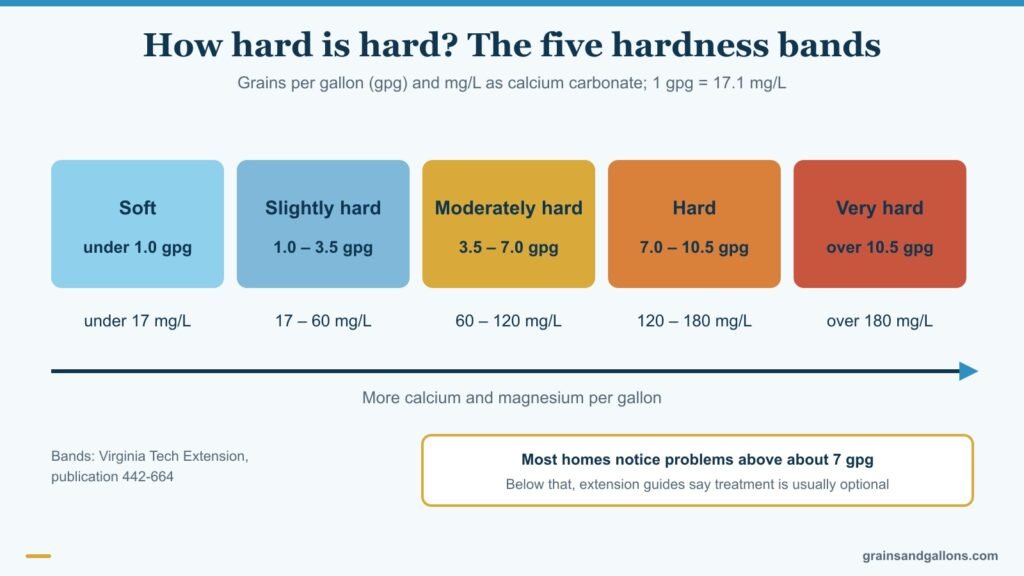
- Grains per gallon (gpg). This is the unit softener makers use. One grain per gallon equals 17.1 mg/L, so divide mg/L by 17.1 to convert.
Virginia Tech Extension sorts results into five bands: soft (under 1 gpg), slightly hard (1 to 3.5 gpg), moderately hard (3.5 to 7 gpg), hard (7 to 10.5 gpg) and very hard (over 10.5 gpg). The USGS uses similar mg/L cut-offs. Our guide to hardness units: gpg vs ppm has a conversion table if your report uses a different unit.
You'll also see a split between "temporary" (carbonate) hardness and "permanent" (non-carbonate) hardness. Temporary hardness drops out as scale when water is heated. Permanent hardness doesn't, but it still causes soap problems and spotting. Our guide to types of water hardness explains why the difference matters for kettles and boilers.
Four places hard water costs you at home

1. Anything that heats water
Heat pushes calcium carbonate out of solution. So the hotter the water gets, the more scale you get. That's why kettles, coffee makers, dishwashers and water heaters suffer most. We explain the chemistry in why hot water causes more scale.
In a tank water heater, scale settles on the bottom and acts like insulation between the burner or element and the water. The heater has to work harder to reach the same temperature, and Virginia Tech notes that scaling can raise heating costs by cutting efficiency. You may hear popping or rumbling as water trapped under scale boils. In tankless heaters, scale narrows small passages in the heat exchanger, and many manufacturers call for regular descaling in hard water areas.
2. Anything water dries on
When a drop evaporates, the water leaves but the minerals stay. That's the white ring on a faucet, the haze on shower glass and the spots on a dark car. Higher hardness means more left behind per drop. These deposits build in layers, so a little ignored for months becomes a crust that's hard to remove.
3. Soap and detergent
Calcium and magnesium react with soap to form an insoluble curd, the familiar soap scum. That uses up soap before it can lather, so you use more and rinse less cleanly. It's also why laundry can come out stiff or dingy. If your shampoo barely foams, this is why. Our page on soap that won't lather in hard water goes deeper.
4. Plumbing over the long run
Scale can build inside pipes, especially hot water lines, over years, and heavy scaling reduces flow and pressure. In practice the first places you'll see restriction are the small openings: faucet aerators, showerhead nozzles, toilet rim jets and appliance inlet screens.
Is hard water safe to drink?

Yes. Hard water isn't considered a health hazard. There's no EPA drinking water standard for hardness, and Virginia Tech Extension calls it safe for drinking, cooking and other household uses. Calcium and magnesium are minerals people also get from food, so hard water adds a small amount of both to your diet.
Montana State University's well water guide even lists a few upsides: harder water tends to be less corrosive to pipes and, within limits, many people prefer its taste. That's one reason some homes soften the main supply but keep an unsoftened tap for drinking.
Some people with dry or sensitive skin feel better in soft water, and research on eczema is ongoing. Our summary of whether hard water is bad for you covers what's known so far. If skin issues are why you're reading this, a dermatologist is a better first stop than a softener dealer.
So when people say hard water "matters," they almost always mean money and time: appliance life, energy, cleaning products and effort.
Spot the signs, then get a real number
Common signs:
- White crust on faucets, showerheads and the inside of kettles
- Spots or a film on glasses and dishes after the dishwasher
- Soap and shampoo that don't lather well
- A ring in the toilet bowl that's hard to scrub off
- Stiff towels and faded laundry
Signs are a hint, not a measurement. City customers can check the utility's annual water quality report, often called a Consumer Confidence Report. Well owners should test at the tap or send a sample to a certified lab. Test strips tell you which band you're in. A drop-count titration kit gives a more exact number, which you'll want if you plan to set up a softener, because softener sizing starts with hardness and daily water use. Our roundup of the best water hardness test kits compares the two.
Match the treatment to your hardness

Virginia Tech's general guidance is that hardness under 7 gpg usually doesn't need treatment unless it's causing a problem you care about. Above that, your options depend on what you want to protect.
Spot treatment. Descale the kettle and coffee maker with citric acid or a descaler. Use a rinse aid in the dishwasher. Squeegee the shower glass. This works fine for moderately hard water or renters.
Point-of-use filters. Some pitchers and under-sink filters reduce hardness for drinking and coffee. They don't help showers, laundry or the water heater.
Salt-free conditioners. These change how scale forms rather than removing hardness. They can reduce scale in pipes and heaters, but they won't stop spotting or improve lather. See how a salt-free conditioner works before you buy one.
Ion exchange water softener. This is the common whole-house option that actually removes calcium and magnesium. It swaps them for sodium (or potassium) on resin beads, then flushes them away during regeneration. Penn State Extension explains the process and the added sodium in detail. For a typical household with hard water, a softener sized around 40,000 to 48,000 grains is common. Our picks for the best water softener for a family of 4 are a good place to start.
One option people forget: you don't have to soften everything. Outdoor taps don't need it. If your only complaint is a scaling water heater, softening only the water headed to the heater is a legitimate setup. If sodium is a concern, keep a cold drinking tap on hard water.
Know your number before you buy anything
So, what is hard water to your household? Mostly a cost question, not a health one. The minerals that made it hard will come back out wherever water is heated or left to dry, and how much that costs you depends on the number. A softener takes salt, some water for regeneration, a drain and occasional maintenance, so test first. At 4 gpg, wiping down the shower is probably enough. At 18 gpg, a softener usually earns its keep.
FAQ
What is hard water in simple terms?
It's water with a lot of dissolved calcium and magnesium in it. The minerals come from rock the water passed through underground, and they show up at home as white scale, spots on glass and soap that won't lather.
What hardness level is considered hard water?
Most US guides call water hard at 7 grains per gallon (120 mg/L) and very hard above 10.5 gpg (180 mg/L). Between 3.5 and 7 gpg is moderately hard, which many homes can manage with cleaning habits alone.
Is hard water bad for your hair and skin?
It doesn't damage them in a medical sense, but soap scum left by hard water can make hair feel dull and skin feel dry or tight. Some people with eczema report feeling better in soft water, though the research isn't settled.
Does boiling water make it soft?
Boiling removes only the temporary (carbonate) hardness, which drops out as scale in the pot. The permanent hardness stays in the water, and you've traded softer water for a scaled kettle.
How do I find out how hard my water is?
City customers can read their utility's annual water quality report or call the utility. Well owners should use a test strip, a titration kit or a certified lab. Check the units: divide mg/L by 17.1 to get grains per gallon.