


Quick Answer: Is hard water bad for you? Not to drink. The World Health Organization hasn't set any health-based limit for hardness, and calcium and magnesium are nutrients. Where hard water can matter is on the outside: soap residue can dry and irritate skin, and studies have linked hard water with more eczema in young children, though softening hasn't been shown to treat it. Most of what hard water costs you is scale, soap and appliance wear.
You moved, or you just tested your water, and the number came back high. Now you're wondering whether the chalky crust in the kettle is building up in you too. It's a fair question, and the short answer to "is hard water bad for you" is reassuring, with a few cases worth a closer look.
In this guide
Drinking hard water: no health-based limit
Hardness is mostly dissolved calcium and magnesium, the same minerals you get from food. WHO's background document on hardness in drinking-water proposes no health-based guideline value, and in the US the EPA doesn't regulate hardness as a health contaminant either.
If anything, research has asked whether hard water is protective:
- Many studies, mostly comparing regions rather than individuals, found lower cardiovascular death rates where water is harder. Some linked higher magnesium in water to lower cardiovascular mortality.
- McGill University's Office for Science and Society, in is hard water dangerous to drink?, adds that most studies find no link between hardness and kidney stones. It estimates that 2 liters of hard water supplies about 52 mg of magnesium, roughly 12% of the recommended daily intake.
- WHO calls the heart evidence debated, because these study designs can't prove cause and effect. Diet matters far more.
Taste is what you'll notice. WHO puts the taste threshold for calcium at roughly 100 to 300 mg/L. Very hard water can taste chalky, which is preference, not safety.
A caveat for well owners: hardness is just one property. Wells with hard water can also carry iron, manganese, arsenic, nitrate or bacteria that a hardness test won't show. Get a full lab test before worrying about hardness.
Hard water on skin, and the eczema question

Hard water reacts with soap to form insoluble scum that can linger on skin after rinsing, and it takes more soap to lather, which strips more natural oil. For many people that just means skin feels tight after a shower. Our guide to hard water and dry skin covers the mechanism.
Eczema is where research has been busiest:
- Observational studies in several countries have linked hard water areas with more eczema in infants and young children.
- But the UK SOFTEN trial, published in 2011, tested whether a softener treats existing eczema in 336 children. McGill summarizes the result: about a 20% improvement with softened water versus 22% with usual care, so no real benefit.
Hard water may play a role in who develops eczema, but softening isn't a proven treatment. If you or your child has eczema, see a doctor. More in hard water and eczema.
What hard water does to hair

Mineral buildup can leave hair dull, stiff or hard to rinse clean, and it can fight color treatments. Two water quality engineers writing in The Conversation note that deposits may also clog pores and follicles. It's cosmetic, not a health issue. Clarifying shampoos and filtered showerheads are the usual fixes; see hard water and hair.
Is softened water healthier? A sodium-for-minerals trade
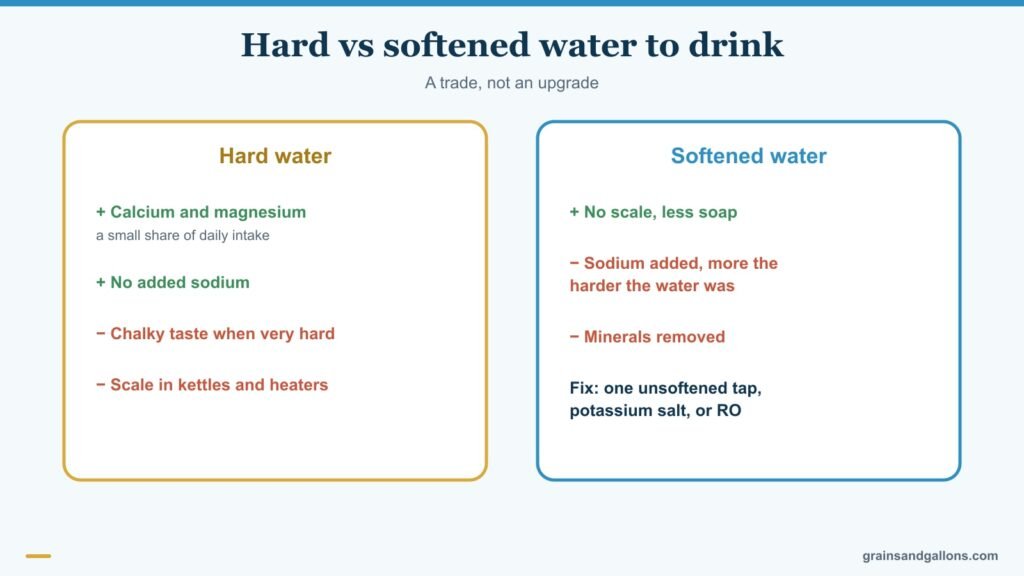
Not exactly:
- Sodium: an ion exchange softener swaps hardness for sodium. The amount is modest for most people and rises with how hard the water was, but it matters on a sodium-restricted diet. See sodium in softened water.
- Minerals: you lose the calcium and magnesium the water supplied.
- Infants: guidance on softened water for formula is more cautious. Our guide to whether softened water is safe to drink covers that.
Many households soften the whole house and leave one kitchen cold tap unsoftened, use potassium chloride, or add a reverse osmosis faucet.
Where hard water really costs you
The real costs are scale in water heaters and appliances, spotted glass, crusty fixtures and higher soap use.
- Get a number first. Our best water hardness test kits covers strips through titration kits.
- Decide what to fix. For skin and hair only, a shower filter is a cheaper experiment, though most do little to remove hardness. For scale-free plumbing, that's a softener job. Our whole-house softener vs. shower filter comparison walks through it.
FAQ
Is it safe to drink hard water every day?
Yes. Hard water isn't considered a health risk, and WHO hasn't set a health-based limit for hardness. The calcium and magnesium it carries are nutrients, though food supplies most of what you need.
Can hard water cause kidney stones?
The evidence doesn't support a strong link. Some studies found an association, but most found none. If you're prone to stones, follow your doctor's advice on fluids and diet rather than changing your water.
Does hard water cause hair loss?
There's no good evidence that it does. Hard water can make hair feel dry, dull or brittle and harder to rinse clean. If you're losing hair, see a doctor or dermatologist.
Is hard water bad for you if you have eczema?
It can make skin feel drier, and hard water areas see more childhood eczema. Many people find softened water gentler because soap rinses off more easily, but the SOFTEN trial found softening didn't improve eczema compared with usual care. Stick with your doctor's treatment plan.
Treat hard water for your house, not your health
So, is hard water bad for you? For drinking, no: there's no health-based limit, and the minerals are nutrients. Skin and hair can feel the difference, and there's a possible eczema link in young children, but softening isn't a cure. The strongest reason to treat hard water is the scale it leaves in your water heater, appliances and fixtures.