

Quick Answer: Hard water and eczema are linked: babies and young children in hard water areas get eczema more often, and lab work shows calcium and magnesium leave soap residue that weakens the skin barrier. But the largest trial in children who already had eczema found a water softener didn't improve it any more than usual care. Hard water may raise the risk or aggravate dry, irritated skin. A softener isn't a treatment, so keep your child's doctor in charge.
Somewhere around the third tube of prescription cream, a lot of parents start looking at the water. The research on hard water and eczema gives a more useful answer than a plain "yes" or "no," and it depends on whether you're trying to prevent eczema or treat it.
This article explains research, not medical advice. Eczema (atopic dermatitis) is a medical condition; talk to your pediatrician or a dermatologist about treatment.
In this guide
- What hard water does to the skin barrier
- The evidence, ranked from weakest to strongest
- Signs your water may be aggravating eczema
- What the hard water and eczema research means for your family
- A bathing routine that helps in hard or soft water
- Check your hardness before buying anything
- FAQ
- Treat the eczema first, then decide about the water
What hard water does to the skin barrier
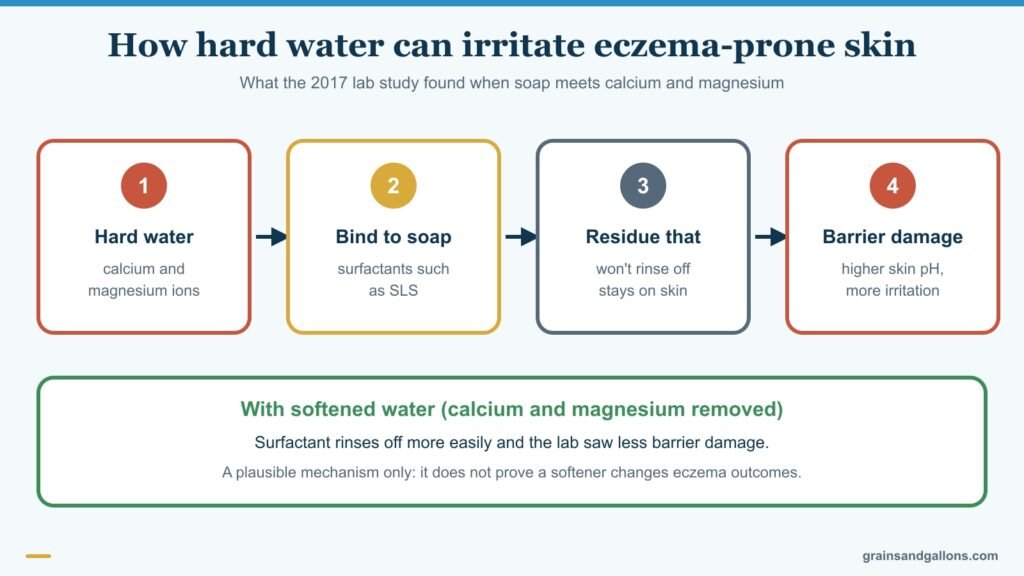
Eczema involves a leaky skin barrier that loses water and lets irritants in. Hard water can add to that in two ways. First, calcium and magnesium bind to common surfactants in soaps and washes, such as sodium lauryl sulfate (SLS). The bound surfactant turns insoluble and sticks to the skin instead of rinsing away. Second, it raises the skin's surface pH, and healthy skin works best slightly acidic.
In 2017, a University of Sheffield and King's College London team tested this in the Journal of Investigative Dermatology. Hard water plus surfactant damaged the barrier and made skin more sensitive to irritants. People with eczema, and especially those carrying filaggrin gene mutations (filaggrin is a protein the barrier depends on), reacted more. Softened water reduced the damage. The work was funded by a softener company, which is worth knowing.
The evidence, ranked from weakest to strongest
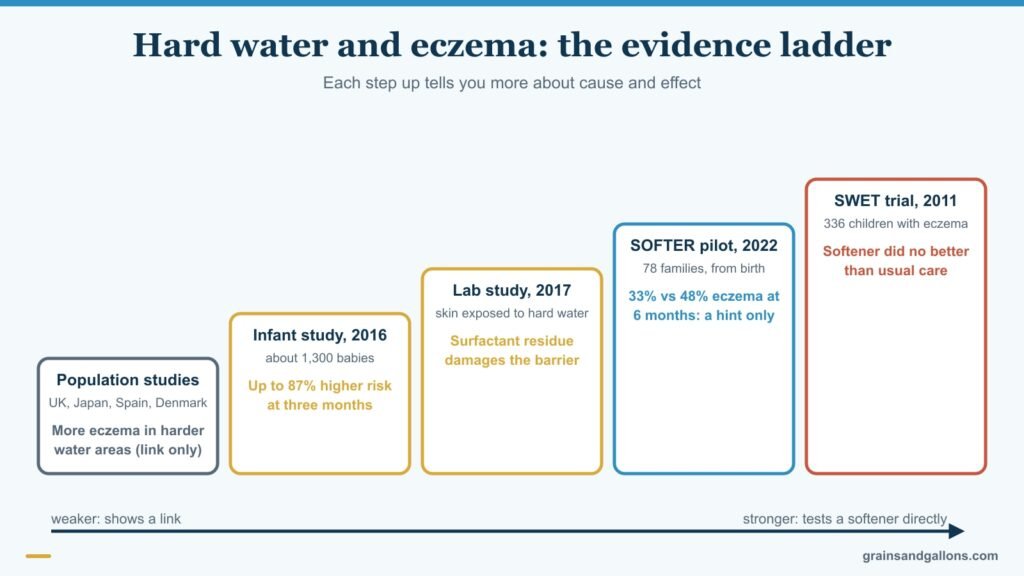
Population studies: more eczema where water is harder
Researchers in the UK, Japan, Spain and Denmark compared eczema rates with local water hardness, and many found more eczema in harder-water areas, mostly in school-age children. A 2020 review pooled them and found higher risk in young children; a 2022 UK Biobank analysis saw a link in adults too. None can prove cause: hard water areas also differ in climate, income and housing.
The infant study: a sharper link in the first months
In 2016, King's College London researchers studied about 1,300 three-month-old babies from the EAT study. According to King's College London, living in a hard water area was associated with up to an 87% higher risk of eczema at three months, regardless of chlorine level. It's an association, but it points at early life, when the skin barrier is still developing.
The lab work: a plausible mechanism
The 2017 study explains how hard water could worsen skin, not whether changing the water changes eczema. That takes a trial.
The prevention pilot: a hint, not a finding
Can softened water from birth prevent eczema in high-risk babies? The SOFTER pilot randomized 78 families in hard water areas around London before their babies were born. It showed a full trial is feasible. At six months, visible eczema was seen in 33% of babies in softened homes versus 48% in hard water homes, but the trial was small and the confidence intervals included no effect.
The treatment trial: a softener didn't beat usual care
The Softened Water Eczema Trial (SWET), published in PLoS Medicine in 2011, gave 336 children (6 months to 16 years) with moderate to severe eczema in hard water areas either a home softener or usual care. After 12 weeks, blinded assessors found eczema improved equally in both groups. The University of Nottingham's summary is blunt: the softener didn't help. Yet 66% of softener families bought the unit afterward: parents liked it, but blinded scores didn't move.
Signs your water may be aggravating eczema
A few clues suggest hard water is part of the picture:
- Skin feels tight or itchy right after bathing, then settles with moisturizer.
- Soap and shampoo are hard to lather and seem to leave a film.
- Fixtures show white scale, spotty glasses or soap scum.
Other triggers often matter more: dry winter air, hot showers, fragrance, harsh detergent, sweat and stress. Red, weepy or crusted skin needs a doctor regardless of the water.
What the hard water and eczema research means for your family
| Your situation | What the evidence supports |
|---|---|
| Child already has eczema | Medical treatment and a steady skin care routine. A softener didn't beat usual care in the biggest trial. |
| Expecting a baby, strong family history of eczema or allergies, very hard water | A softener is reasonable to consider, but its preventive value isn't proven. Ask your pediatrician. |
| You want more comfortable skin and less soap residue | Softened water reliably cuts soap scum and leaves less residue. A comfort benefit, not a medical one. |
A bathing routine that helps in hard or soft water
Steps that reduce surfactant residue are worth doing whatever your water:
- Keep baths short and lukewarm. Hot water strips oils faster.
- Use a small amount of a mild, fragrance-free cleanser, only where needed.
- Rinse thoroughly so less surfactant stays behind.
- Pat dry and moisturize within a few minutes while skin is still damp.
- Follow your treatment plan. The NIAMS atopic dermatitis overview covers moisturizers and medicines your doctor may suggest.
Don't count on a shower filter to soften water. Most reduce chlorine but leave calcium and magnesium alone; our whole-house softener vs shower filter comparison explains the difference, and the best shower filters for dry skin list covers chlorine-sensitive skin. If skin feels odd after a softener goes in, see dry skin after installing a softener.
Check your hardness before buying anything
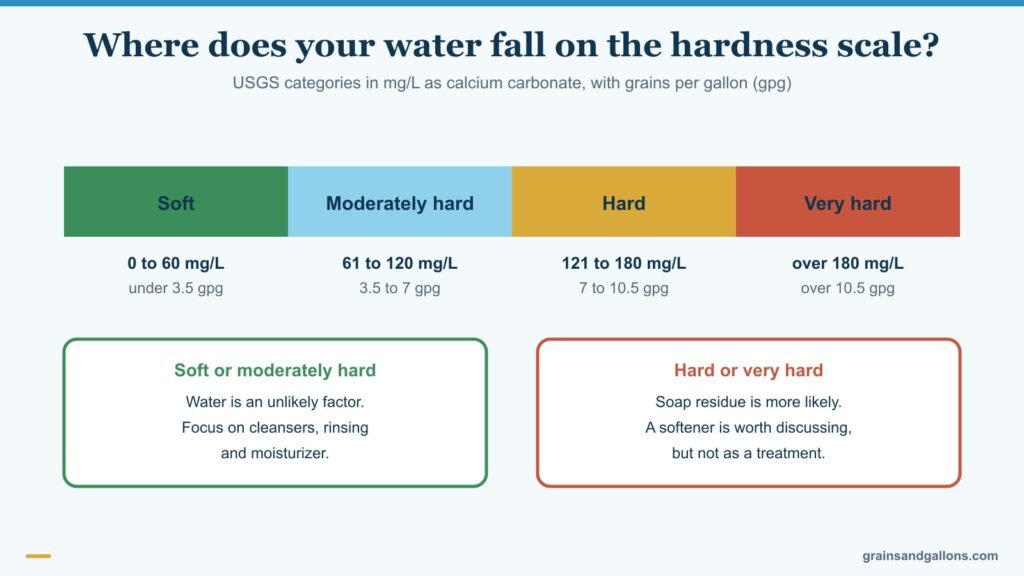
Find your number on your water utility's annual quality report, or test it yourself; our guide to water hardness test kits covers the options. Soft or moderately hard water is unlikely to matter much. Hard or very hard water makes the residue effect more plausible, and a softener becomes a fair thing to discuss, especially before a high-risk baby arrives.
FAQ
Does hard water cause eczema?
Not on its own. Eczema involves genes, the immune system and the skin barrier. Hard water is linked with a higher risk in babies and young children and may aggravate irritated skin, but no study shows it causes eczema by itself.
Is soft water better for eczema?
It leaves less soap residue and many people find it more comfortable, but in the SWET trial children with a softener improved no more than those without. It isn't a proven treatment.
Can hard water cause eczema in babies?
The link is strongest in infancy (up to 87% higher risk at three months in one study), but it's an association, and the softened-water pilot was too small to prove prevention.
Will a shower filter help eczema?
Most shower filters reduce chlorine, not the calcium and magnesium behind soap residue. A filter is a cheap experiment if chlorine bothers you, not a treatment.
Should I install a water softener for my child's eczema?
Treat the eczema medically first. In very hard water a softener is a reasonable comfort and appliance upgrade, and some families expecting a high-risk baby choose one, but don't buy it as a cure.
Treat the eczema first, then decide about the water
The research on hard water and eczema sets a clear order of priorities. Hard water is a plausible irritant and a possible risk factor in the first months of life, but changing the water didn't change eczema severity in children who already had it. Start with your doctor's plan and a gentle bathing routine, check your hardness, and if the water is very hard, weigh a softener for comfort or possible prevention, not as a cure. For the bigger picture, see hard water and dry skin and is hard water bad for you?