


Quick Answer: Hard water and hair don't get along because calcium and magnesium coat each strand and trap soap residue on the cuticle. Hair ends up feeling coated, looking dull, tangling easily and holding color poorly, and one lab study found hard-water-treated hair about 8% weaker. The fastest fix is a chelating shampoo once or twice a week, such as Malibu C Hard Water Wellness Shampoo, followed by conditioner. Long term, only softened water stops the buildup at the source.
Disclosure: As an Amazon Associate, Grains & Gallons earns from qualifying purchases.
You washed it this morning, and it still feels like straw with a film on top. Or your stylist keeps saying your color "isn't holding." Or you moved and your hair changed within a month. All three are classic hard water and hair stories, but plenty of product buildup looks the same, so the first job is working out which one you've got.
In this guide
- Is it the water or your products?
- Seven signs of hard water damage on hair
- What minerals actually do to a hair strand
- What research says about hard water and hair strength
- Hair types that feel hard water most
- A weekly routine for hard water hair
- Shower filters fix chlorine, not hardness
- FAQ
- Chelate weekly now, soften the water for good
Is it the water or your products?
| What you notice | Likely the water | Likely product buildup |
|---|---|---|
| Started after moving or when visiting somewhere new | Yes | Less likely |
| Shower glass spots, crusty showerhead, soap scum | Yes | Not related |
| Hair feels waxy or heavy right after washing | Possible | Very common with silicones and heavy conditioners |
| Clarifying shampoo helps for a day or two, then it's back | Yes, minerals redeposit every wash | Usually lasts longer |
| Blonde or gray hair turning brassy, orange or greenish | Possible (minerals, iron, copper) | Less likely |
| Gets better on vacation or in hotel showers | Yes | No difference |
If you aren't sure how hard your water is, check first. A test strip or your utility's water report takes five minutes; our guide on how to test water hardness at home covers both. Above roughly 7 grains per gallon (about 120 mg/L), most people start noticing hair and skin effects.
Seven signs of hard water damage on hair

Hard water rarely causes one dramatic symptom. It shows up as a cluster of small ones that get worse over weeks:
- Hair feels coated or straw-like even right after washing.
- It tangles easily, because rough cuticles catch on each other.
- Frizz goes up, especially in curly and wavy hair.
- Styles don't hold, since the mineral film weighs hair down or makes it stiff.
- Ends split and snap more readily when you brush.
- Color fades fast or turns brassy, and toner seems to wear off in days.
- Hair looks thinner and flatter, with less shine and movement.
Two or three of these plus scale on your fixtures is a strong hint. If shedding or bald patches are part of the picture, read the hair loss answer in the FAQ before blaming the water.
What minerals actually do to a hair strand

Hair's outer layer, the cuticle, is made of overlapping scales. Smooth, flat cuticles reflect light and let strands slide past each other. Hard water interferes in four ways:
- Mineral film. Calcium and magnesium deposit on the cuticle and build up with each wash, so hair feels rough and looks flat.
- Soap residue. Minerals react with cleansers to form insoluble residue that rinses off poorly, the same reason soap scum forms on tile. On hair it reads as "coated" or "sticky."
- Weaker lather. Shampoo foams less, so people use more, which leaves even more residue behind.
- Color interference. Mineral layers can stop dye and toner from taking evenly and speed fading. If your water also carries iron or copper, those can tint light hair orange or green.
That's why an ordinary shampoo, even a good one, often can't clear the film. You need one built to bind minerals; our roundup of the best shampoos for hard water buildup explains which ingredients do that.
What research says about hard water and hair strength
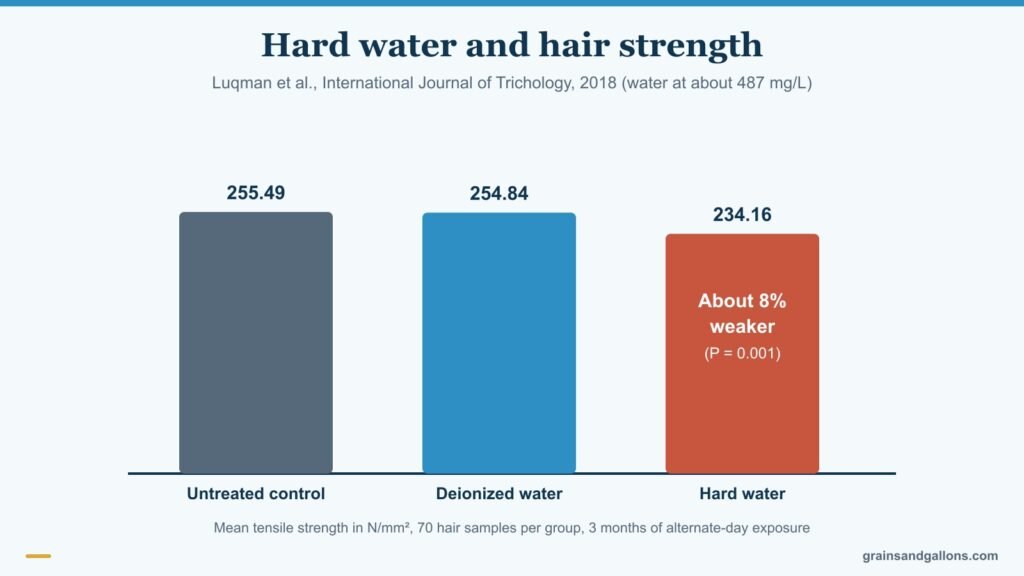
The evidence is thin and mixed. In a 2018 study in the International Journal of Trichology, researchers split hair from 70 men into three groups: untreated, soaked in deionized water, or soaked in very hard water (about 487 mg/L as calcium carbonate) for 10 minutes on alternate days for three months. Hair treated with hard water had significantly lower tensile strength, about 234 versus 255 N/mm² for the controls, while deionized water made no difference.
The same authors point out that an earlier study by Srinivasan and colleagues found no significant effect on strength. That study used women's hair, roughly half the hardness (about 213 mg/L) and a shorter exposure. Scanning-microscope studies are similarly split: some show rougher, mineral-dusted strands in very hard water, others no clear difference.
So the fair summary: hard water plausibly makes hair more prone to breakage, especially at very high hardness, but it isn't proven at the moderate hardness most US homes have. What nobody disputes is the residue, and that's what you can fix.
Hair types that feel hard water most

Everyone's hair collects minerals, but some types show it sooner:
- Color-treated and bleached hair. Lifted cuticles grab minerals faster, and fading or brassiness is often the first complaint. Ask your stylist how to time chelating washes around appointments, because fresh color is the easiest to strip.
- Blonde and gray hair. Light hair shows iron and copper tints that darker hair hides.
- Curly and coily hair. It's naturally drier, and mineral film adds frizz and stiffness to curls.
- Fine hair. Buildup weighs it down quickly, so it looks limp and greasy sooner.
Thick, dark, untreated hair often tolerates hard water best, which is why one person in a household may notice it and another may not.
A weekly routine for hard water hair

You don't need a dozen products. You need to remove the mineral layer regularly and keep the cuticle smooth in between.
- Chelating shampoo, once or twice a week. Chelating agents such as EDTA (often listed as disodium or tetrasodium EDTA) bind calcium and magnesium so they wash away. A basic clarifying shampoo mainly strips oils and styling product, so check the label for a chelator.
- Gentle shampoo on other days, and less of it. Focus it on the scalp and let the rinse handle the lengths.
- Conditioner every time. A smoothed cuticle sheds new deposits more easily.
- A weekly mask if hair is dry or curly, to replace moisture the chelating wash removes.
- An occasional acidic rinse. Diluted apple cider vinegar is a popular home option that may help loosen mineral film. Keep it weak, out of your eyes, and skip it if your scalp is irritated.
- Finish with cooler water. It won't stop minerals landing, but it's gentler on dry hair.
Shower filters fix chlorine, not hardness

Most shower filters use KDF, carbon or vitamin C. They're good against chlorine, which itself can dry hair and fade color, but they remove little or no calcium and magnesium. A filter is worth it if your city water smells of chlorine or your color fades fast; it isn't a substitute for chelating washes in truly hard water. Our guides to the best shower filters for hard water and the best shower filters for color-treated hair are upfront about what each model removes.
A whole-house water softener removes calcium and magnesium before water reaches the shower. Expect a short adjustment: shampoo lathers far more in soft water, so you'll need less, and some people find hair feels limp until they cut back. Our guide to washing hair and skin with soft water covers that transition.
FAQ
Can hard water cause hair loss?
There's no good evidence that it does. Hard water can make hair break more, which looks like thinning, but true shedding or bald patches usually have other causes. The American Academy of Dermatology's list of hair loss causes includes stress, thyroid disease, iron deficiency, hormones and medications, so see a dermatologist.
How often should I use a chelating shampoo?
Once a week is a common starting point. Go to twice a week if buildup returns quickly, and less often if your hair starts feeling dry.
Is clarifying shampoo the same as chelating shampoo?
No. Clarifying shampoo removes oil and product buildup; chelating shampoo contains ingredients like EDTA that bind minerals. Many hard water shampoos do both, but check the label.
Does soft water make hair greasy?
It can feel that way at first because shampoo and conditioner rinse differently and you're probably using too much. Cut the amount by about half and most people adjust within a few weeks.
Can I rinse my hair with bottled water?
You can, and a final rinse with distilled water does cut mineral contact. It's a hassle to keep up, and most people get similar results from regular chelating washes.
Chelate weekly now, soften the water for good
The link between hard water and hair is mostly about residue: minerals and trapped soap build up on the cuticle, and every wash adds more. A weekly chelating shampoo and conditioner clear most of it, and a shower filter helps if chlorine is part of the problem. If you're fighting buildup every week, a softener is the only fix that stops it at the source. The same mechanism affects skin, which we cover in hard water and dry skin.